All of these fruits are eaten by wildlife. This does not mean that they can or should be eaten by people. Three of the species shown are edible. The other four are either inedible or even toxic.
This first photograph shows the possible dangers of foraging for wild fruits. In the center of the photo is an elongated cluster of Riverbank Grapes (Vitis riparia), but along the left side of the photograph is a rounded cluster of Virginia Creeper (Parthenocissus quinquefolia) berries which are toxic to humans.
 |
| Riverbank Grape (Vitis riparia) - Edible |
The second photograph shows just Virginia Creeper berries and leaves.
 |
| Virginia Creeper (Parthenocissus quinquefolia) berries - TOXIC |
The third photograph shows the fruits from a Common Buckthorn (Rhamnus cathartica). The fruits from this species are toxic to humans and other mammals, but birds regularly eat them.
 |
| Common Buckthorn (Rhamnus cathartica) fruit - TOXIC |
This photo shows the berries from Western Poison Ivy (Toxicodendron rydbergii). This species is less common in Michigan than Eastern Poison Ivy (T. radicans). Unlike the Eastern form which typically from climbing vines, Western poison Ivy grows as a low shrub. The berries from both species are toxic to humans.
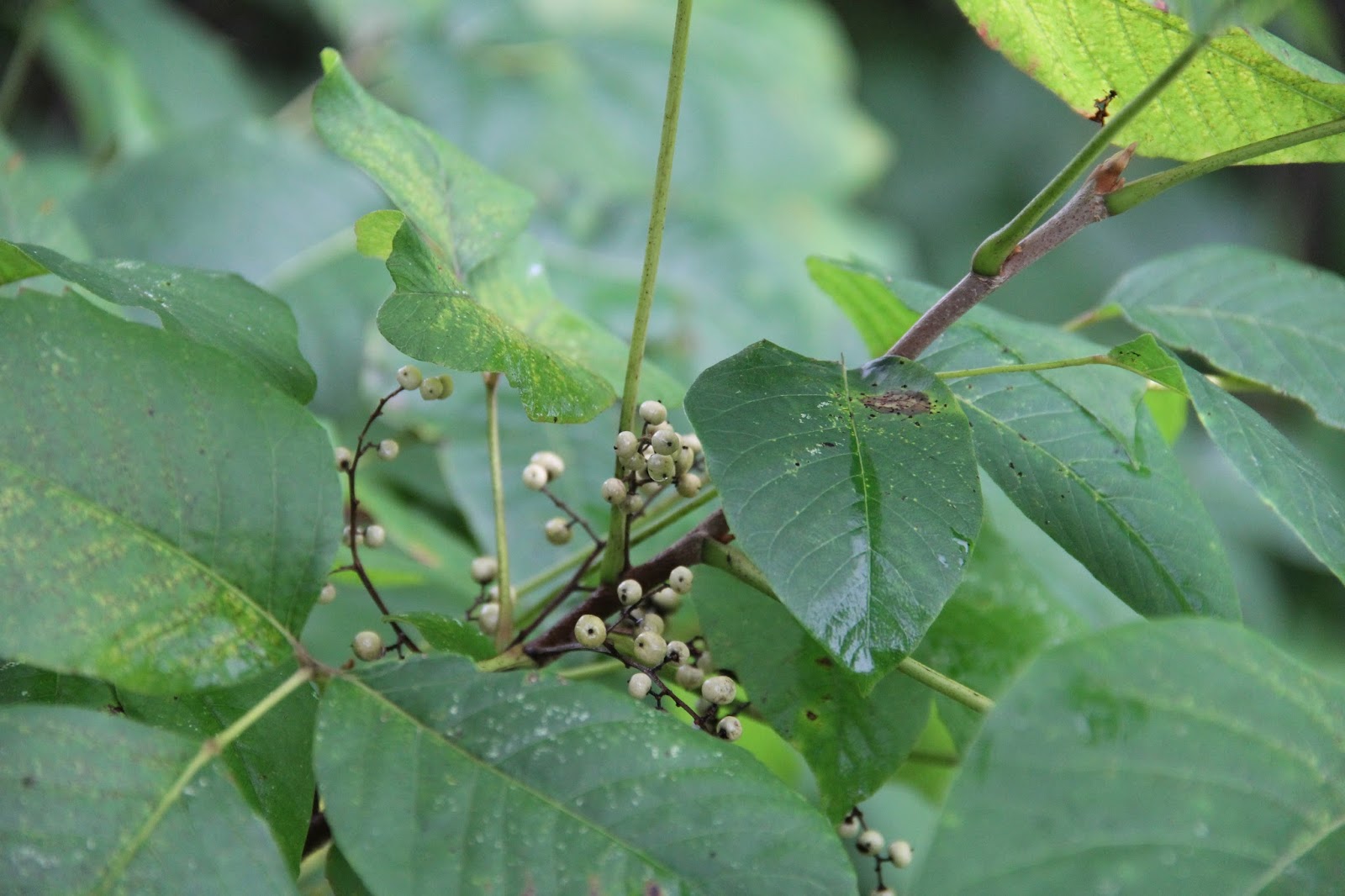 |
| Western Poison Ivy (Toxicodendron rydbergii) berries - TOXIC |
The fifth photograph shows the fruit of American Highbush Cranberry (Viburnum trilobum). There is a closely related species European Highbush Cranberry (V. opulus) that is distinguished only by a difference in the shape of glands at the base of the leaf. The fruit from both species is edible, but it is very tart and may not appeal to all people.
 |
| American Highbush Cranberry (Virburnum trilobum) fruit - Edible |
The next photograph shows fruit from a rose, known as "hips". All species of rose hips are edible, but not all are palatable. I did not identify the species of rose on site, but from the photograph it appears to be Smooth Rose (Rosa blanda).
 |
| Rose hips (fruit), probably a Smooth Rose (Rosa blanda) - Edible |
The next two photographs show drupes (fruit) from two different species of dogwood. The first photograph shows Silky Dogwood (Cornus amomum) fruits. The second shows Red-Osier Dogwood (Cornus sericea). Some sources list dogwood fruits as edible, others as inedible. Some may cause nausea if eaten. In general, even though you may be able to eat dogwood fruits you probably wouldn't want to do so.
 |
| Silky Dogwood (Cornus amomum) - inedible |
 |
| Red-Osier Dogwood (Cornus sericea) - inedible |
It was very interesting to me to find this many different fruits/berries in such a small space - less than 200 yards of riverbank. It looks like the birds will eat well this fall and winter.
On a side note, if you visit Island Park on Thursdays between June 1st and October 31st you will find the Mt. Pleasant Farmers' Market with lots of fresh edible fruits when they are in season.


