Wednesday, March 12, 2014

Spring Wildflowers - What to expect in March and April

Although it doesn't seem like it right now, wildflower season is almost upon us.  Some species in Mid-Michigan begin blooming in March (or even February) and many more follow in April.

Here are some of the wildflowers that you can normally expect to see in the Great Lakes and Northeast in the coming six weeks - we shall see what happens once the snow and ice actually melt.

March Wildflowers

All of these species will continue blooming through April.

Bloodroot (Sanguinaria canadensis) - Click for Species Profile

Common Blue Violet (Viola sororia)

Cut-leaved Toothwort (Cardamine concatenata)

Skunk Cabbage (Symplocarpus foetidus) - Click for More Information

Yellow Trout Lily (Erythronium americanum) - Click for More Information

April Wildflowers

The above species continue blooming April and are joined the following species.  Many of these species will continue to bloom into late May or early June.

Blue Cohosh (Caulophyllum thalictroides)

Broad-leafed Toothwort (Cardamine diphylla)

Dog Violet (Viola conspersa)

Dutchman's Breeches (Dicentra cucullaria) - Click for Species Profile

False Rue-anemone (Enemion biternatum)

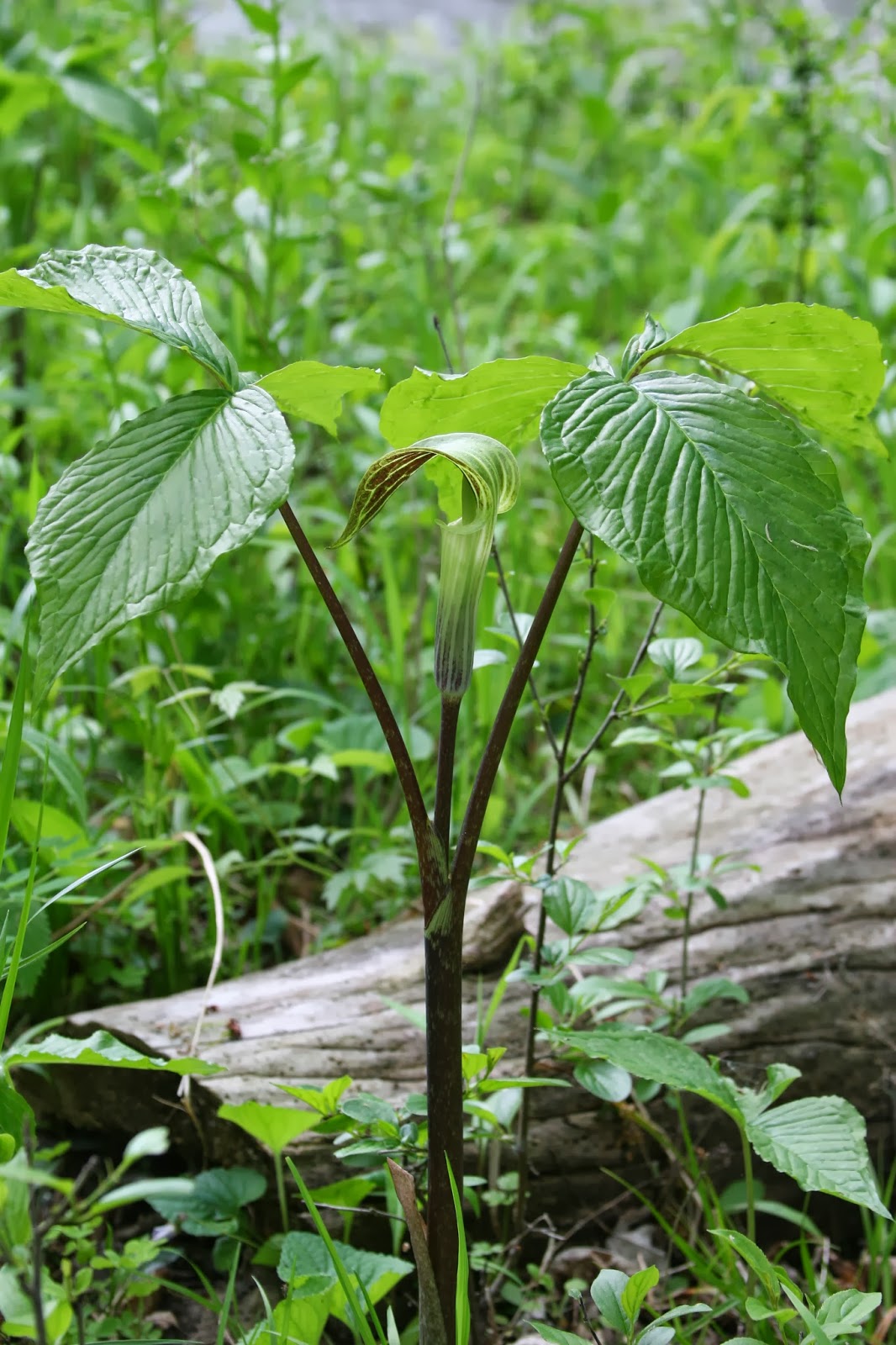
Jack-in-the-pulpit (Arisaema triphyllum)

Large-Flowered Bellwort (Uvularia grandiflora) - Click for Species Profile

Large-flowered Trillium (Trillium grandiflorum) - Click for Species Profile

Marsh Marigold (Caltha palustris) - Click for Species Profile

Mayapple (Podophyllum peltatum) - Click for Species Profile
 
Pussy-toes (Antennaria spp.)

Spring Beauty (Claytonia virginica) - Click for Species Profile

Squirrel Corn (Dicentra canadensis)

Swamp Buttercup (Ranunculus hispidus) - Click for Species Profile
 
Two-leaf Mitrewort (Mitella diphylla) - Click for Species Profile

White Trout Lily (Eythronium albidum) - Click for More Information

Wild Blue Phlox (Phlox divaricata) - Click for More Information

Wild Red Columbine (Aquilegia canadensis)

Wild Ginger (Asarum canadense) - Click for Species Profile

Wild Strawberry (Fragaria virginiana)

Tuesday, March 11, 2014

Late Winter Woods - Mission Creek Woodland Park

Last year on March 11th, I wrote a blog post about the ability of Skunk Cabbage flowers to melt the snow around them - a process called thermogenesis. This ability makes them the first flower of Spring in Mid-Michigan.

Today, after finishing two school presentations, I was able to spend a little time in the woods at Mission Creek Woodland Park in Mt. Pleasant.  I was hoping to find Skunk Cabbage poking up through the snow and ice.  This was not to be... The snow and ice cover in the swamp along Mission Creek is still too thick for any emerging Skunk Cabbage blooms to melt.  With temperatures over the last two day reaching as high as 50 degrees Fahrenheit, the snow is very slushy, but it is still nearly two feet deep in some areas.  (More snow is in the forecast for tonight!)

Despite my disappointment at not finding and blooming skunk cabbage it was still a nice day to be in the woods.

Poplar at Mission Creek Woodland Park

North Hiking Trail at Mission Creek Woodland Park

Cow Parsnip seeds

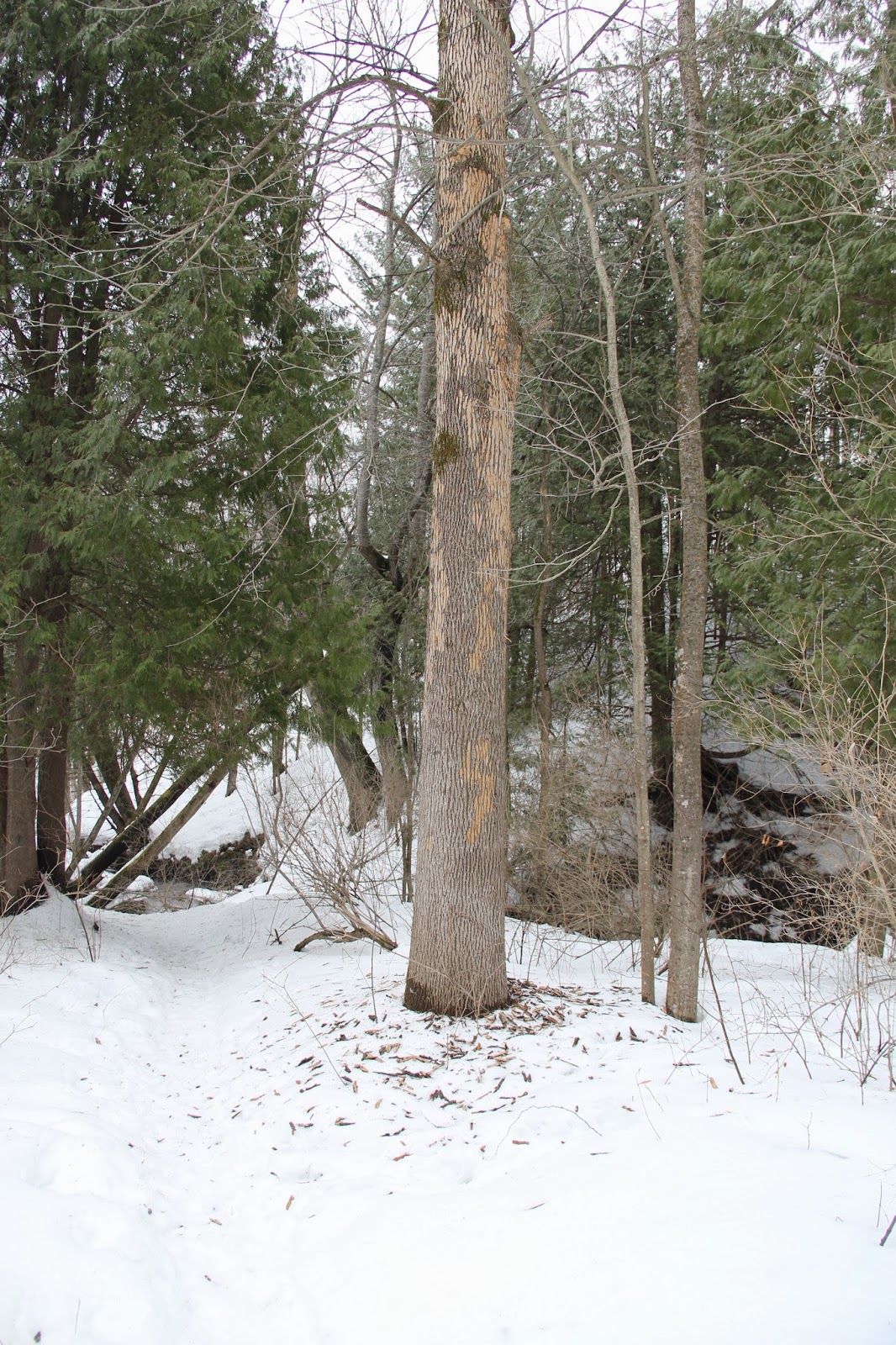
Green Ash - killed by Emerald Ash Borer

Bark at the base of dead Green Ash - the bark is being stripped by woodpeckers to access insect larvae (including Emeral Ash Borer)

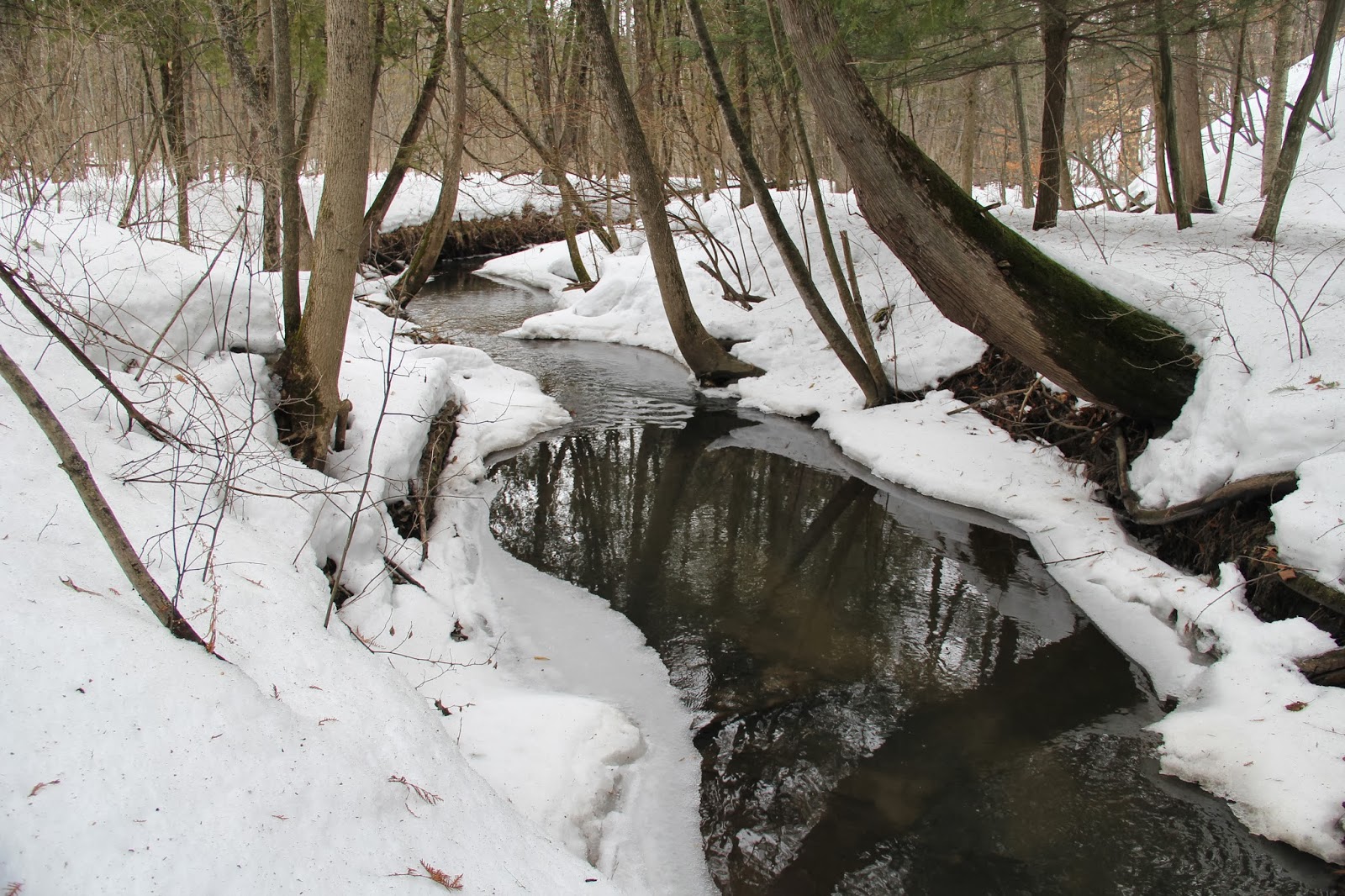
Mission Creek

Cedar leaf on ice at Mission Creek

Forest reflections

Mission Creek flows through a Northern Hardwood-Conifer Swamp

Woodpecker holes in Northern White Cedar

Eastern Cottonwood bark


Raccoon tracks in snow

American Beech leaves - these leaves stay on the tree throughout winter

Monday, March 10, 2014

Native Species Profile - Maximilan's Sunflower

The natural range of some species of plants can be difficult to identify because they have been spread outside that natural range by human activities.  One plant that fits this description is Maximilian's Sunflower (Helianthus maximiliani).

Maximilian's Sunflower is found in 38 states from the Atlantic to the Pacific and in 6 Canadian provinces, but its native range is probably the Central Great Plains.  In most states it is found in only a few widely scattered locations.  According to the USDA PLANTS Database, Maximilian's Sunflower is found in counties in southeastern Michigan, several counties in the southwest part of the state, five counties in the northern part of the Lower Peninsula, and in counties across the Upper Peninsula.  It was first collected in Michigan in 1898.  It is not known from any specimens in Mid-Michigan.

Michigan County Distributional Map for Helianthus maximiliani
Michigan range of Maximilian's Sunflower - USDA PLANTS database
However...

Thursday, March 6, 2014

Hoarfrost and Horned Larks

The temperature last night dropped down below zero degrees Fahrenheit again. Because the ground temperature is higher than the air temperature, the water vapor that is rising up from the ground is condensing on any object that it touches forming hoarfrost.  Hoar comes from an Old English word that means "gray with age".  Hoarfrost gives trees and other objects a coating of ice crystals that resembles a covering of silver-white hair - thus the name.

White hoarfrost covered every tree, shrub and blade of grass this morning

After dropping my wife off at work I spent a short time driving around taking pictures of the hoarfrost.  The first three pictures were taken in the field behind the Saginaw Chippewa Academy.

Hoarfrost covered shrubs and small trees

The sun rising up over the hoarfrost covered landscape

Shrub covered in hoarfrost

The next few photos were taken on a new road just down the road from the Conservation District office.  The first picture shows a Red-tailed Hawk (Buteo jamaicensis) just after it took off from the closest hoarfrost covered tree.  There is a pair of Red-tailed Hawks that nests somewhere nearby.  This may be the same hawk that I photographed on a spruce tree in our parking lot in 2010.

Red-tailed Hawk and hoarfrost on trees

Hoarfrost on roadside weeds
 
Sun shining through a hoarfrost-covered woodland (Image 1)

Sun shining through a hoarfrost-covered woodland (Image 2)


Sun shining through a hoarfrost-covered woodland (Image 3)

At one point where I was stopped taking photographs, I could hear a small bird calling nearby.  I looked to my right and there was a Horned Lark (Eremophila alpestris) perched atop a pile of snow.  Horned Larks have long been one of my favorite birds and their arrival every year indicates that Spring will soon be here.  For the past two weeks the Larks have been returning to Mid-Michigan in large numbers - I have seen several flocks of more than a hundred as well as many smaller flocks and individual birds.  So despite this morning's cold temperature, I am certain that Spring is not far away!

Horned Lark

Horned Lark - note the black "bib" and yellow throat, the black "horns" are barely visible in this image

Horned Lark - preparing to fly away

Wednesday, March 5, 2014

Native Species Profile - Blue-stemmed Goldenrod

One of the themes of the conference that I went to over the weekend was the idea of planting native plants in layers not only fill space, but also to fill time.  Everyone that gardens want plants that will begin blooming as soon as the snow melts in the Spring through the last warm days of Fall.  There is no single plant that will do all of this, but by using the right combination of plants you can get flowers that bloom from April through October providing not only beauty but also food for a sequence of pollinators. (Look here to see some of the pollinators you can attract to the garden by using native plants.)

One real challenge is finding flowering plants that grow well in the shade.  Many of the Spring wildflowers (trilliums, phlox, spring beauty, etc.) do grow in the shade, but by Fall they have gone dormant for the year, leaving the ground under trees bare and lifeless.  Fortunately there are some Fall-flowering wildflowers such as Asters and Goldenrods that will grow in the shade.

In Michigan there are three species of Goldenrod that will add Fall color to a shady garden: Elm-leafed Goldenrod (Solidago ulmifolia), Zigzag Goldenrod (Solidago flexicaulis), and Blue-stemmed Goldenrod (Solidago caesia).  Elm-leafed Goldenrod is uncommon in Michigan and is only found in the most southern counties of the state.

The other two species are more common.  Zigzag Goldenrod is found across Michigan in both the Upper and Lower Peninsulas.  Zigzag Goldenrod prefers moist habitats and is often found in wet woodlands and shaded wetlands.  (Look here to learn more about Zigzag Goldenrod.)

Blue-stemmed Goldenrod grows throughout much of the Lower Peninsula and prefers drier habitats than Zigzag Goldenrod.  In addition to Michigan, Blue-stemmed Goldenrod can be found in a further 30 states (and three Canadian provinces) east of a line running from Wisconsin south-west to eastern Texas.

Blue-stemmed Goldenrod and Big-leafed Aster

Like the majority of goldenrods, Blue-stemmed goldenrod has golden yellow flowers. Blue-stemmed Goldenrod is one of the few goldenrod species that does not have most of its flowers in a terminal cluster at the end of its stem.  Like Zigzag Goldenrod, the flowers of the Blue-stemmed Goldenrod grow in clusters from the leaf axils (the upper part of the joint where the leaf joins the stem).  The flowers bloom in late Summer into Fall and can be found in Mid-Michigan from August to October, with the peak blooming time coming during the first two weeks of September.

The leaves of the plant lance-shaped and are almost all the same size.  Narrow leaves help distinguish this plant from S. flexicaulis which has wider leaves that get smaller toward the end of the stem.


Blue-stemmed Goldenrod - note the axial flowers, lanceolate leaves, and bluish stem

The plant gets its name from the color of its stems which often do look bluish in color.  The caesia in Solidago caesia comes from the Latin adjective caesius which means "blue-grey".   The stems grow 1 to 3 feet long and form a gentle arch instead of standing erect to their full height.

Gently curving stem of the Blue-stemmed Goldenrod
The Blue-stemmed Goldenrod is an attractive plant of the fall woodland that can easily be planted in a woodland garden to add color and texture to the Fall landscape.  It attracts large numbers of pollinators, especially native bees. 

Blue-stemmed Goldenrod


Basic Information

Blue-stemmed Goldenrod 
Solidago caesia

Height:  1-3’ tall

Habitat:  deciduous woods, open woodlands, woodland edges, woodland clearings

Flower Color:  yellow

Bloom Time:  August – October

Monday, March 3, 2014

Photos from Spring 2013

As I mentioned last week I am attending the Wildflower Association of Michigan annual conference right now.  With the weather that we are experiencing right now it doesn't seem like we will ever see wildflowers this year.  However, Spring is only three weeks away (according to the calendar) so I am sharing a few pictures from last April.