Showing posts with label frost. Show all posts

Wednesday, May 10, 2017

Frost damage on Skunk Cabbage plants

 This picture shows how Skunk Cabbage (Symplocarpus foetidus) plants should look right now.


The next picture shows how they actually looked yesterday morning.


Several nights of heavy frost have badly damaged the leaves of the plants.  Hopefully they can recover.
 

It amazing to me that the plant's flowers can melt snow due to the metabolic heat that they generate,


but the leaves can be damaged by a few hours of freezing temperatures.


Thursday, January 28, 2016

Seven Years Ago

I have been spending way too much time in the office this winter.  I have so many programs scheduled that it is difficult to slip away for a couple of hours just to take photographs.  So instead of new photos, here are a few from seven years ago.

These pictures were taken on January 27th 2009 at the Sylvan Solace Preserve.  I remember the morning very well.  The temperature overnight had dropped down into the single digits, possibly even below zero.  The Chippewa River had not frozen over that winter.  The combination of the cold air and the relatively warm river cause dense fog/steam to rise from the river's surface and coat everything nearby with a thick hoarfrost.


Monday, October 26, 2015

Fall Crabapples Photos

A heavy frost covered everything in the Mt. Pleasant area this morning.  It began to melt quickly once the sun came up, leaving water droplets on everything it had touched including this crabapple tree.


Wednesday, February 11, 2015

In Silhouette

Yesterday morning the temperature was hovering just above zero degrees Fahrenheit.  Many of the trees and other plants were covered with a coating of frost.  I took several photos in the field behind the office.  This one of a dried Queen Anne's Lace (Daucus carota) flowerhead silhouetted against pastel colors of the morning sky was my favorite of the bunch.


Tuesday, January 20, 2015

Animal Signs and Ice Crystals


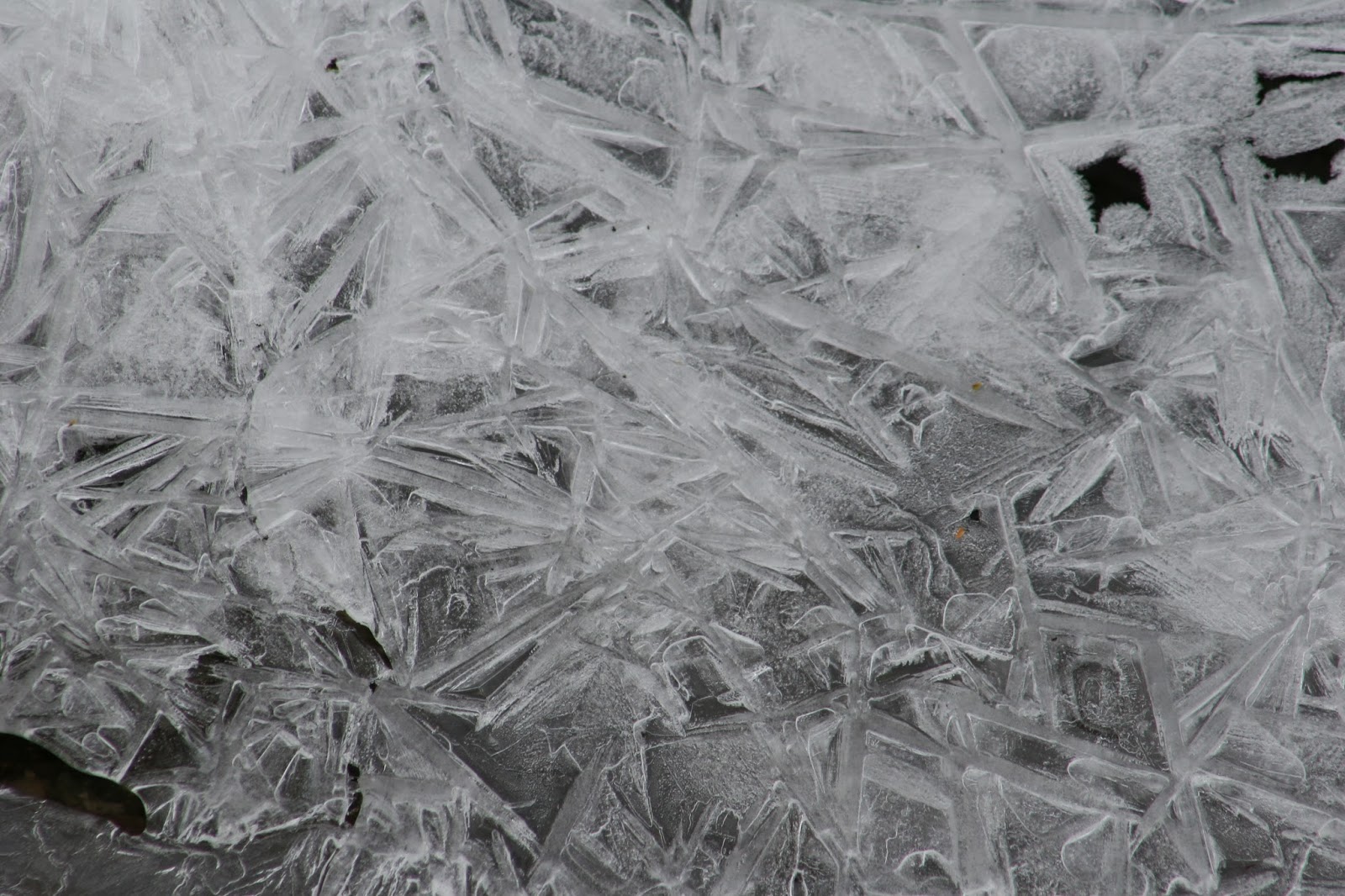
Last Wednesday (14 JAN 2015) I was able to spend a little bit of time walking through the woods at Chipp-A-Waters Park in Mt. Pleasant.  I already posted some pictures of ice taken that day, but ice was far from the only thing I found.

Part of my walk took me off the paved trail and onto the frozen surface of an oxbow pond.   In Summer the edges of this pond are the home to rushes and bur-reeds.

Giant Bur-reed at Chipp-A-Waters Park

The center of the pond is home to a colony of Yellow Pond Lilies.

Yellow Pond Lily colony at Chipp-A-Waters Park

This time of year, the oxbow looks like this...

Ice and snow-covered oxbow pond

It's covered with snow and ice and criss-crossed with tracks from White-tailed Deer and Red Fox.  Many of the fox track passed near an old muskrat lodge along the edge of the oxbow.

Fox tracks converge on an old muskrat lodge

At least one fox took the time to leave its mark with a spray of urine.

This spot serves as a marking post for local wildlife

A yellow spot of urine shows that a fox has recently passed through

Fox tracks and urine were not the only interesting things that I found on the oxbow.

A fox-eye view through the rushes and sedges
Some of these emergent vegetation was covered with delicate blades and feathers of frost

Frost-covered leaves and stems


Some of these frost feathers were nearly an inch long.  This picture shows them in more detail.

Feathers of frost on a rush stem


Friday, October 24, 2014

Hard Frost and Milkweed Seeds (23 OCT 2014)

Six times this month the overnight temperature has dropped down below freezing.  Wednesday night the temperature reached down to 28 degrees Fahrenheit (the third time it has reached this low for the month).  When I got to work, the field behind the office was covered with a heavy layer of frost. 

The Common Milkweed (Asclepias syriaca) plants have dropped all of their leaves.  Their seedpods split open releasing the ripe seeds inside.  The field is covered with milkweed seeds and their fluffy parachutes.


The frost covered seeds spent the morning waiting for a breeze to carry them to a new home.


Most of the seeds never make it beyond the field - they snag on plants and other objects along the way.


Even if their silken parachute only carries them a few feet from their parent plant it has done its job of dispersal.   In this way, the parent plant reduces competition from its own offspring and those seeds that do make it further than a few feet become explores capable of colonizing new fields, expanding the species to the physical limits of its range.

Thursday, March 6, 2014

Hoarfrost and Horned Larks

The temperature last night dropped down below zero degrees Fahrenheit again. Because the ground temperature is higher than the air temperature, the water vapor that is rising up from the ground is condensing on any object that it touches forming hoarfrost.  Hoar comes from an Old English word that means "gray with age".  Hoarfrost gives trees and other objects a coating of ice crystals that resembles a covering of silver-white hair - thus the name.

White hoarfrost covered every tree, shrub and blade of grass this morning

After dropping my wife off at work I spent a short time driving around taking pictures of the hoarfrost.  The first three pictures were taken in the field behind the Saginaw Chippewa Academy.

Hoarfrost covered shrubs and small trees

The sun rising up over the hoarfrost covered landscape

Shrub covered in hoarfrost

The next few photos were taken on a new road just down the road from the Conservation District office.  The first picture shows a Red-tailed Hawk (Buteo jamaicensis) just after it took off from the closest hoarfrost covered tree.  There is a pair of Red-tailed Hawks that nests somewhere nearby.  This may be the same hawk that I photographed on a spruce tree in our parking lot in 2010.

Red-tailed Hawk and hoarfrost on trees

Hoarfrost on roadside weeds
 
Sun shining through a hoarfrost-covered woodland (Image 1)

Sun shining through a hoarfrost-covered woodland (Image 2)


Sun shining through a hoarfrost-covered woodland (Image 3)

At one point where I was stopped taking photographs, I could hear a small bird calling nearby.  I looked to my right and there was a Horned Lark (Eremophila alpestris) perched atop a pile of snow.  Horned Larks have long been one of my favorite birds and their arrival every year indicates that Spring will soon be here.  For the past two weeks the Larks have been returning to Mid-Michigan in large numbers - I have seen several flocks of more than a hundred as well as many smaller flocks and individual birds.  So despite this morning's cold temperature, I am certain that Spring is not far away!

Horned Lark

Horned Lark - note the black "bib" and yellow throat, the black "horns" are barely visible in this image

Horned Lark - preparing to fly away

Tuesday, November 5, 2013

Leaves, Frost, and Ice - Pictures of Fall

Fall officially began six weeks ago.

Many the leaves have fallen from the trees


Frost is becoming a regular morning discovery.


Over the next week, nighttime temperatures are forecast to be in the low 30s and even the upper 20s.  We will probably see ice forming on puddles overnight.


Winter is only six weeks away...