Over time, I have taken hundreds (probably thousands) of photos of rocks, water, and sky and their interactions. Here are a few of my favorites.
Thursday, October 15, 2015
Earth Science Week - A selection of earth science photographs
Happy Earth Science Week!
Over time, I have taken hundreds (probably thousands) of photos of rocks, water, and sky and their interactions. Here are a few of my favorites.
Wednesday, October 14, 2015
Earth Science Week - National Fossil Day
Happy Earth Science Week!
The Wednesday of Earth Science Week is designated as National Fossil Day. National Fossil Day was first celebrated in 2010. This celebration is organized by the National Park Service to "promote public awareness and stewardship of fossils, as well as to foster a greater appreciation of their scientific and educational values."
Happy National Fossil Day!
Like most states, Michigan has an official state fossil - the American Mastodon (Mammut americanum). Over three hundred mastodon fossil sites have been found in Michigan, but only south of a line running west from Saginaw Bay. No mastodon fossils have been found in Northern Michigan, nor any in the Upper Peninsula.
Not only does Michigan have a state fossil, but our official state stone is also a fossil - the Petoskey Stone. Petoskey Stones are the fossilized remains of the extinct Hexagonaria coral. Hexagonaria was a common colonial coral that lived in the warm shallow ocean that covered Michigan during the Devonian period (more than 350 million years ago). Petoskey Stones can be found around the state, but are most common along the shores of Lake Huron and Lake Michigan.
The odds of finding a mastodon fossil are not very high, but with a little luck and a little time searching almost everyone will find a Petoskey Stone.
So Happy National Fossil Day and happy fossil hunting!
The Wednesday of Earth Science Week is designated as National Fossil Day. National Fossil Day was first celebrated in 2010. This celebration is organized by the National Park Service to "promote public awareness and stewardship of fossils, as well as to foster a greater appreciation of their scientific and educational values."
Happy National Fossil Day!
Like most states, Michigan has an official state fossil - the American Mastodon (Mammut americanum). Over three hundred mastodon fossil sites have been found in Michigan, but only south of a line running west from Saginaw Bay. No mastodon fossils have been found in Northern Michigan, nor any in the Upper Peninsula.
| Mural depicting American Mastodons (Mammut americanum) - Museum of Natural and Cultural History at Central Michigan University |
| Fossil American Mastodon Jaw -Museum of Cultural and Natural History at Central Michigan University |
Not only does Michigan have a state fossil, but our official state stone is also a fossil - the Petoskey Stone. Petoskey Stones are the fossilized remains of the extinct Hexagonaria coral. Hexagonaria was a common colonial coral that lived in the warm shallow ocean that covered Michigan during the Devonian period (more than 350 million years ago). Petoskey Stones can be found around the state, but are most common along the shores of Lake Huron and Lake Michigan.
| An unpolished Hexagonaria - found in Shiawassee County, MI |
The odds of finding a mastodon fossil are not very high, but with a little luck and a little time searching almost everyone will find a Petoskey Stone.
| A Hexagonaria coral "Petoskey Stone" on a Lake Michigan beach |
So Happy National Fossil Day and happy fossil hunting!
Tuesday, October 13, 2015
Earth Science Week - Rock Garden Field Trip
Happy Earth Science Week!
This past weekend I attended the Michigan Alliance for Environmental and Outdoor Education (MAEOE) annual conference in Sault Sainte Marie, MI. The main conference was scheduled for Saturday; Friday was taken up by a number of pre-conference sessions that included field trips and other workshops. On Friday afternoon I attended my favorite session of the entire weekend - a field trip to the "rock garden" at Sault Sainte Marie High School.
This field trip was led by retired Sault Sainte Marie science teacher Dennis Dougherty. Before he retired, Mr. Dougherty was largely responsible for the design and creation of this feature. The rock garden was created with mostly donated materials and labor. The garden consists of a number of large blocks of rock surrounding a walkway and large sundial.
The rocks in the garden were all labeled with bronze plaques and represent varieties of igneous, sedimantary, and metamorphic rocks found in the Upper Great Lakes region. If you are a rock hound (or aspiring rock hound) and find yourself in Sault Sainte Marie, a visit to this rock garden is well worth your time.
Here are a few of the rocks contained in the garden.
This past weekend I attended the Michigan Alliance for Environmental and Outdoor Education (MAEOE) annual conference in Sault Sainte Marie, MI. The main conference was scheduled for Saturday; Friday was taken up by a number of pre-conference sessions that included field trips and other workshops. On Friday afternoon I attended my favorite session of the entire weekend - a field trip to the "rock garden" at Sault Sainte Marie High School.
This field trip was led by retired Sault Sainte Marie science teacher Dennis Dougherty. Before he retired, Mr. Dougherty was largely responsible for the design and creation of this feature. The rock garden was created with mostly donated materials and labor. The garden consists of a number of large blocks of rock surrounding a walkway and large sundial.
| Retired science teacher Dennis Dougherty (blue coat) discussing the Sault Sainte Marie "rock garden" |
The rocks in the garden were all labeled with bronze plaques and represent varieties of igneous, sedimantary, and metamorphic rocks found in the Upper Great Lakes region. If you are a rock hound (or aspiring rock hound) and find yourself in Sault Sainte Marie, a visit to this rock garden is well worth your time.
Here are a few of the rocks contained in the garden.
| Copper-Nickel Ore (Metamorphic) |
| Gneiss (Metamorphic) |
| Metagabbro (Metamorphic) |
| Slate (Metamorphic) |
| Dolostone (Sedimentary) |
| Limestone-Marble - This rock was in the process of metamorphosis from limestone to marble, but never completed the process |
| Metaconglomerate (Metamorphic) and Quartzite (Metamorphic) |
| Sandstone (Sedimentary) |
| Granite (Igneous) with inclusions |
| Basalt (Igneous) |
| Sundial atop large block of Limestone (Sedimentary) |
Monday, October 12, 2015
Earth Science Week - Michigan's Largest Waterfall
Happy Earth Science Week!
Earth Science Week is a national and international celebration of the earth sciences (geology, meteorology, oceanography, and astronomy). It is organized by the American Geosciences Institute and has been celebrated since 1989. The mission of Earth Science Week is to "promote understanding and appreciation of the value of Earth Science research and its applications and relevance to our daily lives." This year, Earth Science Week is being celebrated October 11 - 17.
Over the past few days I have been attending the Michigan Alliance for Environmental and Outdoor Education (MAEOE) annual conference in Sault Sainte Marie, MI. On my way to the conference, I took an hour-long detour to visit one of Michigan's most popular earth science destinations - Upper Tahquamenon Falls.
Upper (and Lower) Tahquamenon Falls are located on the Tahquamenon River near the village of Paradise in Luce County. Tahquamenon Falls is close enough to Mid-Michigan to be a long day trip. The falls are approximately 3.5 hours away.
Upper Tahquamenon Falls is one of the largest waterfalls east of the Mississippi River. The Upper Falls formed in a location where there is a transition between hard and soft sandstone types. The river cascades over a layer of hard sandstone before carving out a canyon though the underlying softer layers. The falls are nearly 200 feet wide and drop almost 50 feet.
The waters that cascade over the falls are stained dark by tanins from nearby cedar swamps. In the Spring, the rate of flow over the falls has been recorded at nearly 50,000 gallons (nearly 190,000 liters) per minute! The flow during my visit was much less, but still impressive. I have visited during periods of much lower flow.
The most impressive view of the falls is from a boardwalk at the brink of the falls, but the best view of the falls is from a pair of observation decks near the bottom of the canyon. A warning to visitors: there are more than 80 stairs down to the falls and more than 110 stairs down (and back up) to the canyon observation decks.
Although I did not visit them during this trip, there is another series of falls a few miles downstream from the Upper Falls. Lower Tahquamenon Falls drops approximately 20 feet over several ledges around an island that divides the river. Here is a photo of a portion of the Lower Falls from a 2007 trip.
If you are visiting Michigan's Upper Peninsula, Tahquamenon Falls is a must-see destination - even more so if you are fan of interesting geology.
Earth Science Week is a national and international celebration of the earth sciences (geology, meteorology, oceanography, and astronomy). It is organized by the American Geosciences Institute and has been celebrated since 1989. The mission of Earth Science Week is to "promote understanding and appreciation of the value of Earth Science research and its applications and relevance to our daily lives." This year, Earth Science Week is being celebrated October 11 - 17.
Over the past few days I have been attending the Michigan Alliance for Environmental and Outdoor Education (MAEOE) annual conference in Sault Sainte Marie, MI. On my way to the conference, I took an hour-long detour to visit one of Michigan's most popular earth science destinations - Upper Tahquamenon Falls.
| Upper Tahquamenon Falls (brink view) - October 2015 |
Upper (and Lower) Tahquamenon Falls are located on the Tahquamenon River near the village of Paradise in Luce County. Tahquamenon Falls is close enough to Mid-Michigan to be a long day trip. The falls are approximately 3.5 hours away.
Upper Tahquamenon Falls is one of the largest waterfalls east of the Mississippi River. The Upper Falls formed in a location where there is a transition between hard and soft sandstone types. The river cascades over a layer of hard sandstone before carving out a canyon though the underlying softer layers. The falls are nearly 200 feet wide and drop almost 50 feet.
| Upper Tahquamenon Falls (brink view) - October 2015 |
The waters that cascade over the falls are stained dark by tanins from nearby cedar swamps. In the Spring, the rate of flow over the falls has been recorded at nearly 50,000 gallons (nearly 190,000 liters) per minute! The flow during my visit was much less, but still impressive. I have visited during periods of much lower flow.
| Upper Tahquamenon Falls (gorge view) - July 2007 |
The most impressive view of the falls is from a boardwalk at the brink of the falls, but the best view of the falls is from a pair of observation decks near the bottom of the canyon. A warning to visitors: there are more than 80 stairs down to the falls and more than 110 stairs down (and back up) to the canyon observation decks.
| Upper Tahquamenon Falls (gorge view) - October 2015 |
Although I did not visit them during this trip, there is another series of falls a few miles downstream from the Upper Falls. Lower Tahquamenon Falls drops approximately 20 feet over several ledges around an island that divides the river. Here is a photo of a portion of the Lower Falls from a 2007 trip.
| Lower Tahquamenon Falls - July 2007 |
If you are visiting Michigan's Upper Peninsula, Tahquamenon Falls is a must-see destination - even more so if you are fan of interesting geology.
Wednesday, October 7, 2015
A friendly reminder - Go Outside!
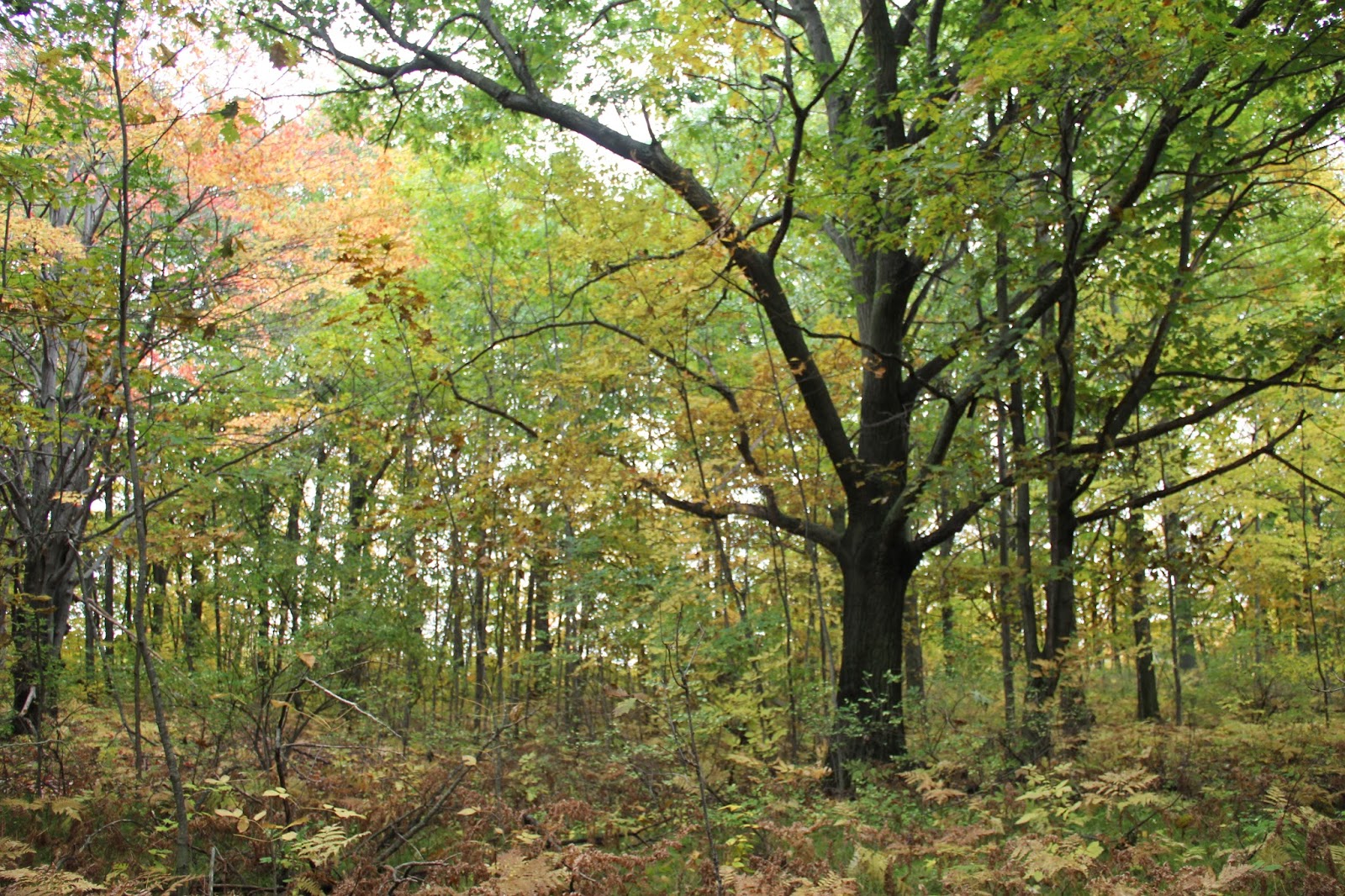
Between school programs and preparing for the upcoming MAEOE conference, this week has been very busy. I have had very little time to write anything substantial for this blog, but I wanted to remind everyone that fall is upon us. In Northern Michigan, fall colors should be at or near peak this weekend and next. Make the time to get outside and enjoy the beautiful colors and the fabulous fall weather - sunny with temperatures predicted in the sixties.
Here are a few photos from past October weekends.
Monday, October 5, 2015
Native Species Profile - American Fly Agaric Mushroom (yellow variant)
Recently I have written profiles of two species of edible mushroom: the Bear's Head Tooth (Hieracium americanum) and Coral Tooth (H. coralloides). Although many species of fungi are edible, many others are toxic. Unless you are an expert, it is never a good idea to eat any mushroom that you find in the woods. There are many look-alike species, with some being edible and some toxic. Even if if you see it being eaten by animal, that does not mean that it is safe for human consumption.
One fungus that fits into the toxic category is the yellow variant of the American Fly Agaric Mushroom (Amanita muscaria var guessowii). This species is found in deciduous and coniferous woodlands. It's mycelium (root-like structures) are found in the ground and have a symbiotic mycorrhizal relationship with the roots of trees. This means that the mycelium form a coating around the hair roots of trees and help the trees absorb water and minerals. In exchange, the fungi receive sugars from the trees roots.
This variant of the American Fly Agaric has a yellow to orange cap with pinkish, tan, or white "warts" on the top. These warts have a cottony or felt-like appearance. The underside of the cap has white gills. This mushroom emerges from the ground as a "button" or "egg". To the inexperienced mushroom hunter it may appear to be a puffball. This mistaken identity has probably resulted in many cases of poisoning.
Eventually the outside edge of the cap spreads out to a width of up to 9 inches. This cap rests atop white stalk with a bulbous base. There is a fragile skirt-like ring part of the way up the stalk.
This species is found much of eastern North America and is particularly common in the Great Lakes region. Because this species is associated with the roots of trees, Fly Agaric mushrooms are often found in large groups and sometimes form arcs or "fairy rings". It is most commonly seen in late summer and fall.
Basic Information
THIS SPECIES IS TOXIC!
American Fly Agaric (Yellow variant)
Amanita muscaria var. guessowii
Size: up to 9" wide by 12"tall
Habitat: found on the ground under evergreen and deciduous trees
Color: yellow to orange cap with pinkish, tan, or white "cottony" warts; white gills; white stalk
Bloom
Time: late-summer to fall
THIS SPECIES IS TOXIC!
One fungus that fits into the toxic category is the yellow variant of the American Fly Agaric Mushroom (Amanita muscaria var guessowii). This species is found in deciduous and coniferous woodlands. It's mycelium (root-like structures) are found in the ground and have a symbiotic mycorrhizal relationship with the roots of trees. This means that the mycelium form a coating around the hair roots of trees and help the trees absorb water and minerals. In exchange, the fungi receive sugars from the trees roots.
This variant of the American Fly Agaric has a yellow to orange cap with pinkish, tan, or white "warts" on the top. These warts have a cottony or felt-like appearance. The underside of the cap has white gills. This mushroom emerges from the ground as a "button" or "egg". To the inexperienced mushroom hunter it may appear to be a puffball. This mistaken identity has probably resulted in many cases of poisoning.
| Egg or button phase of Amanita muscaria var. guessowii |
| Egg or button phase of Amanita muscaria var. guessowii - this one was bright yellow |
Eventually the outside edge of the cap spreads out to a width of up to 9 inches. This cap rests atop white stalk with a bulbous base. There is a fragile skirt-like ring part of the way up the stalk.
| American Fly Agaric (yellow variant) - note bulbous base, white gills, and warts |
This species is found much of eastern North America and is particularly common in the Great Lakes region. Because this species is associated with the roots of trees, Fly Agaric mushrooms are often found in large groups and sometimes form arcs or "fairy rings". It is most commonly seen in late summer and fall.
| Amanita muscaria var guessowii - note the cottony warts |
![]() |
| Part of a large colony of yellow American Fly Agaric |
Basic Information
THIS SPECIES IS TOXIC!
American Fly Agaric (Yellow variant)
Amanita muscaria var. guessowii
THIS SPECIES IS TOXIC!
Thursday, October 1, 2015
Why the "eighth month" is our tenth month...
Happy October!
The word October has its origin in the Latin root word octos which means "eight". To the Romans October was known as October mensis, translated as "eighth month".
Wait a minute? When I look at the calendar it shows me that October is the tenth month of the year, not the eight. What is going on here?
In the earliest Roman calendar, October was indeed the eight month of the year. The original Roman calendar revolved largely around agricultural and religious cycles and began in March - the month that Spring arrives. March is named for Mars (the god of war) and was the traditional beginning to not only the agricultural cycle (planting) but also the military campaigning season. If we begin the calendar in March (Martius mensis) then October is really the 8th month of the year. This calendar is attributed to Romulus, the mythical founder of Rome.
This first Roman calendar only had 10 named months. The period from the end of December (decem for "ten") and the beginning of March did have names on this original calendar - there was not much going on in the realm of agriculture (or warfare) during this period. Around the year 700 BC, the calendar was reformed by the Roman king Numa Pompilius who added the months of January and February and moved the beginning of the year from March to January.
Even though it was no longer the "eighth month", October retained its name, as did the months of Quintilis mensis (fifth month), Sextilis mensis (sixth month), September mensis (seventh month), November mensis (ninth month), and December mensis (tenth month). Quintilis was later renamed in honor of Julius Caesar as Julius mensis, meaning the month of Julius", which became our month of July. Sextilis was renamed after Augustus Caesar (the first Roman emperor) as Augustus mensis, the "month of Augustus".
| October woodland (2014) |
The word October has its origin in the Latin root word octos which means "eight". To the Romans October was known as October mensis, translated as "eighth month".
Wait a minute? When I look at the calendar it shows me that October is the tenth month of the year, not the eight. What is going on here?
In the earliest Roman calendar, October was indeed the eight month of the year. The original Roman calendar revolved largely around agricultural and religious cycles and began in March - the month that Spring arrives. March is named for Mars (the god of war) and was the traditional beginning to not only the agricultural cycle (planting) but also the military campaigning season. If we begin the calendar in March (Martius mensis) then October is really the 8th month of the year. This calendar is attributed to Romulus, the mythical founder of Rome.
This first Roman calendar only had 10 named months. The period from the end of December (decem for "ten") and the beginning of March did have names on this original calendar - there was not much going on in the realm of agriculture (or warfare) during this period. Around the year 700 BC, the calendar was reformed by the Roman king Numa Pompilius who added the months of January and February and moved the beginning of the year from March to January.
Even though it was no longer the "eighth month", October retained its name, as did the months of Quintilis mensis (fifth month), Sextilis mensis (sixth month), September mensis (seventh month), November mensis (ninth month), and December mensis (tenth month). Quintilis was later renamed in honor of Julius Caesar as Julius mensis, meaning the month of Julius", which became our month of July. Sextilis was renamed after Augustus Caesar (the first Roman emperor) as Augustus mensis, the "month of Augustus".
Subscribe to:
Posts (Atom)