Showing posts with label aquatic animals. Show all posts

Monday, May 15, 2017

Aquatic Ecology with Shepherd Elementary students

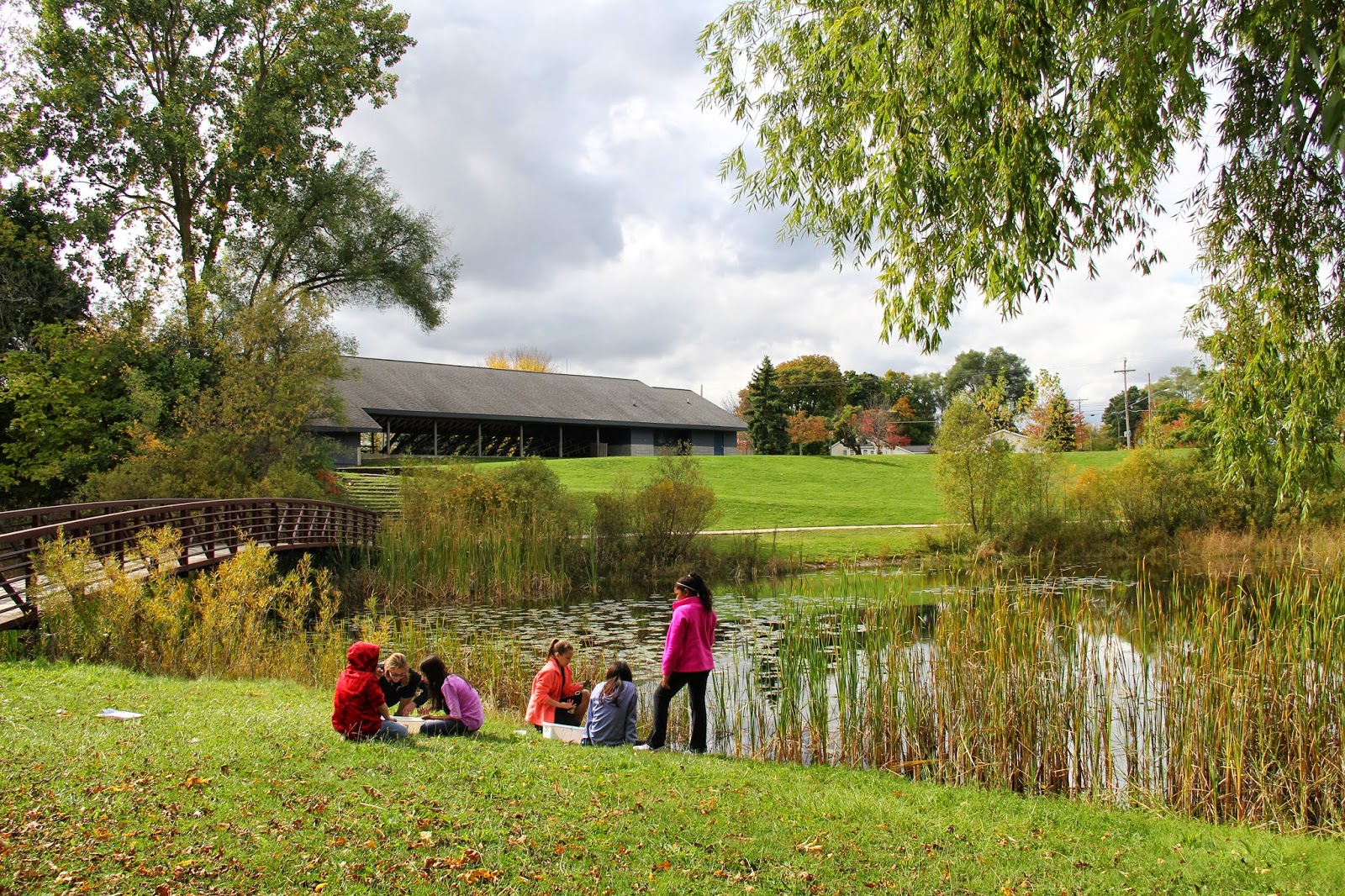
Last week I spent two days at the Little Salt River with students from Shepherd Elementary students. 

Why were we at the river? 

The students were collecting and identifying aquatic macroinvertebrates. 

Shepherd 5th graders use a dip net to sample aquatic macroinvertebrates from the Little Salt River


What exactly is an aquatic macroinvertebrate? 

Let's break that into parts.  Aquatic means that a plant or animal lives in or around water.  It comes from the Latin word aqua which means "water".  The word invertebrate comes from the Latin root word vertebra which means "joint" - normally refering to the joints of the spine.  Invertebrate means that an animal lacks a spine.  The prefix macro- means large or large scale.  It comes from the Greek word makros meaning "large or long".  Therefore, a macroinvertebrate is a large animal that lacks a spine - large in the sense that it is big enough to see without magnification.  Add it all together and an aquatic macroinvertebrate is an animal that lives in water, lacks a spine, and is large enough to see with the naked eye.

This crayfish is an aquatic macroinvertebrate.

So is this gilled snail.


Why were students trying to collect aquatic macroinvertebrates?

Many aquatic macroinvertebrate species have varying tolerances for water pollution.  The absence of certain species may indicate low water quality.  The presence of a wide range of species usually indicates higher water quality.

Students complete a biological monitoring sheet to determine water quality

Overall the students found a wide variety of aquatic macroinvertebrates including mayfly larvae, caddisfly larvae, gilled and pouch snails, damselfly larvae, dragonfly larvae, scuds or amphipods, crayfish, freshwater clams and mussels, leaches, and midge larvae.  Vertebrate lifeforms collected included fish and tadpoles.  The wide variety (and number) of animals collected indicated that at this site, the Little Salt River has excellent water quality.

Here are a few more photos of the students sampling...

Thursday, November 19, 2015

A blast from the past

One of the local schools that I visit is Winn Elementary.  Way back in 1984 - 85, I was a student in the fourth grade at Winn Elementary.  While looking through a file cabinet yesterday, I came across an artwork that I did when I was a student at Winn.  This drawing was entered into a stamp design contest through the US Postal Service.  I was a big stamp collector at that age - I was also into nature as the coral reef theme shows.  Obviously I didn't win the contest... but I like to think that my drawing skills have improved.


Friday, March 6, 2015

Crayfish Test


Blogger has been very cranky toward me over the past few days.  It has not been letting me save or post anything with pictures.  This post is basically just an attempt to see if it will work at all.  On the plus side, if it does work, you get to look at this interesting (and slightly terrifying) picture of the underside of a crayfish.

Thursday, October 9, 2014

Wetland Exploration with Fancher SIxth Graders

On Tuesday (07 OCT) I spent the day exploring Mill Pond Park with three classes of 6th Grade students from Fancher Elementary.  I had previously visited each of these classes to talk about wetland habitats.  This field trip enabled the student to get a hands-on experience with something that they were learning about in class.  Each class visited the park for a little over an hour.  During that time we talked about the different zones found in wetlands(upland plants/emergant plants/floating leaf plants/submersed plants), looked at wetland soil, and searched for aquatic invertebrates.

Here are a few photos from the day.

Me explaining the zones of plant life found in a wetland

Me trying to fall down.

A big thank you to Brooke Friesen for taking the photographs of me.  Brooke is a Central Michigan University student studying environmental and outdoor education.  In her spare time she has started volunteering time with our Environmental Education Program.


The absolute best thing of the day for me was having a student tell me that, after learning about wetlands from me over the past two weeks, she thinks she wants to be a wetlands ecologist.  That is awesome...

A future wetlands ecologist holding a water scorpion


As I was photographing the reflection of the sun and clouds among some water lily leaves, a student asked what I was taking a picture of.  So I showed him.  His reaction was "cool".

The trees are starting to turn, but the water is still warm.

Students cataloging their finds.

Monday, June 2, 2014

Two Ponds in Two Days - Aquatic Macroinvertebrate Sampling

One of the best things about my work is having the opportunity to get kids outside and expose them to the habitats and wildlife in their own hometown.  Last week I was able to get five classes off of school grounds to explore a couple of local ponds.  Here are a few pictures.

The first pictures were taken at Mill Pond Park in Mt. Pleasant on Thursday May 29th.  Two 3rd grade classes from Ganiard Elementary walked down the street from their school to join me in searching for aquatic macroinvertebrates.  The other two 3rd grade classes from the school will be doing the same thing later this week.


On Friday May 30th, the 3rd - 5th grade classrooms from Winn Elementary met me at a private pond near their school.  We were lucky to receive permission from the land owner to use this pond.  This meant that the students were able to walk to this site, instead of having to take a bus to a location far from their school.  Many students pass this pond every day on their bus ride to school.  Now they know what kinds of animals can be found swimming around in it.


Tuesday, April 29, 2014

Videos of Aquatic Invertebrates

Last week I presented several programs on aquatic invertebrates during the Ziibiwing Center's Mother Earth Week Celebration.  Students were able to find and identify nearly 20 different types of aquatic macroinvertebrates using the University of Wisconsin Extension Key to Life in the Pond.

After I was done working with the students I took the buckets of pond water back to my office and used a digital microscope to take photographs and videos of some of the smaller organisms that could be seen in the water samples.  Here are two of the videos.

First up, this video shows a small crustacean known as a daphnia or "water flea".  This water flea is a female - the dark spots near her back are eggs.


The second video shows another type of small crustacean known as a scud or amphipod.  Scuds resemble small shrimp and are also known as "side-swimmers" for their tendency to swim on their sides.


Monday, April 21, 2014

Mother Earth Week 2014 - Aquatic Ecology at the Ziibiwing Center

This week I am participating in the annual Mother Earth Week activities at the Ziibiwing Center.  This will be the 5th year that I have participated int his program.  Every year I bring in buckets of pond water for students to sort through.  The goal of this activity is to show students how the absence or presence of certain aquatic macroinvertebrates can used as indicators of water quality.

I get my water samples from several local ponds in the Mt. Pleasant area.  Unfortunately, most of these ponds were greatly affected by the recent flooding.  Heavy rains resulted in large amounts of sediments being added to the ponds, making the waters very murky.  So instead of getting my samples from permanent ponds, this year I collected water and invertebrates from a series of seasonal ponds located in a local woodland.


Red Maple trees reflected in a seasonal pond

Seasonal ponds offer a unique set of challenges for aquatic life.  Because these ponds only hold water for part of the year it limits the types of species that can be found living in them.  For instance, fish cannot survive in them.  Other species adapt by burrowing into the mud when these ponds dry out and remain dormant until rains flood the ponds again.

Another unique aspect of life in seasonal ponds is the source of food for most of the animals.  Permanent ponds are home to a variety of aquatic plants and algae.  These plants and algae harvest energy from the sun through the process of photosynthesis and form the base of food chains in permanent bodies of water.

However, because seasonal ponds dry out for much of the year these photosynthetic organisms do not grow in seasonal ponds.  Instead dead leaves fill the bottom of shallow seasonal ponds and become the base of the food chain.  These leaves fall from surrounding trees and are shredded and consumed by a variety of organisms in the seasonal ponds. 

Dead leaves form the base of the food chain for many dwellers of seasonal ponds
So what are some of the organisms that you can expect to find in a seasonal pond?

Northern Casemaker Caddisfly

Aquatic Sowbug

Planaria or flatworm

Fingernail or Pea Clam

Pouch Snail

For more information on Aquatic Invertebrate sampling check out these other posts from the past year:

Thursday, February 13, 2014

Public Events - MAY and JUNE 2014


I have several public events coming up later this year in and around Mt. Pleasant.  Be sure to mark these on your calendar.

May 3rd          Celebrate International Migratory Bird Day at the Ziibiwing Center (6650 E. Broadway, Mt. Pleasant).  See a live birds of prey presentation, dissect an owl pellet, handle real and replica bird specimens, make bird crafts, and much more.  This event runs from 1PM to 4PM and is appropriate for all ages.  Free and open to the public.

May 4th          Join me at Millpond Park (607 S. Adams, Mt. Pleasant) for a nature walk as part of the Chippewa River District Library and Broadway Playhouse Kids event "Hi Ho, Hi Ho to the Park with Snow White We Go" event to promote the Broadway Playhouse Kids production of Snow White.
This Event has been cancelled due to scheduling conflicts.
 
May 14th         Learn about Aquatic Macroinvertebrates at the Veterans Memorial Library (301 S. University, Mt. Pleasant).  Join me at the Chippewa Valley Audubon’s regular monthly meeting as I give a presentation about insects, clams, and other underwater residents.  This event runs from 7PM to 9PM and is free and open to the public.

June 21st         Experience the nocturnal world of Moths and Owls.  Join me and expert birder Stan Lilley at Mission Creek Park (1458 N. Harris, Mt. Pleasant) at 9PM for this Chippewa Valley Audubon Club outing as we set up lights and sheets to attract moths and call for owls while we wait.  Free and open to the public.

June 26th        Aquatic Invertebrate Sampling at Hall’s Lake.  Join me and members of the Chippewa Watershed Conservancy at 9:30AM at Hall’s Lake in western Isabella County to search woodland ponds and streams for underwater life.  This program is for all ages and is free and open to the public.

Thursday, November 14, 2013

Waterproof Fur

One of my programs for Third Grade classrooms is called "Fur, Feathers, Skins, and Scales".  It is a comparison of different types of body coverings found on Michigan's native animals.  Different types of body coverings have evolved to perform different jobs.  One of the things that we talk about is the idea that aquatic mammals often have "waterproof" fur that keeps the animals warm and keeps their skin dry even when swimming in ice cold water.  For example, this Muskrat (Ondatra zibethicus) climbed onto a shelf of ice after swimming  in a partially frozen river, shook like a dog and looked almost completely dry within seconds.

Muskrat looking completely dry seconds after emerging from a partially frozen river

On this Muskrat (below) you can see the water beading up on its fur.

A Muskrat (Ondatra zibethicus) with water beading up on its fur

Besides the Muskrat, two of the animals that I use to demonstrate this are the North American Beaver (Castor canadensis) and the North American River Otter (Lontra canadensis).

Beaver pelt

Otter Pelt

Both the Beaver and River Otter (and the Muskrat) have two layers of fur: an outer layer of long straight guard hairs and a dense interwoven inner layer.  The hair of both animals is oily and this combination of dense oily fur prevents most water from reaching through to their skin.  Both the Beaver and Otter groom often to keep their fur clean of debris and to spread oil (from glands located near their tail) evenly over their fur.


Looking closely at the fur, the beaver's fur is nearly twice as long as that of the otter.  Many of the outer guard hairs on the beaver pelt are more than an inch long.


None of the otter hairs measure more than a half an inch long, but the otter has many more hairs per square inch of skin than the beaver.  Both furs are equally good at repelling water.


Beaver fur (above) & otter fur (below)

In addition to the oil that the animals rub on their fur, the secret to waterproofing lies in the structure of the fur.  Looking at the hairs under a microscope, the hair of the beaver and otter look remarkably similar.  The guard hairs are straight and relatively thick.  The underfur is thinner than the guard furs and is wavy.  These wavy hairs interlock easily with each other and form a dense interwoven mat.  It is this dense matted layer, combined with the oil rubbed into the fur, that forms the waterproof barrier that allows these animals to swim in near-freezing water without becoming cold.

Beaver fur (magnified 2Xs) - the straight hairs are the outer guard hairs, the wavy hairs form the underfur

Beaver fur - another closeup at 2X magnification

Otter fur (2X magnification) - thick straight guard hairs and wavy underfur

Otter fur (2X magnification) - notice how the wavy underfur interlocks forming a matted layer