Showing posts with label field guides. Show all posts

Monday, December 4, 2017

Five field guides for holiday gift giving (2017 edition)

Hi, I'm Mike and I have a problem with field guides.  I simply cannot resist the pull of  a new guide.  Birds?  I have guides.  Trees?  I have guides for those too.  Flowers?  Lord, do I have guides for flowers!  Insects?  Not just general guides to insects - I have guide dedicated to bees, aquatic insects, and beetles.  (I love beetles!)  Lichens?  Who has a field guide for lichens?  Um, I do...  Actually, I know I have at least two lichen field guides.

Like I said, I have a problem.

In 2016 I wrote a series of posts (Part 1, Part 2, Part 3, and Part 4) about some of my favorite field guides that I thought would make good Christmas gifts .  Here is an update for 2017.

1.  Amphibians and Reptiles of the Great lakes Region, Revised Edition by James H Harding and David A. Mifsud (ISBN 9780472073382)

This is not a new field guide.  The original edition came out in 1997.  Even if you own the older edition, go out and buy this field guide.  It has more photographs and updated (color) maps.  This book was published by the University of Michigan Press and costs $24.95 (paperback).  When I found out that this edition was in the works, it immediately went on my to-buy list.

2.  Mammals of the Great lakes Region, Third Edition by Allen Kurta (ISBN 9780472053452)


This is another update of a previous addition.  Like Amphibians of the Great Lakes, this book was published by the University of Michigan Press.  It retails for $24.95 (paperback).  The key updates to this edition include color photographs and updated maps.  Another nice feature that I like in this book is that origin of each species' scientific name is described in detail.  Did I need to purchase the updated version of this guide?  No, but I think it was worth the cost.  If you live in the Great Lakes region I definitely recommend this book.

3.  Mushrooms of the Upper Midwest:  A Simple Guide to Common Mushrooms by Teresa Marrone and Kathy Yerich (ISBN 9781591934172)


Mushrooms of the Upper Midwest is not a new book.  It was published in 2014 by Adventure Publications.  This book is one of an entire series of small pocket sized guides.  Some of the books that I have in this series include wildflowers, trees, reptiles and amphibians, and mammals,  Limited in scope, these are great books for beginners.

I like that this book lists many of the common edible and toxic mushrooms that can be found locally.  As always, I caution anyone against relying on a single source for information on edible mushrooms - Mistakes can be deadly!

4.  Bark:  A Field Guide to Trees of the Northeast by Michael Wojtech (ISBN 9781584658528)


This another book that is not new.  Bark was published in 2011 by the University Press of New England.  I have been aware of this book for several years, but have never come across it in a store until this year.  I most tree field guides, bark is an afterthought.  There might be a short description for each species, or even a single picture of the bark of a mature tree.  In this book, bark is the star.  There are photographs of bark at various stages of a tree's life - young, mature, and old trees.  Although this book is not specific to the Midwest/Great Lakes there are enough common species to make it worth purchasing.

5.  Michigan Atlas & Gazetteer by DeLorme (ISBN 9780899334424)


Okay, this one is not a field guide.  Instead it is guide that gets you into the field.  I currently own three different editions of this guide.  Whenever we go on vacation to another state, I am likely to buy the DeLorme Atlas for that state.  I know off the top of my head that we own copies for Maine, New York, North Dakota, South Dakota, and Wisconsin (at a minimum).  These guides are so much more than road maps.  They show waterfalls, geologic sites, museums, scenic drives, lighthouses, hiking trails, and much more.  There are many places that I would never have visited if I hadn't found them in a DeLorme Atlas.

Wednesday, December 14, 2016

Holiday field guide gift guide - 16 guides for 2016 (part 4)

Field Guides to Fungi and Lichen

14.  Mushrooms of Northeast North America (Midwest to New England) by George Barron
(ISBN 9781551052014)


If you have already mastered wildflower identification, tracks are no longer a challenge, and insects identify themselves, you might be up for the challenge of identifying fungi.  I am not a mycologist (mushroom expert), but this is the best and easiest book that I have found so far.  It was originally published  by Lone Pine Publishing in 1999 and currently retails for around $25.  It is slightly too big to fit in a pocket, but I often carry it in my backpack with other commonly used guides.

This book does not try to be the single source for fungus, there are simply too many species to adequately cover in a single field guide.  It does however list over 600 of the common species found within the region.  The species listed in the book are logically organized by their common characteristics.  For example, tooth fungi are grouped together in a section, as are bracket fungi, jelly fungi, etc.. Some mushrooms are grouped together by the color of their spores.


Each species in the book has a detailed description accompanied by a color photograph.  The descriptions in the book also mention the edibility/toxicity of species.  There is a separate section about that lists common easy-to-identify edible mushrooms and a companion section on toxicity.  A with any wild edible, I would always recommend consulting more than one source and making sure that you are 100% certain of your identification before consuming any food found in the wild.

15.  Lichens of the Northwoods by Joe Walewski (ISBN 9780979200601)


The last two field guides that I would recommend are sort of companions, both to each other and to the mushroom field guide listed above.  Lichens are something that I know very little about.  They are a symbiotic organism - a beneficial partnership between a fungus and a photosynthetic algae living together as one organism.


Lichens of the North Woods is one of a series of naturalist books published by Kollath+Stensaas Publishing.  Published in 2007, this guide includes photographs and descriptions of  111 lichen species that can be found in the Great lakes and Ontario.  I like how the book is divided into sections by the surface that the lichen grows on (soil, rocks, or trees).  Each section is further divided into subsections based on the growing pattern of the lichen (crustose - in close contact with the substrate, may look like spray paint; foliose - looks leafy, like "foliage"; fruticose - branching or shrublike, may stand erect or drape downward).   There is a good (approximately 20 page) introduction to lichens at the beginning of the book that is helpful for understanding lichen biology and the terms used in the descriptions.  The book currently sells for under $20.  I would recommend any book in this series for someone looking for a good regional guide for beginners.


16.  Michigan Lichens by Julie Jones Medlin


Published by the Cranbrook Institute of Science in 1996, this book focuses entirely on lichen species that can be found in Michigan.  This is the major reason that I would recommend this book - I like the limited scope of the book. 


The book depicts over 80 species with descriptions and color photographs.  The species are arranged in alphabetical order by their scientific name so it is not as user-friendly as the previous book. Unfortunately some of the scientific names listed in the book are out of date, but this is a good starting point to understanding lichens.  The descriptions are easy to understand and the photographs clearly illustrate diagnostic features of the different species.  The best thing about this book is the price - a paperback version costs less than $10 and an electronic version can be downloaded for less than $5!  At these prices it is hard to pass up. 


Monday, December 12, 2016

Holiday field guide gift guide - 16 guides for 2016 (part 3)

Slightly delayed, but here is part three of my holiday field guide gift guide.  If sorting through hundred of plants or thousands of insect species is not your thing, perhaps you might enjoy a guide to a group of animals with less members.  If you like fuzzy animals try a guide to mammals, if you prefer your animals scaly or slimy try one about reptiles and amphibians.

11.  Mammals of the Great Lakes Region (Revised Edition) by Allen Kurta (ISBN 9780472064977)


Published by the University of Michigan Press (1995), this book is an update of a guide that was originally published in 1957.  It's probably no surprise that I own a copy of the earlier publication as well.

If you are looking for a guide to the mammals of Michigan this is the book to buy.  The book focuses on the entire Great Lakes Basin, so some of the eighty-three species listed in the book are not found within the boundaries of Michigan.  The species listed with are grouped by the order to which they belong - for example all rodents are grouped together in one section.  This makes it relatively easy to find an individual species in the book.  For each species there is a list of measurements; a detailed description of the animal; a range map; and a natural history that explains such things as diet, mating habits, and habitat requirements.  There is also a black and white photograph of each species.  There is also a key at the back of the book for identifying mammal skulls.


The author's preface to the book neatly sums up why you should buy this volume for yourself or another nature lover.

     This book is not intended to be a coffee-table book, ponderous tome, detailed listing of 
     relevant literature, or an in-depth treatment of geographic variation.  It is intended to serve 
     as a quick reference for teachers, students, naturalists, and professional biologists, and to be 
     a concise guidebook, still small enough to be tucked into a backpack and carried in the field.

This edition is currently available for under $20, but I did notice that a as yet unpublished 3rd edition is available for pre-order for $24.95.  The 3rd edition will have color photographs and a section on the tracks of common mammals.  It looks like I will be buying a new field guide soon!

12.  Animal Tracks:  Midwest Edition by Jonathan Poppele (ISBN 9781591933243)


This book would be a good compliment to Mammals of the Great Lakes.  A true field guide, this book measures 5 inches by 7 inches and easily fits in your pocket.  The book includes images of tracks and gaits (walking patterns) for nearly 100 Midwest mammal species - not all species in the book can be found in Michigan.

I like this book because it is so extensive.  It covers a wide range of species, but does lump many similar species together.  Each entry includes images of their footprints, a description of the footprints (both front and rear tracks), a description of the animal's gait, a description of habitat types, and other notes on the animal including other signs to look for.  It is also helpful that the tracks in the book are life-size.  There are range maps included for each species, but some are inaccurate - for instance the book fails to show bobcat as present in Michigan's Lower Peninsula.


This book was published by Adventure Publications in 2012.  It retails for under $15.  Despite the few gripe that I listed above, at this price, you really can't go wrong.

13. Amphibians and Reptiles of the Great lakes Region by James H. Harding (ISBN 9780472066285)


This is another book from the University of Michigan Press.  Originally published in 1997, it also has an update coming in 2017.

Organized in much the same way as Mammals of the Great Lakes Region, this book gives lengthy descriptions of all species of reptiles and amphibian found within the Great Lakes Basin as well as for several species that closely approach the limits of the basin.  Each species depiction includes a detailed physical description (with a color photograph), notes on similar species, information on range (with a map) and conservation status, a description of habitat and ecology, as well as conservation requirements/efforts.


The 2017 edition will include updates range maps and more photographs.  Both the currently available edition and the forthcoming retail for under $25.  If you are a herp (reptile and amphibian) lover this is the book you need.  It is slightly large for a field guide at 5 x 8 inches, but it often finds its was into my backpack when I know I will be encountering snakes, frogs, or turtles. 

If you are looking for something completely different to study stay tuned for part 4 of my gift guide.

Tuesday, December 6, 2016

Holiday field guide gift guide - 16 guides for 2016 (part 2)

Field Guides to Insects

5.  Pollinators of Native Plants:  Attract, Observe and Identify Pollinators and Beneficial Insects with Native Plants by Heather Holm (ISBN 9780991356300).


If you already own a bunch of field guides to plant you probably spend a lot of time looking at plants.  If you spend a lot of time looking at plants you probably see lots of insects.  You might even wonder what the insects are and why you see different ones on different flowers.  If this describes you, then you want to own this book.

I heard the author of this book speak at the 2016 Wildflower Association of Michigan Conference and bought the book the same day.  It is the first book that I am aware of that talks specifically about the associations between native plants and their pollinators.  Although the book is limited in scope with only sixty-five plant species being featured, it includes more than 1600 photographs of flowers and insects!


This flower species in this book are arranged by habitat type.  Each species of plant is given a spread of two (or more) pages that includes a description of the plant, range map, flowering period, and habitat requirements, as well as a list of pollinator species (with photographs).  If you want to plant wildflowers as habitat for bees and butterflies, this is a must-have.  The book was published by Pollination Press LLC and retails for about $30.

6.  Butterflies of Michigan Field Guide by Jaret C. Daniels (ISBN9781591930983)


At some point you might want to know more about a specific group of insects.  Butterflies are a great place to start - there are only 147 species that are likely to be found in Michigan. 


I like this book because each species has its own two page spread.  The information provided includes detailed description, as well as a range map, a list of larval host plants, a calendar showing when it can be encountered, and a list of comparable species.  There are also pictures of both adults and larva - several entries in the book to not have larval photographs.  Another feature that I really like about this book is that the butterflies are divided by color - if a species has more than one color morph it is listed in more than one section.  This sensible approach to identification is something that you usually do not see outside of wildflower books, but it works well for butterflies.


Unlike some of the other books on this list, this is a true "field" guide.  It is small enough (about 5 inches by 7 inches) and light enough to stick in your back pocket and carry all day. The book was published by Adventure Publications in 2005.  It retails for under $20.  I highly recommend this book to anyone wanting to learn more about Michigan's butterfly species as well as anyone interested in observing the relationship between insects and native plants.

7.  Peterson Field Guide to Moths of Northeastern North America by David Beadle and Seabrooke Leckie (ISBN 9780547238487).


If butterflies are too easy (There are only 147 Michigan species after all!), it may be time to try your hand at moth identification.  I was really excited back in 2011 when I found out that this book was in development.  I was so excited that I asked for it for Christmas in 2012 - Thanks Shara!


Published by Houghton Mifflin Harcourt, the moths in this book are arranged by family.  There is a color photograph for each species, with arrows pointing to distinguishing marks.  There is also a brief description and range map for each species.  If you are not familiar with all of the different types of moths, the book can be daunting to use - there are nearly 1500 species depicted in this guide.  Even so, this guide is worth having because of the breadth of species that it covers.  At $29 it is a reasonable price for such an extensive resource.

8.  Caterpillars of Eastern North America: A Guide to Identification and Natural History by David L. Wagner (ISBN 9780691121444)


Published by the Princeton University Press in 2005, this book has all the qualities of a book you would expect from a guide published by a well-renowned university.  It is extensive (more than 700 species), well illustrated with photographs of both caterpillar and their adult forms, and well researched.  Each species description includes information information on range, season, and host plants as well as a detailed description of each species.


The book is slightly too large to carry in your pocket (5 inches by 8 inches).  It is also quite heavy - it is printed on a heavy paper and runs more than 500 pages.  It is however the best guide to caterpillars that I own, so I do frequently carry it in my backpack while out in the field.  Priced at under $25, this is a great edition to the bookshelf of any nature nut or gardener who wants to know what is eating their plants.

9.  A Guide to Common Freshwater Invertebrates of North America by J. Reese Voshell, Jr. (ISBN 9780939923878)


If you would rather wade in swamps and river than chase butterflies through fields, this might be the book for you.  I spend much of the spring working with students to catch and identify aquatic insects (and other macroinvertebrates).  Although I can identify most of the things that we find by sight, this is the book that I use if I want more detailed information.


Although much of the book is devoted to aquatic insects, there are also sections on mollusks (clams and mussels), gastropods (snails), annelids (worms), crustaceans (crayfish, shrimp, etc.), and more.  The book starts with a discussion of aquatic ecology and the roles, life histories, and pollution tolerance of various groups of aquatic invertebrates.  It also provides a  description of collection methods for various organisms and habitats.   There is a separate section of color illustrations which is useful for identification.  The main part of the book is devoted to detailed descriptions of the various organisms.


Published by the McDonald & Woodward Publishing Company in 2002, this book currently sells for nearly $40.  It is a valuable resource for citizen ecologists, fishermen, and anyone interested in what is going on beneath the surface of any body of freshwater.  Despite the hefty price, I highly recommend this book.

10.  Beetle of Eastern North America by Arthur V. Evans (ISBN 9780691133041)


Among other things, I am a beetle fanatic.  When I heard that this book was being published in 2014 I could hardly wait to buy it.  I was not disappointed.

Another book by the Princeton University Press, it is simply the best beetle identification book available for the eastern United States and Canada.  By no stretch of the imagination is this a field guide - it measures 8 inches wide by 10 inches long and has over 550 pages.  Photographs and description of more than 1400 species are included in this book.  It is almost as much a coffee table book as it is field guide - the photographs of the individual beetles are often stunning.  I can admit to looking through this book for hours.  At $35, this book is an incredible value for its size and scope.  I cannot recommend it highly enough.  Any naturalist would be excited to receive this as a holiday gift.


The species in the book are arrange by family - all 115 families found east of the Mississippi River are represented in the book.  Each section of the book begins with a general description of the family and is followed by detailed descriptions of individual species.

That's it for field guides to insects and other invertebrates.  Look for Part 3 (field guides to other animals) later this week.

Monday, December 5, 2016

Holiday field guide gift guide - 16 guides for 2016 (Part 1)

It's no secret that I have a "problem" with field guides.  My problem is that I feel the need to have them all.  This means that they occupy a lot of shelf space (and table space and sometimes floor space) at my home.  It also means that I have a bit of experience using different field guides.  When I do programs for adults, I frequently get asked about the field guides that I would recommend for use or purchase.

With Christmas coming soon, now is the perfect time to think about purchasing field guides as gifts or about which guides you want to add to your list.  Here are a few of my recommendations.

Field Guides to Plants

1.  Wildflowers in the Field and Forest:  A Field Guide to the Northeastern United States by Steven Clements and Carol Gracie (ISBN: 9780195150056).


Published by the Oxford University Press in 2006, this book is not cheap (new copies currently cost $55), but I believe it is totally worth the price.  This is my go-to book for wildflowers.  It is simply the most comprehensive book of wildflowers to the Northeast and Great Lakes.  While I have found flowers that were not listed in this book, I can count them on one hand.  I like this book so much that I own two copies - one is my everyday user and the second copy is for when I wear out the first copy.


In addition to the fact that this book is so comprehensive, I like how his book is laid out.  Flowers are divided first by color, then by leaf arrangement, and finally by flower arrangement/number of petals.  There are good descriptions of each species as well as clear photographs of the flowers and often close-up images of details that help with identification.  There are also range maps for the region.  I wish every wildflower book was laid out this sensibly.  The book is quite large 5 inches by 8 inches and somewhat heavy, but the weight is worth carrying around in a backpack or shoulder bag if you are going to be identifying wildflowers all day.

2.  Michigan Trees: A Field Guide to the Trees of the Great Lakes Region by Burton V. Barnes and Warren Wagner, Jr. (ISBN 9780472089215). 


Published by the University of Michigan Press, this is the best available reference guide to the trees of Michigan.  It has been published in one form or another since 1913.  The current (revised and updated edition) was published in 2004.  The softcover edition of this book sells for under $20 - a great value for such a comprehensive well-organized guide.

 
Each species in this guide has its own two page spread with a detailed description and illustrations.  At the back of the book there is a smaller section that details some common shrubs found in the state.  Again this is not a pocket-sized book, but if you are spending the day looking at trees this is the book you want to carry along.

3.  Wetland Plants of Michigan: A Complete Guide to the Wetland and Aquatic Plants of the Great Lakes State by Steve W. Chadde (ISBN 9781481194945)


This author-published book is on its second edition (2012).  The book retails online and in stores for under $30.  This book is not as easy to use by a beginner as the previous two books.  It is divided by family - if you don't know the family it is best to use a different book.  However, it is still a useful guide, especially for those interested in identification of wetland plant species.  Each section of the book includes a dichotomous key that is useful for distinguishing between similar species.  Each species entry includes a good description of the plant, the plant's wetland classification, and a map showing which Michigan counties the species has been found in.  This useful feature was not included in the first edition and is a welcome addition to the book.  The book includes both line drawing and photographs (black-and-white only) of the species.
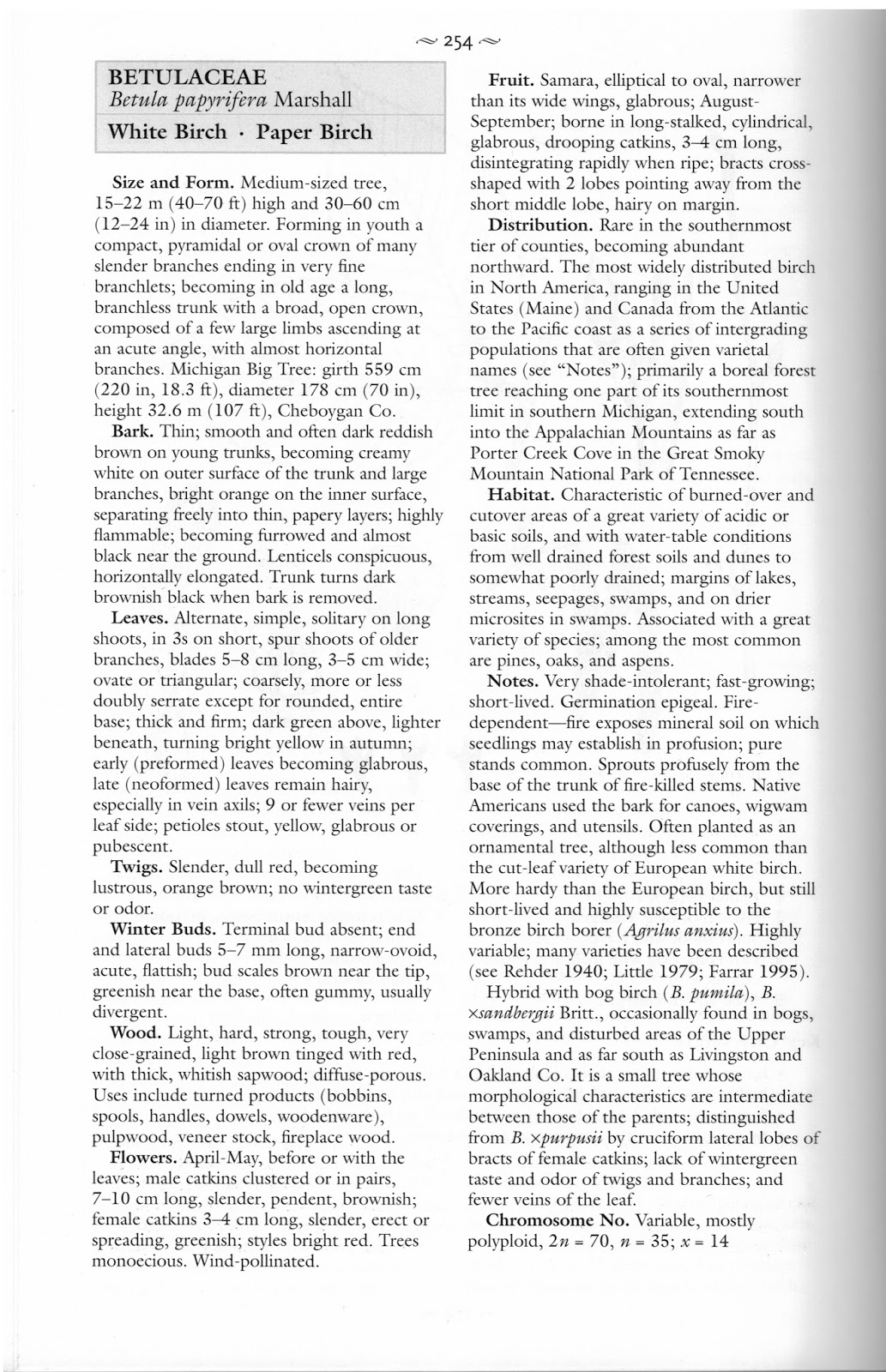

This book is not intended to be the first guide that someone owns.If you already own a few books about wildflower and trees and want to delve deeper, then I would recommend this book.    This book has more than 680 pages and is not pocket friendly, but is a valuable addition to the bookshelf.

4.  A Field Guide to the Natural Communities of Michigan by Joshua G. Cohen, Michael A. Kost, Bradford S. Slaughter, and Dennis A. Albert (ISBN 9781611861341).


Published by the Michigan State University Press in 2015, this book retails for $34.95.  This book is not a guide to individual plants, but rather is a guide to plant communities or habitat types.  Developed by scientists at the Michigan Natural Features Inventory, this book highlights more than seventy distinct natural community types found in Michigan.   The book gives a description of each community which includes a map showing where the community can be found in the state, a list of characteristic plants, and a list of locations of specific sites.  The book also includes a key that can be used to identify the class of an observed habitat.


This a great book to consult before going out into the field or after coming back from a trip.  It is less useful as a "field" guide.  That being said, this is a valuable addition to the library of anyone wanting to learn how larger plant communities work and interact.

That's it for field guides to plants.  Look for Part 2 (Insect field guides!) tomorrow.