Showing posts with label orchids. Show all posts

Friday, July 6, 2018

The Days of Summer - Day Ten through Day Sixteen

This is the second installment of my Days of Summer photo project.  To read about the project and see the first installment click here.

Day 10 (30 June 2018) - Wheatfield


Agriculture may not be the first thing that you think of when you hear the word Michigan, but it is one of the leading industries in the state.  This image of a ripening field of wheat was taken along the border of Isabella County and Gratiot County.  I spent the morning at Forest Hill Nature Area photographing wildflowers in a restored grassland.  Deciding to take a different route home, I passed by this field a couple of miles from Forest Hill.  I've been admiring wheat fields for the past several weeks, but never found one that I could easily photograph.  Stopping here was a no-brainer.

Day 11 (01 July 2018) - Ragged Fringed Orchid


This photo was taken at the Williamston Township Community Park in Ingham County, MI.  I stopped at this park to revisit an older grassland restoration that I have photographed several times over the years.  A pair of Ragged Fringed Orchids (Platanthera psycodes) was my reward.

Day 12 (02 July 2018) - Moss Sporophytes


Mosses are small; thus they are easily overlooked.  For those that take the time to notice them, they are well worth the effort.  One of the best books I have read in recent years is about moss.  These white balloon-like structures are reproductive bodies known as sporophytes.  When conditions are right, they will each release hundred or thousands of spores into the world.  We often associate mosses with shady woodland habitats, but these mosses were growing on bare sandy soil on land owned by Shepherd Public Schools.

Day 13 (03 July 2018) - Last of the Brood


This Days of Summer project means that I have to photograph something every day.  It means I have to get outdoors and away from my desk.  Fortunately Isabella County has lots of public land within a short drive of my office.  This picture of a Wild Turkey (Meleagris gallopavo) with a single poult (chick) was taken at Chipp-A-Waters Park in Mt. Pleasant.  Seeing a hen with only a single chick raises so many questions.  Was this the only egg that hatched?  Were the other eggs stolen by predators such as raccoons? Did predators get the rest of its nest mates?

Unlike most of my photographs, this image has been edited.  It has been cropped from the original size (about 50%) and the highlights have been toned down to bring some of the color back into the image.

Day 14 (04 July 2018) - Curious Fawn


The Fourth of July found me exploring the Maple River State Game Area.  This curious White-tailed Deer (Odocoileus virginianus) fawn wanted to check me out up close.  Unlike the previous picture, this one has not been cropped.  The fawn was that close and approaching closer.  It probably would have allowed me to touch it if I hadn't shooed it away into the woods.

Day 15 (05 July 2018) - Great Spangled Fritillaries


Yesterday I visited the Chippewa Watershed Conservancy's Sylvan Solace Preserve for about an hour in the middle of the day.  Mid-day may not be the best time for photography, but the heat of the day does bring out the pollinators.  I was luck to spot this pair of mating Great Spangled Fritillaries (Speyeria Cybele).

Day 16 (06 July (2018) - Chicory Flowers 


My final photo for the week is of a pair of Common Chicory (Cichorium intybus) flowers.  This photograph was taken at the Mt. Pleasant Discovery Museum early this morning.  Originally from Europe, Chicory is a common roadside plant in Mid-Michigan.  Even though this plant is not native to North America, it is well-behaved and likes roadsides and other waste places.    This is one of my favorite flowers to photograph.  The pale blue color is absolutely beautiful.  You have to get up early to photograph Chicory, by mid-day the flowers have closed up tight.

Tuesday, July 3, 2018

Surprise!

On Sunday (01 July 2018) I visited a park near Williamston, MI to walk through an older prairie restoration.  I first visited this park back in 2010 and I wanted to see how things have progressed in the intervening years.  On my original visit I was impressed by the variety of plant species that I encountered and the impressive number of pollinators visiting them.

My timing could be better.  The majority of the prairie species have yet to flower.  The most impressive blooms that I encountered were those of Black-eyed Susan (Rudbecki hirta).


Black-eyed Susans are great!  They are common, pretty, and easy to identify. I enjoy looking at and photographing Balck-eyed Susans as any flower, but I was disappointed that there was very little in bloom.

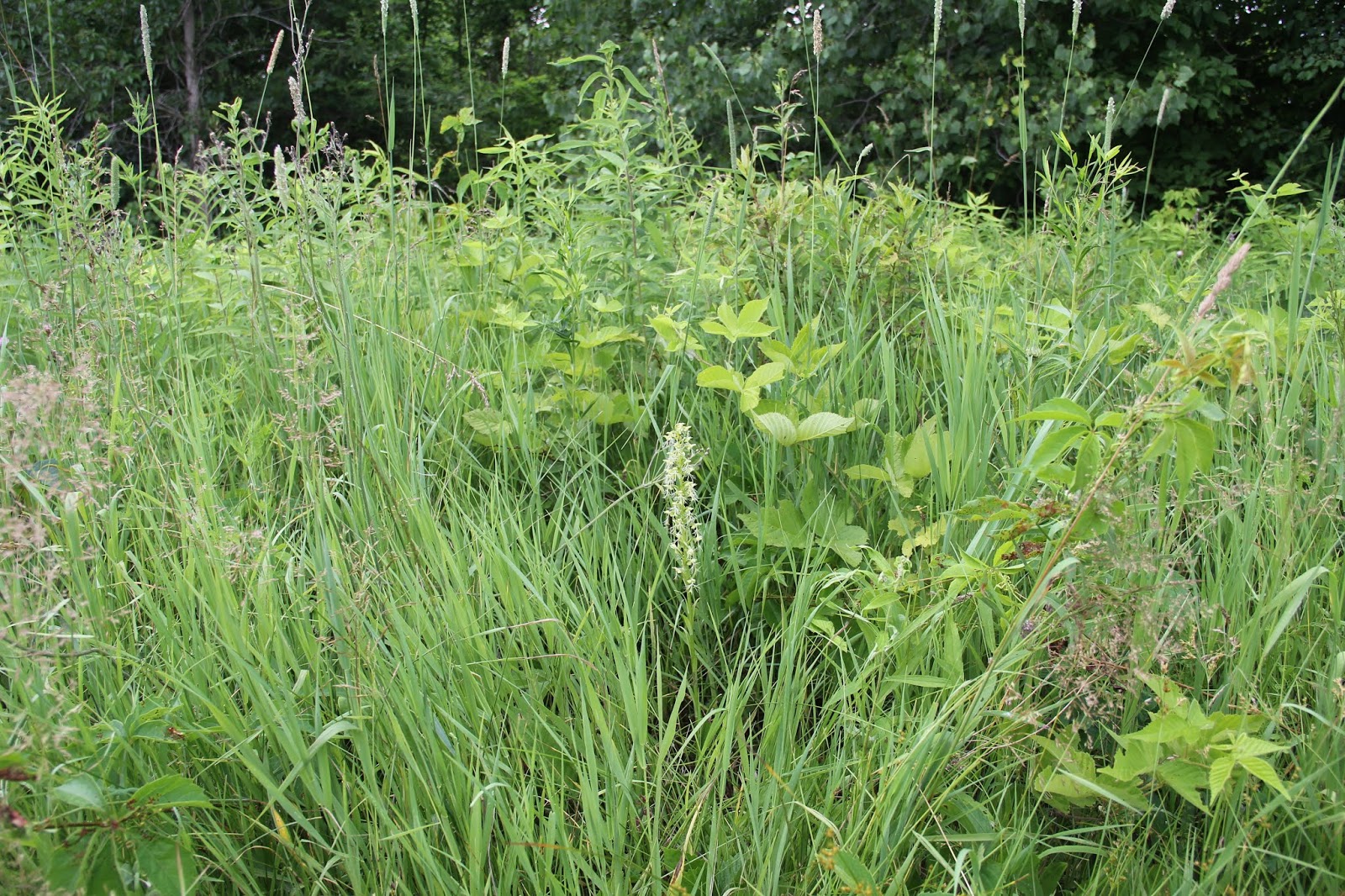
Then I stumbled upon this...


"Orchid!" I think I actually yelled it out loud.  If not, then I certainly screamed it loud enough in my brain.  I knew immediately that this flower was an orchid, but I didn't know which species.  It resembled the Lesser Purple Fringed Orchid (Platanthera psycodes) which I had found previously at the Chippewa Watershed Conservancy's Quigley Creek Preserve.  I was pretty sure this was a related species, but I didn't have a single field guide with me so identification would have to wait until I returned home.

I had to take dozens of pictures to make sure I got the identification correct.  Who am I trying to kid?  When I find an orchid I am going to take dozens of photos even if I know its identity with one hundred percent certainty.


After finding one orchid I was on a mission.  Could I find a second one?  The odds were probably not in my favor.  It was a big field and the orchids were shorter than most of the surrounding vegetation.  Then about twenty yards away I spotted this.


It was a second orchid and the flowers on this one were actually in much better condition.  This plant also had flowers that were more white than green so they stood out against the background better.  Amazingly both of these plants were located with a few feet of a mowed trail through the field!  This meant that I could plop down in the trail and photograph without crushing all of the nearby vegetation.  I did push the surrounding plants away to get a clear view of the orchids, but moved them back in place when I left so as not to draw unnecessary attention.


When I got back home it was easy to make an identification based on all the photographs.  My initial guess was that these were Prairie Fringed Orchids (P. leucophaea), but the fringe on the flowers was too finely cut.  That brought me to the Ragged Fringed Orchid (P. lacera).  This native species is widespread, but uncommon,  across the eastern half of the United States and Canada.  It has been recorded in every state east of the Mississippi River except Florida.  It has been found as far west as eastern Texas, Oklahoma, and Kansas.  In Michigan, it is found in fifty-three of the state's eighty-three counties.  It is typically found in moist to wet sites, including wet meadows, bogs, swamps, along the edges of wet forests.  The species is also known as the Green Fringed Orchid.


Friday, August 1, 2014

Orchid!

Yesterday I spent the day at Quigley Creek Natural Area.  Quigley Creek is Chippewa Watershed Conservancy preserve in Mecosta County that protects 63 acres of diverse upland and lowland habitats.  This a fairly new preserve for the CWC, having been acquired in 2012.  I visited the preserve as part of a small group to do a survey of the preserve's plant and animal species.  While surveying everything, my main focus was on flowering plants (and to a lesser extent trees).  Next week I plan on sharing more about what we found, but for now I just want to share a couple of pictures of the best find of the day - the Lesser Purple Fringed Orchid (Platanthera psycodes).  We found four of these plants in bloom.  With the exception of Pink Lady Slippers, these are the first native orchids that I have ever found. 

Lesser Purple Fringed Orchid

Lesser Purple Fringed - I like how the individual flowers look like happy little dancing ghosts


Like any native orchid, these should only be enjoyed in their natural surroundings.  Orchids have very specific soil conditions and attempts to transplant them almost always result in dead orchids (and a hole in the ecosystem from which they were removed).  Please enjoy responsibly.