Wednesday, September 14, 2016

Selected Mid-Michigan Leaves (A Digital Archive)

Over the past few weeks I have been collecting leaves to press and dry.  Once the leaves were dry, I laminated them on pieces of 8.5x11 card stock.  Then I scanned one leaf of each type to create a digital copy of the leaf.  Now, when I want to create new sets of leaves for students to use for identification or classification, all I have to do is hit "print".


Monday, September 12, 2016

Wildflowers of 2016 - #245 through #247

On Friday September 2nd, a short trip to Mill Pond Park added three species to my Wildflowers of 2016 list.  Two of the specie appeared on my 2014 list while the third species did not.  I am nearing the end of the wildflowers season, but still expect to find three or four more before the year is over.

Wildflowers of 2016 - #245 Big-leaved Aster (Eurybia macrophylla)

The next flower of the day was an Aster - Big-leaved Aster (Eurybia macrophylla).  This species, also called Large-leaved Aster, was formerly known as Aster macrophyllus.  This species is found primarily in the states and provinces surrounding the Great Lakes and in the Northeast.  Populations of it can be found as far south as Georgia and South Carolina (in the Appalachians) and as far west as Manitoba, Minnesota, Iowa, and Missouri.  It mainly grows in mesic (not too wet or dry) soils in upland forest habitats.  The plant spreads both by seeds from underground rhizomes.  It often forms dense colonies.

A colony of Big-leaved Aster
 
Asters are notoriously hard to identify.  Fortunately, Big-leaved Aster is one of the easiest asters to identify.  It has big leaves (1.5 to 12 inches long).  The leaves are heart, oval, or elliptical-shaped.  The plants have both basal and stem leaves.  The stem leaves are arranged alternately.

Big-leaved Aster - note the large heart-shaped basal leaves

Each plant typically has a single flowering stalk that branches into a flat-topped panicle (called a corymb) that measures from 3 to 8 inches across.  Each individual flower measures 1/2 to 1 inch across.  It consists of a yellow disc surrounded by 9 to 20 rays (petals).  The rays are pale blue, lavender, or white.

Big-leaved Aster - a closer view of the flower heads

Wildflowers of 2016 - #246 New England Aster (Symphyotrichum novae-angliae)

My second species of the day was another aster.  New England Aster (Symphyotrichum novae-angliae) is one of the tallest asters growing in Michigan (up to 6 1/2 feet).  It typically has flowers with a yellow (or golden) disc with 45 to 100 purple, blue, or pink rays.  Rarely the rays are white.  These flowers measure up to 1.5 inches across.  Individual plants may have a few or many flower heads.

New England Aster - note many flowers with yellow disc and pink rays.  Blue and purple rays are also common.

The leaves of New England Aster  are narrowly oval and measure 1 to 5 inches long.  The base of the leaves is lobed and clasps the plant's stem.  The stems of New England Aster are sparsely covered with hairs.

New England Aster - note how leaf clasps stem

This species prefers moist soils and can be found in both open habitats such as prairies and wet meadows, and in wooded habitats.  It is most widely distributed in the Great Lakes and Northeast, but is found as far west as California/Oregon/Washington and as far south as Mississippi/Alabama/Georgia.  In Michigan, it is found in both the Upper and Lower Peninsulas.

A colony of New England Aster growing in damp soil at Mill Pond Park

Wildflowers of 2016 - #247 Nodding Beggar-ticks (Bidens cernua)

The third species of the day was Nodding Beggar-tick (Bidens cernua).  This plant is also known as Bur-marigold.  Nodding Beggar-ticks is found in the wet habitats such as swamps, marshes, ditches, and shorelines.  This widely-distributed species is found in every state except Hawaii, Mississippi, South Carolina, and Florida.  I expect that the plant can be found in Mississippi and South Carolina, but so far has avoided collection.

Nodding Beggar-ticks

This species is similar to the Purple-stem Beggar-ticks (B. connata) which appeared at #236.   The two species are often found growing right next to each other.  Fortunately, there are several characteristics which help to distinguish them.  While both species have leaves that are toothed and reach lengths of 8 inches, Nodding Beggar-ticks can reach a height of seven feet, several feet taller than B. connata.  Another difference between the two plants can be seen in the flowerheads.  Nodding Beggar-ticks flowers usually have 8 yellow rays (petals) surrounding a yellow central disc.  Occasionally these rays are absent.  Whether or not the rays are present, the flowerheads of this species nod or droop slightly. 

Nodding Beggar-ticks - note yellow rays and slightly nodding head

Mantids!

The Monarch Butterfly Celebration is this Saturday and I have zero Monarchs right now, despite hours of searching for caterpillars.  This morning, a short walk through the field behind the Conservation District office once again left me empty-handed.

However, the walk was not totally worthless, I did find three preying mantids.  I watched each of these fly in front of me and land awkwardly on plant stalks.


Thursday, September 8, 2016

Wildflowers of 2016 - #238 through #244

My initial goal when I started my Wildflowers of 2016 list was to match my total number of species from my 2014 list.  Last Thursday (01 September), I reached that goal and sped on past.  Now my goal is to reach 250 species before the end of the growing season.  Here are the rules that I gave myself for this self-imposed challenge.

  •  Any native or non-native plant (including trees) can be photographed if it meets two conditions
    • It must be growing in a wild population - it cannot be in a location where it was planted.
    • It must be growing in one of the parks or other city properties within the city of Mt. Pleasant, Michigan.
  • I have to photograph the plant on the day I first find the flower - but I can photograph any flower of the species that I find on that day.
  • I have to be able to identify the species for it to count - unknown specimens do not count.

Without further ado...

Wildflowers of 2016 - #238 Common Heart-leaved Aster (Symphyotrichum cordifolium)

On Thursday 01 September 2016, I went to Mission Creek Woodland Park to search for some of the late summer/fall wildflowers that should be starting to bloom.  Because of its varied woodland and wetland habitats, Mission Creek has been a reliable source of wildflowers for years.  Once again, it did not disappoint. Less than a minute down the trail, I found my first new species of the day - Common Heart-leaved Aster (Symphyotrichum cordifolium).  With this species, I matched my 2014 total.

Common Heart-leaved Aster (Symphyotrichum cordifolium)

This species may be confused with Arrow-leaved Aster (S. urophyllum), which is also found at Mission Creek Park, but the two can be separated by differences in their leaves and flowers.  The leaves of Common Heart-leaved Aster are more typically heart-shaped than those of Arrow-leaved Aster with a deeper notch (sinus) at the base of the leaf.  The margins of the leaves are more coarsely toothed than those of the S. urophyllum, and the leaf petiole (stem) either lacks wings or has narrow wings (unlike the wide wings of S. urophyllum).  The leaves of Common Heart-leaved Aster measure 1.5 to 6 inches long.

Common Heart-leaved Aster - note namesake heart-shaped leaves with toothed margins

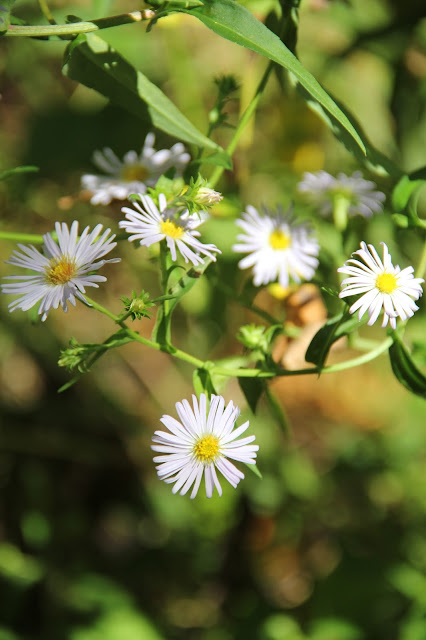
The flowers of Common Heart-leaved Aster measure 1/2 to 1 inch across with a central disc surrounded by 8 to 20 rays.  The rays are typically blue or rarely white.  The flowers grow in branching panicles that rise above the leaves - these panicles are usually wider than those of Arrow-leaved Aster.  Common Heart-leaved Aster is also sometimes known as Blue Wood Aster.

Common Heart-shaped Aster flowers are pale blue or white with 8 to 20 rays (petals)

This species is found in dry wooded habitats throughout the southern half of the Lower Peninsula.  Nationally, it is found as far west as eastern South Dakota and south to the Florida Panhandle.


Wildflowers of 2016 - #239 Calico Aster (Symphyotrichum laterifolium)

Calico Aster - note how flowers grow on lateral branches

My second flower of the day was another aster - Calico Aster (Symphyotrichum laterifolium).  In terms of habitat, this species is more adaptive than the Common Heart-leaved Aster.  It can be found in both wet and dry soils throughout the eastern half of North America.  It typically grows in shaded habitats rather than open places.  Calico Aster plants can reach a height of 1 to 4 feet.

Calico Aster - note hairy stem


This flower is also known as the Side-flowering Aster - lateriflorum means "side-flowering".  The plant's flowers grow on short stems on widely branching panicles.  The panicle's branches are roughly perpendicular to the plant's main stalk.  Individual flowers of the Calico Aster are small, measuring about 1/3 inch across.  They consist of a central disc that starts out yellow and fades to shades of purple as it ages.  The disc is surrounded by 9 to 14 short white rays.  The small number of rays on each flowerhead is what distinguishes this species from similar species with small flowers such as Frost Aster (S. pilosum) and Heath Aster (S. ericoides).


Calico Aster - a closer view of the flowers, note relatively small number of rays (petals)

Wildflowers of 2016 - #240 Swamp Aster (Symphyotrichum puniceum)


My third flower of the day was yet another aster - Swamp Aster (Symphyotrichum puniceum).  This species, also known as Bristly Aster, is a more northern species than those already described.  While it can be found as far south as central Georgia it is also found as far north as Nunavut.  In Michigan, it has been recorded in counties throughout the state.  Swamp Aster is considered an obligate wetland species - meaning it is found almost entirely in wet habitats such as swamps, wet meadows, floodplains, and shorelines.  It rarely is found in dry upland locations.


Swamp Aster in a cedar swamp at Mission Creek

Swamp Aster plants reach heights of 1 to 8 feet tall.  The plant's leaves are arranged alternately along the stem.  The leaves are oval or elliptical, with shallowly tooted or smooth margins, and measure up to 6 inches long.  The main stalk of Swamp Aster plants is thick, usually reddish colored, and covered with bristly hairs.  A similar species lacks these hairs and is known as Smooth Swamp Aster (S. firmum).

Swamp Aster - a closer view of the flowers

The flowers of Swamp Aster are arranged in a panicle (branched cluster) at the top of the plant.  Individual flowers are 1/2 to 1 inch across.  The flowers are composed of a central yellow disc surrounded by 30 to 60 rays (petals).  The rays are normally blue or purple, but may occasionally be white.

Wildflowers of 2016 - #241 Zigzag Goldenrod (Solidago flexicaulis)

Fall doesn't just mean aster, it also is the season for goldenrods.  Probably my favorite goldenrod species is the Zigzag Goldenrod (Solidago flexicaulis) - I have it planted in the flowerbeds next to my front steps.

Zigzag Goldenrod often grows in large colonies
 
Zigzag Goldenrod is one of several goldenrod species that grows in wooded areas instead of open habitats.  It can be identified by its wide leaves and flowers that grow from the leaf axils of its zigzagging stem.  For more information on Zigzag Goldenrod please look at this species profile that I wrote in January 2014.

Zigzag Goldenrod - note zigzagging stem and flowers growing in leaf axils
 
Wildflowers of 2016 - #242 Beech-drops (Epifagus virginiana)

Species #242 is one of a small group of plants that lacks chlorophyll - these means that it cannot use sunlight to manufacture its own food.  Instead, Beech-drops (Epifagus virginiana) is a parasite, stealing sugars from the roots of American Beech trees. If you find American Beech trees in a forest there are likely to be Beech-drops present also.  Conversely, if there are no Beech trees you not find any Beech-drops.  The plant has no other hosts.

Beech-drops lack chlorophyll and have no leaves.  They are parasites of the American Beech.

Beech-drops plants lack leaves.  It's stalks grow up to 20 inches tall.  The stalks often branch near the base.  The plant's flowers are arranged in a raceme or unbranched spike at the end of each branch.   The flowers are 1/4 to 3/8 inches long and shaped like an elongated tube.  The flowers can be found in late summer and fall and vary in color from cream or ivory to brown or purplish-red.  The flowers are often striped.


Beech-drops - a closer view of the flowers

Wildflowers of 2016 - #243 Purple Coneflower (Echinacea purpurea)

I was not expecting to find my next flower, but it was not a complete surprise.  In more than a decade of recording the flowers in Mt. Pleasant's parks system I have never found a Purple Coneflower (Echinacea purpurea) growing wild until 2014. 

A pair of Purple Coneflowers at the base of the Mission Creek sledding hill

That year, I found one bloom at the base of the sledding hill at Mission Creek surrounded by Spotted Joe-pye Weed, Boneset, and Goldenrods.  I suspect that this plant was the result either of a seed being dropped by a bird, or it was contained in fill dirt that was used to extend the sledding hill in recent years.  Even though this plant is commonly planted in gardens and prairie restorations,  it is probably not native to Michigan.  I did not find this species last year.  This year I found two plants.


Purple Coneflower is easily identifiable by its cone-shaped central disc surrounded by drooping purple ray flowers (petals).  The flowerheads may be between 2 and 4 inches across.  Individual plants may grow to a height of 4 feet.  The plant's leaves are up to 6 inches long and three inches wide.  They may be arranged either in opposite pairs or alternately along the stem.


Wildflowers of 2016 - #244 Bluestem Goldenrod (Solidago caesia)

Bluestem Goldenrod (Solidago caesia)

My final flower of the day was one that did not appear on my Wildflowers of 2014 list, but I have found it in other years.  Bluestem Goldenrod (Solidago caesia), is quite similar to Zigzag Goldenrod.  Like that species, it grows in shaded locations.  It also has stems that zigzag and flowers that grow in the leaf axils.  One major difference is that the stems of Blue-stemmed Goldenrod have a definite bluish tint.

Bluestem Goldenrod - note bluish stem

 
Bluestem Goldenrod is found throughout the eastern United States, from a line running from southeast Wisconsin to east Texas east to the Atlantic Coast.  In Michigan, it has been recorded mainly in the southern half of the Lower Peninsula and in the counties up the Lake Michigan shoreline.  I found this plant growing along the trail at the very south end of Mission Creek Park.

Bluestem Goldenrod - note how flowers grow in leaf axils
 

Tuesday, September 6, 2016

A New Project - The Alphabet

I am starting a new project - an alphabet based on the trees and other plants of Mid-Michigan.  Once I have the full series complete, I will make it available to teachers in Isabella County (as well as others who are interested).

Here is one of the first pages that I have completed.


Monday, September 5, 2016

Wildflowers of 2016 - #235 through #237

Earlier this week I made two trips to different areas of Mill Pond Park to collect leaves and photograph wildflowers.  One Monday (29 August) I found two new species for my 2016 list and on Tuesday (30 August) I added one additional species, bringing my year's total to two hundred thirty-seven species.

Wildflowers of 2016 - #235 Jerusalem Artichoke (Helianthus tuberosus)

My first flower was growing along the edge of the Chippewa River near the Leaton St. parking lot.  Jerusalem Artichoke (Helianthus tuberosus) did not appear on my 2014 list - I am pretty sure that I saw these plants in 2014, but misidentified them as Pale-leaved Sunflower (H. strumosus).

Jerusalem Artichoke growing along the Chippewa River at Mill Pond Park

Misidentifying sunflowers is not difficult to do.  Both of these species grow tall (3 to 8+ ft.).  Both species have many composite flower heads composed of a yellow disc surrounded by rays - 8 to 15 for the Rough-leaves Sunflower, 10 to 20 for the Jerusalem Artichoke.  The flowers of Rough-leaved Sunflower measure 1.25 to 4 inches across; Jerusalem Artichoke flowers measure 2 to 3.5 inches across.

Jerusalem Artichoke flowers have a central disc surrounded by 10 to 20 yellow rays

Both Rough-leaved Sunflower and Jerusalem Artichoke have large leaves (4 to 10 inches long) with rough surfaces and toothed margins.  They differ in the fact that Rough-leaves Sunflower leaves are either stalkless or have very short stalks.  Jerusalem Artichoke leaves have stalks up to 3 inches long.  Another critical difference between the two plants is that the stalks of Rough-leaved Sunflower are smooth, while this plant had hairy stalks (a characteristic of Jerusalem Artichoke).

Jerusalem Artichoke - note large stalked leaves and hairy stem

Jeusalem Artichoke prefers wet soils found in floodplains and riverbanks, but can survive in drier soils.  It is often cultivated for its edible starchy roots, and escapes cultivation.  In Michigan it has mainly been recorded in the southern half of the Lower Peninsula and the western UP.  It has a wide national distribution (45 states plus seven Canadian provinces), but is most common in the Upper Midwest and Great Lakes regions.

Wildflowers of 2016 - #236 Purplestem Beggar-ticks (Bidens connata)

Purplestem Beggar-ticks (Bidens connata) can be found throughout much of the eastern United States and Canada as far south as Alabama and Georgia and as far west as central Nebraska.  It has been recorded in all but nine of Michigan's counties.  Purplestem Beggar-ticks are normally found in wetland habitats such as shorelines, swamps, wet meadows, marshes, etc..

Purplestem Beggar-ticks surrounded by other wetland species

Purplestem Beggar-ticks can grow to heights of greater than 3 feet.  Their stems can be either purple (as the name suggests) or green.  Leaves are arranged  in opposite pairs along the stem.  The leaves are sharply pointed, have toothed margins, and can be as long as 8 inches.

The plant's flowers are arranged in groups of 1 to 3 at the ends of the stems.  The flowers are yellow-green and composed of a central disc that usually lacks rays (petals).  If rays are present they are small and few in number.  These ray-less flower are 1/4 to 3/4 inches across.  After these flowers are pollinated, they will develop seeds with four spikes growing off of one end.  These spikes stick the fur or feathers of animals that come in contact with them, pulling the seeds free from the flowerhead and dispersing them away from the parent plant.

Purplestem Beggar-tick flowers are composed of a central disc (usually) lacking rays

Wildflowers of 2016 - #237 False Buckwheat (Fallopia scandens)

My only find of Tuesday 30 August was a new species that did not appear on my Wildflowers of 2014 list.   False Buckwheat (Fallopia scandens) is a native species that is found throughout much of the eastern United States and Canada.  In Michigan, it has been recorded in thirty-eight counties in the Lower Peninsula and in Gogebic County in the far western UP.  This species is sometimes listed as Polygonum scandens.  I am using Fallopia scandens because that is how Michigan Flora lists it.

False Buckwheat - note twining vines and heart-shaped leaves
 
False Buckwheat grows as a climbing or trailing vine up to 20 feet long.  It has heart-shaped or oval leaves that grow up to 5 inches long and are arranged alternately along the vine.  False Buckwheat flowers are small (less than 1/4 inch), have five petals, and are arranged on racemes (elongated clusters) that rise vertically from leaf axils.  Once pollinated, the flowers are replaced by winged fruit.

False Buckwheat - note small white flowers and winged fruits

Thursday, September 1, 2016

Upcoming Event - Monarch Butterfly Celebration (Saturday 17 September 2016)


Join me on Saturday September 17th from 1:00PM to 4:00PM for the annual Monarch Butterfly Celebration at the Ziibiwing Center of Anishinabe Culture & Lifeways.  The Ziibiwing Center is located at 6650 E. Broadway, Mt. Pleasant.


As always, I will  have information about ways to help Monarchs (and other pollinators) and free posters at this event.  I hope to have butterflies to tag and release at the event - unfortunately I am not having much luck finding caterpillars this year.