Showing posts with label projects. Show all posts

Wednesday, September 26, 2018

The Days of Summer - Day One through Day Ninety-four

I said that I would eventually be compiling my Days of Summer photographs into a single slideshow.  Well here it is, in an approximately 9 minutes 30 seconds long video.  I am not super happy with how the image quality looks on the video, but until I can edit it in another format it will stand as is.

Enjoy!


Monday, September 24, 2018

The Days of Summer - Day Eighty-seven through Day Ninety-four

This is the final installment of my Days of Summer photography project.  I began the summer with the plan to photograph something in nature every single day and share one image from each day on this site.  The first image taken on June 21st showed trees lit by the sunrise of the Summer Solstice.  Starting with that first image I have photographed outdoors for 94 consecutive days.  I've photographed the sun and the moon, insects, birds, wildflowers, trees, and more.  I've shared photos from local parks, nature preserves, a national monument, and my own yard.  At times it has been a challenge to pick a single photo to represent each day.  Some days it was a challenge just to take a photograph. 

I think that I had become stagnant in my photography over the past few years and this project gave me a new challenge to embrace.  I do know that if I had to pick my top twenty-five photographs, several of them would come from this project.

Here are the final eight images from the project.  If you would like to see the other pictures, you can start with this link to the previous set of images.

Day 87 (15 September) - Turkey Vulture


This image was take at Forest Hill Nature Area.  A deer had been struck and killed by a car in the road on the east side of the property.  This carcass attracted several Turkey Vultures.  MY hope was to get images of one or more birds feeding on the deer, but the vultures took off when I approached.  I did manage to get several pictures of them on trees and utility poles near the carcass, but this image of one in flight was my favorite picture of the day.

Day 88 (16 September) - Give me some sugar, little honey bee...


This picture was taken in the native pollinator garden at our home in Alma.  The goldenrods and New England Aster are attracting hundreds of bees at a time, including this worker honeybee.  This image has been cropped from a horizontal to a vertical format.

If you recognize the title of this picture comes from a Tom Petty song, good for you!  If you don't, click here to learn more about one of my favorite albums.


Day 89 (17 September) - Waxing gibbous moon


This image of the moon was taken from our driveway in Alma.  The word waxing in the title means that the moon is getting larger.  The word gibbous means that more than fifty percent of the face of the moon is visible.  in other words, the moon has passed the "first quarter" phase and is nearing its "full moon" phase.

This image has been cropped as a square.  This picture is best viewed at full size to see all possible details.

Day 90 (18 September) - Milkweed seeds


I took this photograph in the field next to the Conservation District Office.  I like the contrast between the bright green of the grass, the white fluff of the milkweed, and the brown seeds.

Day 91 (19 September) - Late summer creek


This picture was taken at Chippewa Watershed Conservancy's Alyce J. Peterson Natural Area near Big Rapids.  This small creek flows through the property before emptying into the nearby Muskegon River.  I was visiting Peterson Natural Area to complete an annual monitoring visit for the CWC.  During this visit I walked through the entire property and crossed this creek several times.  Most of the preserve is old field habitat, but part of the land along the creek is shaded by mature hardwood trees.

Day 92 (20 September) - Late summer colors


This picture is all about color and light.  I photographed these flowers in the native pollinator garden on the south side of our house.  If you look just above the center of the image there is Monarch butterfly.  This is one of more than sixty that we raised from caterpillars.

Day 93 (21 September) - Sunset and soybeans


This is my favorite photo of the week.  It was taken in Clinton County between DeWitt and St. Johns.  I hadn't taken a photograph all day and lucked out with a beautiful sunset as we were returning home from dinner in Lansing.  As the sunset started we pulled off the highway and began searching for a backroad with good views of the horizon.  I love how the setting sun lights up all the soybeans in the foreground and the clouds in the sky.


Day 94 (22 September) - Equinox bees


This is the final picture of the summer and again it comes from our native pollinator garden.  As summer ends our garden is more alive than at any other time of the year.  Three species of goldenrod light up the garden with approximately one million tiny flowers (maybe a slight exaggeration). New England Aster adds thousands of purple and yellow flowers of its own.  These flowers are drawing hundreds of honeybees and bumble bees that buzz from the time the sun warms them enough to fly until dark.

That's it.  One photograph for each day of the summer.  I hope you have enjoyed the journey as much as I have.  Someday soon I plan to create a slideshow of all the images and share it here in one post.

Friday, June 29, 2018

The Days of Summer - Day One through Day Nine

I've given myself a photo project.  I love nature photography, but sometimes everything else in life gets in the way and I don't take time to get outdoors and take pictures.  So this summer I decided to do something about it.  Starting with the first day of Summer (21 June) I am going to take at least one photo every day of the season and share it here.  I wish this was an original idea, but it's not.  One of my favorite nature photographers is Jim Brandenburg.  For one season (in this case Autumn), Brandenburg took only one photo per day.  A personal project to reignite his love of photography and to connect with his home ground, these photos were not originally meant to be published but they resulted in the book called Chased By The Light: A 90-Day Journey (1998).  Five years later he published a companion book titled Looking for Summer (2003).  For Looking Brandenburg did not take one photo per day as he did for Chased, but the goal was the same to connect with a place and a time. Both Chased and Looking are sitting in our living room right now - they are among the books I turn to for photographic inspiration. 

So I'm inspired... I sit typing these words on June 29th, the ninth day of summer and I have nine photographs to share.  I am not taking a single photo a day as per Chased By The Light, but I am picking a single image to represent each day.  Collectively, I hope these photos represent the season as I experience it.  Expect updates on a weekly basis from here out.

Day One (21 June 2018) - Summer Solstice


I started summer with a sunrise hike at the Chippewa Watershed Conservancy's Bundy Hill Preserve.  While I took over 200 photos that morning, this image of a pair of brightly lit broadleaf trees in a dark pine forest is my favorite.

Day Two (22 June 2018) - Mare's Tails


I am drawn to clouds - I photograph them over and over again.  A good cloud always merits a photograph.  This image of cirrus clouds was taken on the Saginaw Chippewa Reservation just east of Mt. Pleasant on my way home from work.  I noticed the clouds and pulled into a parking lot to get this image. Cirrus clouds are often referred to as Mare's Tails because of their resemblance to the curling hairs of a horse's tail.  The word cirrus actually means "a curl of hair" in Latin.

Day Three (23 June 2018) - Baby Birds


A Boston Fern on our front porch is currently home to a nest full of baby House Finches (Haemorhous mexicanus).  When I took this picture, the nestlings were several days old but had yet to open their eyes.

Day Four (24 June 2018) - Raindrops on Butterflyweed


Sunday June 24th found us leaving for a trip to Chicago for a graduation party, and then on to Wisconsin and Iowa for a mini-vacation. I photographed this Butterflyweed (Asclepias tuberosa) in our home pollinator garden while I was packing for the truck for our trip.  It had just started to rain and the flowers were covered with hundreds of tiny water droplets. 

Day Five (25 June 2018) - Wading Whooper


One of my favorite places is the International Crane Foundation in Baraboo, Wisconsin.  We originally visited there in July 2015.  When we decided to head back to Wisconsin this summer, ICF was at the top of our list of places to visit.  During our first trip the pair of Whooping Cranes (Grus americana) stayed toward the back of their exhibit space and we barely saw them.  That almost happened again this time, but we hung around the exhibit and the birds decided it was time to feed in the pond near the viewing area.  This is not the closest image that I took, but it is my favorite of the bird in action stalking something in the pond.

Day Six (26 June 2018) -  A Row of Mounds


Our next day found us in eastern Iowa at Effigy Mounds National Monument.  I am fascinated by Native American earthworks, especially mounds.  In 2016 we visited Great Serpent Mound in Ohio and Cahokia Mounds in Illinois.  Effigy Mounds was next on my list.  These mounds are attributed to the Hopewell Culture that existed in the area approximately 1500-2000 years ago.  Although the site is best know for its effigy mounds (earthen mounds in the shapes of animals or humans) I was equally impressed by the rows of conical mounds such as this group leading up the the area known as Fire Point.


Day Seven (27 June 2018) -  Bufflehead Drake


Shara firmly believes that if a city you are visiting has an aquarium it must be visited; I tend to agree.  That's how we ended up at the National Mississippi River Museum and Aquarium in Dubuque, Iowa. My favorite thing was the American Paddlefish feeding (daily at 10:30AM), but my favorite photo was this one of a Bufflehead (Bucephala albeola) drake at the Backwater Marsh exhibit. 


Day Eight (28 June 2018) - Moonrise


The photo for June 28th was taken back home in Michigan at the Forest Hill Nature Area.  After driving home from Iowa earlier in the day, I decided to go out to Forest Hill to watch the sun set and the full moon rise.  There were not enough clouds for a spectacular sunset, but just enough to prevent really clear photos of the moon.  Even so I really like this yellow moon in the inigo sky as barely rises above the black treeline.

Day Nine (29 June 2018) - Hope is a tree with seeds


Emily Dickinson famously wrote that '"Hope" is the thing with feathers-', but to me this tree represents hope.  It's a Green Ash (Fraxinus pennsylvanica).  Why does this tree give me hope?  Do you see all the dead trees in the background?  Those are also Green Ash trees.  They were killed by the Emerald Ash Borer, an invasive species that has obliterated ash populations in Michigan and across the Midwest.  Entire forests were wiped out in a few short years.

But...

The Emerald Ash Borer didn't get every tree.  Trees that were small when the Ash Borer arrived in an area were sometimes passed over as Ash Borer populations moved on to more promising feeding grounds.  These small trees are now reaching a size where they are capable of reproducing.  In a short walk at Mill Pond Park I discovered several 15 - 25 foot Green Ash trees.  The best part of the discovery; they all had seeds (hundreds of them)!  These seeds represent hope for the survival of the species as a viable component of our forests.

Tuesday, October 31, 2017

Visiting four CWC preserves in one day (Part Two)


Yesterday I started to share a bunch of photographs from my Sunday (29 October 2017) trip to four Chippewa Watershed Conservancy Preserves.  I entered the first preserve (Sylvan Solace) at approximately 9:00AM and left the final preserve (Audubon Woods) at 3:45PM.  Add in driving to and from my home in Alma and the trip took nearly eight hours and covered 78 miles by car and (probably) 10 miles on foot.

Here are the photos from the second half of my trip.


Hall's Lake Natural Area


The Hall's Lake Natural Area is actually comprised of three connected preserves (the Schaftenaar, Kabana, and Neely Preserves) on the north and east sides of Hall's Lake.  A fourth, unconnected, Preserve (Fox Run) is located on the southwest side of the lake.  My trip took me mostly through the Schaftenaar and Kabana Preserves, with a short dip into the Neely Preserve.  Hall's Lake Natural Area is only three miles (as the crow flies) from Bundy Hill.  However, it takes six miles of driving to get from one preserve to the other.

Small American Beech sapling grows along the edge of a shrub swamp.

Lycopodium (a relative of ferns) will remain green throughout the winter.

A Tamarack sapling turns golden yellow before losing its needles.  It is the onlylocal conifer to lose its needles every fall.

In the previous post I mentioned that I found deer scrapes at every preserve I visited.  I probably found a dozen scrapes in total.  This scrape at Hall's Lake was the only one that I photographed with its overhead "licking branch".  Located directly over a heavily used trail, deer will both lick this branch and rub it with scent glands located on their nose and forehead.  The scrape acts like a sign drawing attention to the overhead branch.

A deer scrape located underneath an overhanging branch provides a place for deer to leave scent signals.

Located just a few short feet away, I found another type of deer sign known as a "rub'.  Rubs are formed by bucks scraping their antlers against a small tree.  Early in the fall, rubs are used to scrape velvet off the deer's fully developed antlers.  Later in the fall they are used much like the licking branch as a place to leave scent information for other deer.

A freshly rubbed sapling shows that one or more bucks has passed this way.

In this image both a scrape (left) and rub (right) can be seen. 

Green pine saplings and drying ferns add their own colors to the fall leaf palette.

Amanita mushrooms are toxic to humans.

Paper Birch trunks stand out in any fall forest.

Several benches provide a place to sit and view Hall's Lake.

Birch trunks rot within only a few years - the watertight bark holds moisture in!

Bronze American Beech leaves against a slowly decaying tree trunk

Winterberry (Ilex verticillata) adds its own color to the woods.

A miniature forest of Ground Pine sprouts in the larger forest.

 
Bittersweet Nightshade (Solanum dulcamara) leaves can turn a shocking shade of purple in the fall.

Water flows north out of Hall's lake into Pony Creek.

An old shelf fungus slowly decays, as does the log it grew on.

A bolete mushroom rises from the forest floor.

The bark on this tree formed an interesting pattern of cracks and fissures.

The preserve boundaries at Hall's Lake are well marked.

A large wetland divides the Schaftenaar and Kabana preserves.  An osprey nest platform can be seen in the distance.

Sometime in the recent past, beavers felled a large number of aspen trees at the northern edge of the preserve.

Red Oak leaves living up to their name for once.

Most of the canopy has fallen by now.

Audubon Woods Preserve

Audubon Woods Preserve is approximately 10 miles from the Hall's Lake Natural Area.  Audubon Woods is definitely the CWC preserve that I am most familiar with.  I have made many trips to Audubon Woods with school groups over the past few years and have written about that experience  several times.  Audubon Woods is a mature hardwood forest located on the banks of the Chippewa River.  The entire preserve slopes downhill toward the river's high banks.  Because I have spent so much time at this preserve, I decided to spend most of my time wandering off trail in hopes of finding something new.

Looking down the trail toward the river.

A small intermittent stream divided the property.

Northern Maidenhair Fern grows along the stream.
 
A pile of scat shows that a White-tailed Deer passed this way.


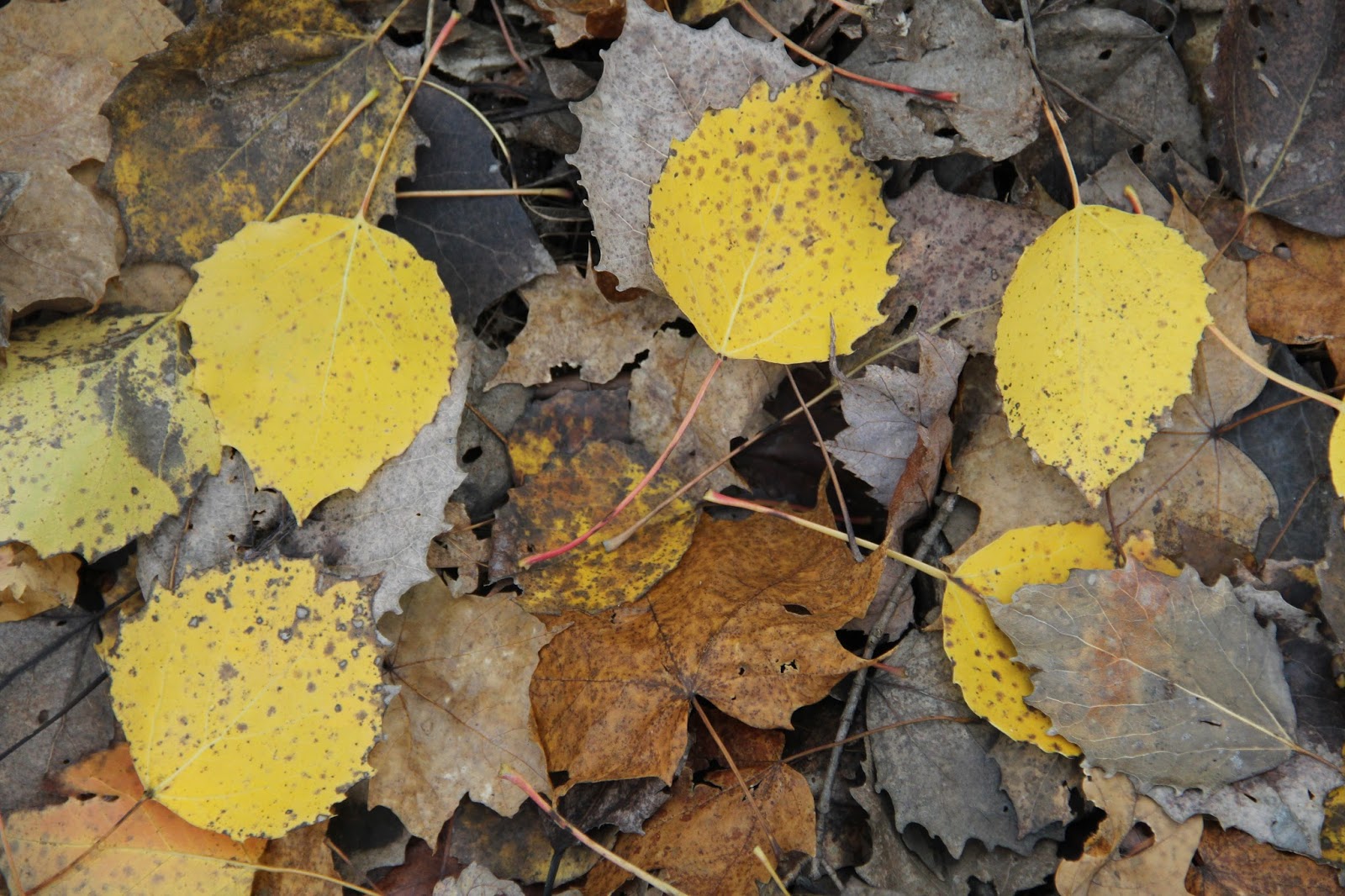
Bigtooth Aspen leaves turn golden yellow, but quickly fade to brown.

Looking up at Bigtooth Aspen leaves caught in an Eastern Hemlock.

A small fern grows deep in Audubon Woods.


Eastern hemlock forms several groves within Audubon Woods

Burls are irregular growths caused by damage to the tree.

Wild Grapes climb an Eastern Hemlock to the canopy.

This Sassafras seedling is near the northern limit of its range in Michigan.


Was it worth it?  I spent an entire day driving between preserves and hiking around.  I could have probably spent all day at any one of the preserves and still came away with the same number of photographs.  I did this mostly for the challenge - maybe other people have done something like this in the CWC preserves, but if they have I'm not aware of it.  I already have a more ambitious round of preserve visits mapped out in my mind, but that will have to wait until next summer when there is more available daylight.

Hopefully someone will see this and be inspired to challenge themselves to a similar photography project.