Showing posts with label igneous rock. Show all posts

Monday, October 15, 2018

Geology rocks!

Happy Earth Science Week 2018!

Earth Science Week is an annual week-long celebration of everything earth science.  This celebration is sponsored the American Geosciences Institute.

Of the four earth science disciplines (geology, meteorology, oceanography, and astronomy), geology is my favorite.  Geology is the study of the earth itself, the substances that make up the earth, the processes that shape the earth, and how those processes and substances have changed over time (and continue to change today). 

Everywhere we go we see geologic processes and materials, especially rocks in their various states.  It is easy to overlook them because they are so commonplace, but when you understand the processes that shape them and the history behind them rocks are much easier to appreciate. 

It all starts with knowing how rocks form.

Rocks are divided into three main types based on how they form: igneous, sedimentary, or metamorphic.


Igneous rocks form when molten magma or lava cool down and become solid.  Magma and lava are both the same thing – rock that is so hot it has melted.  The only difference between magma and lava is their location.  Magma is found below the surface of the earth.  Lava is found above the surface.

When magma and lava cool down, the molten minerals that are contained within crystallize.  We can tell where an igneous rock formed by looking at the size of the crystals.  Igneous rocks that form below the surface cool slowly and form large crystals.  These rocks are known as intrusive igneous rocks or plutonic rocks.  Igneous rocks that form above the surface cool down quickly and the crystals are smaller because they have less time to form.  These are known as extrusive igneous rocks.

Pegmatite (an intrusive igneous rock) has very large visible crystals.

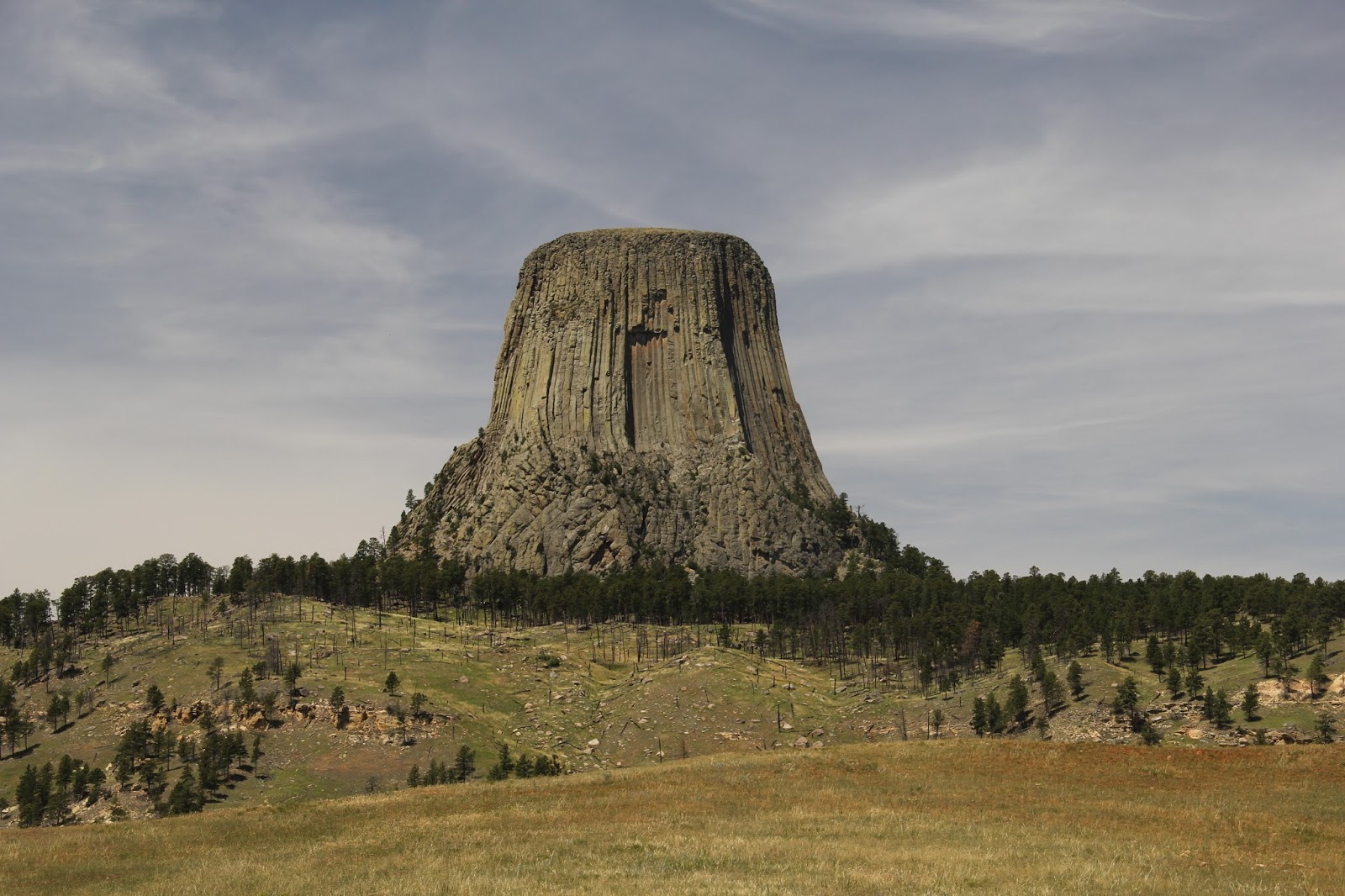
Devil's Tower is made of intrusive igneous rock - the softer rock surrounding it has eroded away over time.

Sedimentary rocks are formed from smaller particles of rocks and/or minerals that have been fused together by pressure and the crystallization of dissolved minerals.  Large rocks of all types break down over time.  Natural factors such as wind, water, and temperature change cause the surface of rocks to weaken.  This process is known as weathering.  If the surface of a rock breaks down enough, wind and water may remove this weathered material from the surface of the parent rock and deposit it in another location.  This process of removal and deposition is known as erosion.  The particles that are carried away and deposited are known as sediment.

Given enough time these sediments can build up in thick layers.  The weight of upper layers of sediment can cause particles in the lower layers to fuse together.  Sometimes dissolved minerals in the lower layers will crystallize as water is forced out by the pressure of the upper layers.  These minerals act like a cement or glue, further fusing the sediments together.  The layers of sediment can often be seen in sedimentary rocks.
 
Visible layers in sandstone show how this sediment was deposited over time.
 
The angled layers in this sandstone indicate that a current was present when the sediment was deposited.

Metamorphic rocks are rocks that have been changed by heat, pressure, or chemical processes.  The word metamorphic actually means “changed in form”.  The intense heat and pressures that are found deep within the earth can cause changes to preexisting rocks.  The minerals within a rock may partially melt and become glassy in appearance.  The crystals may rearrange themselves in reaction to external pressures.  This often results in bands or “foliations” forming within the metamorphic rock.  Metamorphic rocks can also form through a change in the chemical composition of the minerals within a preexisting rock.

Metamorphic rocks can form from any type of rock.  Igneous rocks, sedimentary rocks, and even metamorphic rocks can all change form.


Fracturing and folding in a metamorphic rock indicate that this rock faced pressure coming from the sides


Wednesday, July 12, 2017

Nature Geek Vacation Destination - Devil's Tower National Monument (Crook County, WY)

On Monday I wrote about how a visit to Badlands National Park left me completely awestruck.  There was one other location that we visited during our vacation that had the same effect on me - Devil's Tower National Monument.

Devil's Tower as seen from the road entering the Monument
Devils Tower a monolithic rock structure composed primarily of an igneous rock known as phonolite porphyry.  Like granite, phonolite forms when magma below the surface of the earth cools slowly allowing visible crystals to form.  Phonolite contains many of the same minerals as granite, but largely lacks quartz (a prime component of granite).  Instead, the bulk of phonolite is composed of potassium feldspars.  The phonolite at Devil's Tower is a type known as phonolite porphyry.  To say that a rock is porphyritic means that it has both small and large crystals.  At Devil's Tower, the phonolite porphyry cooled at a rate that caused it to contract and form vertical columns of hexagon rock up to 15 feet across.  These columns give the surface of Devil's Tower its unique look.

Devil's Tower - note columns of igneous rock and boulders littering its base

There are several theories of how Devil's Tower formed.  The simplest theory is that a column of magma pushed up from the earth's mantle through overlying layers of sedimentary rock.  This magma probably cooled and solidified before it broke the surface - there is no evidence to suggest it reached the surface.  Over time the layers of sedimentary rock eroded away, exposing the harder igneous rock that forms Devil's Tower.  The tower itself is slowly eroding away as evidenced by the broken boulders of phonolite porphyry scattered around its base. 

Devil's Tower rises 867 feet (265 meters) from its base to its summit.  Completely isolated from any other peaks, it rises above the surrounding prairie and pine forests.  Awesome (in the sense of causing or inspiring awe; inspiring an overwhelming feeling of reverence, admiration or fear) barely begins to describe Devil's Tower.  It is little wonder that all Native American Tribes from the region consider it a sacred place.  Many of the trees at the base of  the tower are tied with prayer bundles.

Devil's Tower - note the prayer bundles tied to the tree at the right of the image

Because of the site's sacred nature and its unique geology, in 1906 President Theodore Roosevelt used the newly passed Antiquities Act to declare Devil's Tower our nation's first national monument.  Administered by the National Park Service, Devil's Tower National Monument protects the tower and approximately 1374 acres (a little over two square miles) of surrounding prairie and Ponderosa Pine forest.

If you want to visit Devil's Tower, from Mid-Michigan it is approximately one thousand two hundred eighty mile (or nearly nineteen hours) of driving away.  Obviously, this is not a weekend trip, but when combined with other sites such as the Badlands and Black Hills this is a can't miss vacation destination for any nature geek!

If you do choose to travel to Devil's Tower, here's a little hint:  the best views of the tower are not the one's you get by visiting the base of the tower.  The base of the tower is crowded, with approximately 400,000 visitors each year.  Do yourself a favor and after leaving the visitor center parking lot, turn onto a gravel road that lead to the Joyner Ridge Trail.  This road lead to a gravel parking lot about one mile northwest of Devil's Tower.  When we arrived there, there were only two other cars in the lot.  Here is the view you are rewarded with...


Here are a few more Devil's Tower photos from the Joyner Ridge trailhead.  I like how the clouds in these images look like a puff of smoke coming out of the Tower.  Enjoy.


This final picture is probably my favorite on of Devil's Tower with the lone Ponderosa Pine, grasses, and the Tower off in the distance surrounded by more pines.