Showing posts with label deer. Show all posts

Friday, June 21, 2019

Vernal: A Spring Photo Project (Day 71 through Day 80)

Here come more photographs from my spring photography project.  To see the previous set of photos click this link.

Day 71 (29 May 2019) - Green Frog 


This image of a male green frog (Lithobates clamitans) was taken in Mt. Pleasant at Chipp-A-Waters Park.  Earlier in the spring I shared a photograph of an American toad taken in the same pond - both species breed in this pond, but at different times.  The fact that this is a male frog can be determined by the size of its tympanum (the circle behind its eye).  Female green frogs will have a tympanum the same size as their eye while the tympanum of a male frog is larger than the eye.  These frogs are often heard before they are seen as they announce their presence with a loud PLUNK! sounding like someone plucking a single out-of-tune guitar string.  This photograph has been cropped to a widescreen (16:9) format to eliminate some distracting elements at the top of the image.

Day 72 (30 May 2019) - Wild Geranium 


I selected this image of wild geranium (Geranium maculatum) because of color.  I like how the pink of the flowers contrasts with the varying shades of green from the geranium itself and surrounding plants.  This photograph was taken at the Chippewa Watershed Conservancy's Sylvan Solace Preserve.  Wild Geranium has long been one of my favorite wildflowers to photograph.

Day 73 (31 May 2019) - Mayapple 


This photograph was taken at Mill Pond Park in Mt. Pleasant.  Mayapple (Podophyllum peltatum) produces a single large while flower beneath as pair of large umbrella-like leaves.  From above its almost impossible to see the flowers, but from below...  This image was taken by holding the camera at ground level and using the moveable digital viewer to compose the image.

Day 74 (01 June 2019) - White-tailed Fawn 


June 1st was National Trails Day.  I was scheduled to lead hikes at four CWC preserves, but the weather was horrible almost the entire day.  We dodged thunderstorms and rain all morning with even heavier rain due early afternoon.   Everyone bailed on the hike scheduled for 1:00 except me and Shara.  Despite the rain we went for a short hike at Hall's Lake Natural Area.  I kept my camera tucked inside my raincoat for most of the hike, but I did bring it out when we spotted this white-tailed deer fawn.  Despite the rain, the hike was worth it for this picture.

Day 75 (02 June 2019) - Portrait of an Iris


In the last set of photographs I shared an image of a Siberian iris photographed in our home flower garden.  This iris image comes from our gardens too, but this is a bearded iris.  I deliberately shot this image to focus on the iris' beard.

Day 76 (03 June 2019) - Monarch Egg 


On June 3rd I decided to stop at Forest Hill Nature Area on the way home.  Large parts of the property were mowed down last fall and then (apparently) sprayed with herbicide this spring.  I can only assume the intent is to replant these areas with native seed sometime this year.  Right now walking through these areas is rather depressing.

However, I did notice that the herbicide did not kill all of the common milkweed (Asclepias syriaca).  On a whim I decided to search the milkweed plants for a monarch butterfly egg.  I found this one on the second plant I searched.  This image has been cropped down to about 30% of the original size and has been the brightness of the image has been adjusted.


Day 77 (04 June 2019) - Impressions of grass @ icd office


The photograph for Day 77 was taken at the Isabella Conservation District Office.  The wind was constantly creating waves in the grassy field behind the office.  I decided to work with the wind and create an Impressionist photograph of the scene.  The image above was shot at 1/6 second at f/32 to capture the blur of the grass as the wind moved it around.  This image reminds me a bit of some of the landscapes in Frederick Remington's later paintings that were heavily influenced by Impressionism.  Of this set of ten photographs, this is my favorite image.

Day 78 (05 June 2019) - Dead Man's Fingers


A trip to Mission Creek Woodland Park yielded this photograph of the appropriately-named Dead Man's Fingers fungus poking out of the ground.  I like this image more for the subject than I do for the composition.

Day 79 (06 June 2019) - Common Whitetail


I love photographing dragonflies... when they will sit still for more than a few seconds

This female common whitetail (Plathemis lydia) perched on a blade of grass a few inches off the ground at Chipp-A-Waters Park in Mt. Pleasant.  She sat still as I approached to within about 4 feet and stayed there long enough for me to snap several dozen photos from more than one angle.  This picture has been cropped from a horizontal to a vertical image.

Day 80 (07 June 2019) - Raindrops on Spiderwort leaf @ Saginaw Chippewa academy 


The final image of this set was taken at 7:30 in the morning at the Saginaw Chippewa Academy's native pollinator garden.  The garden has reached its early summer glory with hordes of coreopsis, penstemon, Canada anemone, and spiderwort bursting into bloom.  On this morning the star of the show as not the flowers but rather the thousands of water droplets left by an overnight rain shower.  My favorite image of the day was of this single large droplet poised on the end of a spiderwort leaf.  A couple of smaller drops sit further back along the leaf and droplets in the background refract circular globes of light.  If you look closely at the central water drop you can see an inverted image of the background plants and sky.

Wednesday, March 6, 2019

A long reach...


Deep snow can make winter survival difficult for white-tailed deer.  Getting around is difficult and requires more energy.  Most of the food sources are inaccessible, especially if the snow is combined with a layer of ice that prevents deer from digging down to the ground.


Because foods such as grasses, forbs, and nuts are often unavailable, deer survive mostly on a diet of browse (buds, leaves, branch tips) during the winter months.  Where deer populations are heavy, all the food that is easy to reach is already gone by this time of winter.  Sometimes the only food left available in area is high overhead.  It is not unusual to see where deer have browsed as high as eight feet off the ground by standing on their hind legs.

I retrieved my trail cameras this afternoon and was lucky enough that one of the cameras had recorded this behavior.  The deer in this series of images is reaching up to eat needles from an Eastern Hemlock (Tsuga canadensis).


Normally I just change out the memory cards in my trail cameras and leave the cameras in the woods, but I decided to remove the cameras completely for now.  Even though its in a public park, the area that I place the cameras is quite secluded when the ground is not frozen - it's in the middle of a swamp.  However, right now its easy to access because everything is frozen over.  I also left a trail of footprints directly to the camera sites.  I also recorded a person on one of the cameras.  This is not the first time I have ever seen a person on one of the cameras, but it was the first time I could tell that they knew the camera was there.  Fortunately, they only smiled at the camera and left it in place.

If this you - Thank you for being an honest person!


Thursday, January 17, 2019

Trail cam pics and a walk in the January woods.

In late December I placed my trail cameras in the woods for the first time in nearly a year.  Today I went to switch out the memory cards.  Although I managed to get pictures of red fox, raccoon, squirrels, and deer (including several bucks) I was disappointed by the results and ended up moving both cameras.

A fox runs in front of the camera

Part of a herd of deer, including two bucks, passing by the camera

After moving the cameras I used the opportunity to take a walk through the woods and take some photographs.  There was no snow on the ground, but lots of ice.  My favorite photos of the day were probably those showing leaves locked in ice.  Here are a few of the images that I captured.

Bright sunlight has been a rare sight in recent days

This picture was not planned - the plane flew over just as I was taking the picture.

Flowing water carved this channel down through the ice

Many shades of brown

Living and dead trees stand bare in the winter swamp


Oak leaves trapped in ice

Coyote scat on top of a pile of deer scat

Water levels have dropped several inches since this ice formed

Eastern Hemlock


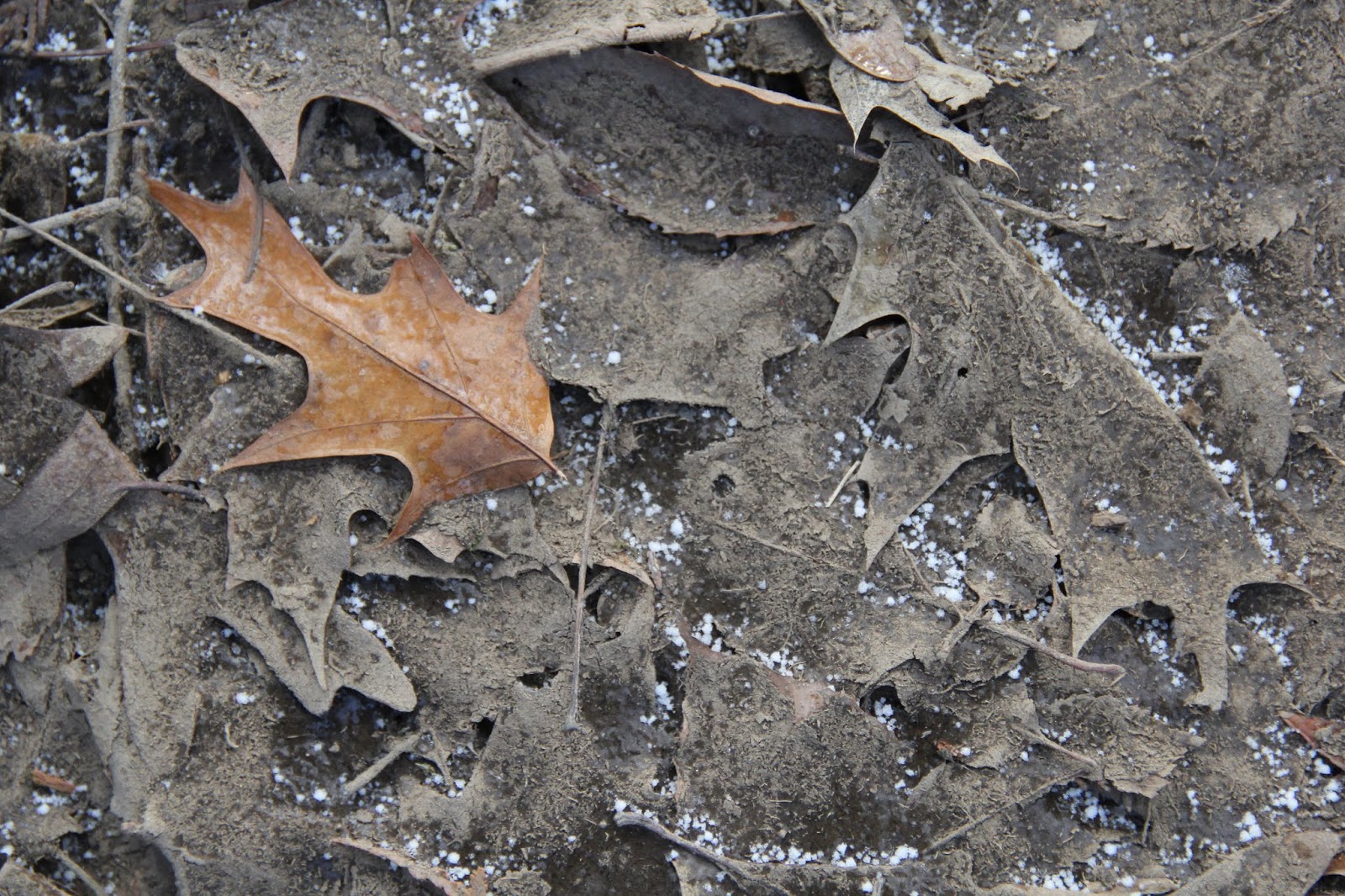
Silt covered leaves, topped by a single clean oak leaf

A boardwalk crosses an eroded area on the trail

Northern White Cedar

The bright trunks of aspen trees glow in the sunlight

Thursday, November 15, 2018

Deer Season 2018


Today is opening day of the 2018 Michigan firearms deer season.  I wish all hunters a safe and successful season!

One of my favorite pieces of writing is about deer hunting (and life).  The following passage is from the book Hunting from Home: A Year Afield in the Blue Ridge Mountains by Christopher Camuto (ISBN 978-0393049152).

One November the hunter will not be in the woods and neither the deer nor the woods nor the wind will know or mark the difference his absence makes.  If you hunt, and if you have taken your modest share of game--not as trophies but as food for your table--then you will understand the beauty in the thought of that unmarked difference in the woods.  Folks who are on their way to heaven or some other imagined paradise where the true cost of living does not have to be paid won't understand or accept this.  But I am not trying to get to heaven.  I am trying to get to earth.

Tuesday, September 11, 2018

Michigan Species to Know - White-Tailed Deer (Odocoilus virginianus)

Yesterday I did my first classroom programs of the school year.  I create most of the handouts and other materials that I use in my programs.  Right now I am working on a set of materials highlighting Michigan species.  I have over one hundred fifty animal species represented so far and am working on a similar number of plant species.  As the school year progresses I plan on sharing one or more of these every week.  Feel free to use these for any education purpose.


Thursday, August 23, 2018

The Days of Summer - Day Fifty-two through Day Fifty-eight

It's a little late, but here is installment eight of my Days of Summer photo project.  This project started on the Summer Solstice (21 June 2018) and will continue until the Fall Equinox (22 September 2018).  The intent of this project is to get outdoors every day and photograph something in nature.  I am picking one photograph from each day to share as part of this project.  To see the previous installments click here.

On to the photos!

Day 52 (11 August 2018) - My what big ears you have!


This image of a fawn was taken at Forest Hill Nature Area.  While photographing bees and butterflies among the wildflowers of Forest Hill's native grassland restoration I noticed a pair of fawn watching me.  Sometimes, if you move slowly and carefully, you can walk right up to a deer without scaring it away.  Over the course of several minutes i was able to walk to within about 20 yards of this fawn.  This picture was taken when it turned to watch a car pass on nearby Rich Road.  I picked this image because of the pattern created by the veins on the back of the fawn's ears.  They remind me of a butterflies wings.  Check the picture for Day 58 (below) if you don't believe me.

Day 53 (12 August 2018) - Perseid Meteor


On August 12, Shara and I went back to Forest Hill to watch the Perseid Meteor Shower (and hopefully to get a few photos).  We saw several spectacular fireballs crossing the sky, but unfortunately they were no in the direction that my camera was pointed at the time.  I did manage to get several lesser meteors on camera.  To see the meteor in this image click on the photo to enlarge it.  The meteor is just above the band of clouds near the left side of the image.

Day 54 (13 August 2018) - Lunch


This picture of a Black-and-Yellow Argiope spider (Argiope aurentia) was photographed in its web at Mill Pond Park in Mt. Pleasant.  I was actually photographing a different Argiope when I glanced to the right and spotted this lady less than a meter away.  This picture shows the underside of the spider as she perches on her web near a silk-wrapped insect that she will make a meal of later.  Again, this picture is best viewed by clicking on it.  If you look close you can see a line of silk emerging from her spinnerets.

Day 55 (14 August 2018) - A Different Kind of Grasshopper


This is my second grasshopper image that I have shared as part of this project.  I photographed a Carolina Locust at Chipp-A-Waters Park on Day 41.  This grasshopper was also photographed at Chipp-A-Waters park, but this grasshopper belongs to a different species.  This is a Differential Grasshopper (Melanoplus differentialis).  This grasshopper allowed me to creep very close and photograph it with my longest lens from just under a meter away (the minimum focusing distance for this lens).

Day 56 (15 August 2018) - Gotcha!


While working on this project, there have been days when I have had a difficult time selecting a picture to share.  Sometimes I don't like any of the pictures all that much; other times I have too many photos that I like.  On other occasions, I have known right away which photo was going to be the "winner" for the day.  This picture of a Jagged Ambush Bug with a European Honeybee was an easy choice.  I captured this image at Forest Hill Nature Area late in the day.  The sun was almost on the horizon and I was heading back to my truck to meet Shara when I glanced at this Lance-leaf Goldenrod as I was passing it by.

Day 57 (16 August 2018) - Rainy Day Boxelder


This picture was also taken at Forest Hill Nature Area.  It is easy to stop here on my way home from Mt. Pleasant.  August 16th was kind of a "blah" day for photography.  It was cloudy all day and threatened rain while I was at Forest Hill.  I probably would have been better off photographing something up close rather than landscapes, but I thought this image of a Boxelder (Acer negundo) against the gray sky best represented the day.

Day 58 (17 August 2018) -  Monarch on Rosinweed


The final image in this set was taken in our home native pollinator garden.  It seems to be a very good year for Monarch butterflies here in Mid-Michigan.  We have repeatedly had one visiting our plants.  In the past we have noticed maybe one or two Monarchs in our garden each year.  This year they are an almost daily visitor.  We do have some milkweed plants (the Monarch's only larval host plant), but right now the main attraction is nectar especially from Cup Plant and Rosinweed.  These two plant species are attracting dozens of bumble bees and hundreds of honey bees in addition to the butterfly visitors.

Friday, July 6, 2018

The Days of Summer - Day Ten through Day Sixteen

This is the second installment of my Days of Summer photo project.  To read about the project and see the first installment click here.

Day 10 (30 June 2018) - Wheatfield


Agriculture may not be the first thing that you think of when you hear the word Michigan, but it is one of the leading industries in the state.  This image of a ripening field of wheat was taken along the border of Isabella County and Gratiot County.  I spent the morning at Forest Hill Nature Area photographing wildflowers in a restored grassland.  Deciding to take a different route home, I passed by this field a couple of miles from Forest Hill.  I've been admiring wheat fields for the past several weeks, but never found one that I could easily photograph.  Stopping here was a no-brainer.

Day 11 (01 July 2018) - Ragged Fringed Orchid


This photo was taken at the Williamston Township Community Park in Ingham County, MI.  I stopped at this park to revisit an older grassland restoration that I have photographed several times over the years.  A pair of Ragged Fringed Orchids (Platanthera psycodes) was my reward.

Day 12 (02 July 2018) - Moss Sporophytes


Mosses are small; thus they are easily overlooked.  For those that take the time to notice them, they are well worth the effort.  One of the best books I have read in recent years is about moss.  These white balloon-like structures are reproductive bodies known as sporophytes.  When conditions are right, they will each release hundred or thousands of spores into the world.  We often associate mosses with shady woodland habitats, but these mosses were growing on bare sandy soil on land owned by Shepherd Public Schools.

Day 13 (03 July 2018) - Last of the Brood


This Days of Summer project means that I have to photograph something every day.  It means I have to get outdoors and away from my desk.  Fortunately Isabella County has lots of public land within a short drive of my office.  This picture of a Wild Turkey (Meleagris gallopavo) with a single poult (chick) was taken at Chipp-A-Waters Park in Mt. Pleasant.  Seeing a hen with only a single chick raises so many questions.  Was this the only egg that hatched?  Were the other eggs stolen by predators such as raccoons? Did predators get the rest of its nest mates?

Unlike most of my photographs, this image has been edited.  It has been cropped from the original size (about 50%) and the highlights have been toned down to bring some of the color back into the image.

Day 14 (04 July 2018) - Curious Fawn


The Fourth of July found me exploring the Maple River State Game Area.  This curious White-tailed Deer (Odocoileus virginianus) fawn wanted to check me out up close.  Unlike the previous picture, this one has not been cropped.  The fawn was that close and approaching closer.  It probably would have allowed me to touch it if I hadn't shooed it away into the woods.

Day 15 (05 July 2018) - Great Spangled Fritillaries


Yesterday I visited the Chippewa Watershed Conservancy's Sylvan Solace Preserve for about an hour in the middle of the day.  Mid-day may not be the best time for photography, but the heat of the day does bring out the pollinators.  I was luck to spot this pair of mating Great Spangled Fritillaries (Speyeria Cybele).

Day 16 (06 July (2018) - Chicory Flowers 


My final photo for the week is of a pair of Common Chicory (Cichorium intybus) flowers.  This photograph was taken at the Mt. Pleasant Discovery Museum early this morning.  Originally from Europe, Chicory is a common roadside plant in Mid-Michigan.  Even though this plant is not native to North America, it is well-behaved and likes roadsides and other waste places.    This is one of my favorite flowers to photograph.  The pale blue color is absolutely beautiful.  You have to get up early to photograph Chicory, by mid-day the flowers have closed up tight.

Thursday, July 5, 2018

Field Trip - Maple River State Game Area

Yesterday (04 July 2018) I took a short trip to the Maple River State Game Area (MRSGA).  I have lived in Mid-Michigan for the majority of my life, but I have never visited MRSGA before despite driving through part of it hundreds of times.  I grew up in the area and hunted and fished in several State Game/Wildlife Areas as a youth, but because MRSGA has been managed primarily for waterfowl and I have never been a duck or goose hunter so this area was mostly not on my radar.

With no other plans for the morning I decided it was finally time to explore the area a little.  My trip took me to a part of the game area known as the East Unit (Wetlands Wildlife Management Unit).  This Unit is located on both sides of US-127 between St. Johns and Ithaca.  The East Unit is further (confusingly) subdivided into smaller sections also known as units.  The highway itself separates Unit A on the west side of the road from Unit B on the east side of the road.  Several other Units stretch further east from Unit B including a Wildlife Refuge that is closed to the public from September 1st to December 1st. 


There is a parking lot located along US-127 at the northwest corner of Unit B.  This is where I began my visit.  Unit B like most of these other units is enclosed by a series of dikes that allow the water level to be raised or lowered on a seasonal basis.  I walked east along the dike on the north edge of the unit to the dike that separates Unit B from the Wildlife Refuge and followed that dike south.  I returned to my truck by the same route.

The berm along the north edge of Unit B

Along the east edge of the unit is a wood observation tower.  This tower is actually visible from the highway.  The tower was my goal of my hike.  For some reason I didn't take any photos of the tower, but I did take several of the view from the top.  There is also a handicap-accessible ground blind along the North boundary of Unit B.  The view right now consists entirely of tall cattails; I did not take any photos from there.

The view South from the observation tower - berms and a ditch can be seen on the left of the image

Southeast - a better view of the ditches and berms that mark the edges of the Units

West-northwest - the highway is the white line on the horizon

East - looking across the Wildlife Refuge

It didn't seem like it at the time, but I was able to see and photograph a surprising amount of wildlife.  This included butterflies such as Monarchs (Danaus plexippus) and Eastern Tailed Blue (Cupido comyntas).  I also saw several species of Skippers, a Fritillary, and a bunch of small brown butterflies with eyespots on their wings including Wood Nymphs (Cercyonis pegala).

Monarch

Eastern Tailed Blue

I also saw lots of birds.  A partial list includes Red-winged Blackbird (Agelaius phoeniceus) , Song Sparrow (Melospiza melodia), American Goldfinch (Spinus tristis), Mallard (Anas platyrhynchos), Wood Duck (Aix sponsa), Great Blue Heron (Ardia Herodias) , Green Heron (Butorides virescens), Double-crested Cormorant (Phalacrocorax auritus), Barn Swallow (Hirundo rustica), Cedar Waxwing (Bombycilla cedrorum), Bald Eagle (Haliaeetus leucocephalus), and Osprey (Pandion haliaetus).


Red-winged Blackbirds in a drowned tree
 
Red-winged Blackbird on cattail
 
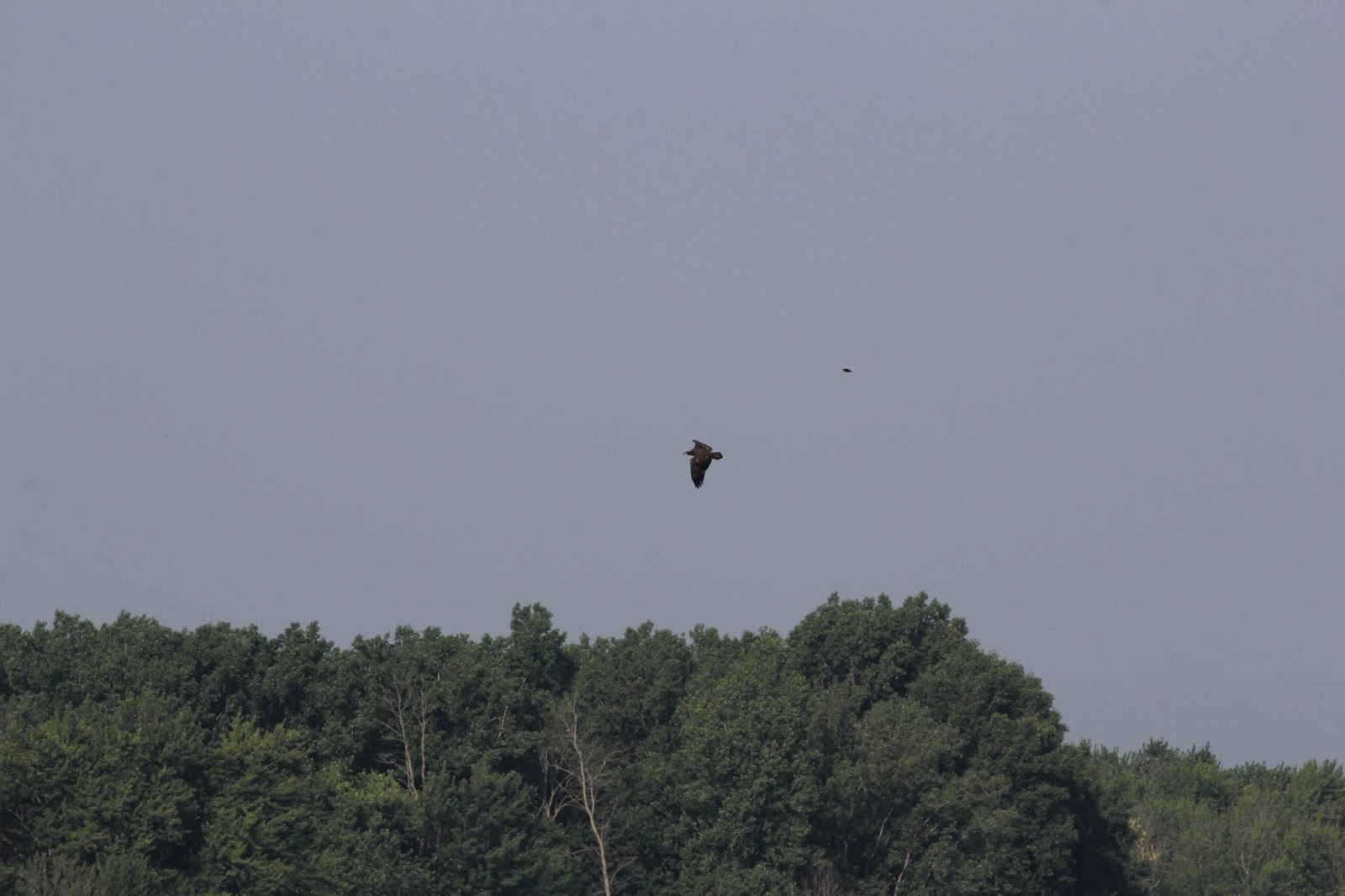
Juvenile Bald Eagle being chased by Red-winged Blackbird

Cedar Waxwing

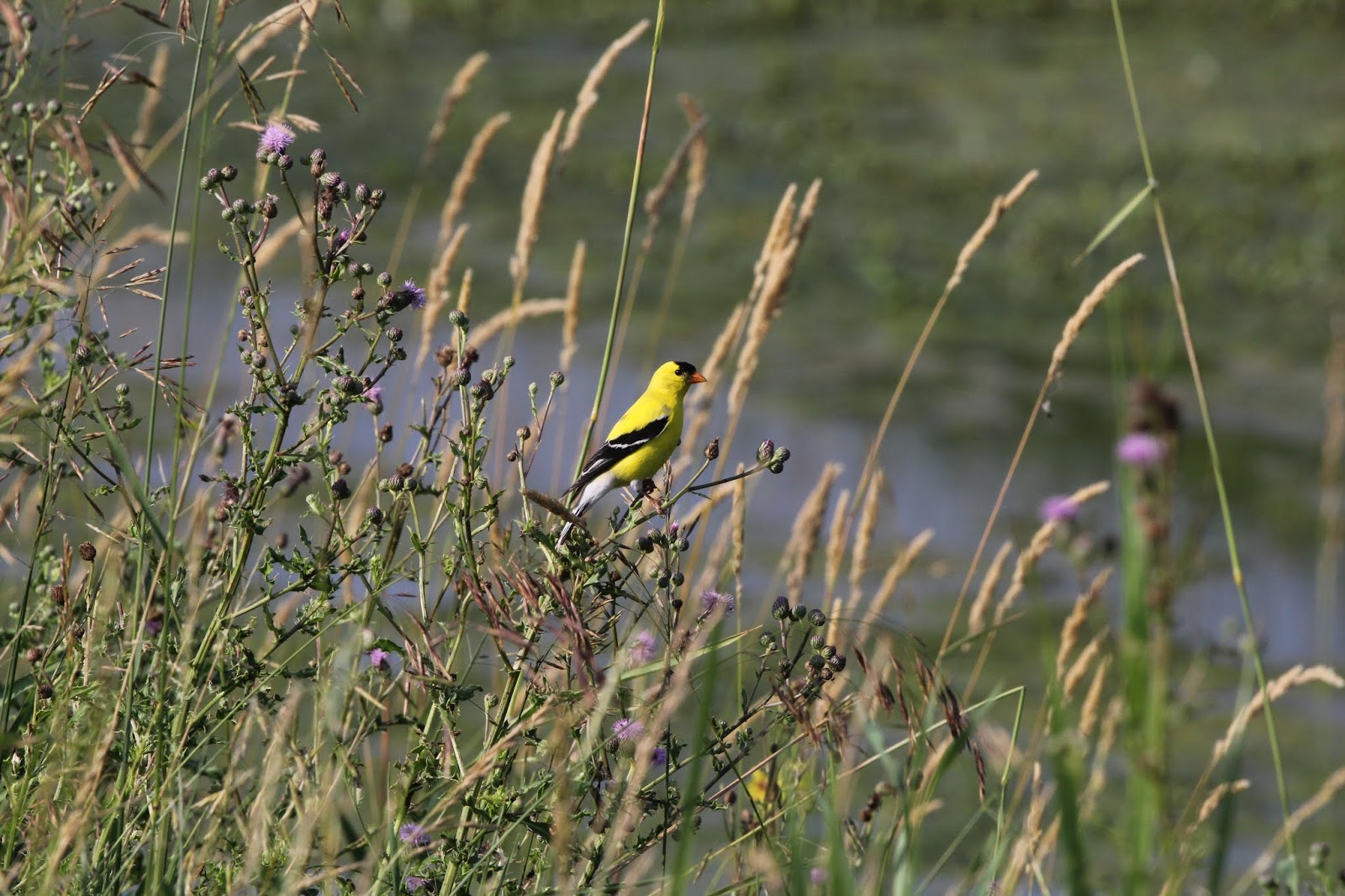
American Goldfinch

Green Heron

A young Wood Duck runs across the water to hide in some cattails
In one of the ditches I noticed a schools of smallish (6-8 inch) Large-mouthed Bass and Bluegill sunfish.


I also saw several White-tailed Deer (Odocoileus virginianus) including this buck. 


I also had a fawn run up to me and approach within ten feet.  I'm not sure why it came up to me, except maybe curiosity.  It saw me well before it approached.  I shooed it away when it got too close, but I was able to get several good photos before it ran into the woods.


I plan to go back to Maple River State Game Area, but probably not until next spring.  I want to see if I can photograph some of the thousands of migratory waterfowl that pass through every year.