Showing posts with label sawmill. Show all posts

Thursday, February 23, 2017

Logging Images

During the winter, in addition to the science programs that I present at schools, I also spend a couple of months presenting two different programs on Michigan history.  One of these programs focuses on Michigan's logging history.

Logging was one of the first major industries in Michigan and products from Michigan's forests were used to build much of the nation's cities during the period after the American Civil War. For nearly half a century Michigan could lay claim to the title of the logging capital of the world.  While other a few other states may dispute this claim, it is hard to argue with a place where one river system alone produced over 22 Billion board feet of lumber during its run!

Recently I purchased a new lot of logging postcards.  Most of these are from Michigan, but unfortunately some of the photo locations are not documented on the images.


These postcards show vignettes of logging life. Most images are posed, with little action portrayed in the photograph.  One of my favorite images shows a crew of four with a team of horses (used to skid or drag the logs through the woods).  Two of the men lean on cant hooks used for rolling logs.  A third man leans on a double-bit axe.  I especially like the fact that two of the men in the picture have cut off the bottom of their overalls so they don't get soaked with snow.

A crew of men ready and equipped to move logs through the snowy woods. (Unknown location)
This next picture is a later image - it dates to probably the 1950s.  What I like about this picture is that it shows how teams of oxen (or horses) would be used to skid the logs.  A close look at the picture reveals the skidding tongs clamped onto each log.  The two sharp points of the tongs would bite into the log so it could be pulled through the snow.  Oxen were sometimes used in the camps because of their brute strength, but horse were both faster and required less feed so most camps preferred to use horses.

Oxen skidding logs (Newaygo County, MI)

I think this next picture is another later image.  The cleared land and fences give the impression that this photo was not taken during the early days of logging in Michigan.  I like that this image shows how multiple teams of horses would be connected in tandem to pull a load uphill.  When going downhill, a chain was often connected to the back of the sleigh and wrapped around a tree at the top of the hill where a team of horses would be used to help slow the sleigh down.

Three teams pulling a sleigh uphill (Oceana County, MI)

I have several pictures in my collection showing crews loading logging sleighs.  The men who stacked the logs on the sleighs were known as top loaders.  This was one of the most difficult and dangerous jobs in a lumber camp.  A good top loader would receive higher pay than many other members of a crew.


One common feature of many logging postcards is lumber camps showing off by loading the biggest sleigh-load of logs imaginable.  Sleighs loaded were not loaded like this on a daily basis.  Loads of this size are highly impractical.  They take too long to load and are really too large of a burden for the horses.
Loads like this were used to show off - they were not practical. (Wexford County, MI)

Despite the label on the postcard, this is not a "typical lumber scene".  While many lumbering images show full logs that would eventually be cut into boards, another side of logging was the cutting of railroad ties and fence posts.  Men who cut posts and ties were often paid by the piece rather than being paid by the day as they were in camps that cut large logs.

A forgotten part of logging was the cutting of ties and posts (Alpena County, MI)

I think this is another later image (sometime in the 20th Century).  It would have been highly unusual to use a sleigh to haul a single log.

Hauling a single log on a sleigh (Location unknown)

The next photograph shows a crew of "river hogs".  Also known as "river pigs", these men would float down the river during the spring log drives.  Corked boots (boots with spikes on the soles) allowed the to keep their footing as they walked on the floating logs.  They used pike poles (the long-handled tools) and peaveys (the short-handled tools) to keep the logs moving downstream.

River hogs use pike poles and peaveys to control the movement of logs on a river drive (Antrim County, MI)

By the 1880s, railroads became an important part of logging operations.  Trains allowed lumber crews to work far away from rivers.  The first image shows a train loaded with logs.  At the back of the train is a steam jammer.  This steam-powered winch and boom, pivoted on a central axis and allowed crews to lift logs to load them on the train cars.

Logging trains allowed companies to efficiently log far from rivers (Location unknown)

In this image, train cars are being loaded by the simpler method of cross-hauling.  In this process chain attached to a team of horses (or a powered winch) is used to drag logs up a ramp onto the train where they would be chained in place.  If you click on the image, both the chain and team of horses can be seen in the photo.

Crosshauling logs onto a Grand Trunk rail car at the Coopersville Depot (Ottawa County, MI)

After World War One, gasoline powered equipment such as this Holt tractor became available for logging.  These strong engines could pull long trains consisting of ten or more loaded sleighs across the snow.  In this picture, a second tractor with an additional train of sleighs can be seen at the left rear.

Gasoline tractors greatly reduced the need for horses in logging (Location unknown)

The piles of logs waiting for sawing at mills are a common feature of many logging photographs.  Logs would be stockpiled at the mills after the spring river drives and remain there until thy could be cut up into boards and other products such as shingles, barrel staves, etc..

Logs at a mill in Alpena. The ship in the middle ground is probably a lumber schooner. (Alpena County, MI)


The amount of logs could be truly staggering (Charlevoix County, MI)

The development of small steam-powered circular saws allowed portable mills to be set up almost anywhere.  Boards sawn at these mills would often used locally instead of being shipped for use out of state.

Portable mills often sawed lumber for local use (Location unknown)

Information on the back of the next image identifies it as Phipps Mill.  It was sent from Henderson, MI and I assume the image was taken near there.  I like that you can see the steam engine to the left of the photo and the belt drives that would power the mill.  I love seeing how the men are dressed in those old photos - I only wish they were in color.

Portable mill - note the steam engine and belt drives (Shiawassee County, MI)

The next picture shows a group of men outside a mill - a circular saw can be seen in the building at the rear.  I am going to presume that they are sawing wood  to lengths that would later be split into shingles.  The wood could also be used to feed the boiler that would provide steam power to the mill.  I like this image because it shows a clear picture of a two-man bucking saw.  Bucking saws are used to cut logs into lengths.  A man to the left rear holds a single-bit axe over his shoulder, and the man to the far right holds the handle of a cant hook (or peavey) for rolling logs.

A crew processing logs into short lengths probably for shingles (Location unknown)

The final picture shows an area of land after logging.  The stumps, snags, and slash on the ground would do little to hold the sandy soil in place.  Later, during the Great Depression, much of this area would be replanted by members of the Civilian Conservation Corps.

Large areas of the Great Lakes State were completely deforested during the latter half of the 19th Century          (Roscommon County, MI)

For more logging images check out these four posts.

Logging Photos - Getting Logs out of the Woods

More Logging Photographs

Michigan Logging Photos

Days Gone By - Logging Photos


Monday, June 29, 2015

Michigan Forest Association Teacher Workshop - Wrapping It Up

I spent all of last week at the Ralph A. McMullen Conference Center attending a forestry education workshop.  This workshop was hosted by the Michigan Forest Association and was designed to give teachers insight into past and current forestry practices.  Photographs from Day One, Day Two, and Day Three were posted last week while I was at the conference.

Day Four began with a review and discussion of the previous days' activities and how this information can be incorporated into the classroom.  After this discussion, our next stop was a tour of the Weyerhaeuser mill near Grayling, MI.  This facility is one of six mills owned by Weyerhaeuser in North America that produces oriented strand board (OSB).  Oriented strand board is commonly used in the construction industry as sheathing for walls and for flooring and roof decking.  It is made by bonding in flakes of wood (many species are used) with a blend of waxes and resins inside a very large hydraulic press.  The press at the Grayling mill is capable of handling sixteen super-sized (16ft x 24 ft) panels of OSB at once.  After emerging from the press the panels are cut into their standard 4ft by 8ft size.  Unfortunately, I do not have any photographs of this process.  Weyerhaeuser does not allow photography inside their mill to protect trade secrets.

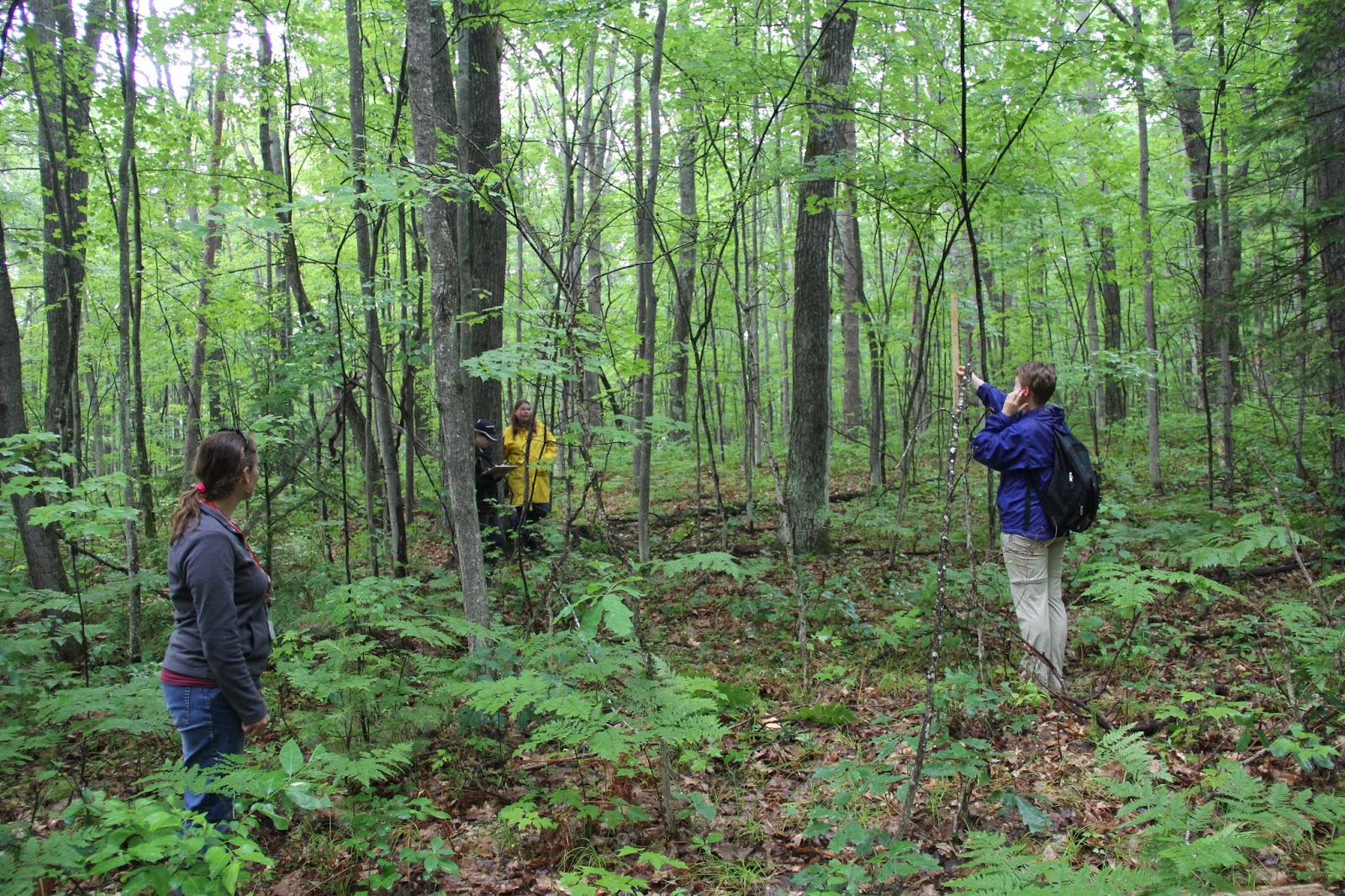
After leaving the Weyerhaeuser plant, the remainder of Thursday was spent preparing for and doing a timber cruising exercise.  During this exercise groups of teachers counted the number of 2 inch or larger trees in 1/10th acre plots.  Each group of teachers did this exercise on two plots.  Because there were five groups, by adding these plots together we were able to get an estimate of the number of trees per acre in the woods.  Data from each group was compiled on a tally sheet before being compiled back in the classroom.


Fixed-radius plot tally sheet - used to record data during our timber cruising exercise

In addition to counting the trees, we had to separate them into size classes and estimate their height.  To do these two tasks each group was given a tool known as a Biltmore stick.  When held at arm's length against the tree, marks on the Biltmore stick give a rough estimate of the diameter of the tree.


Using a Biltmore stick to estimate diameter

The other use of a Biltmore stick is to estimate the number of logs that can be cut from a tree.  To use the stick in this manner you first have to pace a specified distance from the tree (ours were calibrated for 25 feet) and then hold the stick vertically, lining up the bottom end of the stick with the base of the tree.

Estimating height with a Biltmore stick

To make this experience even better the instructors arranged for a rainstorm to soak the woods before and during the exercise.  (The instructors didn't really make the rain happen, but it definitely added to the experience - it took two days for my boots to dry afterwards).

The workshop concluded on Friday with a panel discussion about the current and future state of the forest products industry in Michigan.  I did not take any photos of this panel discussion.

Overall, I would rate this as one of the best workshops/conferences that I have ever attended.  The activities were well thought out and gave a pretty complete (if condensed) picture of the forestry industry from its roots (no pun intended) to its present and future.  I will highly recommend this workshop in the future. 


Wednesday, June 24, 2015

Michigan Forest Association Teacher Workshop - Day Three

Today was day three of the teacher workshop being hosted by the Michigan Forest Association.

While Day One and Day Two focused on the historical side of logging and forest management, today's focus was on current manage procedures and logging operations.

Our first stop of the day was a hardwood sawmill operated by AJD Forest Products in Grayling, MI.   AJD primarily produces hardwood boards that are used in the flooring industry, cabinetry, and furniture industry.  Lesser grades of lumber are used in the packing industry for crates and pallets.  Their waste products are used as mulch, processed into pellets for pellet-burning stoves, and used as fuel for power generation. 

The visit started in the parking lot where we were greeted not only by AJD employees, but also by a massive pile of decked logs. 

Log deck in the yard at AJG - Grayling, MI


These logs were being sorted and carried with a clamshell-equipped forklift to a debarker - a clamshell is kind of like a giant version of a claw machine at the fair.

A forklift sorts and moves logs in the yard at AJD

This machinery peals or debarks logs before they enter the mill

After running through the debarker, a series of conveyer belts carries the logs to one of several band saws - a band saw is a continuous saw blade that runs around two pulleys.  Before entering the band saw a computer scans each log to optimize the amount of lumber that can be cut from each log.  The band saw itself is not new technology; it was used in sawmills during the 1800s.  However, in older sawmills the location of the saw was fixed and the logs passed through the saw.  In new mills, the log is often held into place and the saw travels along the length of the log.  The AJD mill cuts boards into thicknesses of 4/4, 5/4, and 6/4 inches.

A large band saw cuts slabs of lumber from a pealed log

Band saw blades in AJD's sharpening shop - the back blade is being calibrated by a computer

After being cut into slabs by the band saw, the lumber then passes through an edger that cuts it to standard widths.  Although much of the process is mechanized, human hands touch the boards throughout nearly every step of the process.

Running boards through an edger to determine their final width

It was interesting to see that although the technology is different, the process would not be entirely unfamiliar to millworkers from a century ago.  In fact some of the equipment remains exactly the same.

A millworker from the late 1800s wielding a cant hook

A cant hook, pickaroon, and single-bit axe on the production floor at the AJD mill.

After the boards are edged, they are then graded and sawed into standard lengths before being sorted and bundled for their final destinations.  Over the course of today, AJD would process approximately 70,000 board-feet of lumber.

Grading boards by hand before they go through a computer controlled grader

This conveyer drops computer-sorted boards into the correct slot for their length and grade

Boards undergoing a final sorting and bundling

Piles of select grade red oak lumber awaiting sale at AJD