Showing posts with label swamps. Show all posts

Wednesday, March 20, 2019

Spring is...

Spring is the season of my favorite wildflower.


Skunk Cabbage (Symplocarpus foetidus) is the first wildflower of the year in Mid-Michigan.  This species is so insistent on blooming that it has the ability to melt through snow and ice!  I often find this species blooming in seeps and swamps as early as the first week of March, but regardless of when I find it I know that spring will soon be here. 

My first sighting of Skunk Cabbage for 2019 coincided with the Vernal Equinox - so for this year at least Skunk Cabbage truly was a sign of spring!

Saturday, October 28, 2017

Late October afternoon (27 October 2017)

Yesterday, late in the day, I headed out to retrieve the memory cards from my trail cameras.  I had planned to leave them out until after November 1st, but given the opportunity I decided to retrieve them a few days early. 

This also gave me the opportunity to get a few pictures of the fall leaves.  Mid-Michigan is well past prime color.  Most of the trees have already changed color and dropped their leaves, but there are still opportunities to be found.

It was rather a dreary day, with overcast skies and flat light; not the best conditions for photography.  Add in the fact that by the time I got into the woods the sun was already getting low in the West.  Lower light levels meant longer exposure times.  I wasn't using a tripod so there was the good change that many of my pictures would end up being blurry.  Despite these challenges I was happy with my results.

Looking down into the swamp.

A black-phase grey squirrel.  These are becoming more and more common.

Sugar Maple leaves in the swamp.

A deer trail cuts through this edge of the swamp.

Ferns change color in the fall too.

A pop of red sticks out amid the many shades of brown.

Maidenhair ferns can be found along edges of the swamp

The park is surrounded on three side by private land.

Sugar maple leaves floating in a puddle.

Some maples are still hanging on to their leaves.

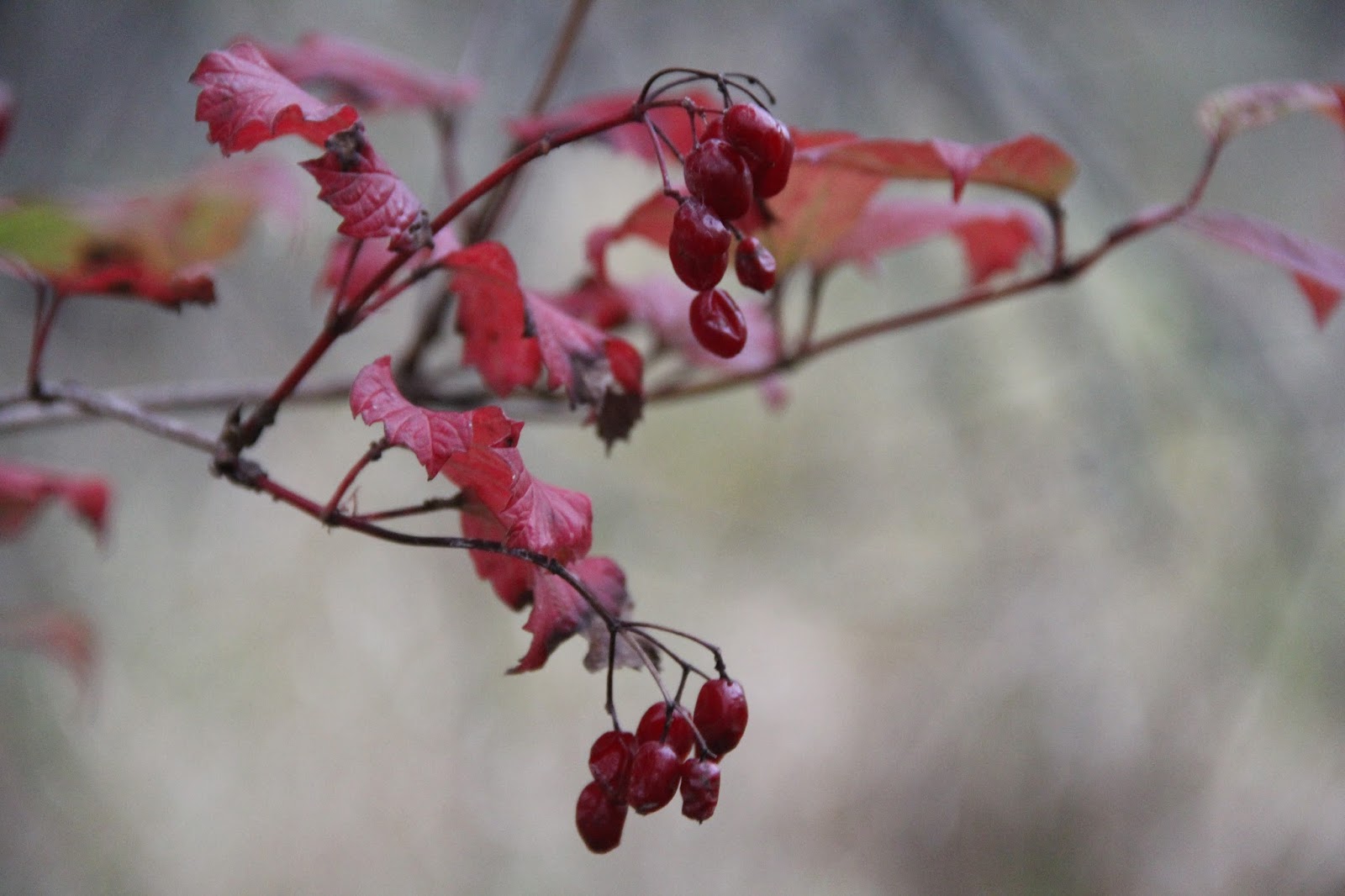
High-bush Cranberry adds its two shades of red to the swamp.

These berries will probably persist into the winter - birds eat them but only when other foods are gone.

Lichen adds its own shades of color to the swamp

Sugar Maples flank an Eastern Hemlock

Paper Birch bark and Sugar Maple leaves

The canopy around this large Sugar Maple is definitely thinned out.

Most leaves are now on the forest floor.

Tuesday, July 11, 2017

Trail camera photos - 2017 Isabella County floods edition

This morning I went to retrieve the memory cards from my two trail cameras. These cameras have not been touched since 14 June.  I was anxious to see if they recorded any images of the flooding that happened around 22- 25 June.  Both cameras are located in high areas of a swamp/floodplain forest and I knew that there was the potential that they would be in flooded areas.  Because we left for vacation right after the flooding happened this was my first chance to see these pictures.

This first picture is from before the flooding.  This area sits about 2 or 3 feet above the surrounding swamp.  Usually by the end of June large areas of the swamp are dry.


At approximately 5:00AM on 23 June, after a night of heavy rain, there is some puddling visible in this area.


By 5:45AM the water level had risen drastically and there is almost no dry land in sight, with the exception of the immediate foreground.


By 11:15AM even the foreground is covered with a shallow layer of flood waters.


By 12:00 noon, the water had risen several more inches.  This wet fawn does not seem to be enjoying the overabundance of water.


The water continued to rise until at least 4:38PM.


By 5:00AM on the 24 June the waters had receded a foot or more.  The only water remaining was trapped in low spots.  This family of Norther Raccoons (Procyon lotor) was taking advantage of the increased foraging opportunities brought about by the flooding.


This water continued to drain away over the next twenty-four hours.


By 7:30PM on 25 June, this area was essentially back to normal.  The surrounding low areas still retain more water than is typical for this time of year.


Thursday, June 22, 2017

So many shades of green (14 June 2017)

Last week I shared a photograph of a Cinnamon Fern that I took on a walk at Mission Creek Woodland Park.  Here are some more images from the same walk.  Everything is so impossibly green!  Walking through an area like this you can almost feel the oxygen being pumped out of the plants.


I call this activity a walk, but it is really more of a slog (defined as a long, tiring walk or march as per dictionary.com).  A person does not tiptoe lightly through a swamp, but slogs through the mucky bottom that threatens to suck the boots off your feet.  If you are lucky you can step from sedge tussock to sedge tussock of log to log, but at some point you are forced into the muck.  The giant Skunk Cabbage (Symplocarpus foetidus) leaves in the photo below indicate a location with out firm footing.  Notice the Sensitive Fern (Onoclea sesibilis) at the bottom left of the photograph?  Surrounded by Skunk Cabbage leaves, this is just the sort of image I was looking for when I entered the swamp.


First is a horizontal image.  I like this image with the degree of contrast between the fern and Skunk Cabbage leaves and the differing areas of light and shadow.  I also like the smaller fern leaf poking through the leaves to the right of the picture.


Now here is the same central leaf zoomed in closer and in a vertical composition.  This image is all about the fern leaf; it is basically a portrait of the fern with the Skunk Cabbage leaves acting as a backdrop.  I like both images.  Which one do you think works better?  If you have an opinion, let me know in the comment section.


In another portrait of a Sensitive Fern, a small fern frond peeks between the lobes of a larger leaf.


In one section of the Mission Creek swamp, Cinnamon Ferns are by far the most prominent and charismatic plant that you can see this time of year. 


I was especially drawn to the red fertile fronds.  They really stick out against the green background of the fern's fronds. 


Although, these pictures are not as "artistic" as the fern photo that I shared last week, I still really like their overall appearance, especially on this final image.  The bright green and red compliment each other well and there is enough texture to keep me interested in the photo's various elements.


Friday, April 28, 2017

More spring wildflowers (Mission Creek Woodland Park - 25 APR 2017)

The spring wildflower season is definitely upon us.  Earlier this week, I spent some time photographing the plants at Mission Creek Woodland Park.  Mission Creek is probably my favorite local photography destination.


The park is located on the north side of Mt. Pleasant at 1458 N. Harris Street (Crawford Rd.).  The park measures 60 acres in size, with the majority of the park being wooded and undeveloped.  The north and east edges of the park are mostly swamp.  This is where I like to spend my time.

Skunk Cabbage (Symplocarpus foetidus) is one of my favorite subjects to photograph.  Its flowers are mostly done for the year and beginning to develop seeds.


The large leaves of the skunk cabbage give the plant its name.  They do indeed look like cabbage leaves and they smell like a skunk when crushed or broken.  The leaves are just now emerging from the muck of the swamp, but will reach eventually grow to be as much as 1foot wide and 2 feet long.  Sections of this swamp will be completely covered with the leaves.


I love how the immense size of the skunk cabbage leaves contrast with just about any other plant such as these sedges.


Right now the swamp is also full of Marsh Marigold (Caltha palustris).  Their yellow flowers certainly brighten up the overall green color scheme of the swamp.


I never got close, but I saw a Red Admiral (Vanessa atalanta) butterfly feeding on Marsh Marigold nectar.  It looks like its going to be a big year for Red Admirals - they are everywhere.


One edge of the swamp was covered with the small white flowers of Spring Cress (Cardamine bulbosa).


Spring Cress requires a little bit drier soil than either Skunk Cabbage or Marsh Marigold.  Many of the Spring Cress plants were growing on clumps of sedge.  It is amazing how a change of a few inches can influence the types of plants that can be found.


In drier areas of the park I found dozens of Yellow Trout Lilies (Erythronium americanum).  This seems to be a good year for finding trout lilies - a friend sent me a photograph showing at least twenty flowers in an area of probably less than 3 feet by 3 feet.  Unlike many other spring wildflowers, trout lilies do not bloom every year.  Producing a flower takes lots of energy and it takes each plant as much as 7-10 years to store up enough (in the form of sugar) to be able to create a flower.


I found a few Bloodroot (Sanguinaria canadensis) flowers in bloom.  These plants typically only flower for a day or two.  Once pollinated they begin to lose their petals within hours.  My Bloodroot plants at home have been done flowering for a week. 


Bloodroot is one of many spring wildflowers that are spread by ants.  Each Bloodroot seed has a fleshy coating known as an eliaosome;  ants like to eat this coating.  They harvest the seeds and carry them back to their tunnels where they eat the eliaosome before depositing the seeds in their garbage piles.


I also found many hundreds (probably thousands) of Spring Beauty (Claytonia virginica) flowers in bloom in the drier areas of the park.