Showing posts with label vines. Show all posts

Tuesday, September 19, 2017

30-Minute Nature Fix (Mill Pond Park - 18 SEP 2017)

Going outside is good for you.  Studies show that even as little as 30 minutes of outdoor activity a week has been proven to have health benefits such as reducing stress and lowering the risk of heart disease.  During the school year, I spend my days teaching kids about science and nature.  Unfortunately, out of necessity, most of this teaching takes place in the classroom.  My job teaching about nature means that I have less time to enjoy nature.  (This is what is known as a paradox: a statement or proposition that seems self-contradictory or absurd but in reality expresses a possible truth.)

I try to find time every day to get out and enjoy nature.  Sometimes this means spending time in the garden watching the bees feeding on nectar.  Yesterday I was able to stop at Mill Pond Park after giving a presentation to the local garden club.  I only had 30 minutes.  How much can you see in 30 minutes?

Quite a bit, if you are inclined to look!


Mill Pond Park - my path is highlighted in red


Painted Turtles taking advantage of the late summer sun to bask.

Reeds growing in the remnants of the old mill pond.

Swamp Milkweed seeds are ripe and ready to fly away.

So are the seeds of cattails!

White Water Lily leaves are changing color as they use up their chlorophyll.

Wood Nettle - llok close and you can see the needle-like hairs that give the plant its sting.

The fluffy seedheads of Virgin's Bower cause the plant to also be known as also known as Old Man's Beard.

This Virgin's Bower is not quite as far along as the previous photo.

A few Spotted Joe-pye Weed flowers are still in bloom.

Most Goldenrod species are in full bloom, attracting pollinators like this wasp.

Purple Loosestrife is an invasive species, but pollinators love it.
 
Sun shining through White Oak leaves.

This patch of Common Goldenrod was attracting the attention of dozens of wasps and Locust Borer beetles.

That's it.  My walk through the park is over.  Not bad for 30 minutes!

Thursday, August 31, 2017

Never look a gift caterpillar in the mouth

A large caterpillar clasp a Virginia Creeper vine with its fleshy prolegs.

Yesterday while traipsing through the swamp at Mission Creek Park, I happened to look down at just the right time.  Right on the ground, I saw this large reddish brown caterpillar clinging to a Virginia Creeper (Parthenocissus quinquefolia) vine. 

This large caterpillar was about 3 inches long and 3/4 inch across

I immediately recognized it as a sphinx moth caterpillar, did not know which one.  Finding it on a Virginia Creeper helped to identify it;  freshly chewed leaves indicated that Virginia Creeper was probably its host species.  Knowing a host plant made it relatively easy to look up.

Pandorus Sphinx caterpillar - a face only a mother (or insect-lover) could love!

It's a Pandorus Sphinx Moth caterpillar (Eumorpha pandorus).  As a larvae, this species feeds on Virginia Creeper and grapes (Vitis spp.).  This species is found across the eastern half of the United States.  Mid-Michigan is on the northern edge of its range.  It is found as far south as the Gulf Coast and west to a line running from eastern Nebraska to eastern Texas.  It's range roughly coincides with the range of Virginia Creeper.  Pandorus comes from Greek and means "all-giving" or "all-gifted"; the female form of the word is Pandora.  In Greek mythology, Pandora is the first woman.  In the myth, she opens a jar containing all forms of evil releasing them into the world.


Pandorus Sphinx caterpillar (head and thorax to upper left) - note white markings on abdomen

The most distinguishing feature of this caterpillar is the row of white spots on each side of its abdomen.  Five of these oval-shaped spots surround spiracles on the caterpillar's abdomen.  Spiracles are pores or apertures through which an insect breathes.  Insects lack lungs.  Instead, oxygenated air enters the insects bodies through the spiracles and passes through a system of tubes known as trachea before entering directly into the insect's body tissues.  Gases that are produced in the insect's body pass from the body tissues into the trachea and leave the body through the trachea.   Some insects have no control over the flow of gases while others are able to expand and contract abdominal muscles to draw in in or expel air (much like the way we use our lungs).

Wednesday, September 9, 2015

Fresh Fruits of Island Park - Edible, Inedible, and Toxic

Between the light rain yesterday morning and the heavy rain yesterday afternoon I was able to take a short stroll along the Chippewa River at Island Park in Mt. Pleasant.  I went there with the intent of taking photographs of several different species of grasses and sedges for a presentation.  Along the way I started noticing the great variety of berries and fruits along the riverbank and decided to photograph those too.

All of these fruits are eaten by wildlife.  This does not mean that they can or should be eaten by people.  Three of the species shown are edible.  The other four are either inedible or even toxic.

This first photograph shows the possible dangers of foraging for wild fruits.  In the center of the photo is an elongated cluster of Riverbank Grapes (Vitis riparia), but along the left side of the photograph is a rounded cluster of Virginia Creeper (Parthenocissus quinquefolia) berries which are toxic to humans.

Riverbank Grape (Vitis riparia) - Edible

The second photograph shows just Virginia Creeper berries and leaves.

Virginia Creeper (Parthenocissus quinquefolia) berries - TOXIC

The third photograph shows the fruits from a Common Buckthorn (Rhamnus cathartica).  The fruits from this species are toxic to humans and other mammals, but birds regularly eat them.
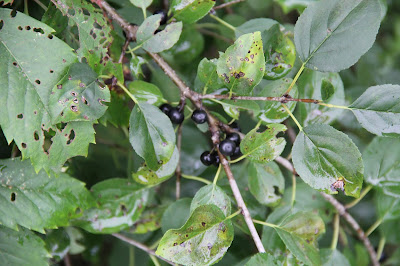
Common Buckthorn (Rhamnus cathartica) fruit - TOXIC

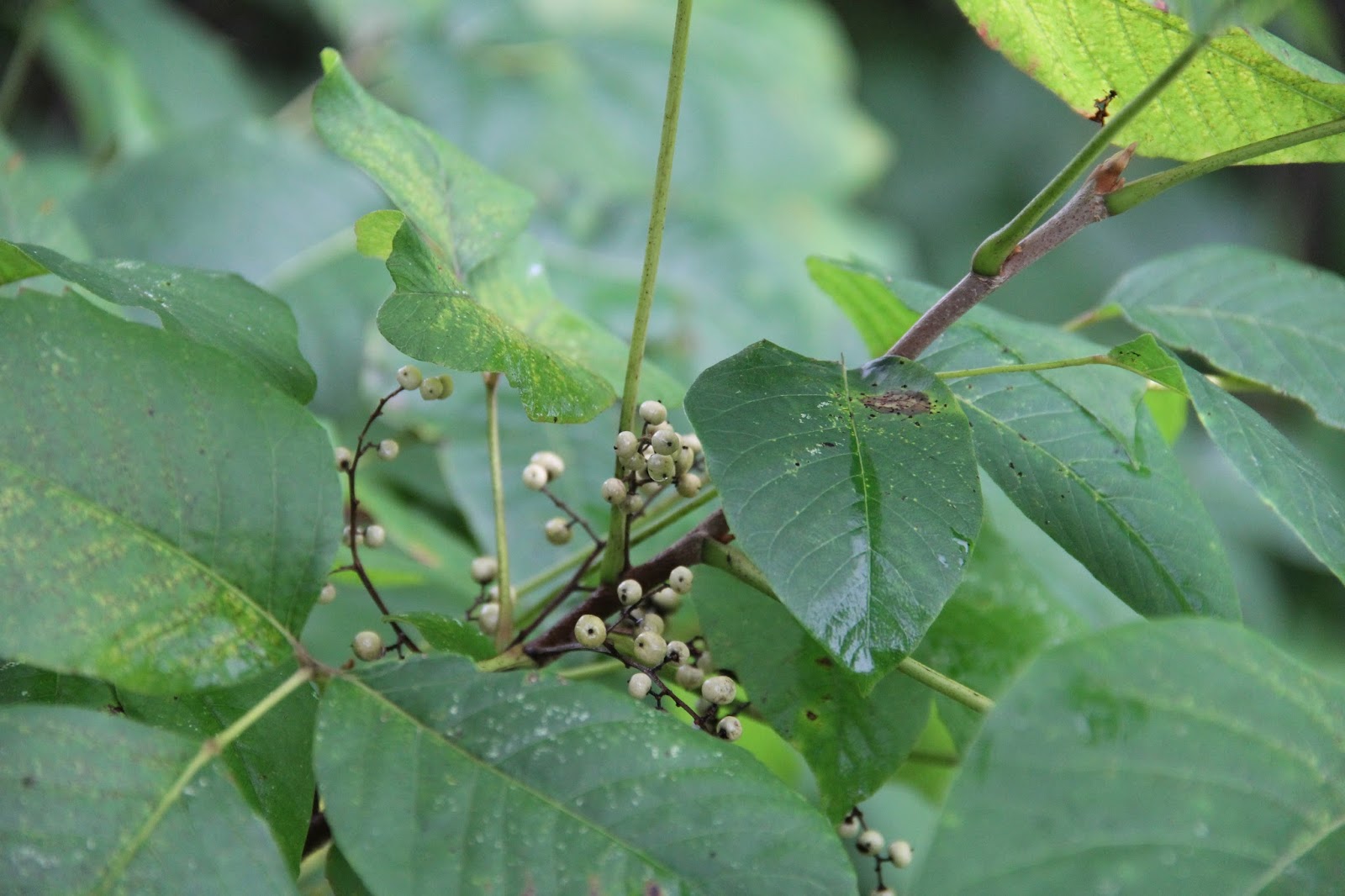
This photo shows the berries from Western Poison Ivy (Toxicodendron rydbergii).  This species is less common in Michigan than Eastern Poison Ivy (T. radicans).  Unlike the Eastern form which typically from climbing vines, Western poison Ivy grows as a low shrub.  The berries from both species are toxic to humans.

Western Poison Ivy (Toxicodendron rydbergii) berries - TOXIC

The fifth photograph shows the fruit of American Highbush Cranberry (Viburnum trilobum).  There is a closely related species European Highbush Cranberry (V. opulus) that is distinguished only by a difference in the shape of glands at the base of the leaf.  The fruit from both species is edible, but it is very tart and may not appeal to all people.

American Highbush Cranberry (Virburnum trilobum) fruit - Edible


The next photograph shows fruit from a rose, known as "hips".  All species of rose hips are edible, but not all are palatable.   I did not identify the species of rose on site, but from the photograph it appears to be Smooth Rose (Rosa blanda). 

Rose hips (fruit), probably a Smooth Rose (Rosa blanda) - Edible

The next two photographs show drupes (fruit) from two different species of dogwood.  The first photograph shows Silky Dogwood (Cornus amomum) fruits.  The second shows Red-Osier Dogwood (Cornus sericea).  Some sources list dogwood fruits as edible, others as inedible.  Some may cause nausea if eaten.  In general, even though you may be able to eat dogwood fruits you probably wouldn't want to do so.
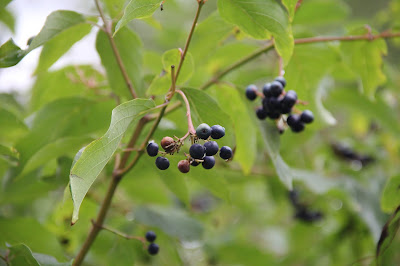
Silky Dogwood (Cornus amomum) - inedible

Red-Osier Dogwood (Cornus sericea) - inedible

It was very interesting to me to find this many different fruits/berries in such a small space - less than 200 yards of riverbank.  It looks like the birds will eat well this fall and winter.

On a side note, if you visit Island Park on Thursdays between June 1st and October 31st you will find the Mt. Pleasant Farmers' Market with lots of fresh edible fruits when they are in season.