Thursday, January 23, 2014

Geology Concepts - Cross-bedding

Continuing with the geology theme...

Yesterday I wrote about the geologic principle of Original Horizontality.  This is the idea that the sediments that formed sedimentary rocks were originally deposited horizontally, even if the rocks are no longer in a horizontal position.  These horizontal layers are known as beds. These beds are typically found over wide areas and are uniformly thick.

However, sometimes the sediments within those beds are not laid down evenly in a horizontal layers.  The sediments within a bed may be laid down in inclined layers.  This process is known as Cross-bedding.  Cross-bedding happens when sediment is moved by water (or wind) currents.  Cross-bedding is often found in dunes, ripples, and sand/gravel bars.  Cross-bedding in sedimentary rock provides evidence of past currents preserved in stone.

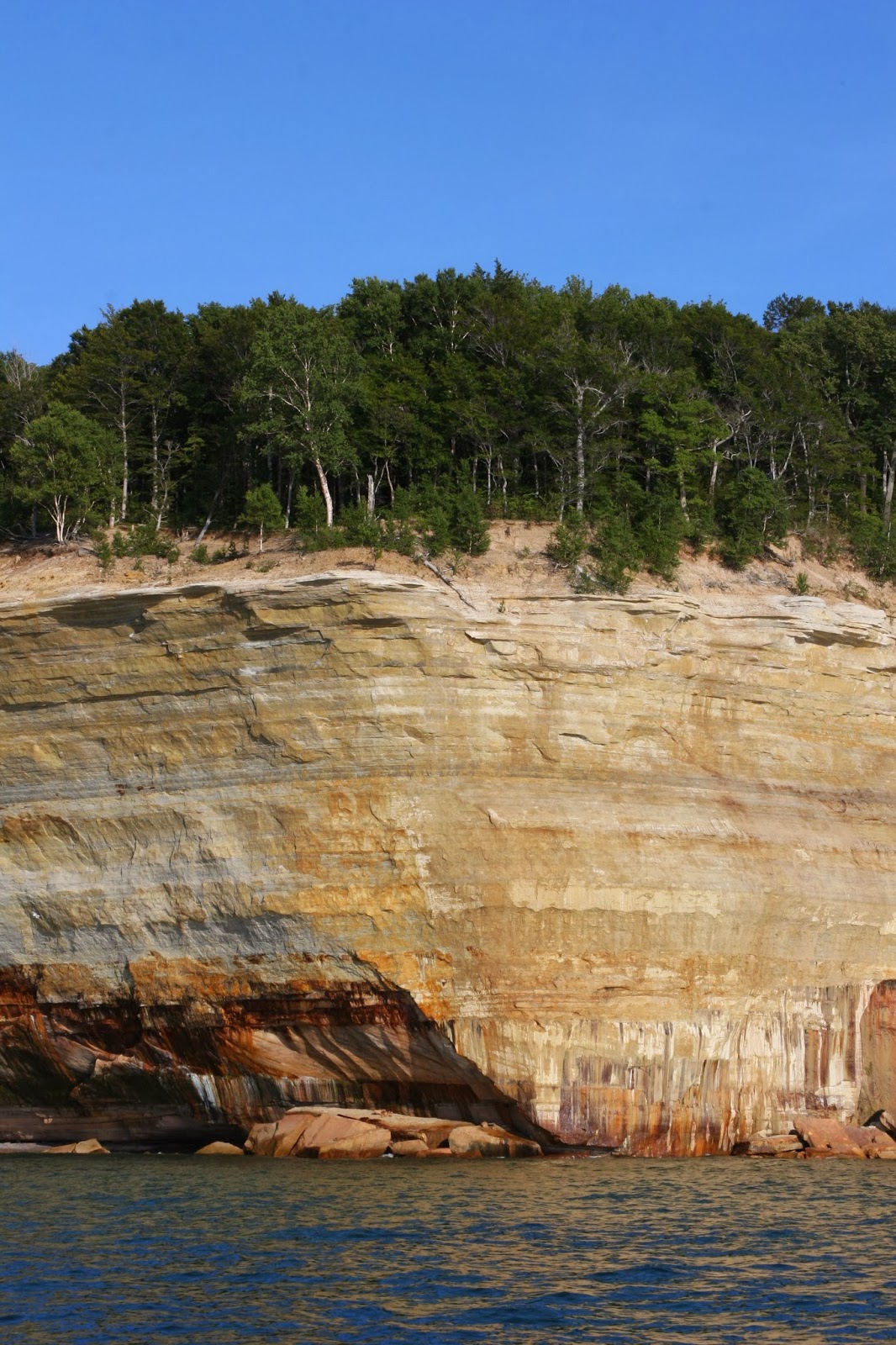
Looking at a photo from Pictured Rocks National Lakeshore, most of the beds found in the exposed sandstone are horizontal, just as they were originally deposited.  There are several beds in which the sediments were not deposited horizontally.  These beds show cross-bedding and are evidence of currents moving the sediments around.

Sandstone beds at Pictured Rocks National Lakeshore - Can you find the cross-bedding?

The next image is the same photograph with some of the cross-bedding indicated by tilted yellow lines.  If you look closely, there are several more areas of cross-bedding that I have not marked.

Sandstone beds at Pictured Rocks National Lakeshore - areas of cross-bedding are indicated by diagonal lines
The next photograph is another image of sandstone deposits at Pictured Rocks National Lakeshore.  The horizontal beds are easily visible, as is one section of cross-bedding.

Horizontal and cross-bedding at Pictured Rocks National Lakeshore

Here is the same photograph with the cross-bedding outlined. 

Sandstone formation at Pictured Rocks National Lakeshore - area of cross-bedding outlined
The above photographs are taken at Pictured Rocks National Lakeshore.  Pictured Rocks is located in Michigan's Upper Peninsula along the southern shore of Lake Superior.  This is about a 4 1/2 hour drive from Mid-Michigan. 

Why didn't I just use photos of a rock formation from Mid-Michigan instead?

There is no surface bedrock to be found in Mid-Michigan.  Most of the bedrock in Michigan is covered by glacial deposits of sand, gravel, and rock.  These deposits range from a few inches in some area to up to 1200 feet.  The State of Michigan estimates that the average depth of glacial deposits in Michigan is 300 feet!

Wednesday, January 22, 2014

Geology Concepts - Original Horizontality

Yesterday I did a program at a school on historical geology.  Students learned about the processes through which rocks form, break down, and reform.  They also learned about several concepts that can be used to determine the relative age of geological features.  One of the concepts was that of Superposition - the idea that rock layers that are found on top of other rock layers are usually younger than the layers below them.  Another concept that helps make the idea of superposition work is the concept of Original Horizontality.

Original Horizontality is the idea that the sediments that form sedimentary rocks were originally deposited horizontally - even if the rocks are no longer in a horizontal position.

To show this concept I want to look at two waterfalls in the Upper Peninsula.

The first two photographs show the horizontal sandstone layers at Tahquamenon Falls in the eastern UP.  The sandstone at Tahquamenon Falls formed during the Cambrian Period (500 - 600 Million Years Ago) and are part of a group of rocks called the Jacobsville Formation.

Upper Tahquamenon Falls - note the horizontal layers of sandstone

Horizontal sandstone formations on the Tahquamenon River

The sandstone layers at Tahquamenon Falls remain in their original horizontal position.  In contrast at Bonanza Falls in the western Upper Peninsula, the bedrock formations have been tilted from the horizontal.  The rock here is a type of shale known as Nonesuch Shale.  Nonesuch Shale is part of the Nonesuch Formation and dates to the Precambrian Era.  The Nonesuch Shale is between 900 million and 1 billion years old!

Bonanza Falls on the Big Iron River - note the layers of shale tilting back toward the falls

Looking upriver from Bonanza Falls - the tilted layers of Nonesuch Shale are easily visible in the river

Tuesday, January 21, 2014

Geology Concepts - Superposition


Superposition is a concept in geology that states that the layers at the bottom of a rock column are older than the layers at the top of a rock column.  This is especially true for layers of sedimentary rock that remain in their original horizontal position.  These individual layers are known as beds.

Sedimentary rock formations at Pictured Rocks National Lakeshore - layers at the the top of the formation are older than layers at the bottom

Pictured Rocks National Lakeshore - Sandstone deposited in distinct layers with the oldest layers at the bottom of the formation.

If you think of a rock column as a layer cake this concept makes perfect sense.  When a baker makes a layer cake, they add each new layer to the top of the cake.  In nature, when sediment is deposited at the bottom of a lake or at the base of a hill new layers form over the top of older layers.

Bedding in a dune a Sleeping Bear Dunes National Lakeshore - the upper beds are younger than the lower beds.


Friday, January 17, 2014

A Walk in the Woods - Chipp-A-Waters Park

It feels like it has been weeks since I set foot outside for more than a few minutes.  This morning I was able to get out for about 2 hours.  I went to Chipp-A-Waters Park here in Mt. Pleasant to take a walk along the trails.  There was only one set of human footprints in the new snow covering the trail (but lots of animal tracks) and I did not see another person during the time that I spent there.

Because the opportunity to take this short trip was unexpected, I was not dressed properly for wandering through deep snow so I stayed on the trail most of the time.

Open water near the canoe landing at Chipp-A-Waters Park
The Chippewa River is mostly frozen over right now.  There are only a few locations where a faster current has kept ice from forming.  Because most of the river (and all the standing water) is covered with ice there are very few waterfowl in the area right now.  There is however at least one Great Blue Heron still hanging around. I found its tracks on the ice near one of the few patches of open water.

Great Blue Heron tracks on the ice

The view downstream from the canoe landing - there is one more small stretch of open water along the left bank.
Although there are spots where the river has not frozen over the ice that covers most of the river is thick enough to support the weight of most animals including White-tailed Deer. While there was evidence of many species of animals, the animals themselves were more difficult to locate.

White-tailed Deer tracks crossing the river with Great Blue Heron Tracks at lower right.
The trail at Chipp-A-Waters Park winds through a floodplain forest following the curves of the river before crossing over a pedestrian bridge and into an area of upland hardwood forest (American Beech, Sugar Maple, and Red Oak).  There the trail forms a loop taking you back across the same bridge.

Looking upstream from the pedestrian bridge

Snow through the trees

American Beech leaves will often cling to the tree until Spring

White Oak leaf

A cluster of American Beech trunks
Back on the west bank of the river, the trail continues along passing through more floodplain forest.  Then the trail rises up, crossing one old river levee and following the top of another before ending at a boardwalk and observation deck that overlooks an old river oxbow.

Fertile fronds from Cinnamon Ferns poke through the snow

Small mammals left trails in the snow

Heading back down the boardwalk and through the woods
I did now see much wildlife on my walk.  I saw eight species of birds, but only managed to get a decent photo of this Red-Bellied Woodpecker.  I also saw one Fox Squirrel from a distance. 

Red-bellied Woodpecker

White-tailed Deer tracks on the shoreline and crossing the ice
One nice thing about walks in the winter is that the lack of leaves allows you to see plants with a whole different perspective.  Often fruit can be found much easier in the winter than when there are leaves on the trees.  One species that looks much different in the winter is the Eastern Poison Ivy.  Stay away from these berries, they are just as capable of causing an allergic reaction as the leaves are.


Poison Ivy berries
Overall, despite some cold toes and fingertips it was nice to get out of the office and into the woods for a short time.

Thursday, January 16, 2014

Plants can adapt...

I thought I would share one of my favorite photographs.  This photo shows that plants are tough and can adapt to less than ideal growing conditions.

Trilliums coming up through a cut in a log.
 
This photo shows two Large-flowered Trilliums (Trillium grandiflorum) emerging from a saw-cut in a log.  This picture was taken near a trail in Sleeping Bear Dunes National Lakeshore.  The log was from a tree that had fallen across the trail at some time.  The trail crew cleared the fallen tree and tossed the sections of logs into the woods to decay.  Then one of two things happened.

First, the section of log may have landed on some existing Trilliums - two of those plants survived being covered by the log and eventually their sun-seeking stems found the cut in the log and grew through it. 

An alternate explanation is that the plants were not there before the log landed in this space.  One way that the Trillium is spread is by ants dispersing their seeds.  There may have been a colony of ants nesting beneath this log.  The ants brought the seeds from a trillium into their nest as food.  The ants ate a fleshy coating that covers the seed and then discarded the seed in their garbage pile where they then germinated and grew up through the cut.

To learn more about the Large-flowered Trillium look here.

Tuesday, January 14, 2014

Native Species Profile - Feathery False Solomon's Seal

Feathery False Solomon's Seal (Maianthemum racemosum) is a large wildflower found throughout the eastern United States and Canada. The name Maianthemum means "May flower".  Racemosum refers to the plant's bloom - a raceme .  A raceme is a single spike of flowers at the end a plant in which each flower grows on a short stem off the main stem, flowers bloom from the base to the tip of the raceme in sequence.  Feathery False Solomon's Seal was formerly known as Smilacina racemosa but was recently renamed and reclassified from the Lily Family (Liliaceae) to the Butcher's Broom Family (Ruscaceae).  Many books still list the plant under this older classification and name.

Feathery False Solomon's Seal - note the raceme of flowers
The Feathery False Solomon's Seal has small (1/8 inch) white flowers with three petals and three petal-like sepals.  Although the individual flowers are small, the raceme may be up to 4 inches long.  The plant blooms between May (as its name implies) and July.

Feathery False Solomon's Seal flower

The plant itself is between 1 and 3 feet tall.  The plant does not grow upright, but instead bends into an arc. It typically grows in wooded areas, but can sometimes be found in open areas.  The plant prefers moist habitats but will grow in drier soils.

The plant has alternate, elliptical shaped leaves that grow are up to 6 inches long and 3 inches wide.  The leaves are marked by heavy parallel veins that run form the base of the leaf to the pointed tip.

Feathery False Solomon's Seal - note the alternate leaves and the prominent parallel veins


There is a second species of False Solomon's Seal that is native to eastern North America - Star-flowered False Solomon's Seal (Maianthenum stellatum).  The two plants are easy to distinguish because M. stellatum has fewer flowers, but each flower is larger (1/3 inch across).

Star-flowered False Solomon's Seal


Basic Information


Feathery False Solomon’s Seal 
Smilacina racemosa or Maianthemum racemosum

Height:  1-3’ tall

Habitat:  deciduous woods

Flower Color:  white

Bloom Time:  May – July

Monday, January 13, 2014

Upcoming Event - 18 January - 11 May

After posting the song "Bein' Green" which was made famous by Kermit the Frog, this post is appropriately enough about frogs also.

Green Frog (Rana clamitans)


Next Saturday (18 JAN 2014) The Alden B. Dow Museum of Science & Art will be opening its newest rotating exhibit: "FROGS! A Chorus of Colors".  This exhibit will be open until May 11th.  From the Alden B. Dow Museum website:

Explore TOAD-ally cool creatures and get eyeball to eyeball with more than 70 live frogs from around the world!

View frogs from across the globe, complete with their noisy croaks, yaps, chirps, whoops, snores and whistles, all housed in detailed habitats with rock ledges, live plants and waterfalls.
Interactive games and displays help visitors of all ages have fun while exploring frogs’ biology and natural history, the roles they play in human cultures, their importance to ecosystems and the perils they face in a changing environment.
    • Check out the skeleton of the world’s largest frog and learn how the frog’s skeleton allows it to out-jump Olympic athletes
    • Examine the stages of metamorphosis with preserved specimens
    • Perform a virtual dissection without hurting any frogs
    • Create a chorus when you push buttons to activate recorded frog calls
    • Test your frog knowledge on subjects – from basic to bizarre!
Bring your camera: Non-flash photography is permitted!

In addition to the live frogs, the museum will also be featuring two other exhibits about frogs that will run until April 13th: 

Batrachology: Amphibians in Art 

Works by artists fascinated by batrachology: the study of amphibians.


Nature’s Fading Chorus: The Works of Brandon BallengĂ©e 

Using high-resolution scanner photography, BallengĂ©e creates large-scale portraits of frogs that document his ecological studies to increase the public’s environmental understanding.

The live frog exhibit is from Clyde Peeling's Reptileland from Allenwood, PA.  The "FROGS!" exhibit has touring across the United States and Canada since 2003 and has appeared in museums such as the Museum of Science and Industry in Chicago, the Houston Museum of Natural Science, the Academy of Natural Sciences in Philadelphia, and the Canadian Museum of Nature in Ottawa.  Most recently the exhibit was shown at the American Museum of Natural History in New York.

I have actually been to Reptileland on a trip to Pennsylvania in 2009.  Shara and I were both greatly impressed by the animals on display there.  We are both very excited about the exhibit coming to Mid-Michigan. 

To view some of my photos of two frog species native to Mid-Michigan check out this post.