I'm writing this on April 22nd, more than a month into my spring photography project. We have finally turned the corner and spring is really here, but you wouldn't know it from a couple of the photos in this set.
The goal of this project is to get outdoors every single day and document what is happening throughout the entire season. Some days I take hundreds of photographs and on other days I may take less than a dozen. Regardless of how many images I take each day, they have been pared down to a single photo to represent each day.
Enjoy the most recent set of images!
Day 21 (09 April 2019) - Oh, Canada!
This photograph was taken at Forest Hill Nature Area. A pair of Canada Geese (Branta canadensis) are nesting atop a muskrat lodge on the north side of the property. Sometimes they will sit silently as you pass by, but other times they make a big ruckus (as seen in this picture). I like how this image captures the gander (the male goose) in mid "Honk". This photo has been cropped from a horizontal to a vertical format. I think the simplicity makes it a stronger image.
Day 22 (10 April 2019) - Ramping up to spring...
One of the earliest plants in the local woods is the Wild Leek (Alium tricoccum). Also known as "ramps" the leaves of this species emerge from the forest floor before most of the other wildflowers, but it won't flower until summer. By that point the leaves will have all dried up for the year. Considered by many a choice wild edible, over-harvesting has reduced the population of this plant in many areas. I photographed these plants at Chipp-A-Waters Park in Mt. Pleasant - please not that harvesting is not allowed in any park in Mt. Pleasant.
Day 23 (11 April 2019) - Bloodroot Leaves
We have a small patch of Bloodroot (Sanguinaria canadensis) in our native pollinator garden. The plants here often emerge a week or more before the same species in Mt. Pleasant. Our Bloodroot is already blooming and I have yet to find a single plant in Mt. Pleasant.
Day 24 (12 April 2019) - Birch Grove
This photo has taken late in the day at Forest Hill Nature Area. I like the minimalist look of the bare trunks of birch against the darker trees in the forest behind. Although this photo could just as well represent late fall, it was my favorite image of the day so it became part of this collection.
Day 25 (13 April 2019) - Brown-headed Cowbirds
April 25th found me back at Forest Hill for the third time in five days. My favorite picture of the day was this trio of Brown-headed Cowbirds (Molothrus ater) perched on a grape vine covered thicket of dogwood. The top bird and the bird to the right are both females; the male is on the left. I tried several different crops of this image to remove the twig on the right, but ultimately decided that the original looked best. I like the repetition of the birds' forms and the warm tones created by the afternoon light.
Day 26 (14 April 2019) - White-throated Sparrow and a Brief Return to Winter
Winter gave us one last blast on April 14th. We only received about two inches of snow in Alma, but areas north and west of Mt. Pleasant ended up with six to nine inches! I hadn't filled the birdfeeders in a couple of weeks, but the snow brought the birds back, including this White-throated Sparrow (Zonotrichia albicollis). I photographed this bird perched on a gate in our back yard. If you look closely you can see snow falling in the background.
Day 27 (15 April 2019) - Wood Duck Pair
I photographed this pair of Wood Ducks (Aix sponsa) at Chipp-A-Waters Park in Mt. Pleasant. This is one of three pairs that I saw in the oxbow pond at the back of the park. This was the only pair that I was able to get a photograph of. The colorful male is on the left and the more drab female on the right. This image has been cropped to a widescreen (16:9) format.
Day 28 (16 April 2019) - Skunk Cabbage
I have frequently said on this blog that Skunk Cabbage (Symplocarpus foetidus) is my favorite wildflower. I can't resist photographing it each and every spring, especially once its leaves begin to emerge. I think my eyes just crave green after a long winter lacking the color. I love how the color "pops" against the rich browns of last autumn's leaves. This photo was taken at Mission Creek Woodland Park during a light rain. This might be my favorite weather to photograph in, the rain and even light just enhances the colors of everything in the woods.
Day 29 (17 April 2019) - Dutchman's Breeches Buds
This image was taken at Chipp-A-Waters Park in Mt. Pleasant. I couldn't find a single wildflower in bloom last week, but these Duchman's Breeches (Dicentra cucullaria) are almost there. When these flowers are mature, they will look like little pairs of pantaloons pinned up by their ankles to dry. There is a large patch of these flowers at Chipp-A-Waters Park - follow the trail to toward the back of the park and look for an interpretive sign highlighting wildflowers. The plants are right there near the sign along with close to a dozen other species of spring ephemerals.
Day 30 (18 April 2019) - Nesting Dove
The final photo in the set was taken from our front porch. Every year we have an American Robin (Turdus migratorius) nest on one of our roof brackets. Every year we have a Mourning Dove (Zenaida macroura) use one of the old robin nests as the base for its own nest. Normally the robin is the first to nest, but this year the dove decided to get the jump on things and got the first pick of nesting locations. This picture has been cropped to a square format.
Showing posts with label seasons. Show all posts
Monday, April 22, 2019
Wednesday, March 20, 2019
Spring is...
Spring is the season of my favorite wildflower.
Skunk Cabbage (Symplocarpus foetidus) is the first wildflower of the year in Mid-Michigan. This species is so insistent on blooming that it has the ability to melt through snow and ice! I often find this species blooming in seeps and swamps as early as the first week of March, but regardless of when I find it I know that spring will soon be here.
My first sighting of Skunk Cabbage for 2019 coincided with the Vernal Equinox - so for this year at least Skunk Cabbage truly was a sign of spring!
Skunk Cabbage (Symplocarpus foetidus) is the first wildflower of the year in Mid-Michigan. This species is so insistent on blooming that it has the ability to melt through snow and ice! I often find this species blooming in seeps and swamps as early as the first week of March, but regardless of when I find it I know that spring will soon be here.
My first sighting of Skunk Cabbage for 2019 coincided with the Vernal Equinox - so for this year at least Skunk Cabbage truly was a sign of spring!
Monday, March 18, 2019
Spring!
Spring may be two days away on the calendar, but according to the birds it's already here! The surest sign of spring to me is the return of the Red-winged Blackbirds (Agelaius phoeniceus). I saw my first blackbird of the year about ten days ago; now they are everywhere in Mid-Michigan.
Wednesday, March 6, 2019
A long reach...
Deep snow can make winter survival difficult for white-tailed deer. Getting around is difficult and requires more energy. Most of the food sources are inaccessible, especially if the snow is combined with a layer of ice that prevents deer from digging down to the ground.
Because foods such as grasses, forbs, and nuts are often unavailable, deer survive mostly on a diet of browse (buds, leaves, branch tips) during the winter months. Where deer populations are heavy, all the food that is easy to reach is already gone by this time of winter. Sometimes the only food left available in area is high overhead. It is not unusual to see where deer have browsed as high as eight feet off the ground by standing on their hind legs.
I retrieved my trail cameras this afternoon and was lucky enough that one of the cameras had recorded this behavior. The deer in this series of images is reaching up to eat needles from an Eastern Hemlock (Tsuga canadensis).
Normally I just change out the memory cards in my trail cameras and leave the cameras in the woods, but I decided to remove the cameras completely for now. Even though its in a public park, the area that I place the cameras is quite secluded when the ground is not frozen - it's in the middle of a swamp. However, right now its easy to access because everything is frozen over. I also left a trail of footprints directly to the camera sites. I also recorded a person on one of the cameras. This is not the first time I have ever seen a person on one of the cameras, but it was the first time I could tell that they knew the camera was there. Fortunately, they only smiled at the camera and left it in place.
If this you - Thank you for being an honest person!
Thursday, January 17, 2019
Trail cam pics and a walk in the January woods.
In late December I placed my trail cameras in the woods for the first time in nearly a year. Today I went to switch out the memory cards. Although I managed to get pictures of red fox, raccoon, squirrels, and deer (including several bucks) I was disappointed by the results and ended up moving both cameras.
After moving the cameras I used the opportunity to take a walk through the woods and take some photographs. There was no snow on the ground, but lots of ice. My favorite photos of the day were probably those showing leaves locked in ice. Here are a few of the images that I captured.
| A fox runs in front of the camera |
| Part of a herd of deer, including two bucks, passing by the camera |
After moving the cameras I used the opportunity to take a walk through the woods and take some photographs. There was no snow on the ground, but lots of ice. My favorite photos of the day were probably those showing leaves locked in ice. Here are a few of the images that I captured.
| Bright sunlight has been a rare sight in recent days |
| This picture was not planned - the plane flew over just as I was taking the picture. |
| Flowing water carved this channel down through the ice |
| Many shades of brown |
| Living and dead trees stand bare in the winter swamp |
| Oak leaves trapped in ice |
| Coyote scat on top of a pile of deer scat |
| Water levels have dropped several inches since this ice formed |
| Eastern Hemlock |
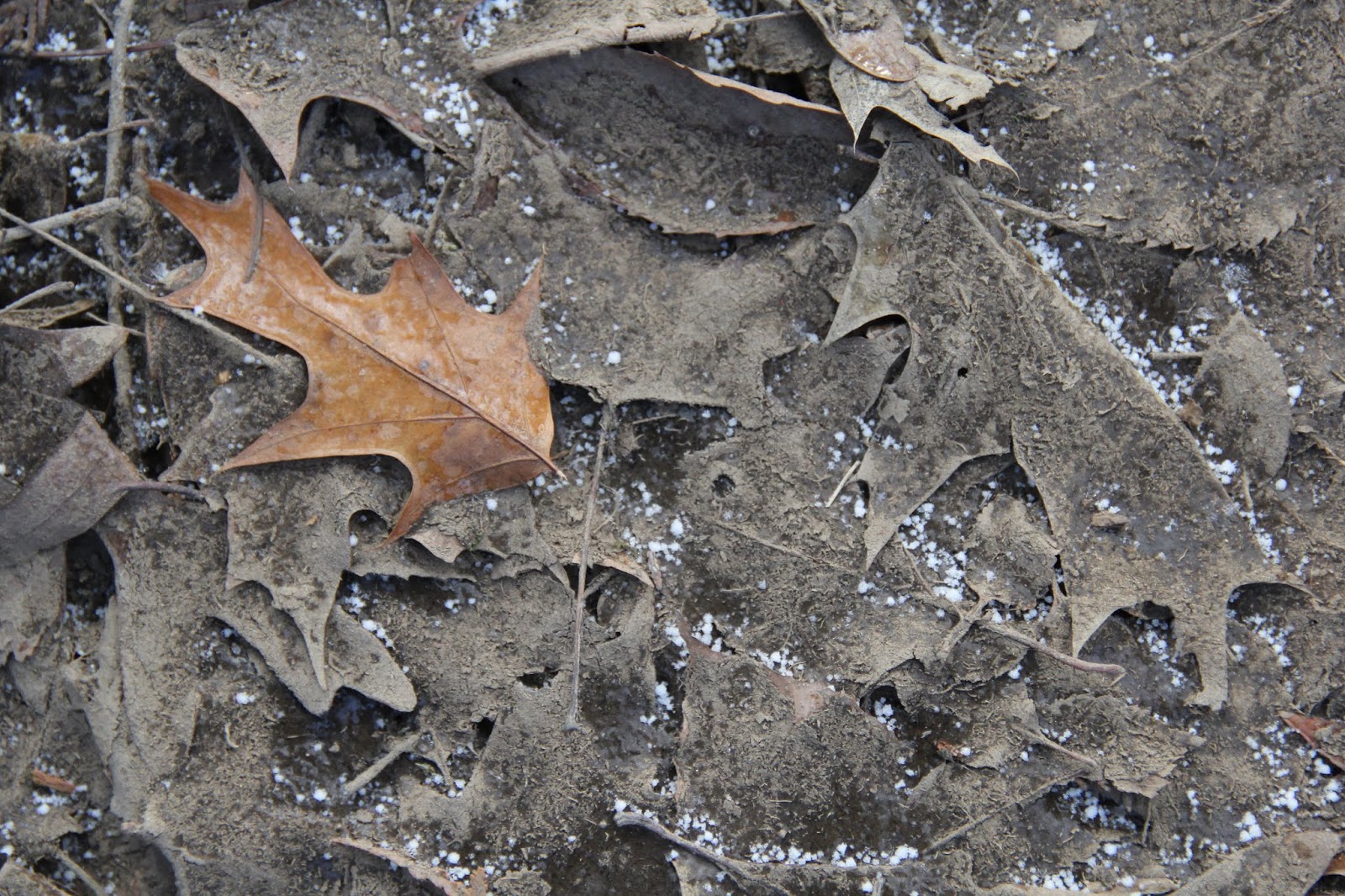
| Silt covered leaves, topped by a single clean oak leaf |
| A boardwalk crosses an eroded area on the trail |
| Northern White Cedar |
| The bright trunks of aspen trees glow in the sunlight |
Tuesday, January 15, 2019
A new way of looking at ice
This morning, Mid-Michigan woke up to find everything covered in a layer of ice. The icy road meant that dozens of schools throughout the state canceled classes for the day. Weather conditions haven't changed so there is a good chance that classes will be canceled again tomorrow.It's winter here in Mid-Michigan. During winter you might expect to see everything covered in ice and snow, but have you ever thought about what ice and snow are?
The obvious answer is that ice (and snow) is the solid state of water.
The less obvious answer is that ice is a mineral.
Yes, a mineral.
Like the thing that rocks are made of.
How is that possible? If you look at the definition of a mineral, ice checks all of the boxes. A mineral is a naturally-occurring inorganic crystalline solid with a specific chemical composition.
Ice is naturally-occurring. Ice can form outdoors when the temperature drops below 32 degrees Fahrenheit. (As I write, the temperature outdoors is 28 degrees.) Ice that forms in your freezer is not a mineral because it would be considered man-made.
Ice is inorganic. Inorganic simply means that it has never been alive. Things might live in ice, but the ice itself has never been alive.
Ice is crystalline. Ice forms crystals that have a specific internal structure - the water molecules that form ice bond together in a predictable pattern. Liquid water and water vapor form much looser bonds and do not lock together in a predictable patter.
Ice is a solid. When water drops below 32 degrees Fahrenheit, the molecules of water bond together to form a solid. Only in its solid form can water be considered a mineral; neither liquid water or water vapor meet the definition of being a mineral.
Ice has a specific chemical composition. Ice is formed from bonded molecules of water, each composed of two atoms of hydrogen and one atom of oxygen. Other elements or molecules may be included in the ice, but the ice itself is formed only from the water molecules.
Ice is the only state of water that can be called a mineral. If the ice melts or evaporates to form water vapor (a process known as sublimation) it ceases to be a mineral. Due to the ability of water to shift states of matter, ice is a very ephemeral mineral across most of the earth. In mid-latitudes such as where Michigan is located, ice can only be found during roughly half of the year. At latitudes closer to the equator, ice would only be found in the highest elevations where the temperature can drop below the freezing point. It is only in the highest elevations and the highest latitudes (the Arctic and Antarctic) that ice can be found year round.
It's fun to look at familiar things in new and unexpected ways - like looking at ice as a mineral. Right now large portions of the United States and Canada are rich in naturally formed ice, but come the period May to September it will be unavailable at any price throughout much of the same region.
The obvious answer is that ice (and snow) is the solid state of water.
The less obvious answer is that ice is a mineral.
Yes, a mineral.
Like the thing that rocks are made of.
How is that possible? If you look at the definition of a mineral, ice checks all of the boxes. A mineral is a naturally-occurring inorganic crystalline solid with a specific chemical composition.
Ice is naturally-occurring. Ice can form outdoors when the temperature drops below 32 degrees Fahrenheit. (As I write, the temperature outdoors is 28 degrees.) Ice that forms in your freezer is not a mineral because it would be considered man-made.
Ice is inorganic. Inorganic simply means that it has never been alive. Things might live in ice, but the ice itself has never been alive.
Ice is crystalline. Ice forms crystals that have a specific internal structure - the water molecules that form ice bond together in a predictable pattern. Liquid water and water vapor form much looser bonds and do not lock together in a predictable patter.
Ice is a solid. When water drops below 32 degrees Fahrenheit, the molecules of water bond together to form a solid. Only in its solid form can water be considered a mineral; neither liquid water or water vapor meet the definition of being a mineral.
Ice has a specific chemical composition. Ice is formed from bonded molecules of water, each composed of two atoms of hydrogen and one atom of oxygen. Other elements or molecules may be included in the ice, but the ice itself is formed only from the water molecules.
Ice is the only state of water that can be called a mineral. If the ice melts or evaporates to form water vapor (a process known as sublimation) it ceases to be a mineral. Due to the ability of water to shift states of matter, ice is a very ephemeral mineral across most of the earth. In mid-latitudes such as where Michigan is located, ice can only be found during roughly half of the year. At latitudes closer to the equator, ice would only be found in the highest elevations where the temperature can drop below the freezing point. It is only in the highest elevations and the highest latitudes (the Arctic and Antarctic) that ice can be found year round.
It's fun to look at familiar things in new and unexpected ways - like looking at ice as a mineral. Right now large portions of the United States and Canada are rich in naturally formed ice, but come the period May to September it will be unavailable at any price throughout much of the same region.
Tuesday, December 25, 2018
Merry Christmas 2018!
Merry Christmas!
It's not a very white Christmas here in Mid-Michigan, but it is a Merry one nonetheless!
I got some warm socks, waterproof notebooks, and a new field guide (plus a bunch of other cool stuff) - I'm ready to get outdoors!
Tuesday, December 18, 2018
Celebrating a (Solar) New Year
On January 1st, much of the world will be celebrating the new year, but this Friday might be a more appropriate day to celebrate (at least from an astronomical viewpoint).
This Friday (22 December 2018) marks the Winter Solstice, the date on which the calendar changes seasons from Fall to Winter here in Mid-Michigan (and the rest of the Northern Hemisphere). Winter will officially begin at 5:23 PM EST.
The word solstice comes from two Latin root words sol (sun) and sistere (to stand still). On the solstice, the path of the sun appears to stand still!
Assume that you were to awaken every morning before dawn and mark the location that the sun rises on the eastern horizon. You would notice that the sun does not in fact arise from the same place every day. Instead it wanders north and south along the horizon, moving north during the Winter and Spring and back south again during the Summer and Fall. On the Summer Solstice (June 21st) and Winter Solstice (December 21st), the sun ceases to move further along the horizon, appearing to "stand still" before reversing its course the next day.
You have probably already noticed in addition to the location of the rising sun, the length of day and night vary throughout the year. As the sun progresses south, the day shortens and the night lengthens. The Winter Solstice marks the shortest day (and longest night) of the year in the Northern Hemisphere. Here in Mid-Michigan we will mark the date with approximately 8 hours 57 minutes of daylight. As the sunrise moves back north along the horizon our days will slowly get longer until on the Summer Solstice we will experience nearly 15 hours 25 minutes of daylight.
Why does the sun move and the length of day vary?
It all has to do with a tilt in the Earth's axis. The Earth rotates on its axis approximately once every 24 hours - giving us the length of our day. It also revolves around the sun approximately once every 365 days - the length of our year. If the Earth's axis was perpendicular the plane on which it revolves around the sun, our days would be the same length throughout the year (approximately 12 hours), but the axis is not perpendicular to this plane. Instead the Earth's axis tilts 23.5 degrees from the vertical.
The points on the globe that the axis revolves around are referred to as the North and South Poles. The axis is always pointed toward the same location in the sky. The North Pole points toward the "North Star" - Polaris. As the earth revolves around the sun, sometimes the North Pole is closer to the sun, sometimes the South Pole is closer to the sun. When the North Pole is at its closest, we experience Summer in Mid-Michigan and the Southern Hemisphere experiences Winter. When the North Pole is at its furthest, we experience Winter and the Southern Hemisphere experiences Summer.
On two days of the year, the Earth's axis is perpendicular to the plane of its revolution. On those two days we do experience equal periods of day and night because the sun rises due east and sets due west. During the rest of the year our hours of daylight vary depending on where the axis is pointed. During our summer months, the tilt in the axis means that the northern hemisphere is closer to the sun and receives more hours of sunlight. During the winter months, the reverse is true. On the Winter Solstice, the North Pole is tilted at its furthest angle from the sun resulting in the shortest day (and longest night) of the year for those of us in the Northern Hemisphere.
Why did I say that the Winter Solstice would be a better day to celebrate the new year?
Tracking the position of the rising sun was among the first astronomical observations. Many ancient monuments seem to have been constructed as solar observatories, aligned with the locations of sunrise and sunset on the longest and shortest day of the year. To early agricultural societies especially, tracking the seasons accurately could mean the difference between a bountiful harvest and failure of a year's crops. The day that the sun "stood still" in its southward journey and then began to return north, bringing more hours of daylight and eventually warmer weather seems such an obvious point to mark the beginning of a new year!
Join me on a hike to celebrate the Solstice!
To celebrate the Winter Solstice, I am leading a nighttime hike at the Chippewa Watershed Conservancy's Sylvan Solace Preserve. This hike will begin at 7:00PM. Sylvan Solace Preserve is located on Pickard Road, between Gilmore Road and Littlefield Road, approximately 8 miles west of downtown Mt. Pleasant.
We are doing a nighttime hike because another celestial event lines up with the solstice this year - a full moon. (Technically the full moon will be on December 22nd, but it will be more than 97% illuminated on the night of the 21st.) We are expecting light snowfall early in the day - this should brighten up the woods. Hopefully the moon will peek through the expected clouds and illuminate our hike. The trails at Sylvan Solace are flat and well-defined making this a great first night hiking experience! I hope to do the hike without any artificial lights. Wear warm clothes and bring a headlamp or flashlight just to be safe.
Monday, November 19, 2018
Of scattering abroad...
This morning I had a little bit of time free after giving a program at Fancher Elementary. I hadn't been out in the woods for a few days do I decided to head to Chipp-A-Waters Park and walk the trails. I didn't have plan, I just wanted to get outdoors and take a few pictures. Almost immediately I noticed a Common Milkweed (Asclepias syriaca) with a few seeds still hanging to its dried out pods and nearby was Bitter Dock (Rumex obtusifolius) with its flattened seeds. When I a bit further I noticed the fluffy seeds of a Canada Goldenrod (Solidago canadensis) and a Boxelder's (Acer negundo) winged samara. At that point I had an idea - how many different fruits, seeds, or nuts could I find?
| #1 - Common Milkweed (Asclepias syriaca) |
| #2 - Bee Balm (Monarda fistulosa) |
| #3 - Bitter Dock (Rumex obtusifolius) |
| #4 - Canada Goldenrod (Solidago canadensis) |
| #5 - Boxelder (Acer negundo) |
| #6 Queen Anne's Lace (Daucus carota) |
| #7 - Multiflora Rose (Rosa multiflora) |
| #8 - Buckthorn (Rhamnus sp.) |
| #9 - Common Burdock (Arctium minus) |
| #10 - Virginia Creeper (Parthenocissus quinquefolia) |
| #11 - Honeysuckle (Lonicera sp.) |
| #12 - Aster (Symphyotrichum sp.) |
| #13 - Eastern Poison Ivy (Toxicodendrom radicans) |
| #14 Blue Cohosh (Caulophyllum thalictroides) |
| #15 - Orange-fruited Horse-Gentian (Triosteum aurantiacum) |
| #16 - Buttonbush (Cephalanthus occidentalis) |
| #17 - Japanese Barberry (Berberis thunbergii) |
| #18 - American Bladdernut (Staphylea trifolia) |
| #19 - Black Locust (Robina pseudoacacia) |
Is the situation hopeless? No, of course not. However it will take planning and effort to reduce and control the invasive species and encourage the native species found there.
Subscribe to:
Posts (Atom)