As of yesterday (28 April 2019) I'm forty days into my Spring photography project. My plan is to photograph something in nature every single day. This means that I have to go outdoors every single day no matter how busy I am. Sometimes I only have ten minutes available, on other days I may spend a couple of hours. No matter how much time I have it's always worth it. You can check out the first three sets of images at the following links:
Day 1 through Day 10
Day 11 through Day 20
Day 21 through Day 30
Over the last ten days spring has finally begun to look like spring. There are so many more things to photograph now - insects, birds, gardens, wildflowers, unfurling leaves, and more! The challenge now become choosing which photograph will be used to represent each day. Tough choices need to be made, some photographs that I really loved just didn't make the cut... Here are the next ten images that did.
Day 31 (19 April 2019) - Bud Burst
This photograph was taken at Chipp-A-Waters Park in Mt. Pleasant. Much of the park is in the floodplain of the Chippewa River. Boxelder (Acer negundo) is one of the common trees found in the floodplain. It is also one of the first trees species in the area to develop leaves. I love the pale green of this stage as well as the overall "fuzziness" of the newly forming leaves.
Day 32 (20 April 2019) - Mission Point Beach
Over the weekend of April 19th - 21st, we took a trip to Traverse City to celebrate Shara's birthday. One of our favorite locations in the area is Lighthouse Park at the tip of the Old Mission Peninsula. We visit this park almost every time we are in Traverse City love photographing the lighthouse and the lake. The lake looks appealing right now, but the water is still COLD...
Day 33 (21 April 2019) - Bloodroot
This photograph was taken in our home (mostly) native pollinator garden. Bloodroot (Sanguinaria canadensis) is one of the earliest woodland wildflowers in mid-Michigan. We have it planted along the porch on the east side of our house - it gets lots of morning sun, but it shaded by midday. This clump started as a single plant. Our early native bees are very successful at pollinating and then ants help disperse the seeds. The ants consume a fleshy coating on the seed (known as an eliasome) and then discard the seed itself in their garbage heaps.
I tried several formats for this picture, but I think the square crop looks the best. I did adjust the brightness on this image to tone down the whites a little bit. The same adjustment allows the greens to become more prominent.
Day 34 (22 April 2019) - Sleepy bee
This photograph was taken during a walk at Mission Creek Woodland Park. This queen common eastern bumblebee (Bombus impatiens) had only recently emerged from hibernation. She was busy foraging for nectar on wildflowers and searching for the perfect site to establish her nesting colony. All that work is tiring on a cool spring day. Sometimes the best thing to do is to nap in the sun and recharge. That's what this lady is doing in the picture, snuggling up to that downed branch and waiting for the annoying human to go away so she could sleep in peace.
Day 35 (23 April 2019) - The Boys' Club
I noticed this trio of mallard (Anas platyrhynchos) drakes cavorting together on the Chippewa River at Chipp-A-Waters Park. Either these three drakes have not paired up with hens or their hens were sitting on nests somewhere nearby as these enjoyed some time male bonding time. As I watched them they repeated splashed themselves with water, groomed their feathers and scratched themselves. I took about a dozen photos of the group with this being my favorite. I did crop this down to a widescreen (16:9) format to remove the far riverbank at the top of the picture and some open water at the bottom.
Day 36 (24 April 2019) - Gooseberry
I photographed this gooseberry plant (Ribes sp.) at the Chippewa Watershed Conservancy's Sylvan Solace preserve. Without flowers or fruit I can't be exactly sure which species it is, but my guess is prickly gooseberry (Ribes cynosbati). I like this image because of the way the backlighting shows off the hairs on the leaves and the overall simplicity of the image. I do wish the background had been all dark. Again this image seemed to work best as a square crop.
Day 37 (25 April 2019) - Spring Beauty
These spring beauty (Claytonia virginica) flowers were photographed at Mission Creek Woodland Park. From a distance the overall impression of spring beauty is that the flowers are white or pale pink. Up close you can make out the pink or purple stripes on the petals (nectar guides) and the pink tipped stamen.
Day 38 (26 April 2019) - Flying Dutchmen
I photographed these Dutchman's breeches (Dicentra cucullaria) flowers at Chipp-A-Waters Park. This park has long been my favorite location for spring woodland wildflowers. It's name comes from the shape of the flowers - they look like little pairs of pants hanging upside down from the ankles.
Day 39 (27 April 2019) - Norway Maple Flowers
Norway maples (Acer platanoides) is not native to Michigan, but it has naturalized across the state. It is currently flowering throughout mid-Michigan. I photographed these flowers at Mill Pond Park. Yesterday I noticed a flock of cedar waxwings feeding on the flowers in the to Norway maples in my front yard - amazingly that picture didn't make the list.
Day 40 (28 April 2019) - Beetles are pollinators too!
Picking a photograph for yesterday was tough. I had a photo of cedar waxwings feeding on maple flowers. I also photographed a bronzed tiger beetle on the trail at Chipp-A-Waters Park and a closeup of a bloodroot flower. Any of these could have been selected, but my favorite image of the day was this one of a beetle on a yellow trout lily (Erythronium americanum).
Showing posts with label beaches. Show all posts
Monday, April 29, 2019
Wednesday, October 25, 2017
Red Oak leaf (May 2009)
| Red Oak leaf and beach rocks (07 May 2009) |
I took this photograph on 07 May 2009 at the mouth of the Platte River in Benzie County, MI. I came across this picture yesterday while backing up files to an external hard drive.
Sometimes I look at pictures that I took nearly a decade ago and those that I took this year and I wonder if my photography skills have improved at all.
Monday, November 28, 2016
Clouds over Lake Michigan (26 November 2016)
Stormy skies and waves are among my favorite subjects to photograph - It's almost impossible to take a bad picture. We spent this past weekend visiting northwest Michigan and I got plenty of photographic opportunities on Saturday (26 November).
The first set of photos was taken at the Empire municipal beach. Despite years of visiting this part of the state. This was the first time that we have ever stopped at this beach.
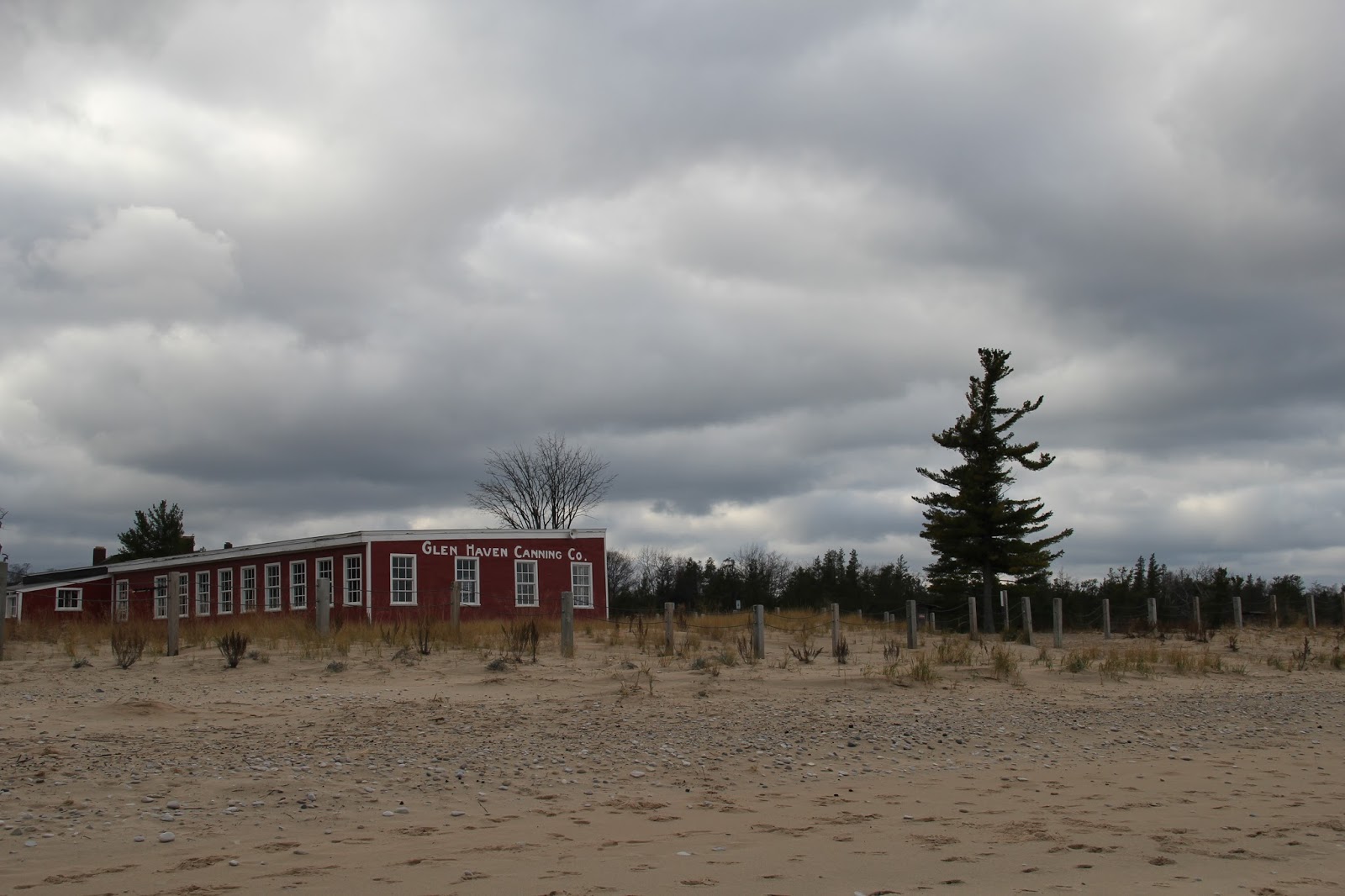
After leaving Empire, we next made a stop at Glen Haven. Glen Haven is a restored fishing village located within Sleeping Bear Dunes National Lakeshore.
Our final shoreline stop of the day was the Mission Point Lighthouse located at the tip of the Old Mission Peninsula that divides the East Arm and West Arm of Grand Traverse Bay. This is one of my favorite places to photograph.
The first set of photos was taken at the Empire municipal beach. Despite years of visiting this part of the state. This was the first time that we have ever stopped at this beach.
After leaving Empire, we next made a stop at Glen Haven. Glen Haven is a restored fishing village located within Sleeping Bear Dunes National Lakeshore.
Our final shoreline stop of the day was the Mission Point Lighthouse located at the tip of the Old Mission Peninsula that divides the East Arm and West Arm of Grand Traverse Bay. This is one of my favorite places to photograph.
Tuesday, October 14, 2014
Earth Science Week - Tuesday
Every day of Earth Science Week has a focus. The focus today is "No Child Left Inside". There is a lot of research that shows that the average child today spends less time playing outside that his/her parent's generation did. While there are many reasons for this, the point is that kids need to spend more time outside. What better way to spend time outside and learn about earth science than to go somewhere and pick up rocks.
Interesting rocks can be found throughout Mid-Michigan. The glaciers that covered Michigan during the Ice Age picked up rocks from further north (Canada) and dumped them across Michigan. Any time you did a hole in Mid-Michigan you are likely to come across rocks that are not only hundreds of millions of years old, but that have also traveled hundreds of miles from where they formed.
Rather than digging holes to search for rocks, I would rather go to a place where I can look over thousands of rocks at once. There is no better place to do this than a rocky beach. I have two favorite beaches where I like to search for rocks. Unfortunately neither one is very close to Mid-Michigan.
Peterson Park Beach
Peterson Park Beach is located near the tip of the Leelanau Peninsula (Michigan's pinkie finger). Unlike the sandy beaches that can be found along most of Northwest Michigan, the beach at Peterson Park is covered with rocks. Most of the rocks range from fingernail to fist-size, but larger ones can be found in the water offshore. The rocks are variety of igneous, sedimentary, and metamorphic types and represent the many types of bedrock found in the Canadian Shield and Michigan Basin.
If you go to Peterson Park make sure that you bring a bucket to carry your treasures home. You will want to limit how many rocks you collect - it's 114 stairs back up to the parking lot...
Click here for directions to Peterson Park from Mt. Pleasant.
Peterson Park is my favorite place in the Lower Peninsula to pick up beach rocks, but my favorite place in Michigan to look for rocks is in the Upper peninsula.
Muskallonge Lake State Park Beach.
Muskallonge Lake is located about 4 1/2 hours from Mt. Pleasant, Muskallonge Lake State Park is located in Luce County in Michigan's Upper Peninsula. The park is situated between Muskallonge Lake and Lake Superior and includes two miles of Lake Superior Beach. Storms and waves constantly bring a new supply of rocks to the beach. The rocks here are concentrated along the edge of the water with sand higher up the beach. Again, the rocks come mainly from bedrock types found in the Canadian Shield - lucky searchers find Lake Superior Agates. There is no stairway to climb back up here so you can easily collect as many rocks as you want to carry. On our last trip to the park we brought back about 3 gallons of rocks.
The campground at Muskallonge Lake State Park is one of my favorites in Michigan. On one clear night we spent about an hour lying on a picnic table staring up at the innumerable stars.
Click here for directions to Muskallonge Lake from Mt. Pleasant.
Interesting rocks can be found throughout Mid-Michigan. The glaciers that covered Michigan during the Ice Age picked up rocks from further north (Canada) and dumped them across Michigan. Any time you did a hole in Mid-Michigan you are likely to come across rocks that are not only hundreds of millions of years old, but that have also traveled hundreds of miles from where they formed.
Rather than digging holes to search for rocks, I would rather go to a place where I can look over thousands of rocks at once. There is no better place to do this than a rocky beach. I have two favorite beaches where I like to search for rocks. Unfortunately neither one is very close to Mid-Michigan.
Peterson Park Beach
Peterson Park Beach is located near the tip of the Leelanau Peninsula (Michigan's pinkie finger). Unlike the sandy beaches that can be found along most of Northwest Michigan, the beach at Peterson Park is covered with rocks. Most of the rocks range from fingernail to fist-size, but larger ones can be found in the water offshore. The rocks are variety of igneous, sedimentary, and metamorphic types and represent the many types of bedrock found in the Canadian Shield and Michigan Basin.
| Peterson Park Beach |
| The rocks extend out into the lake. |
| Sizes, shapes, and colors of Peterson Park Beach rocks |
If you go to Peterson Park make sure that you bring a bucket to carry your treasures home. You will want to limit how many rocks you collect - it's 114 stairs back up to the parking lot...
| The stairway down to the beach. |
Click here for directions to Peterson Park from Mt. Pleasant.
Peterson Park is my favorite place in the Lower Peninsula to pick up beach rocks, but my favorite place in Michigan to look for rocks is in the Upper peninsula.
Muskallonge Lake State Park Beach.
Muskallonge Lake is located about 4 1/2 hours from Mt. Pleasant, Muskallonge Lake State Park is located in Luce County in Michigan's Upper Peninsula. The park is situated between Muskallonge Lake and Lake Superior and includes two miles of Lake Superior Beach. Storms and waves constantly bring a new supply of rocks to the beach. The rocks here are concentrated along the edge of the water with sand higher up the beach. Again, the rocks come mainly from bedrock types found in the Canadian Shield - lucky searchers find Lake Superior Agates. There is no stairway to climb back up here so you can easily collect as many rocks as you want to carry. On our last trip to the park we brought back about 3 gallons of rocks.
| The Lake Superior Beach at Muskallonge Lake State Park |
| A closer view of the beach rocks |
| Lake Superior's waves constantly bring new rocks toward shore. |
The campground at Muskallonge Lake State Park is one of my favorites in Michigan. On one clear night we spent about an hour lying on a picnic table staring up at the innumerable stars.
Click here for directions to Muskallonge Lake from Mt. Pleasant.
Wednesday, November 13, 2013
November in Northwest Michigan
November comes,
And November goes
With the last red berries
And the first white snows,
With night coming early
And dawn coming late,
And ice in the bucket
And frost by the gate.
The fires burn
And the kettles sing,
And earth sinks to rest
Until next spring.
-Elizabeth Coatsworth
And November goes
With the last red berries
And the first white snows,
With night coming early
And dawn coming late,
And ice in the bucket
And frost by the gate.
The fires burn
And the kettles sing,
And earth sinks to rest
Until next spring.
-Elizabeth Coatsworth
"November"
This past weekend offered us one last time to visit Sleeping Bear Dunes National Lakeshore and the rest of northwest Michigan before winter sets in. While many of the facilities Sleeping Bear Dunes are closed down for the season, the park is just as beautiful as it is during the Spring and Summer. The big advantage to visiting in the "off-season" is that you will have the park almost to yourself - many of the places that we stopped at in the park were completely deserted. This was a nice contrast to Summer when there is no place to park and other visitors always at hand.
Sunday was cold and windy, with beautiful cloud formations during the entire day.
![]() |
| Poplar trees with Glen Lake in the background |
![]() |
| Bare poplar trees |
![]() |
| Dune Climb - Sleeping Bear Dunes |
![]() |
| Red, White & Blue - Highbush Cranberry (red), Red Osier Dogwood (white) and Riverbank Grape (blue) |
![]() |
| "the last red berries" |
![]() |
| Beach rocks and clouds - the view west at Glen Haven |
![]() |
| The view east at Glen Haven |
| Waves crashing on the seawall at the "Open Space" in Traverse City |
| "and the first white snows" |
Subscribe to:
Posts (Atom)