The best part of my job is getting students outdoors. I especially enjoy getting them into the woods to study forestry and forest ecology
Want to make a kid's jaw drop? Tell them that they are going to count how many trees are in a forest. Even better is to tell them that they have to find out how many leaves can be found on the forest floor or that they have to find out how the leaves weigh!
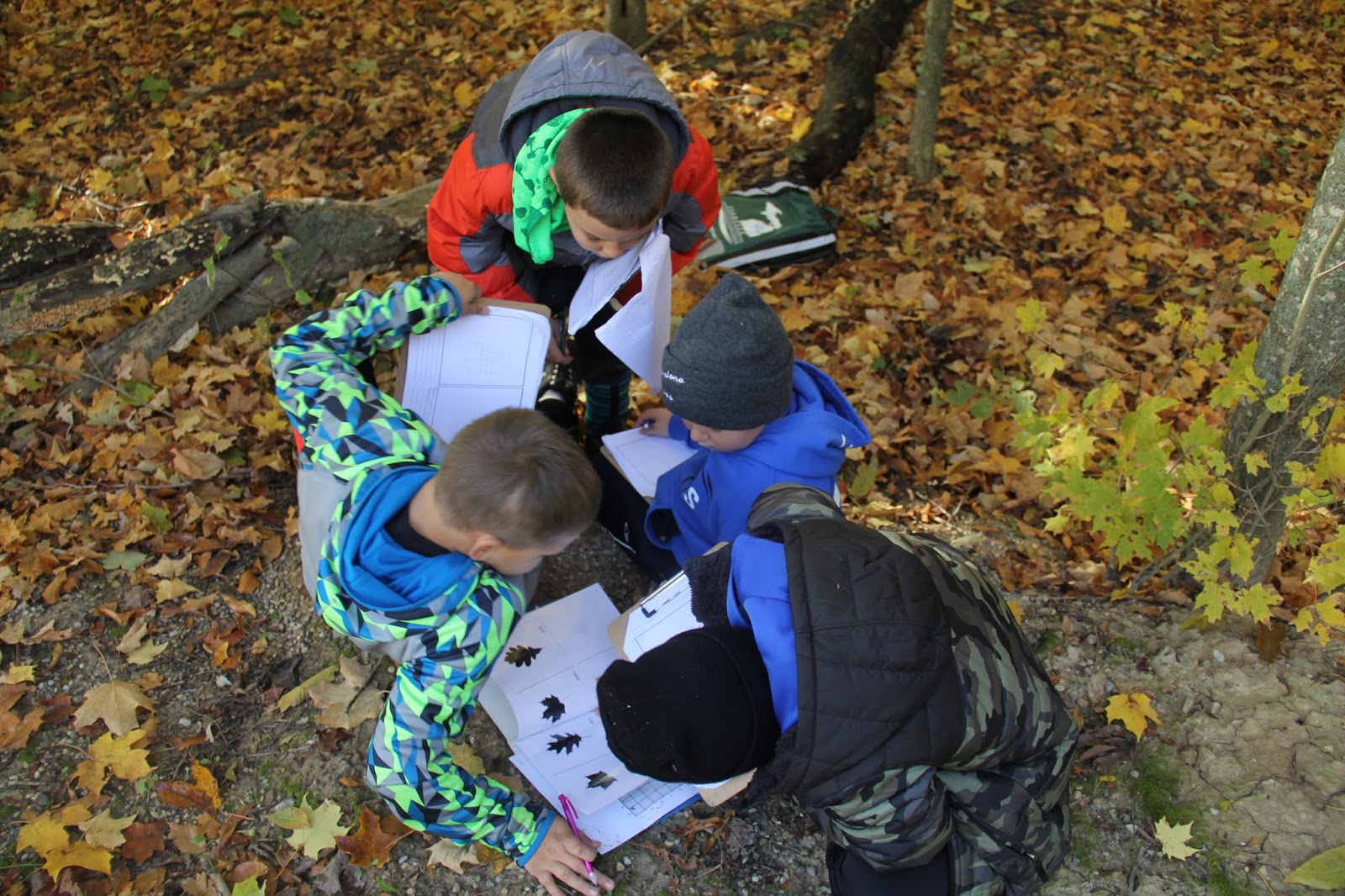
I always manage to get lots of students outdoors in the spring, but this year I made an effort to schedule more field explorations for the fall. Over the past three weeks, I was able to get eleven classrooms from four different schools out into the woods. Two of the classrooms have been out in the woods with me before, but for the other nine classes it was a completely new experience. It's always interesting to see how the students (and their teachers) react to the independence.
Here are a few pictures from three of the schools. (Unfortunately, it looks like I did not take any photos of the two classrooms from the fourth school.) The students in these photos are counting leaves in a square foot plot (or quadrat), collecting leaves to weigh, measuring the forest canopy using a clear grid, and identifying leaves using a guide.
12 October 2018 - Winn Elementary at Audubon Woods
16 October 2018 and 19 October 2018 - Mary McGuire Elementary at Mission Creek Park
25 October 2018 - Beal City Elementary at Beal City School woodlot
Showing posts with label forest. Show all posts
Sunday, October 28, 2018
Monday, September 17, 2018
The Days of Summer - Day Eighty through Day Eighty-six
Summer is nearly at an end. This is my next-to-last installment of my Days of Summer photography project. I began this project on the Summer Solstice (21 June 2018) with the idea that I would photograph something in nature every day until the Fall Equinox (22 September 2018) and share one image from each day of the summer. If you've missed the previous seventy-nine photographs, you can start to get caught with the images that I shared last week.
Day 80 (08 September) - Golden
This image of the sun shining through a Boxelder (Acer negundo) was photographed at Forest Hill Nature Area. This is one of my favorite photos of the summer. In addition to the sun, I like the contrast of the light sky with the band of dark trees on the horizon, the goldenrods lit up by the setting sun and the shadows in the foreground.
Day 81 (09 September) - Eastern Hemlock
We spend so much time looking down, sometimes we need to remember to look up. This photograph was taken during a hike at the Chippewa Watershed Conservancy's (CWC) Audubon Woods Preserve. Audubon Woods is my favorite CWC nature preserve. On September 9th, I led a group on an off-trail hike at the preserve. One of the sites that I led the group to was this small grove of Eastern Hemlock (Tsuga canadensis) trees. Most visitors to the preserves never leave the established trails and I wanted to show off some of my favorite sites in the woods including this grove.
Day 82 (10 September) - Milkweed Portrait
When I started this project I knew that it would be a challenge to take a good nature photo every day, especially once school started. Fortunately there are many local parks and preserves that can be easily accessed within a few minutes distance from schools or the office. On September 10th, I did my first school programs of the 2018-19 School Year. This photo was taken in the field behind the Conservation District offices after completing my classroom presentations for the day.
Day 83 (11 September) - Ah-choo!
This picture was taken at Chipp-A-Waters Park in Mt. Pleasant. This bumble bee (and a bunch of other insects) were eating pollen and nectar from Sneezeweed (Helenium autumnale) blossoms. I took several pictures of this bee as it foraged, but this was my favorite. I like how you can see the bee's long tongue as it sips nectar. I have never found Sneezeweed growing wild in Mt. Pleasant. These flowers were planted about a decade ago as part of restoration project.
Day 84 (12 September) - Fall Abstract
I photographed these poplar leaves at the Conservation District offices. This trees has been changing color and dropping leaves for about a week. I thought about cropping the right leaf out of the picture to make the picture more of an abstract image, but decided that I liked the contrast of color.
Day 85 (13 September) - Coral Mushrooms
Recent rains have caused fungi to fruit in every local woods. This image of coral mushrooms was taken at the CWC's Sylvan Solace Preserve. I think this is one of several species of Ramaria fungi - there are several yellow Ramaria species that can be difficult to tell apart. I would have liked to have taken several more images of this mushroom, but the rains have also caused mosquito populations to explode! I couldn't stop in one place for more than a few seconds. I am generally pretty tolerant of mosquitos, but they are absolutely miserable right now.
Day 86 (14 September) - Bean Fields
The final image for the week was taken in southern Isabella County. Mid-Michigan is farm country and soy beans are one of the major crops. I really liked the color of the sky when I took this picture and wanted to find the simplest landscape that I could. The row of trees blocked out more distant elements and let me focus on the field and sky without worrying about other distractions. The color of the ripening bean fields, sky, and clouds remind me of an impressionist landscape painting.
I hope that you have been enjoying viewing this series of photographs as much as I have enjoyed capturing them. I am into the final week of the project and I don't know what my next photographic journey will be.
Day 80 (08 September) - Golden
This image of the sun shining through a Boxelder (Acer negundo) was photographed at Forest Hill Nature Area. This is one of my favorite photos of the summer. In addition to the sun, I like the contrast of the light sky with the band of dark trees on the horizon, the goldenrods lit up by the setting sun and the shadows in the foreground.
Day 81 (09 September) - Eastern Hemlock
Day 82 (10 September) - Milkweed Portrait
When I started this project I knew that it would be a challenge to take a good nature photo every day, especially once school started. Fortunately there are many local parks and preserves that can be easily accessed within a few minutes distance from schools or the office. On September 10th, I did my first school programs of the 2018-19 School Year. This photo was taken in the field behind the Conservation District offices after completing my classroom presentations for the day.
Day 83 (11 September) - Ah-choo!
This picture was taken at Chipp-A-Waters Park in Mt. Pleasant. This bumble bee (and a bunch of other insects) were eating pollen and nectar from Sneezeweed (Helenium autumnale) blossoms. I took several pictures of this bee as it foraged, but this was my favorite. I like how you can see the bee's long tongue as it sips nectar. I have never found Sneezeweed growing wild in Mt. Pleasant. These flowers were planted about a decade ago as part of restoration project.
Day 84 (12 September) - Fall Abstract
I photographed these poplar leaves at the Conservation District offices. This trees has been changing color and dropping leaves for about a week. I thought about cropping the right leaf out of the picture to make the picture more of an abstract image, but decided that I liked the contrast of color.
Day 85 (13 September) - Coral Mushrooms
Recent rains have caused fungi to fruit in every local woods. This image of coral mushrooms was taken at the CWC's Sylvan Solace Preserve. I think this is one of several species of Ramaria fungi - there are several yellow Ramaria species that can be difficult to tell apart. I would have liked to have taken several more images of this mushroom, but the rains have also caused mosquito populations to explode! I couldn't stop in one place for more than a few seconds. I am generally pretty tolerant of mosquitos, but they are absolutely miserable right now.
Day 86 (14 September) - Bean Fields
The final image for the week was taken in southern Isabella County. Mid-Michigan is farm country and soy beans are one of the major crops. I really liked the color of the sky when I took this picture and wanted to find the simplest landscape that I could. The row of trees blocked out more distant elements and let me focus on the field and sky without worrying about other distractions. The color of the ripening bean fields, sky, and clouds remind me of an impressionist landscape painting.
I hope that you have been enjoying viewing this series of photographs as much as I have enjoyed capturing them. I am into the final week of the project and I don't know what my next photographic journey will be.
Labels:
bumble bee,
clouds,
farms,
fields,
forest,
fungi,
leaves,
milkweed,
photography,
sun,
trees,
wildflowers
Tuesday, May 29, 2018
Forestry with Winn Elementary (23 & 24 May 2018)
Last week I spent two days (Wednesday 23 May & Thursday 24 May 2018) working with students from Winn Elementary at Audubon Woods Preserve. On Wednesday the Third and Forth Grade classrooms each spent half a day at the preserve. On Thursday the Fifth Grade class spent the entire day (minus a break for lunch back at the school) in the woods.
The students were doing a variety of activities related to forestry and forest ecology. Activities included measurement of tree diameter, using a compass and measuring tape to map trees in 1/10th acre plots, estimating the number of leaves on the forest floor, estimating the weight of all the leaves, measuring canopy cover, identifying and sketching leaves; and sketching the layers in the forest.
This might seem like a lot of work, but this is not the first time these students have visited Audubon Woods. Third Grade students visited once last fall, and the other two grades have visited at least once a year since they were in Third Grade. By now the Fifth Graders are quite familiar with the preserve and the activities they are being asked to accomplish. The lower grades have less time available on site and less experience so they correspondingly do less work.
Here are a few images of the students hard at work as well as some nature photos from the two days.
Wednesday 23 May 2018
The students were doing a variety of activities related to forestry and forest ecology. Activities included measurement of tree diameter, using a compass and measuring tape to map trees in 1/10th acre plots, estimating the number of leaves on the forest floor, estimating the weight of all the leaves, measuring canopy cover, identifying and sketching leaves; and sketching the layers in the forest.
This might seem like a lot of work, but this is not the first time these students have visited Audubon Woods. Third Grade students visited once last fall, and the other two grades have visited at least once a year since they were in Third Grade. By now the Fifth Graders are quite familiar with the preserve and the activities they are being asked to accomplish. The lower grades have less time available on site and less experience so they correspondingly do less work.
Here are a few images of the students hard at work as well as some nature photos from the two days.
Wednesday 23 May 2018
| The compass is an important forestry tool |
| Mapping the location and size of trees |
Tuesday, May 8, 2018
Forestry for Fifth Graders (07 & 08 May 2018)
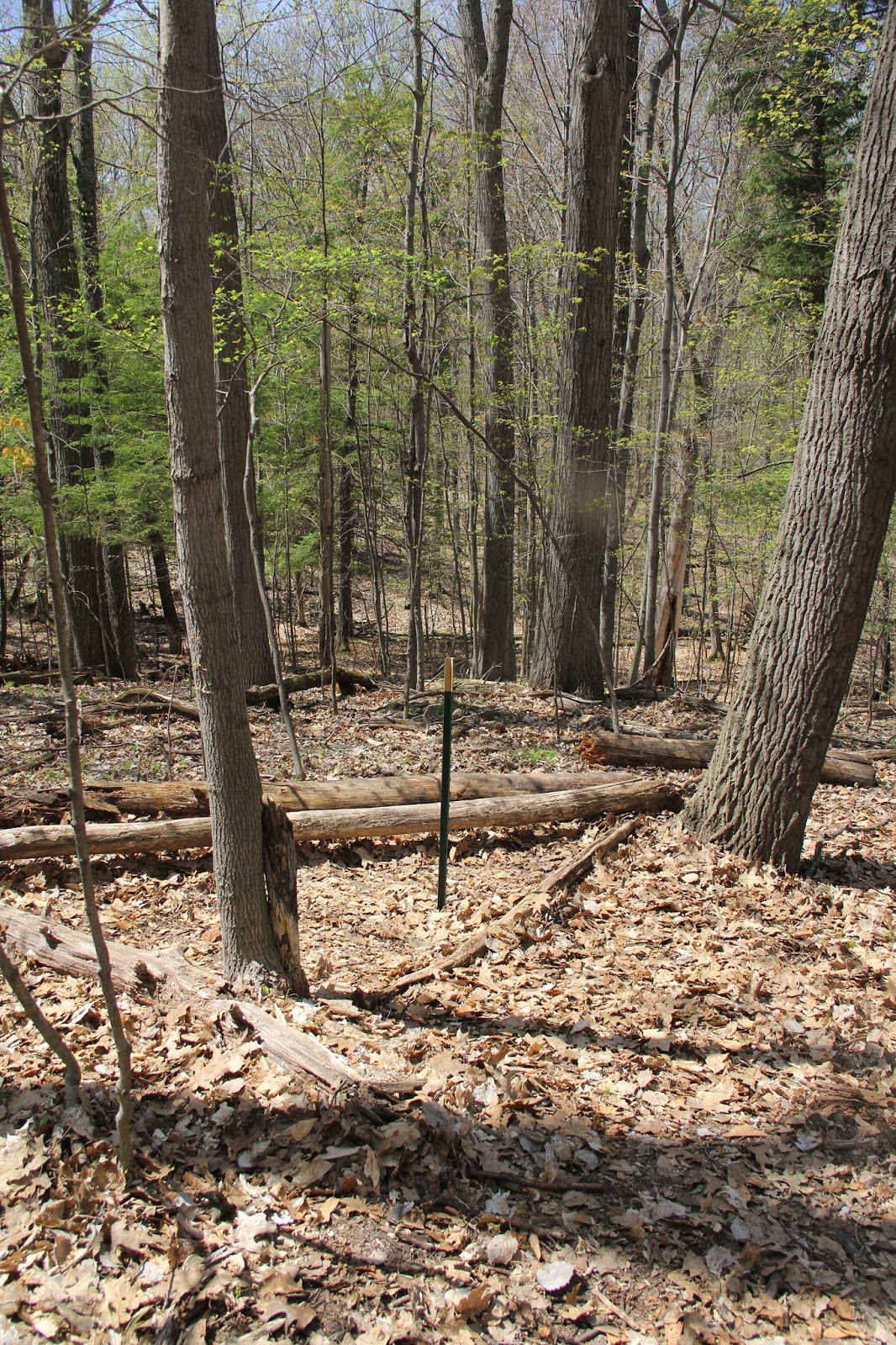
If you have visited the Chippewa Watershed Conservancy's Audubon Woods Preserve in the past week you may have noticed some metal T-posts that weren't there before.
Why are these posts at Audubon Woods? What are they for?
For the past seven years, I have used Audubon Woods as an outdoor science classroom for local elementary students. The T-posts are meant to be semi-permanent education stations. In the past, every time I took students to Audubon Woods I would set up temporary stations at somewhat random points in the woods. There is a lot that can be done by using temporary points, but more can be learned long term if students use the same locations time after time.
With permission, I set about placing posts along a series of transects (lines) throughout the woods. I set up three transects at regularly spaced intervals in the woods and placed six evenly-spaced posts along each transect. Now with semi-permanent locations, data that the students collect can be compared over time.
So what kinds of data are the students collecting?
Over the past two day (07 & 08 MAY 2018) I have been working with fifth grade students from Shepherd Elementary. These classes were able to travel to Audubon Woods because last fall their teachers applied for and received a Wheels To Woods field trip grant.
Students are measuring the circumference of trees in their study plot and using that to calculate diameter.
Students are also counting trees at their study plot to determine the number of trees in one acre of forest and in the entire forest. Audubon Woods is 40 acres in size - at 43,560 sq. ft/acre, that means Audubon Woods is 1,742,400 sq. ft! Counting all of the trees in an area this size would be an impossible task. Luckily, it is easy to count the number of trees in a much smaller area and then use that number to estimate the total number of trees in the forest. A circle with a radius of approximately 37 feet will have an area of 1/10 acre. Remember those T-posts? Students counted every tree within 37 feet of the post and used multiplied that number by 10 to find the number of trees in one acre and then again by 40 to find the total number of trees in Audubon Woods.
Students then calculated the number of leaves on the forest floor by counting the number of leaves in one square foot and then multiplying by 43,560 to get the number of leaves in one acre, and then by 40 to get the total number of leaves on the floor of Audubon Woods. Imagine if a single square foot holds exactly 100 leaves, this would calculate out to over 172 million leaves in the forest!
Students also calculated the weight of all the leaves in the forest, identified and sketched leaves, and drew a sketch of the forest near their study plot. Perhaps just as important as the science, this field trip allowed students to get out of the classroom for a few hours. The months of April and May are testing time in Michigan. Students spend hours taking state-mandated assessments and even more hours taking tests required by their local school district. A field trip like this exposes them to sights, sounds, and smells that thy can never experience in the classroom.
| A metal T-post standing alone at Audubon Woods Preserve |
Why are these posts at Audubon Woods? What are they for?
For the past seven years, I have used Audubon Woods as an outdoor science classroom for local elementary students. The T-posts are meant to be semi-permanent education stations. In the past, every time I took students to Audubon Woods I would set up temporary stations at somewhat random points in the woods. There is a lot that can be done by using temporary points, but more can be learned long term if students use the same locations time after time.
With permission, I set about placing posts along a series of transects (lines) throughout the woods. I set up three transects at regularly spaced intervals in the woods and placed six evenly-spaced posts along each transect. Now with semi-permanent locations, data that the students collect can be compared over time.
So what kinds of data are the students collecting?
Over the past two day (07 & 08 MAY 2018) I have been working with fifth grade students from Shepherd Elementary. These classes were able to travel to Audubon Woods because last fall their teachers applied for and received a Wheels To Woods field trip grant.
Students are measuring the circumference of trees in their study plot and using that to calculate diameter.
| Measuring a tree's circumference |
| Measuring large trees takes teamwork |
Students are also counting trees at their study plot to determine the number of trees in one acre of forest and in the entire forest. Audubon Woods is 40 acres in size - at 43,560 sq. ft/acre, that means Audubon Woods is 1,742,400 sq. ft! Counting all of the trees in an area this size would be an impossible task. Luckily, it is easy to count the number of trees in a much smaller area and then use that number to estimate the total number of trees in the forest. A circle with a radius of approximately 37 feet will have an area of 1/10 acre. Remember those T-posts? Students counted every tree within 37 feet of the post and used multiplied that number by 10 to find the number of trees in one acre and then again by 40 to find the total number of trees in Audubon Woods.
| Tape measures are an important forestry tool |
| Measuring trees to make sure they fit in their plot |
Students then calculated the number of leaves on the forest floor by counting the number of leaves in one square foot and then multiplying by 43,560 to get the number of leaves in one acre, and then by 40 to get the total number of leaves on the floor of Audubon Woods. Imagine if a single square foot holds exactly 100 leaves, this would calculate out to over 172 million leaves in the forest!
| Students had a square made from PVC pipe to make their task easier |
| Counting leaves from a single square foot of forest |
| Re-calculating... |
Students also calculated the weight of all the leaves in the forest, identified and sketched leaves, and drew a sketch of the forest near their study plot. Perhaps just as important as the science, this field trip allowed students to get out of the classroom for a few hours. The months of April and May are testing time in Michigan. Students spend hours taking state-mandated assessments and even more hours taking tests required by their local school district. A field trip like this exposes them to sights, sounds, and smells that thy can never experience in the classroom.
| Large-flowered Trillium |
| Trillium surrounded by Mayapple |
| Spring Beauty flowers |
| Bloodroot |
| Skunk Cabbage |
| Wood Frogs were everywhere hidden among the leaves |
| Another Bloodroot flower |
| The maples and other trees are just starting to leaf out |
Subscribe to:
Posts (Atom)