Showing posts with label forestry. Show all posts

Friday, June 21, 2019

Vernal: A Spring Photo Project (Day 61 through Day 70)

To this point I've shared two months worth of spring photographs.  As of today (June 21st) spring has reached its end, but I have a months worth of photographs still to share.  Here are the photos from day 61 through day 70.  To see the previous set of images follow this link.

Day 61 (19 May 2019) - Plum flowers


We have a plum tree right outside our back door.  It rarely produces much fruit, but every spring it is absolutely covered with blossoms.  I photographed these flowers after a light rain covered everything with water and softened the light.

Day 62 (20 May 2019) - Audubon Woods Creek


Another rainy day.  This image was taken in a light drizzle at the Chippewa Watershed Conservancy's Audubon Woods Preserve.  The CWC owns 23 separate properties, but Audubon Woods is my favorite because of the mature trees.  The center of the preserve can often feel ten degrees cooler than the edge.  The water trickling over these rocks helps add moisture to the air cooling it even further.  Even the color of the woods feels cool as the mist in the air diffuses the light making everything glow green as the sunlight penetrates the forest canopy.

Day 63 (21 May 2019) - Dandelions 


Spring wouldn't be spring without dandelions.  Homeowners may not love them, but the bees and other pollinators do.  Some people are taking notice - the Ziibiwing Center of Anishinabe Culture has adopted the policy of not mowing until the dandelions have gone to seed.  I photographed this dandelion bloom in the lawn at the Isabella Conservation District office.

Day 64 (22 May 2019) - Forest Ecology Studies 


Most of the programs that I do are in the classroom out of necessity, but every year I take students from Winn Elementary out to Audubon Woods to explore forestry and forest ecology.  In this photograph the students are measuring the distance from a stake (representing the center a 0.1 acre plot) to a tree in their study plot.  If the tree is within 37 feet of the stake (the radius of a 0.1 acre plot), they will then get an azimuth to the tree, measure the diameter of the tree, and record all of this date on a map of their plot.  I keep copies of all this date in the hope that it can be used to record changes in the forest over time.

Day 65 (23 May 2019) - Look up...


May 23rd was another day of forest ecology studies at Audubon Woods.  I think actually took more photographs of students on this day than I did on the 22nd, but my favorite photo of the day was taken when the students had gone back to school for lunch.  Looking up, I spotted this combination of blue sky, white clouds, dark branches, and yellow-green leaves.  With the sun lighting up the edge of a cloud formation I couldn't resist this photograph.

Day 66 (24 May 2019) - Honey Locust Thorn 


This photograph was taken right outside my back door.  We have a large honey locust (Gleditsia triacanthos) growing only a few feet from the house.  This tree provides lots of shade in the summer and a home for many species of birds and insects (not to mention squirrels).  The most interesting thing about the tree is the large thorns that grow from a few branches.  The honey locust originally developed these thorns as defense against ice age mammals - now they are just a reminder of a time when elephants walked the tundra and forests of North America.

Day 67 (25 May 2019) - Fern Frond 


Another photograph from home.  This fern covered with a layer of fine spider webs was photographed in the garden on the side of the house.  This image has been cropped to a square from its original format.

Day 68 (26 May 2019) - Home, Sweet Home


On May 26th we drove about forty-five minutes from home to visit my parents near Laingsburg, MI.  At one point I took a few minutes to walk around their property looking for something to photograph.  As I walked past this nesting box in a wooded area, a wren popped its head out of the box.  It's not grand architecture, but it's good enough for a wren.  If you look close you can see the wren's toes gripping the entrance hole.  The bird looked at me for a few seconds and then flew off into the underbrush.

Day 69 (27 May 2019) - Iris


When we moved into our house eight years ago there was already a patch of irises planted on the south side of the house.  I think these are Siberian iris, but am not certain.  I love the nectar guides on each large landing pad of a petal directing pollinators toward the nectar (and pollen).  The large serrated leaves in the background belong to cut-leaved coneflower (Rudbeckia laciniata).

Day 70 (28 May 2019) - Wild Columbine 


My final image from this set of photos was taken at the Chippewa Watershed Conservancy's Williams-Blackburn Preserve.  Wild Columbine (Aquilegia Canadensis) is one of my favorite late-spring wildflowers.  It's very photogenic when the flowers are fully mature (like this one), but I often miss out on finding them so it's always exciting to find a perfect bloom.  One really interesting thing to me about these flowers is how hairy they are.  Look close and you can see that the petals, stem, and leaves are all covered with minute hairs.  I like being able to peer in and see that level of detail.

Sunday, October 28, 2018

Fall Forestry Studies

The best part of my job is getting students outdoors.  I especially enjoy getting them into the woods to study forestry and forest ecology

Want to make a kid's jaw drop?  Tell them that they are going to count how many trees are in a forest.  Even better is to tell them that they have to find out how many leaves can be found on the forest floor or that they have to find out how the leaves weigh!

I always manage to get lots of students outdoors in the spring, but this year I made an effort to schedule more field explorations for the fall.  Over the past three weeks, I was able to get eleven classrooms from four different schools out into the woods.  Two of the classrooms have been out in the woods with me before, but for the other nine classes it was a completely new experience.  It's always interesting to see how the students (and their teachers) react to the independence.

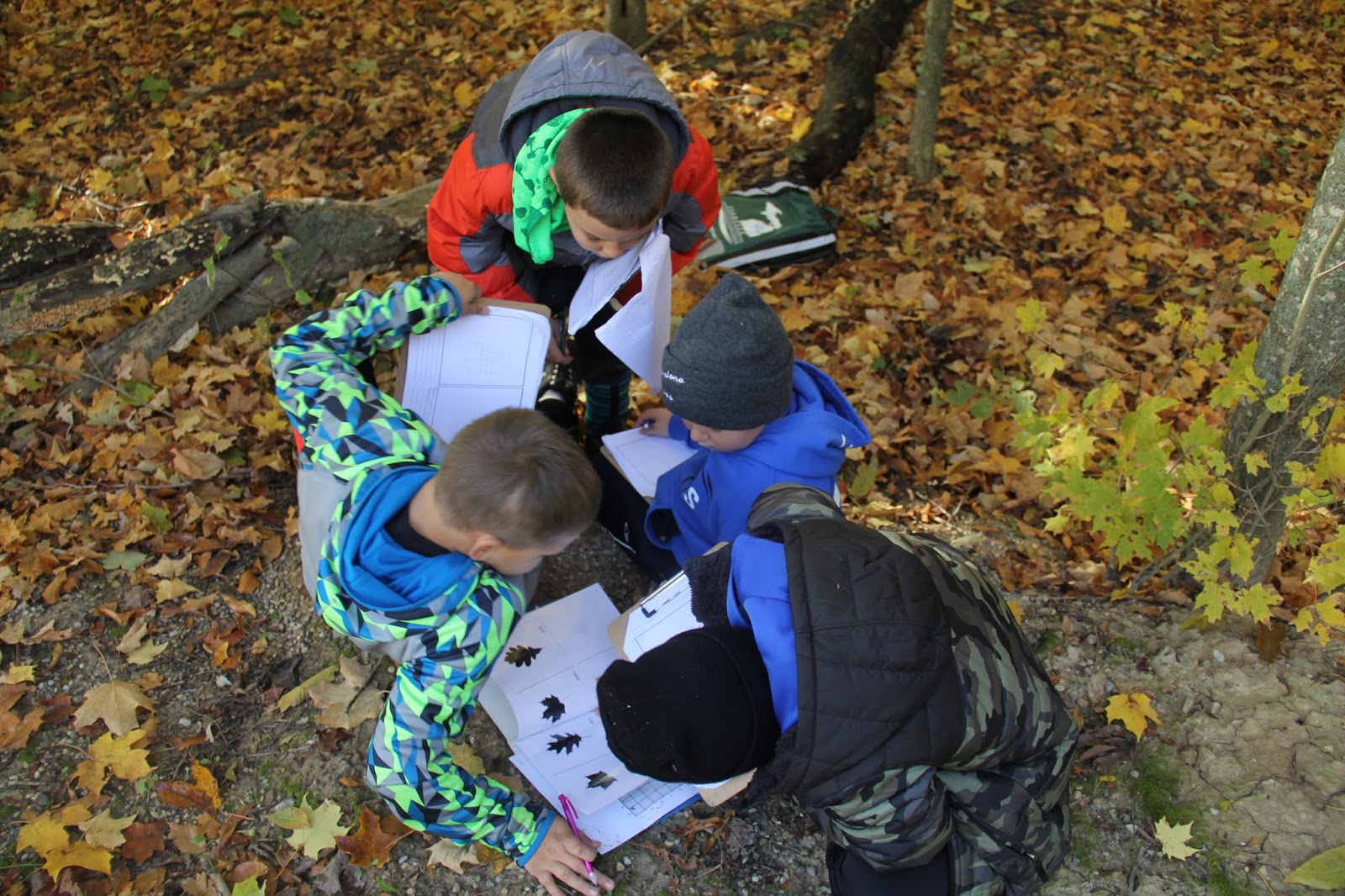
Here are a few pictures from three of the schools.  (Unfortunately, it looks like I did not take any photos of the two classrooms from the fourth school.)  The students in these photos are counting leaves in a square foot plot (or quadrat), collecting leaves to weigh, measuring the forest canopy using a clear grid, and identifying leaves using a guide. 

12 October 2018 - Winn Elementary at Audubon Woods


16 October 2018 and 19 October 2018 - Mary McGuire Elementary at Mission Creek Park


25 October 2018 - Beal City Elementary at Beal City School woodlot


Tuesday, May 29, 2018

Forestry with Winn Elementary (23 & 24 May 2018)

Last week I spent two days (Wednesday 23 May & Thursday 24 May 2018) working with students from Winn Elementary at Audubon Woods Preserve.  On Wednesday the Third and Forth Grade classrooms each spent half a day at the preserve.  On Thursday the Fifth Grade class spent the entire day (minus a break for lunch back at the school) in the woods.

The students were doing a variety of activities related to forestry and forest ecology.  Activities included measurement of tree diameter, using a compass and measuring tape to map trees in 1/10th acre plots, estimating the number of leaves on the forest floor, estimating the weight of all the leaves, measuring canopy cover, identifying and sketching leaves; and sketching the layers in the forest.

This might seem like a lot of work, but this is not the first time these students have visited Audubon Woods.  Third Grade students visited once last fall, and the other two grades have visited at least once a year since they were in Third Grade.  By now the Fifth Graders are quite familiar with the preserve and the activities they are being asked to accomplish.  The lower grades have less time available on site and less experience so they correspondingly do less work.

Here are a few images of the students hard at work as well as some nature photos from the two days.

Wednesday 23 May 2018


The compass is an important forestry tool

Mapping the location and size of trees

Tuesday, May 8, 2018

Forestry for Fifth Graders (07 & 08 May 2018)

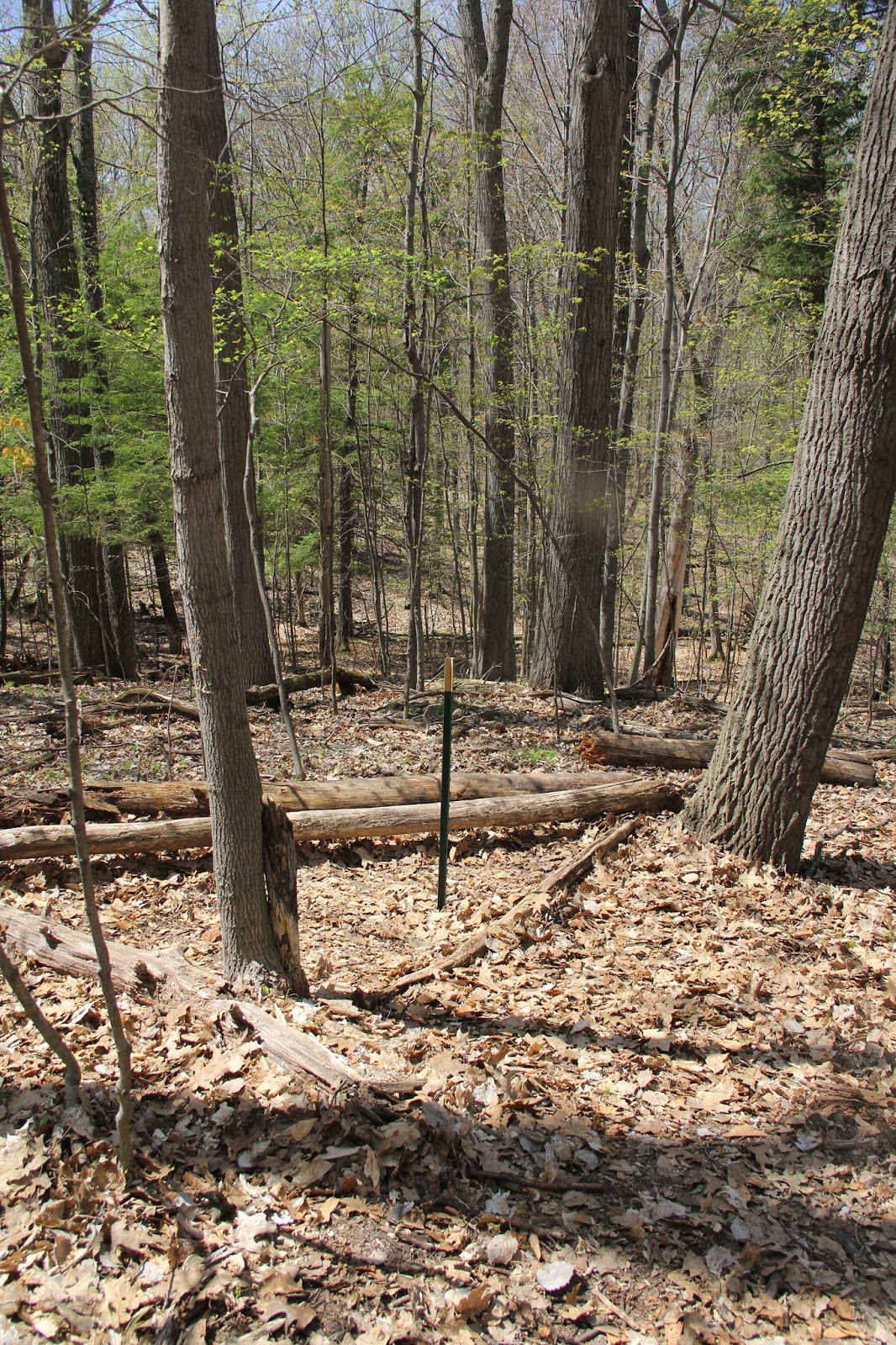
If you have visited the Chippewa Watershed Conservancy's Audubon Woods Preserve in the past week you may have noticed some metal T-posts that weren't there before.

A metal T-post standing alone at Audubon Woods Preserve

Why are these posts at Audubon Woods?  What are they for?

For the past seven years, I have used Audubon Woods as an outdoor science classroom for local elementary students.  The T-posts are meant to be semi-permanent education stations.  In the past, every time I took students to Audubon Woods I would set up temporary stations at somewhat random points in the woods.  There is a lot that can be done by using temporary points, but more can be learned long term if students use the same locations time after time.

With permission, I set about placing posts along a series of transects (lines) throughout the woods.  I set up three transects at regularly spaced intervals in the woods and placed six evenly-spaced posts along each transect.  Now with semi-permanent locations, data that the students collect can be compared over time.

So what kinds of data are the students collecting?

Over the past two day (07 & 08 MAY 2018) I have been working with fifth grade students from Shepherd Elementary.  These classes were able to travel to Audubon Woods because last fall their teachers applied for and received a Wheels To Woods field trip grant. 

Students are measuring the circumference of trees in their study plot and using that to calculate diameter.

Measuring a tree's circumference

Measuring large trees takes teamwork


Students are also counting trees at their study plot to determine the number of trees in one acre of forest and in the entire forest.  Audubon Woods is 40 acres in size - at 43,560 sq. ft/acre, that means Audubon Woods is 1,742,400 sq. ft!  Counting all of the trees in an area this size would be an impossible task.  Luckily, it is easy to count the number of trees in a much smaller area and then use that number to estimate the total number of trees in the forest.  A circle with a radius of approximately 37 feet will have an area of 1/10 acre.   Remember those T-posts?  Students counted every tree within 37 feet of the post and used multiplied that number by 10 to find the number of trees in one acre and then again by 40 to find the total number of trees in Audubon Woods.

Tape measures are an important forestry tool

Measuring trees to make sure they fit in their plot

Students then calculated the number of leaves on the forest floor by counting the number of leaves in one square foot and then multiplying by 43,560 to get the number of leaves in one acre, and then by 40 to get the total number of leaves on the floor of Audubon Woods.  Imagine if a single square foot holds exactly 100 leaves, this would calculate out to over 172 million leaves in the forest!

Students had a square made from PVC pipe to make their task easier

Counting leaves from a single square foot of forest

Re-calculating...

Students also calculated the weight of all the leaves in the forest, identified and sketched leaves, and drew a sketch of the forest near their study plot.  Perhaps just as important as the science, this field trip allowed students to get out of the classroom for a few hours.  The months of April and May are testing time in Michigan.  Students spend hours taking state-mandated assessments and even more hours taking tests required by their local school district.  A field trip like this exposes them to sights, sounds, and smells that thy can never experience in the classroom.

Large-flowered Trillium

 
Trillium surrounded by Mayapple


Spring Beauty flowers


Bloodroot

Skunk Cabbage

Wood Frogs were everywhere hidden among the leaves

Another Bloodroot flower

The maples and other trees are just starting to leaf out