Showing posts with label change. Show all posts

Thursday, January 5, 2017

Change over time

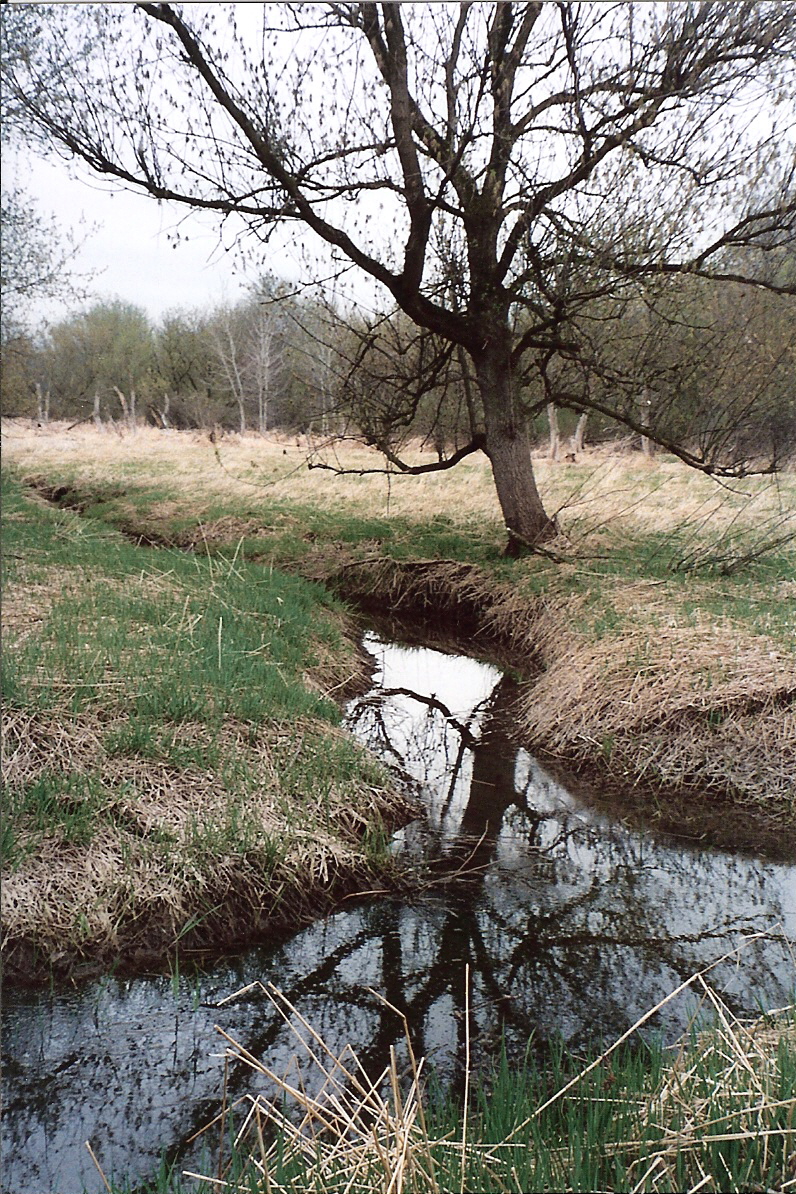
On Tuesday (03 JAN) I stopped at Mill Pond Park just to take a few photographs.  There is a small stream that runs from a cattail marsh into the Chippewa River.  Over the past 10+ years I have photographed this stream repeatedly.   The photographs are usually nothing special.  I mainly take them because it is a place that I have documented so many times in the past.  Here are two photographs from this place that show how things have changed in the past decade.

This is the first photo that I ever took of this location.  It dates from sometime in the Spring of 2006 and was taken with a film camera.  The picture was eventually scanned.  When I took this picture, I liked how the bend in the stream is matched by the branches in the Boxelder tree growing next to the bank.  I also liked how the tree was reflected in the stream.


Here is the same location, photographed this week.  The Boxelder tree has long since died and fallen over.  The remaining trunk and branches lay over the stream.  Given a few more years, the trunk will rot away to nothing - Boxelder is not a strong, dense, rot-resistant wood. 


 I like this ability to look back through time, to see how the landscape has changed.  Not for the better, or the worse.  It has simply changed.


Monday, December 22, 2014

Happy Solar New year!

Happy New Year!

No, not the calendar "new year".  Yesterday marked the Solar New Year

Yesterday 21 DEC 2014 at 6:03PM Eastern Standard Time, Mid-Michigan (and the rest of Earth's Northern Hemisphere) celebrated the annual Winter Solstice.  On our current calendar the Winter Solstice marks the end of Fall and the beginning of Winter.  Many ancient societies (in the Northern Hemisphere) marked the Winter Solstice as the beginning of a new year.

The word Solstice comes from the Latin words sol (sun) and sistere (to stand still).  Yesterday the sun will have reached its lowest position in the southern Sky, giving us our shortest day of the year.  On the Summer Solstice, Mid-Michigan received approximately 15 hours and 24 minutes of sunlight.  Today Mid-Michigan will see only 8 hours and 58 minutes of sunlight, but from now until the Summer Solstice each day will grow longer.

The Earth rotates around its axis approximately once every 24 hours.  However this axis is tilted at 23.5 degrees from the vertical.  The points on the globe that the axis revolves around are referred to as the North and South Poles.  The axis is always pointed toward the same location in the sky.  The North Pole points toward the "North Star" - Polaris.

As the earth revolves around the sun, sometimes the North Pole is closer to the sun, sometimes the South Pole is closer to the sun.  When the North Pole is at its closest, we experience Summer in Mid-Michigan and the Southern Hemisphere experiences Winter.  When the North Pole is at its furthest, we experience Winter and the Southern Hemisphere experiences Summer. 

If you were to arise at dawn every day of the year and record at which point on the horizon the sun rises from you would be able to track the progression from the Summer solstice (in which the sun rises furthest North) to the Winter Solstice (in which the sun rises furthest South) and back again.  Tracking the postion of the rising sun was one of the earliest astronomical observations.  Many ancient monuments were constructed to act as solar observatories, recording the longest and shortest days of the year.
Saturday, December 21, 2013

Winter Solstice

It has felt like Winter for several weeks, but Winter officially begins today at 12:11PM EST.

The moment this change of seasons occurs is known as the Winter Solstice.  The word Solstice comes from the Latin words sol (sun) and sistere (to stand still).  Today the sun will have reached its lowest position in the southern Sky, giving us our shortest day of the year.  On the Summer Solstice, Mid-Michigan received approximately 15 hours and 24 minutes of sunlight.  Today Mid-Michigan will see only 8 hours and 58 minutes of sunlight, but from now until the Summer Solstice each day will grow longer.

The Earth rotates around its axis approximately once every 24 hours.  However this axis is tilted at 23.5 degrees from the vertical.  The points on the globe that the axis revolves around are referred to as the North and South Poles.  The axis is always pointed toward the same location in the sky.  The North Pole points toward the "North Star" - Polaris.

As the earth revolves around the sun, sometimes the North Pole is closer to the sun, sometimes the South Pole is closer to the sun.  When the North Pole is at its closest, we experience Summer in Mid-Michigan and the Southern Hemisphere experiences Winter.  When the North Pole is at its furthest, we experience Winter and the Southern Hemisphere experiences Summer. 

If you were to arise at dawn every day of the year and record at which point on the horizon the sun rises from you would be able to track the progression from the Summer solstice (in which the sun rises furthest North) to the Winter Solstice (in which the sun rises furthest South) and back again.  Tracking the postion of the rising sun was one of the earliest astronomical observations.  Many ancient monuments were constructed to act as solar observatories, recording the longest and shortest days of the year.


In honor of the Solstice...

A low winter sun - Chipp-A-Waters Park, Mt. Pleasant, MI