Showing posts with label ice. Show all posts

Thursday, January 17, 2019

Trail cam pics and a walk in the January woods.

In late December I placed my trail cameras in the woods for the first time in nearly a year.  Today I went to switch out the memory cards.  Although I managed to get pictures of red fox, raccoon, squirrels, and deer (including several bucks) I was disappointed by the results and ended up moving both cameras.

A fox runs in front of the camera

Part of a herd of deer, including two bucks, passing by the camera

After moving the cameras I used the opportunity to take a walk through the woods and take some photographs.  There was no snow on the ground, but lots of ice.  My favorite photos of the day were probably those showing leaves locked in ice.  Here are a few of the images that I captured.

Bright sunlight has been a rare sight in recent days

This picture was not planned - the plane flew over just as I was taking the picture.

Flowing water carved this channel down through the ice

Many shades of brown

Living and dead trees stand bare in the winter swamp


Oak leaves trapped in ice

Coyote scat on top of a pile of deer scat

Water levels have dropped several inches since this ice formed

Eastern Hemlock


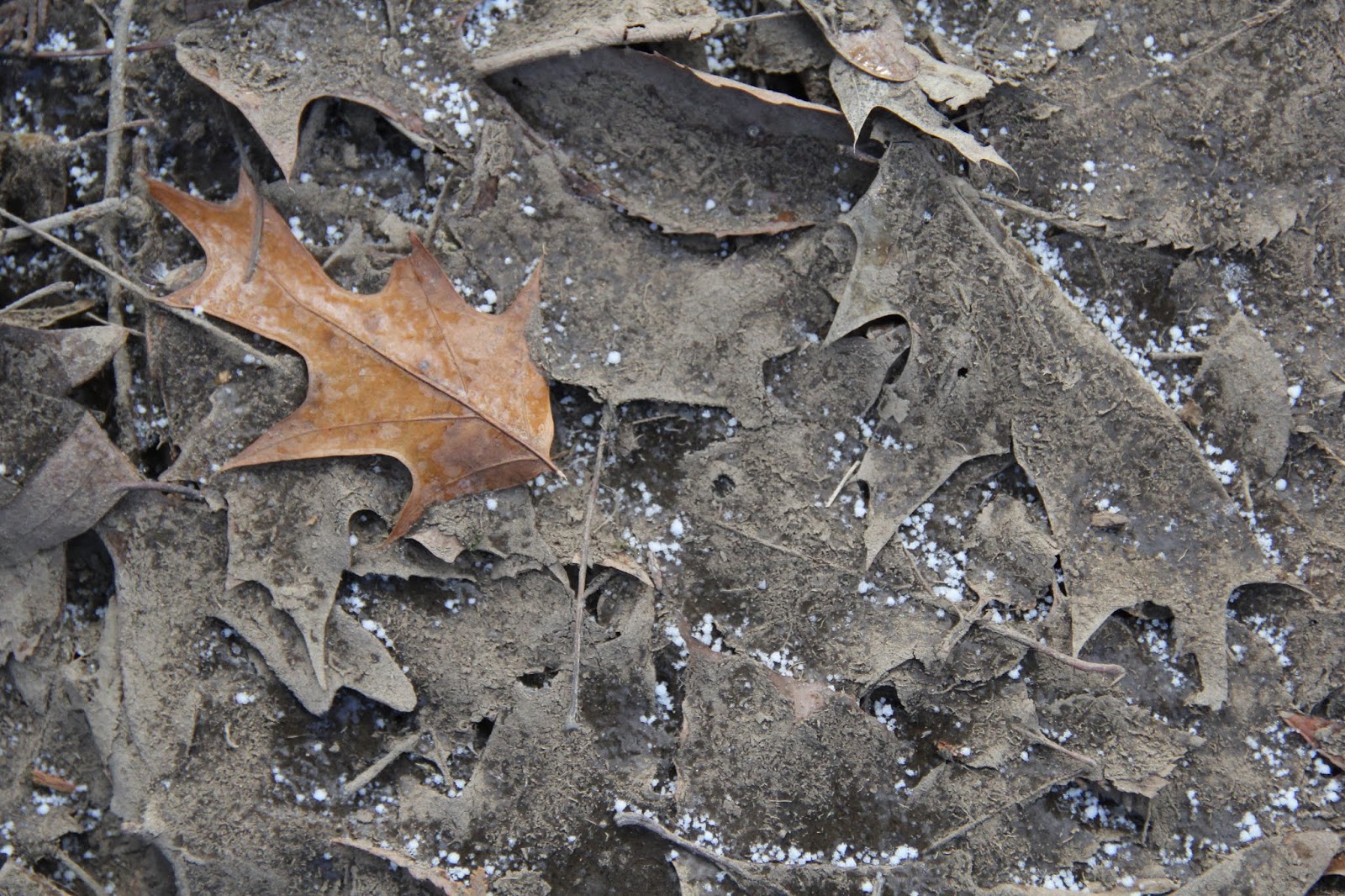
Silt covered leaves, topped by a single clean oak leaf

A boardwalk crosses an eroded area on the trail

Northern White Cedar

The bright trunks of aspen trees glow in the sunlight

Tuesday, January 15, 2019

A new way of looking at ice

This morning, Mid-Michigan woke up to find everything covered in a layer of ice.  The icy road meant that dozens of schools throughout the state canceled classes for the day.  Weather conditions haven't changed so there is a good chance that classes will be canceled again tomorrow.It's winter here in Mid-Michigan.  During winter you might expect to see everything covered in ice and snow, but have you ever thought about what ice and snow are?

The obvious answer is that ice (and snow) is the solid state of water.

The less obvious answer is that ice is a mineral.  

Yes, a mineral.

Like the thing that rocks are made of.


How is that possible?  If you look at the definition of a mineral, ice checks all of the boxes.  A mineral is a naturally-occurring inorganic crystalline solid with a specific chemical composition.

Ice is naturally-occurring.  Ice can form outdoors when the temperature drops below 32 degrees Fahrenheit.  (As I write, the temperature outdoors is 28 degrees.)  Ice that forms in your freezer is not a mineral because it would be considered man-made.

Ice is inorganic.  Inorganic simply means that it has never been alive.  Things might live in ice, but the ice itself has never been alive.


Ice is crystalline.  Ice forms crystals that have a specific internal structure - the water molecules that form ice bond together in a predictable pattern.  Liquid water and water vapor form much looser bonds and do not lock together in a predictable patter.

Ice is a solid.  When water drops below 32 degrees Fahrenheit, the molecules of water bond together to form a solid.  Only in its solid form can water be considered a mineral; neither liquid water or water vapor meet the definition of being a mineral.

Ice has a specific chemical composition.  Ice is formed from bonded molecules of water, each composed of two atoms of hydrogen and one atom of oxygen.  Other elements or molecules may be included in the ice, but the ice itself is formed only from the water molecules.


Ice is the only state of water that can be called a mineral.  If the ice melts or evaporates to form water vapor (a process known as sublimation) it ceases to be a mineral.  Due to the ability of water to shift states of matter, ice is a very ephemeral mineral across most of the earth.  In mid-latitudes such as where Michigan is located, ice can only be found during roughly half of the year.  At latitudes closer to the equator, ice would only be found in the highest elevations where the temperature can drop below the freezing point.  It is only in the highest elevations and the highest latitudes (the Arctic and Antarctic) that ice can be found year round. 

It's fun to look at familiar things in new and unexpected ways - like looking at ice as a mineral.  Right now large portions of the United States and Canada are rich in naturally formed ice, but come the period May to September it will be unavailable at any price throughout much of the same region. 

Friday, February 9, 2018

A Winter day at Mill Pond Park (08 February 2018)

Yesterday, during the middle of the day, I was able to spend a little more than an hour walking through Mill Pond Park.  This 90 acre park is located along the Chippewa River right in the middle of Mt. Pleasant.


Despite its location, this park is home to a diverse collection of wildlife.  Although I saw only a few birds and one squirrel (plus a feral cat), I did find lots of evidence of animals including tracks and evidence of feeding.

Tracks on ice at the river's edge

Ice flows in the Chippewa River

A Fox Squirrel high in a tree at Mill pond Park

A gentle curve of the Chippewa River

Like other parks in the city, Mill Pond Park has lost large numbers of trees due to an Emerald Ash Borer infestation.  As these trees fall it can be very difficult to travel off trail within the park.


Fungi on a dead tree


A deer trail through the woods


 A clump of reeds along the edge of the marsh

Looking south over the marsh

Dramatic clouds

I was surprised to find several trees that showed evidence of beavers.  There have been beavers in the park many times, but these trees were nearly one hundred yards from the river.  Despite this distance, it was obvious that the beaver had visited this site multiple times


Vole of shrew tracks on the ice


Looking down at the spillway of the Mill Pond dam

Trees and ice on the Chippewa River

Ice formed in patches on one of the weirs that slow the rivers drop

I like how the shape of the trees is repeated by the shape of the clouds

Monday, January 15, 2018

IMG_0115 for 01/15 (A random collection of photos that all have the same name)

The following photographs have nothing in common, except their file names.  Each of these photos is titled IMG_0115.  I don't do a good job of labeling photos as I add them to my computer.  Each of the pictures goes into a separate file according to the date that the picture was taken, but the individual pictures all have the name that the camera assigned to them.

I actually thought of this idea of posting several of the pictures a few months ago while I was searching for an image on my computer.  I was writing a new blog post and wanted to use a certain photograph, but I couldn't remember which file it was saved in.  Fortunately I had used the file previously in another blog post.  When I use an image on this blog the link to the image contains the name of the file so I was able to look at that link and then do a search on my computer for the original file.  I found the file that I wanted, but I also found several dozen more images with the same name.

With that experience, I decided that I would share several photos that share the same name.  Why did I pick IMG_0115 as the title to share?  Today's date is January 15th, or if you are expressing it as a number in the format MM/DD it is 01/15.  So IMG_0115 it is.


IMG_0115 - Devil's Tower as seen from the base of its boulder field (July 2017)

IMG_0115 - Mt. Rushmore (July 2017)

IMG_0115 - Red Admiral butterfly  (May 2017)

IMG_0115 - Yellow Trout Lily (April 2017)

IMG_0115 - Trail clearance at Audubon Woods Preserve (April 2017)
 
IMG_0115 - Rural sunrise (January 2017)
The rest of the photos can be found below the break.

Thursday, December 21, 2017

A walk in the park (20 December 2017)

Tuesday was my last classroom program before schools went on break for the holidays.  With that freedom of schedule, I managed to get outdoors yesterday (20 December) for a short visit to Mill Pond Park. 

Here are some of the photos that came from that trip.

This small creek remains flowing through a swamp.

Shallow roots and waterlogged soils mean fallen trees.
 
Air bubbles captured in ice in a puddle in the woods

Fertile fronds of Sensitive Fern poke up through the snow.

Oak and maple leaves

Cattails, cattails, and more cattails!


Sedges and leaves frozen in the ice

Rushes and frozen pancakes of ice

These patterns in the ice remind me of waves in Japanese woodblock prints, fabrics, and pottery.