Showing posts with label animal sign. Show all posts

Friday, February 9, 2018

A Winter day at Mill Pond Park (08 February 2018)

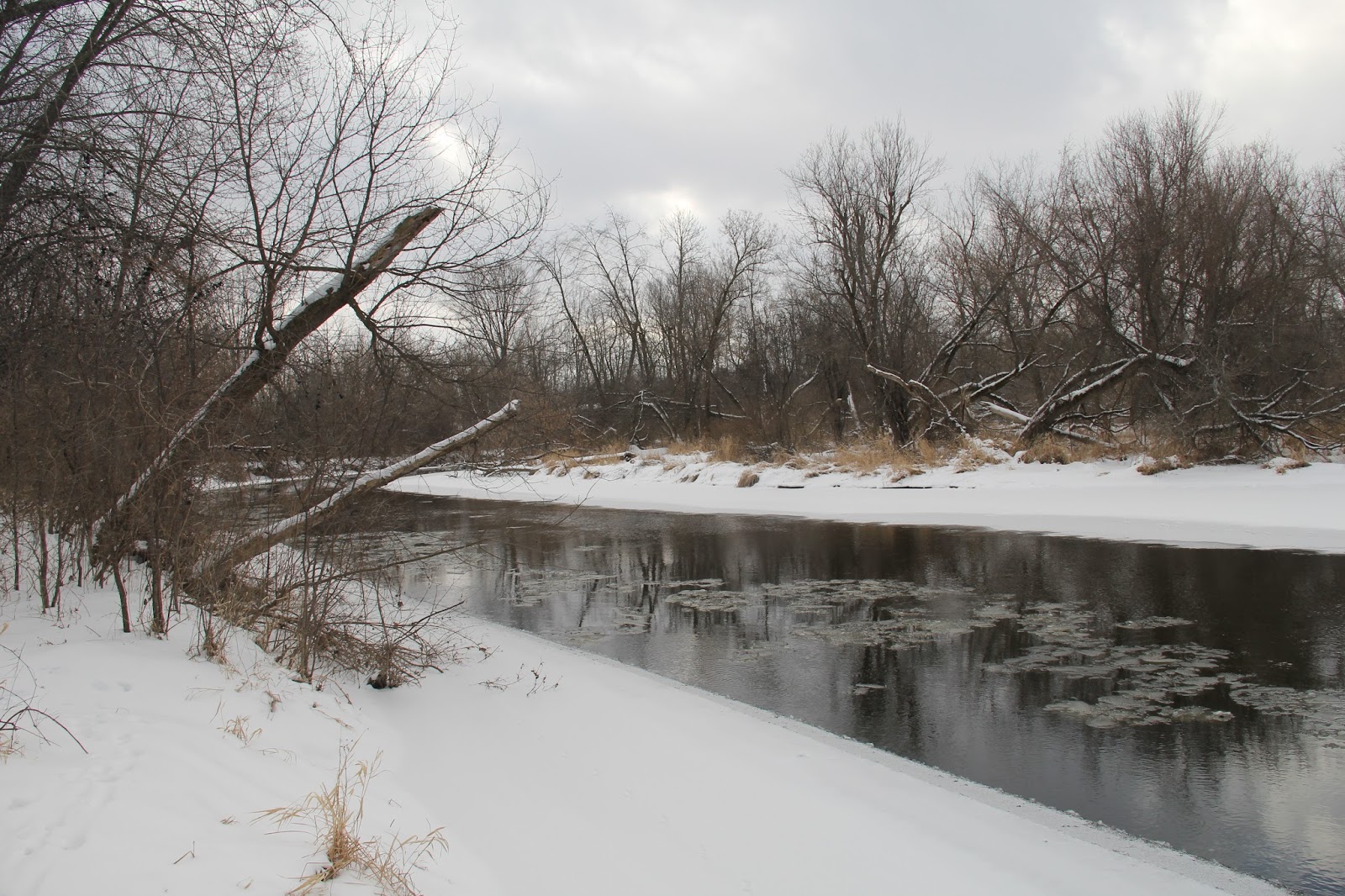
Yesterday, during the middle of the day, I was able to spend a little more than an hour walking through Mill Pond Park.  This 90 acre park is located along the Chippewa River right in the middle of Mt. Pleasant.


Despite its location, this park is home to a diverse collection of wildlife.  Although I saw only a few birds and one squirrel (plus a feral cat), I did find lots of evidence of animals including tracks and evidence of feeding.

Tracks on ice at the river's edge

Ice flows in the Chippewa River

A Fox Squirrel high in a tree at Mill pond Park

A gentle curve of the Chippewa River

Like other parks in the city, Mill Pond Park has lost large numbers of trees due to an Emerald Ash Borer infestation.  As these trees fall it can be very difficult to travel off trail within the park.


Fungi on a dead tree


A deer trail through the woods


 A clump of reeds along the edge of the marsh

Looking south over the marsh

Dramatic clouds

I was surprised to find several trees that showed evidence of beavers.  There have been beavers in the park many times, but these trees were nearly one hundred yards from the river.  Despite this distance, it was obvious that the beaver had visited this site multiple times


Vole of shrew tracks on the ice


Looking down at the spillway of the Mill Pond dam

Trees and ice on the Chippewa River

Ice formed in patches on one of the weirs that slow the rivers drop

I like how the shape of the trees is repeated by the shape of the clouds

Wednesday, January 27, 2016

More Animal Sign

This morning I took a short wander around the field beside the Conservation District office with hope of finding some more animal sign to photograph.  Here is what I found...

When I arrived at the office this morning I noticed a domestic cat at the edge of the parking lot.  With several nearby homes this was not much of a surprise.  


The cats are drawn to the area by the presence of small mammals (voles and rabbits) and birds in the nearby field.  I decided to follow one set of cat tracks to see where they led.  The tracks meandered all over through the field.  At one point I did see where a cat had paused to examine a tunnel going down through the snow.  Freezing rain earlier this month transformed the surface of the snow into a thick layer of ice.  This ice protects the mice and voles that us the space below (called the subnivean zone) quite secure from predators above the snow - for more info on the subnivean zone check out "Next stop, the subnivean zone!" from February 2014


Nearby I noticed a single Black-capped Chickadee preening itself in an Autumn Olive bush.  Chickadees have several winter survival strategies including bulking up with fatty foods, puffing up, and even entering a state of torpor - see "Chickadees in Winter" (January 2013) for more information.


Many of the Autumn Olive shrubs in the field have been severely damaged by rabbits (and to a lesser extent, voles) over the past few winters.  This year is no different.  Because rabbits are almost exclusively vegetarian, their food options are limited during the winter months.  One reliable food source that is available is the tender buds, bark, and small branches of trees and shrubs.  Rabbits snip off the buds and branches and strip the bark with their sharp chisel-like incisors.  If enough bark is removed the tree or shrub can potentially die.  This can be a problem for people that own orchards or have recently planted small trees.  It's not a problem when the rabbits are munching on invasive species like the Autumn Olive.


Did I find anything more exciting?  No, not really.  I did see a vole scurry under the snow near a shrub, but was unable to get a picture.  I keep checking the snow in this field hoping to find a coyote track or even a deer track, but so far I have been disappointed.  That's really okay.  I got to get outside and away from my desk for a few minutes and was able to interact with nature.  It gave me a slight recharge that I needed.

Tuesday, January 26, 2016

Hall's Lake Hike Highlights (23 January 2016)

On Saturday (23 Jan), I led a walk for the Chippewa Watershed Conservancy (CWC) at their Neely and Kabana Preserves in western Isabella County.  The Neely Preserve is part of a larger parcel known as the Hall's Lake Natural Area.

http://i2.wp.com/www.chippewawatershedconservancy.org/wp-content/uploads/2014/08/NeelyPreserveLarge.gif 
Our walk focused on animal sign.  When most people think of animal sign they think about tracks, but tracks are only a small part of the picture.  We looked at tracks, but we also searched for other things such as animal homes, signs of feeding, food caches, and scat. 

Looking for animal sign at Hall's Lake Natural Area

I have been to the Hall's Lake Natural Area several times in the past, but never to areas that we visited on Saturday.  Because I had never visited these sites, I had not expectations about what to expect.  Much of the two preserves are covered by a mature mixed conifer-hardwood forest.  Several inches of snow covered the ground, including a dusting about 36-48 hours prior to our walk.

I was actually surprised, by the lack of sign from several species.  There were very few tracks from White-tailed Deer, no deer scat, and no evidence of recent feeding.  Rabbit tracks were only found in the the area immediately adjacent to the lake in any area of swamp.  We also did not see or hear a single bird during our almost two hour walk.  In fact, I didn't see a single live animal of any species while I was there.

So what did we find?

There was lots of evidence to indicate that squirrels live in the preserve.  We saw squirrel tracks heading from tree to tree in most of the preserve.  There were also places where the squirrels had dug through the snow to search for cached (hidden) acorns.  Most squirrels do a really poor job of remembering where they have cached acorns and other nuts.  Instead they rely on their sense of smell to locate food hidden under the snow.  This means that they do not recover all of the things that they have buried.  Many of those nuts (and other seeds) will germinate during the following year.  So even though the squirrel may not benefit from everything that they have hidden, they are helping to reseed the forest.

Unfortunately, squirrel tracks are not all that exciting.  Neither were the hundred of mouse tracks that we saw throughout the forest.  While these tracks are interesting and give an insight into the small prey species found throughout the forest, they are not something that gets my heart pumping.

This, however, does.


That is a pile of coyote scat.  It was full of hair and seeds, indicating that the coyote that left this in the middle of the trail was eating a diverse omnivorous diet.

Why was the pile of scat in the middle of the trail?  Like all canines, coyotes frequently mark their territory.  There was evidence that someone had recently walked down that trail with a domestic dog.  The coyote left that scat in the trail to cover over the dog's scent and assert its dominance.

Scat was not the only coyote sign that we found.  We found several sets of tracks including this set on the ice covering the outlet to the lake.


Coyote tracks on the ice

The coyote skirted around several area of thin ice

Following tracks onto the ice - make sure the ice is solid before proceeding

For me the other highlight of the walk was a visit to an active porcupine den tree.  CWC Executive Director Stan Lilley led the group to this site.  Unfortunately, the porcupine crawled up inside its den as the group approached so we did not get to see it, but it left lots of evidence of its presence.  (This is not the not the first den tree that I have seen on a CWC property - in 2015, I found one at the Quigley Creek Natural Area.)

Examining porcupine scat under the den tree

The porcupine left a prominent trail from its den to its feeding area in some nearby pines

The porcupine den is in the hole in the left trunk

A pile of scat under the den tree

Even though I did not see a porcupine, it is always worth the time to take a walk in the woods.  It was especially enjoyable to share my knowledge of animal tracks and sign with other nature lovers.  One participant commented that it was going to make her walk to the end of the driveway to get the daily newspaper a lot more interesting.

For more photos from the walk please check out the Chippewa Watershed Conservancy's website.

Thursday, January 7, 2016

Upcoming Event - Winter Animal Signs (23 JAN 2016)

Pointing out shrew tracks during a January 2015 walk at the CWC's Sylvan Solace Preserve


Join me on Saturday January 23rd at 10:00AM at the Chippewa Watershed Conservancy's Hall's Lake Natural Area for a winter walk.  The walk will begin at the Neely Preserve at the corner of Broomfield Rd. and Old State Rd.

This walk will focus on locating and identifying signs left by the preserve's resident animals.  If you want to learn more about animal track identification or how to "read" animal signs this is the event for you.

I have never explored the Hall's Lake Preserve during the winter months and have never visited the Neely Preserve portion so I don't know what surprises we shall find.  This should be an adventure for everyone!

Please call the Chippewa Watershed Conservancy at (989) 772-5777 to register for this event.  There is no cost to attend, but donations are always appreciated.

http://i2.wp.com/www.chippewawatershedconservancy.org/wp-content/uploads/2014/08/NeelyPreserveLarge.gif

Wednesday, January 28, 2015

Upcoming Event - Winter Wildlife Walk (Saturday 21 FEB 2015)

On Saturday 21 FEB 2015, I will be leading a walk at Deerfield Nature Park.


This walk is scheduled to begin at 9:00AM and is open to the public.  The main focus of this walk will be on animal tracks and other sign.  People are asked to pre-register for this walk because space is limited.  Admission to the park is free for this walk. 

Deerfield Nature Park is located at 2425 W. Remus Road (M-20) west of Mt. Pleasant.  This walk will start at the Fussman Pavilion. 


Thursday, January 22, 2015

Event Reminder - Sylvan Solace Snowshoe Walk (Saturday 24 January 2015)

Cottontail Rabbit tracks
 
Just a reminder that I am scheduled to lead a walk at the Chippewa Watershed Conservancy's Sylvan Solace Preserve this Saturday at 9:00AM.  This is being billed as a "snowshoe walk", but I don't think snowshoes will be needed unless we receive several more inches of snow over the next two days. 

Providing that we find snow on the ground, the focus of this walk will be on finding and identifying animal tracks and other signs.

Registration is required for this event.  For more information please visit the Chippewa Watershed Conservancy webpage.


Tuesday, January 20, 2015

Animal Signs and Ice Crystals


Last Wednesday (14 JAN 2015) I was able to spend a little bit of time walking through the woods at Chipp-A-Waters Park in Mt. Pleasant.  I already posted some pictures of ice taken that day, but ice was far from the only thing I found.

Part of my walk took me off the paved trail and onto the frozen surface of an oxbow pond.   In Summer the edges of this pond are the home to rushes and bur-reeds.

Giant Bur-reed at Chipp-A-Waters Park

The center of the pond is home to a colony of Yellow Pond Lilies.

Yellow Pond Lily colony at Chipp-A-Waters Park

This time of year, the oxbow looks like this...

Ice and snow-covered oxbow pond

It's covered with snow and ice and criss-crossed with tracks from White-tailed Deer and Red Fox.  Many of the fox track passed near an old muskrat lodge along the edge of the oxbow.

Fox tracks converge on an old muskrat lodge

At least one fox took the time to leave its mark with a spray of urine.

This spot serves as a marking post for local wildlife

A yellow spot of urine shows that a fox has recently passed through

Fox tracks and urine were not the only interesting things that I found on the oxbow.

A fox-eye view through the rushes and sedges
Some of these emergent vegetation was covered with delicate blades and feathers of frost

Frost-covered leaves and stems


Some of these frost feathers were nearly an inch long.  This picture shows them in more detail.

Feathers of frost on a rush stem