I still trying to get caught up on my Wildflowers of 2016 list. The following twenty species were photographed on Wednesday May 25th. The first two species (#70 and #71) were photographed at Mill Pond Park. Species #73 through #86 were found along the Chippewa River either at Island Park or Mt. Pleasant City Hall. The final three species (#87 - #89) were photographed at Mission Creek Woodland Park.
Wildflowers of 2016 - #70 Red-osier Dogwood (Cornus sericea)
My first species of the day was a small shrub -
Red-osier Dogwood (
Cornus sericea). Reddish branches and flat-topped clusters of white flowers helped to identify this plant, but Dogwood identification can be tricky.
 |
| Red-osier Dogwood |
Both Red-osier and Silky Dogwood (C. amomum) have flat-topped flower clusters. Silky Dogwood branches can also be red sometimes. If I had seen fruit, this identification would have been simple. Red-osier berries are white while those of Silky Dogwood are blue. But, alas, there were no berries present at this time of year. A final factor to confirm my identification was the color of the pith on the inside of small branches. A white pith confirmed my identification.
 |
| Red-osier Dogwood - note red bark and white flower cluster |
For more on identifying dogwoods check out this post from 2013.
Wildflowers of 2016 - #71 Common Fleabane (Erigeron philadelphicus)
My second flower of the day was
Common Fleabane (
Erigeron philadelphicus). Common Fleabane is a weedy native plant with composite flowers. This means its "flowers" are
made up of many smaller flowers clustered together in a disc, while
what appear to be petals are actually individual flowers called ray
flowers. While there are seven
Erigeron species in Michigan, Common
Fleabane can be distinguished from other species by the number of rays
on the flower (150 - 400) and the leaves which clasp the stem.
 |
| Common Fleabane |
As its name implies Common Fleabane is "common". It can be found in 46
states (not Utah, Arizona, Alaska, or Hawaii) and most of Canada (except
Nunavut and Labrador). In Michigan it is currently listed in all but nine
counties.
Wildflowers of 2016 - #72 Dame's Rocket (Hesperis matronalis)
My next species of the day is commonly mistaken for Wild Blue Phlox (
Phlox divaricata) -
#61 on this year's list. However while Wild Blue Phlox is a native species,
Dame's Rocket (
Hesperis matronalis) is non-nativeand is often considered invasive because of its aggressive nature.
 |
| A colony of Dame's Rocket |
Despite confusion by the public, the two species are easy to differentiate. Wild Blue Phlox flowers always have five petals. As a member of the Mustard Family (Brassicaceae), Dame's Rocket flowers always have four petals. The flowers of Dame's Rocket vary in color from white to pink to purple, with variegated forms being fairly common. The leaves on the two plants are also arranged differently; Wild Blue Phlox has opposite leaves and those of Dame's Rocket are arranged alternately.
 |
| Dame's Rocket - note hairy sepals and four petals |
For more information on how to identify these species please check out my 2013 post:
A tale of two flowers - one native, one alien.
Wildflowers of 2016 - #73 Canada Anemone (Anemone canadensis)
My fourth species of the day was photographed along the Chippewa River at Island Park.
Canada Anemone (
Anemone canadensis) is a native plant that can be found across the northern parts of the United States and Canada. It can be aggressive and often forms large colonies. For more information on this species check out my
April 2013 species profile.
 |
| Canada Anemone - note whorl of leaves |
 |
| Canada Anemone - note five petals and yellow stamen |
Wildflowers of 2016 - #74 White Mulberry (Morus alba)
White Mulberry (
Morus alba) is a non-native tree. Originally from China, this tree has been recorded in every state but Alasaka and Nevada. It is widely planted as an ornamental or fruit tree. The fruit is eaten by more than two dozen species of birds and many mammals. Because the seeds are difficult to digest, they often pass through animal digestive tracts unharmed and easily sprout.
 |
| White Mulberry flowers |
This species can grow as much as 60 feet tall. It requires at least partial sun, so will probably not be found growing in deep woods. The flowers of this plant are dangling white catkins. White Mulberry trees contain both male and female flowers.
 |
| White Mulberry |
Wildflowers of 2016 - #75 Common Buckthorn (Rhamnus cathartica)
Common Buckthorn (
Rhamnus cathartica) is another non-native tree species. The flowers of this species are small (about 1/4 inch across) and a nondescript greenish color. After pollination the flowers are replaced by glossy black berries. These fruits are eaten by a number of bird species including
American Robins and
Cedar and Bohemian Waxwings. It can quickly spread as these birds deposit the seeds in their droppings. The berries are not edible for humans and should not be consumed.
 |
| Small green flowers of Common Buckthorn |
Common Buckthorn has been recorded in thirty-four states. Six states list it as a prohibited species or noxious weed.
Wildflowers of 2016 - #76 Common Yellow Wood-sorrel (Oxalis stricta)
Common Yellow Wood-sorrel (
Oxalis stricta) is a small
native plant that often treated as a weed . It grows in dry open soils,
so it is often found along roadsides, in garden, and in other disturbed
places. Common Yellow Wood-sorrel is actually quite attractive with
lemon yellow flowers and compound leaves with three heart-shaped
leaflets. The flowers have five petals and measure 1/8 to 1/2 inch across. The leaves measure 3/8 to 3/4 inch across.
 |
| Common Yellow Wood-sorrel - note yellow flowers and three-lobed leaves. Small blue flowers belong to the next species. |
There is another species also known as Common Yellow Wood-sorrel (
O. dillenii). There is some debate about whether these species should be split or lumped together. They both range across most of the United States and share the same range in Michigan. If indeed these are two separate species, they can also hybridize further confusing identification.
 |
| Common Yellow Wood-sorrel - note five notched petals |
Wildflowers of 2016 - #77 Corn Speedwell (Veronica arvensis)
My eighth species of the day may be the smallest species that I have documented so far.
Corn Speedwell (
Veronica arvensis) plants may grow up to eight inches tall, but their flowers only measure 1/8 inch or less across. Each miniature flower consists of four violet-blue petals, a pair of white stamen, and a single pistil. The plant's opposite leaves are also small, measuring 1/4 to 1/2 inch long. The leaves and stems of this species are covered with small hairs.
 |
| The tiny violet-blue flowers of Corn Speedwell |
Corn Speedwell is originally native to Europe, but has naturalized across North America. It has been documented in every state but North Dakota as well as six Canadian provinces/territories. In Michigan, it is absent though much of the Upper Peninsula.
Wildflowers of 2016 - #78 Thyme-leaved Speedwell (Veronica serpyllifolia)
Growing within inches of the Corn Speedwell, I found a second
Veronica species:
Thyme-leaved Speedwell (
Veronica serpyllifolia). Thyme-leaved Speedwell is a small
non-native plant that is commonly found in lawns, along roadsides, and
in other areas of disturbed ground. It spreads easily and can be found
in most types of upland habitats and along the banks of rivers and
streams. Because of its small size (4-12 inches tall) this plant rarely
out-competes native species. It is usually only noticed when it forms a
fairly large colony and the flowers can be seen. The small flowers
(1/4 inch across) form in a raceme at the top of the stalk and are
usually white with dark blue veins.
 |
| Thyme-leaved Speedwell |
This species is less widely distributed across North America. It is absent from Mississippi through the Southwest to California, as well as Wyoming, South Dakota, and Florida. In Michigan it has been documented in 63 of 83 counties.
Wildflowers of 2016 - #79 Autumn Olive (Elaeagnus umbellata)
 |
| Autumn Olive shrubs can produce thousands of blooms |
Many states and government agencies used to encourage the planting of
Autumn Olive (
Eleagnus umbellata)
for erosion control and wildlife habitat. Now it is considered an
invasive species that can quickly crowd out native plants. It spreads
when birds consume its fruit and is very hard to eradicate. It can be found in every state east of the Mississippi, in urban areas of the Pacific Northwest and in Hawaii.
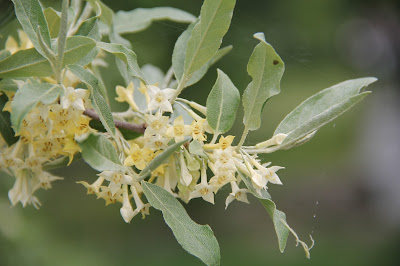 |
| Autumn Olive - note grey-green leaves and flowers with four petals |
Wildflowers of 2016 - #80 White Clover (Trifolium repens)
Although it is not native,
White Clover (
Trifolium repens)
is found throughout North America. Although originally introduced as a
forage crop, it is now also commonly found in lawns and roadsides. As
the name
Trifolium indicates, the plant typically has leaves with three lobes. Its white flowers grow in round heads that measure 0.5 to 1.25 inches wide.
 |
| White Clover - note three-lobed leaves and globe shaped flower heads |
Wildflowers of 2016 - #81 Black Medick (Medicago lupulina)
My next species was
Black Medick (
Medicago lupulina).
This plant was introduced from Eurasia to all 50 states and all
Canadian provinces and territories except Yukon, Nunavut, and Labrador.
Black Meddick is often found as a weed in lawns and fields, along
roadsides, and in other disturbed spaces. It has small yellow flowers
in the form of a globe or cylinder. This flower head measures less than 1/2 inch across. The plant can grow to nearly 3
feet, but is frequently much smaller. Both White Clover and Black Medick are members of the Pea Family (Fabaceae).
 |
| Black Medick - note small yellow globe-shaped flowers and three-lobed leaves |
Wildflowers of 2016 - #82 English Plantain (Plantago lanceolata)
English Plantain (
Plantago lanceolata) is another non-native weedy species. This species has been documented in every state and across the lower tier of Canadian provinces. Also known as Narrow-leaf Plantain, this species has a basal rosette of narrow leaves measuring up to 3/4 inch wide and 10 inches long. The flowers of this species are clustered on a spike that can be up to 2 inches long. This spike rises on a leafless stalk and can be 6 to 18 inches tall. The flowers are a dull grey-green color, with white stamen that extend outward from the spike. These stamen are the most prominent feature of the flowers.
 |
| English Plantain - note extended stamen |
 |
| English Plantain - note tall flower stalks and basal rosette of narrow leaves |
Wildflowers of 2016 - #83 American Highbush Cranberry (Viburnum trilobum)
American Highbush Cranberry (
Viburnum Trilobum) is a native shrub that prefers moist soils along shorelines, floodplains, wet woodlands, and deciduous and conifer swamps. The white flower clusters of American Highbush Cranberry consist of a
round cluster of small fertile flowers surrounded by a ring of larger
sterile flowers. The shrub's leaves resemble small maple leaves.
 |
| American Highbush Cranberry |
This species is found across the northern half of the United States and southern Canada. In Michigan it has been recorded in a little more than half of the counties. There is a closely related European native called European Highbush Cranberry (
V. opulus). Sometimes the two plants are considered a single species, with thee American Highbush Cranberry being called
Viburnum opulus var. americanum. The two can be (theoretically) sorted by differences in the petiole glands.
 |
| American Highbush Cranberry - note small fertile flowers and large sterile flowers |
Wildflowers of 2016 - #84 Common Buttercup (Ranunculus acris)
 |
| Common Buttercup |
My next species was the non-native
Common Buttercup (
Ranunculus acris).
This native of Europe has been introduced throughout most of North
America. It has glossy yellow flowers with five petals and deeply lobed
leaves. Common Buttercup can be found in fields, pastures, and
meadows, along roadsides, and along shorelines. I found it growing in
moist soil along the Chippewa River. Individual Common Buttercup plants
may flower any time between May and August. The flowers measure about 0.5 to 1.5 inches across and like most Buttercup species consist of five petals and five sepals. The leaves of this species are deeply divided into three to five lobes.
 |
| Common Buttercup flowers |
 |
| Common Buttercup leaves are deeply lobed |
Wildflowers of 2016 - #85 Winged Euonymus (Euonymus alatus)
Winged Euonymus (
Euonymus alatus) was my next species of the day.
Also known as Burning Bush for its red fall foliage, Winged Euonymus is
a common landscape shrub that has escaped into the wild throughout the
eastern United States. Like most escaped shrubs, it is spread when
birds consume its fruit and leave the seeds in their droppings. This
shrub was found growing along the Chippewa River behind the Mt. Pleasant
City Hall.
 |
| Winged Euonymus - note flowers with four petals, four sepals, four stamen, and a central disc |
This species is named Winged Euonymus for the cork-like wings that
project off the sides of its branches and trunks. These wings can be
seen on several of the twigs in the photo below. The flowers of this species are small - measuring about 1/3 inch across. The flowers have four yellow-green petals, four green sepals, four short stamen, and a green central disc. The flowers grow from the leaf axils in groups of three or less.
 |
| Note the winged stems that give Winged Euonymus its name |
Wildflowers of 2017 - #86 Field Peppergrass (Lepidium campestre)
Field Peppergrass (
Lepidium campestre) is a
non-native member of the Brassica family. Originally a native of Eurasia, it has become
naturalized across North America. It is opportunistic and will quickly colonize areas of open or disturbed
soil.
 |
| Field Peppergrass |
Field Peppergrass grows 8 to 18 inches tall. It has both basal and stem leaves. The stem leaves are arranged alternately, measure 1 to 1.5 inches long, and clasp the stem. The plant is densely covered with hairs and has a grey-green color. The flowers are small (less than 1/4 inch), white, and as is typical of Brassicas have four petals.
Wildflowers of 2016 - #87 Creeping Buttercup (Ranunculus repens)
My first flower was one that I first identified encountered during my Wildflowers of 2014 ramblings. I found it growing in and along the shoreline of
Mission Creek. This plant was easy to identify as a member of the
Buttercup or Crowfoot Family (
Ranunculaceae). Identifying it to species was a little more difficult - there are 18
Ranunculus species that can be found in Michigan. I have already included three species on this 2016 list:
#43 Swamp Buttercup (R. hispidus),
#45 Small-flowered Buttercup (R. arbortivus), and #84 Common Buttercup (R. acris).
Those three species could be eliminated for various reasons. Several
other species could be eliminated for reasons such as habitat type,
location, color, etc.
 |
| Creeping Buttercup leaves - note "watermarks" |
This colony of plants is the
Creeping Buttercup (
Ranunculus repens). This non-native buttercup is lot listed in
Michigan Flora
for Isabella County, but I am fairly certain of my identification. I
based this identification on the size of the flower (larger than 1/2
inch), leaf shape (compound leaves with a stalked terminal lobe), and
flowering time. Another feature that pushed my identification to
Creeping Buttercup was white blotches (watermarks) on the leaves. My
Peterson Field Guide to Wildflowers as well as several web sources list these watermarks as being a characteristic of this species.
 |
| Creeping Buttercup |
This year I found Creeping Buttercup in the growing in the exact same location as in 2014. It displayed all of the same characteristics so I was positive of my identification.
Wildflowers of 2016 - #88 Golden Ragwort (Packera aurea)
I went to Mission Creek with the intent of finding my next species of plant -
Golden Ragwort (
Packera aurea). Golden Ragwort can be identified by its small yellow flowers (1/2 -3/4
inch wide), heart shaped basal leaves, and lobed upper leaves. It
prefers the wet soils found in floodplains, hardwood and conifer swamps,
and other shallow-water wetland habitats. It grows very well in the cedar swamp along the edge of Mission Creek. It can be found across eastern North America, as far south as Florida and as far north as Manitoba.
 |
| Golden Ragwort surrounded by Skunk Cabbage, Equisetum, and other wetland species |
 |
| Golden Ragwort flowers |
Wildflowers of 2016 - #89 Wild Columbine (Aquilegia canadensis)
Growing in a drier area along Mission Creek, I found several
Wild Columbine (
Aquilegia canadensis) plants. Wild Columbine can be found across the eastern United States and Canada, as far west as a line running from Texas to Saskatchewan. In Michigan it has been recorded in all but five counties.
 |
| Wild Columbine flower - not the best picture |
Wild Columbine plant grow 1 to 3 feet tall and have both basal and stem leaves. The stem leaves are arranged alternately. All leaves are compound (divided into smaller leaflets). The flowers of Wild Columbine dangle individually from long stems. Each flower is composed of five petals, five sepals, and dangling stamen and styles. The opening of the flowers point downward. The upper part of the flower consists of five pointed, nectar-filled spurs. Overall the flowers are reddish, with the lower parts of the petals being yellow. The red color of the flowers and the long spurs attract hummingbirds as one of the plant's primary pollinators. Individual flowers measure 1 to 1.5 inches long.
For a better photo of a Columbine see my
National Trails Day post