I have a little catching up to do on my list of the Wildflowers of 2014. I am not really behind in posting - after a slow first month, the flowers species are just blooming in rapid order and I have ten flowers to add to my list.
Wildflowers of 2014 - #24 Wood Anemone (Anemone quinquefolia)
I found
Wood Anemone (
Anemone quinquefolia) blooming earlier in the week in Shepherd, but because it was not blooming in one of Mt. Pleasant's parks I did not count it toward this list. On Thursday (08 MAY 2014) I found it blooming along the edge of a wooded area at Pickens Field in Mt. Pleasant.
 |
| Wood Anemone leaves and flowers - the leaves on the right belong to Wild Geranium |
The
quinquefolia part of the scientific name refers to its five-lobed leaves.
 |
| Wood Anemone - the five-lobed leaves are easy to see in this photograph |
Wildflowers of 2014 - #25 Jack-in-the-pulpit (Arisaema triphyllum)
The next six wildflowers were found on Sunday (11 MAY 2014) at Mission Creek Woodland Park either in or along the edge of a
Northern Hardwood-Conifer Swamp. The first wildflower of the day and #25 for the year was
Jack-in-the-pulpit (
Arisaema triphyllum)
 |
| Jack-in-the-pulpit |
 |
| Closeup of the flower of the Jack-in-the-pulpit |
Over the course of several hours I saw numerous examples of Jack-in-the-pulpit. The photographs above are of the first one that I found. The photo below was taken later in the day of a different plant and shows the color variance among the blooms of this species, ranging from many shades of green to reddish. The
triphyllum in its Latin binomial mean "three-leaved". Because of its three part leaves, this plant is sometimes incorrectly identified as Poison Ivy.
 |
| Jack-in-the-pulpit flowers exhibit a range of colors from pale green to reddish |
Wildflowers of 2014 - #26 Spring Cress (Cardamine bulbosa)
The next flower of the day was found growing on a tussock within the swamp.
Spring Cress (
Cardamine bulbosa) is a member of the Mustard family (
Brassicaceae). Like other member of this family, it can be identified by its flowers with four petals.
 |
| Spring Cress |
 |
| A closer view of the Spring Cress |
 |
| Spring Cress flowers - note the four petals on each flower |
Wildflowers of 2014 - #27 American Dog Violet (Viola labradorica)
The third wildflower of the day was one of two new violet species that I would find during the course of the day -
American Dog Violet (
Viola labradorica). This species has recently been renamed, it was formerly known as
Viola conspersa, but has been lumped with
V. labradorica - many books and websites still refer to it by its old name. American Dog Violet is one of several species of violets that have flowers stalks with leaves on them - many other species such as
Common Blue Violet (V. sororia) have basal leaves and separate flower stalks.
 |
| American Dog Violet - not the leaves and flowers on the same stalks |
Wildflowers of 2014 - #28 Swamp Buttercup (Ranunculus hispidus)
The fourth flower of the day was
Swamp Buttercup (
Ranunculus hispidus). I wrote a profile of this plant last year - for more information look
here.
 |
| Swamp Buttercup |
 |
| Swamp Buttercup |
Wildflowers of 2014 - #29 Downy Yellow Violet (Viola pubescens)
The fifth flower of the day and number twenty-nine for the year was
Downy Yellow Violet (
Viola pubescens). I found it growing along the margins of the same swamp at Mission Creek and also later in the day in a drier area of woods at Chipp-A-Waters Park. This is the only yellow violet recognized in Michigan. Although called a "Downy" Yellow Violet, the appearance of this species is highly variable - some plants are extremely hairy while others have almost no hairs.
 |
| A single bloom of Downy Yellow Violet surrounded by leaves of Skunk Cabbage and Spring Beauty |
 |
| Downy Yellow Violet - the only species of yellow violet native to Michigan |
 |
| A closer view of the flower |
Wildflowers of 2014 - #30 Two-leaf Mitrewort (Mitella diphylla)
Two-leaf Mitrewort (Mitella diphylla) was one of the plants that I was specifically looking for yesterday. After nearly an hour of searching (and photographing other plants) in likely habitat, I found a single small plant with tiny flowers that were just beginning to open.
 |
| A small Two-leaf Miterwort plant surrounded by Skunk Cabbage leaves |
Wildflowers of 2014 - #31 Mouse-ear Chickweed (Cerastium fontanum)
Up until this point of the day, all of the flowers have been native plants found in wetlands and rich woodlands. The next flower is a non-native plant found in fields, lawns, roadsides, and other weedy places.
Mouse-ear Chickweed (
Cerastium fontanum) is originally from Europe but has been introduced in all fifty states and most of Canada (no records from Nunavut). Because the flowers of Mouse-ear Chickweed are tiny (less than 1/4 inch across) and the plant grows low to the ground, it is easy to overlook this species.
 |
| Mouse-ear Chickweed in the lawn at Mission Creek Park - the tiny (1/4 inch) flowers have five deeply notched petals |
 |
| Mouse-ear Chickweed -pen added for scale |
Wildflowers of 2014 - #32 Woodland Strawberry (Fragaria vesca)
The next flower is one that is probably familiar to many people - a strawberry plant. This is the Woodland Strawberry (Fragaria vesca). One of two species of strawberries that are native to Michigan, Woodland Strawberry can be distinguished from the more common Wild Strawberry (F. virginiana) by the tips of its leaflets. The three part leaves of the both species are serrated (or toothed). On Woodland Strawberry leaves the terminal tooth (tooth at the very tip of the leaf) is as long or longer then the two adjacent leaves; on the Wild Strawberry, this terminal tooth is shorter than the two adjacent teeth.
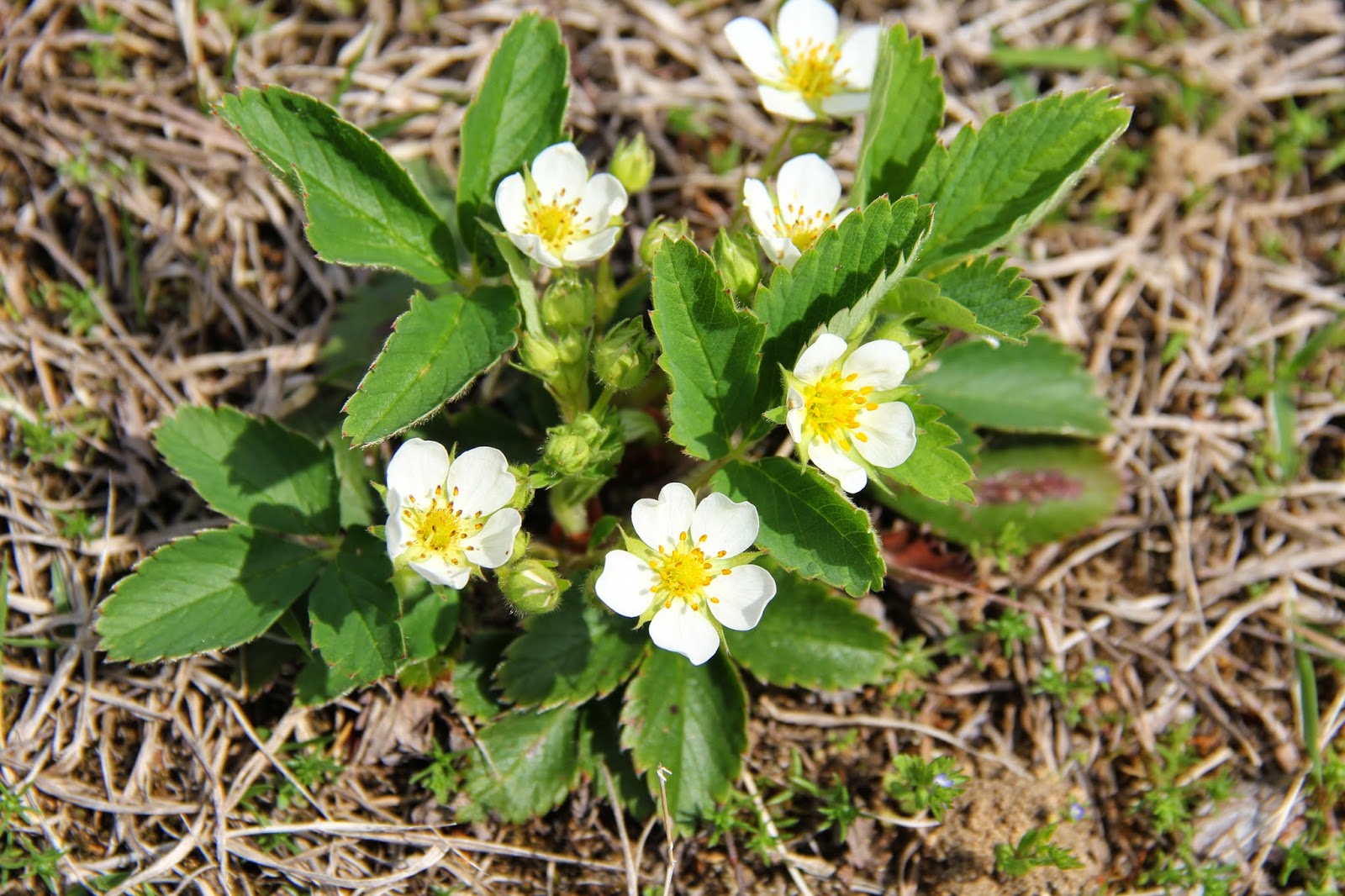 |
| Woodland Strawberry - note the terminal teeth of the leaves are as long or longer than the adjacent teeth |
Wildflowers of 2014 - #33 Garlic Mustard (Alliaria petiolata)
The final flower of the day is a plant that I really wish could not find in Mt. Pleasant.
Garlic Mustard (
Alliaria petiolata) is a very aggressive
non-native species that will quickly outgrow many native species. In addition to growing quickly and producing hundreds of seeds, Garlic Mustard also is an allelopathic species. Allelopathy is basically a form of chemical warfare by plants. Garlic Mustard releases chemicals into the soil that inhibit the germination and growth of other species of plants - resulting in large pure stands of Garlic Mustard and the elimination of native species in an infested area.
 |
| Garlic Mustard growing in the floodplain of the Chippewa River |
Like other Mustard plants, Garlic Mustard had flowers with four petals. Other distinguishing features include heart-shaped leaves and a "garlic" smell. This plant is a biennial - on first year plants the leaves are more rounded. If you find this plant growing anywhere PULL IT and dispose of it before it spreads further.
 |
| Garlic Mustard - note the flowers with four petals and heart-shaped leaves |


