Wednesday, June 25, 2014

Wildflowers of 2014 - #140 through #150

Doing a "Big Year" of wildflowers is something that I have been thinking of for several years.  I have been keeping a list and photographing flowers since 2002 when I started working in Mt. Pleasant.  Finally, this past winter I decided that 2014 was going to be the year.

The long cold winter and late start to spring had me worried about how many species I would be able to find.  I did not find my first wildflower until April 10th - Skunk Cabbage (Symplocarpus foetidus).

It took me forty-one days to find the first fifty flowers - #50 Wild Blue Phlox (Phlox divaricata) was found on May 20th.

After that it only took fourteen days to find the next fifty species.  Wildflower #100 Common Buttercup (Ranunculus acris) was found on June 3rd.

On Sunday (June 22nd), I found species #150 for the year.  This was nineteen days since I hit #100 for the year.

Here are the species that I found on Sunday.

Wildflowers of 2014 - #140 White Avens (Geum canadense)

My day began at Mission Creek Park.  Often I go to a park with a plan to search for a specific flower.  this time I had no clearcut goals, but just planned to walk along the trails and see what could be found.  The first flower was growing directly along what the city's maps refer to as the Creek Trail (West) - see link above for a map of the park's trails.  White Avens (Geum canadense) is a native perennial that can grow up to 48 inches tall. It grows throughout the eastern United States and Canada as far west as Wyoming and Montana.  Part of the reason for this species' wide range is its adaptability.  While the plant is most commonly found in moist woodlands, it will also grow in dry woodlands or even open fields.

White Avens (Geum canadense)


White Avens can be identified by its basal leaves which are split into three leaflets.  Plants also have smaller leaves (also with three leaflets) growing alternately along the plant's rising stem.  The basal leaves resemble those of Wild Strawberry plants - I have a White Avens growing in my garden at home that I only notice once it grows over the top of the surrounding strawberries.

White Avens - note the leaves with three lobes

The flowers of White Avens are about 1/2 inch across and have 5 small white petal with five pointed green sepals between the petals.  The sepals are shorter than the petals.  The flowers grow in one or several branched clusters at the end of the stem.  Flowers bloom sequentially from the lowest to the highest.

White Avens - note three-lobed leaves and white flowers

A closer view of White Avens flowers - note the five white petals and green sepals


Wildflowers of 2014 - #141 Wild Rose (Rosa blanda)

The next flower was also found at Mission Creek Woodland Park along the same trail where it descends from the uplands into the floodplain for Mission Creek.  Growing on this slope is patch of Wild Rose (Rosa Blanda).  Also known as Smooth Rose or Smooth Wild Rose, this native rose has 1 to a few pink (or rose) blooms growing on the ends of new stems.  The flowers are approximately 1 1/2 to 2 1/2 inches across and have five petals.

Wild (Smooth) Rose - note the five pink petals

The leaves of this species have between 5 and nine leaflets (typically 7).  There are a pair of "wings" attached at the base of each leaf.  Leaves grow alternately.

Wild (Smooth) Rose - note thornless stems and leaves with 5-9 leaflets

New brambles have no thorns and old brambles may have only a few thorns on their lower parts - resulting in the name Smooth Rose.

Wildflowers of 2014 - #142 Northern Bush-honeysuckle (Diervilla lonicera)

Growing directly across the trail from the Wild Rose was the next flower - Northern Bush-honeysuckle (Diervilla lonicera).  While people are probably most familiar with introduced species of Honeysuckle there are seven native species that can be found in Michigan.  Bush-honeysuckle is the only one in the Diervilla genus; all of the remaining species are in the Lonicera genus (the same genus as the exotic species that are found in the state).

Northern Bush-honeysuckle (Diervilla lonicera)

Northern Bush-honeysuckle is a low growing shrub (6 to 36 inches tall) with oblong shaped leaves with pointed tips and finely toothed margins.  The leaves are arranged in opposite pairs along the round woody stems.  This is the only honeysuckle with toothed leaves.

Northern Bush-honeysuckle - not the opposite toothed leaves

The flowers of Northern Bush-honeysuckle are funnel shaped with five petals.  The petals curl backwards revealing the flower's pistil and stamen.  The flowers are are a pale lemon yellow color, but after pollination fade to a darker yellow-orange or red color.  The flowers are pollinated by bees.

Northern Bush-honeysuckle flowers - note the funnel shape and curled back petals

Northern Bush-honeysuckle typically grows in dry rocky soils.  It is found in woodlands throughout eastern North America as far west as Saskatchewan and as far south as the Appalachians of northern Georgia and Alabama.


Wildflowers of 2014 - #143 Gray Dogwood (Cornus foemina)

The final flower from Mission Creek Park was Gray Dogwood (Cornus foemina).  This is the third Dogwood species on the list - #80 Red-osier Dogwood (Cornus sericea) and #108 Silky Dogwood (Cornus amomum) were the other two species.

Gray Dogwood (arching from left) growing in a hardwood swamp

Gray Dogwood can be easily distinguished from the other two species by the shape of its flower clusters.  While both Red-osier and Silky Dogwood have flat-topped flower clusters, those of Gray Dogwood are pyramid shaped or have a rounded top.  All three species have opposite leaves.  For more information on dogwood identification please see this post.

Gray Dogwood - note the rounded flower clusters

Gray Dogwood leaves

Gray Dogwood can be found throughout eastern North America and grows in both wet and dry soils.  It can reach a height of 15 feet.


The next six flowers were all found at Chipp-A-Waters Park.

Wildflowers of 2014 - #144 Eastern Poison Ivy (Toxicodendron radicans)

The first species that I found at Chipp-A-Waters Park was Eastern Poison Ivy (Toxicodendron radicans).  The small whitish-green flowers dangle is elongated clusters.  When they fruit, they look like bunches of very small white grapes.

Eastern Poison Ivy (Toxicodendron radicans) leaves and flowers

Eastern Poison Ivy - a closer view of the small greenish-white flowers

I have written a lot in the past about how to identify Poison Ivy.  For more information look here.  The main points to remember are three glossy leaflets, with smooth or margins or a few teeth, on reddish stems.


Wildflowers of 2014 - #145 Common Cattail (Typha latifolia)

I found the next species growing along the margins of a small pond at Chipp-A-Waters Park.  Common-Cattail (Typha latifolia) is one of two cattail species that can be found in Michigan - Narrow-leafed Cattail (T. angustifolia) was listed at #134.  Common Cattail is native to Michigan, while there is debate about whether Narrow-leafed Cattail is native or non-native to the state.  Common Cattail can be found in wetlands throughout North America (with the exceptions of Nunavut and Labrador).

Common Cattail (Typha latifolia)

Although Common Cattail typically has wider leaves than Narrow-leafed Cattail, there can be some overlap in leaf width so this is not always a reliable species indicator.  Fortunately it is easy to distinguish between the two species when they are flowering.  The "cattails" that we see are actually the flowers and seed heads of the plant.  Each flower has two parts: a male part that produces pollen and a female part that produces seeds.  The male part of the flower is always above the female part on the stem.  On the Narrow-leafed Cattail there is a gap separating the two parts of the flower.  On the Common Cattail the two parts of the flower are touching.

Common Cattail - the "cat tail" is actually the plant's flower

Another Common Cattail flower - note how the male and female halves of the flower touch

For more on cattail identification look at this post from January 2013.

Wildflowers of 2014 - #146 Hedge Bindweed (Calystegia sepium)

Flower #146 was growing on a bank along the trail.  Hedge Bindweed (Calystegia sepium) is one of six Bindweed species that can be found in Michigan - a seventh species Macoun's Bindweed (C. macounii) was collected on time in the 1930s.  Of those seven species only three are native to Michigan including Hedge Bindweed.

Hedge Bindweed (Calystegia sepium) growing in a mound on other vegetation

The flowers of Hedge Bindweed are trumpet shaped and have five petals.  The flowers can grow up to 2 3/4 inches across.  Flowers may be white or pink and bloom between May and September.

Hedge Bindweed flower - note the trumpet shape

A small native bee collects pollen at a Hedge Bindweed

Like most of the other Bindweed species, Hedge Bindweed either trails along the ground our uses its stems to twin up surrounding vegetation.  It can be distinguished from all of the other Michigan Bindweed species by the shape of its leaves.  Hedge Bindweed has arrow-head shaped leaves with a sharp tip and blunt rear points (basal lobes).  The leaves may be 2-5 inches long.


Hedge Bindweed - note arrowhead shape of leaves and twining stem

Hedge Bindweed grows in a variety of sunny habitats in both wet and dry soil.  In Michigan it is found throughout the southern half of the Lower Peninsula and along the shores of both Lakes Huron and Michigan and in scattered locations throughout the Upper Peninsula.  Overall, the plant can be found throughout North America with the exception of the Canadian Arctic.


Wildflowers of 2014 - #147 Motherwort (Leonurus cardiaca)

The next flower found was a non-native member of the Mint Family (Lamiaceae) - Motherwort (Leonurus cardiaca).  Motherwort is native to Eurasia and was once commonly grown as a medicine.  It can grow in a variety of wet and dry habitats in both sun and shade and has naturalized throughout most of North America.
Motherwort (Leonurus cardiaca) - note pointed leaves and flowers growing in leaf axils

Motherwort can be identified by it pairs of opposite leaves with three sharply-pointed lobes.  Each pair of leaves grows perpendicular the pairs above and below.  The plant's pink (or white) flowers grow from each leaf axil.

Motherwort - a closer view of the flowers

Wildflowers of 2014 - #148 Common Enchanter's-nightshade (Circaea canadensis)

When I think of woodland wildflowers, I typically think of plants that bloom early in the Spring and disappear once the overhead canopy has fully leafed out.  Common Enchanter's-nightshade (Circaea canadensis) is an exception.  It is a woodland wildflower that blooms in Mid-Summer. 

Common Enchanter's-nightshade is a summer blooming woodland wildflower
 
Also known as Circaea lutetiana ssp. canadensis, Common Enchanter's-nightshade has small white flowers that grow on a branched spike which rises above the plants leaves.  The flowers are unusual because they only have two petals and two sepals.  The leaves of Common Enchanter's-nightshade  are oblong or oval with pointed tips and margins with shallow teeth.

Common Enchanter's-nightshade - note opposite pairs of leaves and small white flowers

Although it is most common in the deciduous woodlands of the Great Lakes and Northeast, Common Enchanter's-nightshade can be found as far west as Wyoming and as far south as Louisiana.

Wildflowers of 2014 - #149 Field Bindweed (Convolvulus arvensis)

Unlike #146 Hedge Bindweed, Field Bindweed (Convolvulus  arvensis) is non-native.  It is a trailing or twining vine with trumpet shaped white or pink flowers.  It is similar in appearance to Hedge Bindweed, but the leaves (1-2 inches) and flowers (less than 1 inch wide) are both much smaller.

Field Bindweed (Convolvulus arvensis)

Wildflowers of 2014 - #150 Canada Thistle (Cirsium arvense)

The final wildflower of the day and #150 for the year was found growing at Mill-Pond Park. Canada Thistle (Cirsium arvense), despite its name, is a weedy species introduced from Europe to North America sometime before 1800.  It is also known as Field Thistle. 

Canada Thistle (Cirsium arvense) - note blueish flowers and spiny leaves
 
This species of thistle has blueish flowers arranged in flat-topped clusters.  The stems of this plant do not have spines but the the edges of the lobed leaves are tipped with spines. 

Canada Thistle - a closer view of the flowers

Unlike most other thistles, this species is a perennial and can spread both by seed and by rhizomes.  It can form dense colonies - in Europe it is known as Creeping Thistle because of this tendency for colonies to expand from their roots.

Tuesday, June 24, 2014

Some numbers...

Five.

The number of school years that I have been employed by the Isabella Conservation District.

Forty-eight.

The number of school programs that I did during the first year of the program.

Three hundred nineteen.

The number of programs that I did during this past school year.

Nine hundred sixty-two.

The total number of programs that I presented over the past five school years.

Two thousand forty.

The number of students that have attended our annual environmental education day over the past five years.

Twenty thousand eight hundred forty-seven.

The number of students that participated in the nine hundred sixty-two programs over five years.


Monday, June 23, 2014

A Light in the Dark Woods

On Saturday (21 June 2014) a group of seven Chippewa Valley Audubon club members met at Mission Creek Woodland Park for a new experience.


Mothing.

Moth hunting.

Call it whatever you want.

It involved standing around a sheet hanging from a line in the woods, lit by several 100 watt bulbs.


I often turn on my porch light with the purpose of attracting insects.  This is the first time I have ever done it with a group of people.
 
We turned our lights on at about 8:30PM (before the sun had set) and turned them off at 10:45PM (the park closes at 11:00PM).

In our 2 hours 15 minutes of mothing, we had a great time and saw a couple dozen moths as well as lots of other insects (beetles, flies, gnats, mosquitoes, etc.).


Most of the moths that came to the light were small and not easily identified.  We are still working on identifying most of them.

However, at about 10:35 a large moth flew in and fluttered around for more than a minute before finally settling on someone's boot.

It was a male Polyphemus (Antheraea polyphemus) Moth.


After letting everyone take several photos, I picked it up for a closer look.  You can tell it's a male based on the feathery antennae.   It uses these to sense pheromones that are released by the female.


After admiring it for a minute or two, I placed it on a nearby tree.


Even though we could not readily identify most of the moths and other insects that came to our light, the appearance of the Polyphemus Moth made everything worthwhile.

Friday, June 20, 2014

Native Pollinator Garden Update - Saginaw Chippewa Academy

Since I posted photos from the Native Pollinator Garden at the Mt. Pleasant Discovery Museum yesterday, today I am going to share some photos from the Native Pollinator garden at the Saginaw Chippewa Academy.  This garden was planted in June 2011 and is in its fourth summer of growth.  Because plants in this garden grow very enthusiastically, it sometimes looks a little bit weedy.  This garden does need a little bit of maintenance (relocating self-seeded plants, moving wooden ""stepping-stones", etc.).

Regardless, I think this garden is beautiful in it exuberance.

Looking north into the garden

Lance-leafed Coreopsis is the foreground

The white flowers are Canada Anemone - the path is going to be moved to the open space on the right

Coreopsis has self-seeded  and is spreading across the garden.  The hazy pink plants are Prairie Smoke

Hairy Beard-tongue surrounded by Lance-leafed Coreopsis

A mouse-eye view of Lance-leafed Coreopsis

Thursday, June 19, 2014

Native Pollinator Garden Update - Mt. Pleasant Discovery Museum (18 June 2014)

I stopped by the Mt. Pleasant Discovery Museum yesterday to check on their Native Pollinator Garden.  Earlier this year I had transplanted a few plants from the garden at the Saginaw Chippewa Academy to the Museum and I wanted to make sure that those plants were doing well.  This is really the first full growing season for this garden.  It was planted on June 26th of last year with plants left over from another project.

Here is what it looked like as of 30 August 2013:

Mt. Pleasant Discovery Museum Native Pollinator Garden - 30 August 2013


Here is the same view from this April:

Mt. Pleasant Discovery Museum Native Pollinator Garden - 08 April 2014

Here was the garden as of yesterday (18 June 2014):

Mt. Pleasant Discovery Museum Native Pollinator Garden - 18 June 2014


The paving stones marking the path were added this spring

Coreopsis (yellow) and Yarrow (white) in bloom

The view from the opposite end of the walkway

Ohio Spiderwort in bloom


Wednesday, June 18, 2014

Wildflowers of 2014 - #132 through #139

On Monday (16 June 2014) I took a walk around portions of Mill Pond Park that I had not visited this Spring.  I generally followed the paved trails with a couple of exceptions and was able to add eight species to my 2014 list.  Of those eight species, four are native plants and the remaining four are non-native

Wildflowers of 2014 - #132 Wild Garlic (Allium canadense)

The first species that I found was Wild Garlic (Allium canadense).  I had identified this species two weeks ago, but the plants were not in bloom.  While crouching down to photograph Oriental Poppy plants (Papaver orientale) on June 3rd I smelled garlic.  Looking down, I noticed that I was crouched in the middle of a small colony of Wild Garlic plants. The plants were topped with a cluster of bulblets encased in a papery husk.
Wild Garlic (Allium canadense) flowers and bulblets


After two weeks passed, the bulblets had swollen and the papery husks have opened up revealing both the bulblets and several small flowers encased inside.  The small flowers have six petals and are usually pink (sometimes white).


Wild Garlic can be found in most states east of the Rocky Mountains.  In Michigan, it is found mainly in the southern half of the Lower Peninsula.  Wild Garlic grows in a variety of habitats such as woodlands, meadows, and floodplains, in both sun and shade.


Wildflowers of 2014 - #133 Moonseed (Menispermum canadense)

Moonseed (Menispermum canadense)

The next plant is another species that is typically found in floodplains and other moist wooded areas.  Moonseed (Menispermum canadense) is a native vine with lobed leaves that bears a resemblance to Wild Cucumber (Echinocystis lobata), but while Wild Cucumber climbs with the aid of tendrils that wrap around objects for support, Canada Moonseed uses its main stem to twine around supports.  Moonseed vines may grow to a height of 6-20 feet.  The small white flowers of Moonseed have six petals and are borne in hanging panicles.  After pollination small (1/4-1/3) round berries will develop.  These berries are purple-blue to purple-black and are covered with a white waxy bloom.  Unfortunately these berries look a lot like wild grapes.  I say unfortunately because Moonseed berries are toxic and can be mistaken for edible grapes. 

A closer view of the Moonseed flowers

Wildflowers of 2014 - #134 Narrow-leafed Cattail (Typha angustifolia)

Mill Pond Park is named because much of the park fits within the former boundaries of the city's mill pond.  Water from this pond was once used to power a flour mill and a sawmill.  While the dams that formed this pond are now gone, the water that they held protected portions of the Chippewa River's floodplain from being developed.  Part of this floodplain is now occupied by a large emergent marsh.  The primary plants found growing in this marsh are cattails.  There are two species of cattails found growing in this marsh (and possibly hybrids of the two species).  On Monday I only found one of the two species in bloom - Narrow-leafed Cattail (Typha angustifolia).

A colony of Narrow-leafed Cattail (Typha angustifolia)

Narrow-leafed Cattail is native to North America, but is probably not native to Michigan.  It can be aggressive and will often out-compete Common Cattail (T. latifolia) when the two species are found together.  Some states list Narrow-leafed Cattail as an invasive species.

Narrow-leafed Cattail

Both species have narrow ribbon-like leaves.  The width of these leaves is not a reliable way to distinguish between the two species.  While Narrow-leafed Cattail generally has narrower leaves than Common Cattail, there is overlap in size.

The most reliable way to decide between the species in the field is to look at their flowers - the "cat tails".  The flowers of both species are divided into two parts with the male (staminate) flowers being located near the end of the stalk and the female (pistillate) flowers located further down on the same stalk.  On the Common Cattail, the two halves of the flower touch with no gap between them.  The male and female flowers of Narrow-leafed Cattail are separated by a gap.  Hybrids of the two species probably have a narrower gap, but there is not reliable way to identify hybrids outside the lab.

Narrow-leafed cattail - note the separation between the male (upper) and female (lower) parts of the flower

Wildflowers of 2014 - #135 Cow Parsnip (Heracleum maximum)

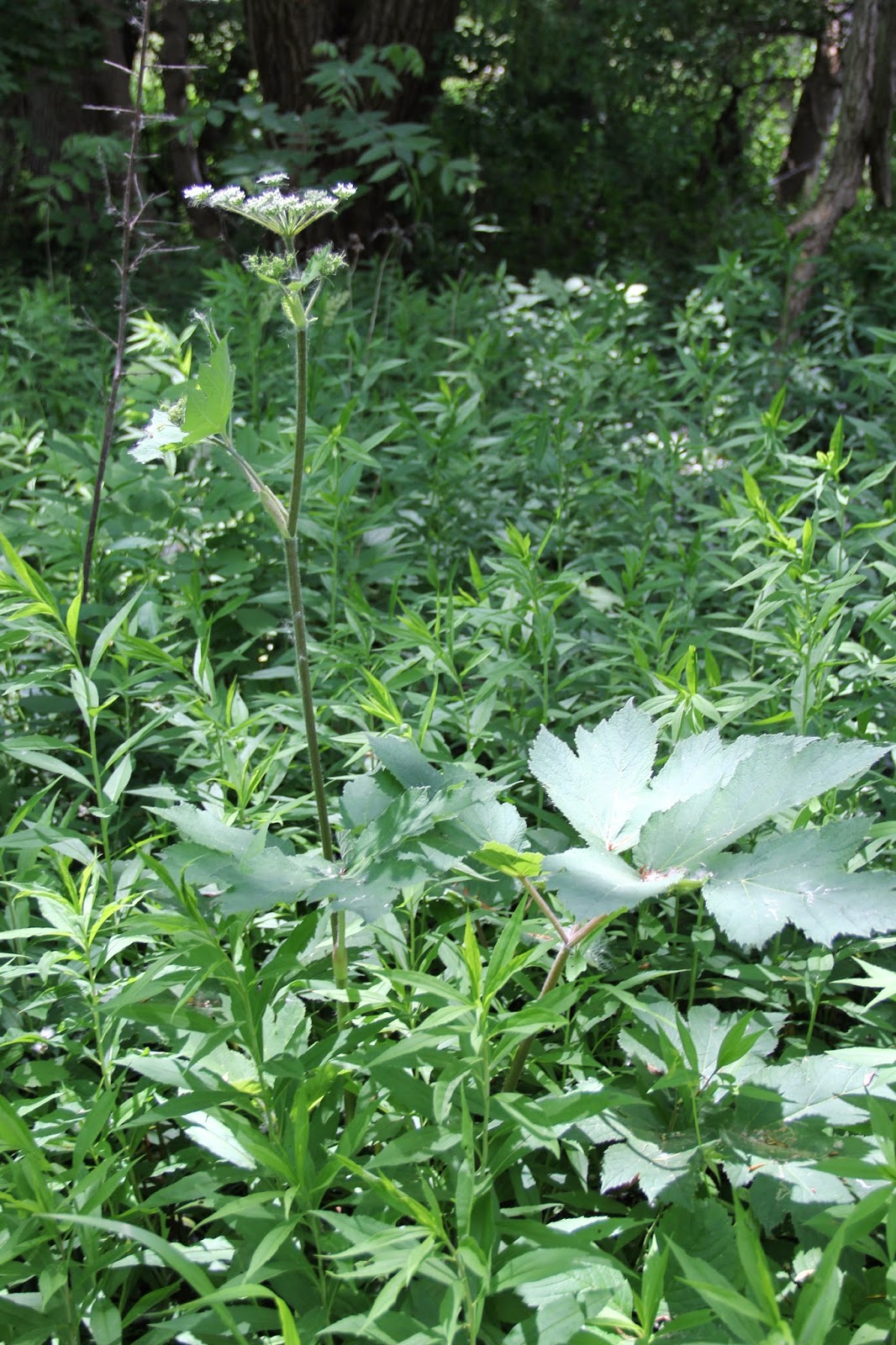
The next plant is one that I wrote about earlier this Spring - Cow Parsnip (Heracleum maximum).  This member of the Carrot Family (Apiaceae) is easy to identify due to its size.  Cow Parsnip plants may reach a height between four and nine feet!  Like other plants in this family, Cow Parsnip plants are topped with a wide flat cluster of flowers known as an umbel.  Individual flowers are small, but the umbels may be up to 8 inches across.

Cow Parsnip rising above the surrounding vegetation

Cow Parsnip - a closer view of the flowering umbel


Cow Parsnip can be found growing in any low wet area including floodplains, swamps, shorelines, roadside ditches , etc..

For more information please see my post about Cow Parsnip from March 25th.


Wildflowers of 2014 - #136 Everlasting Pea (Lathyrus latifolius)

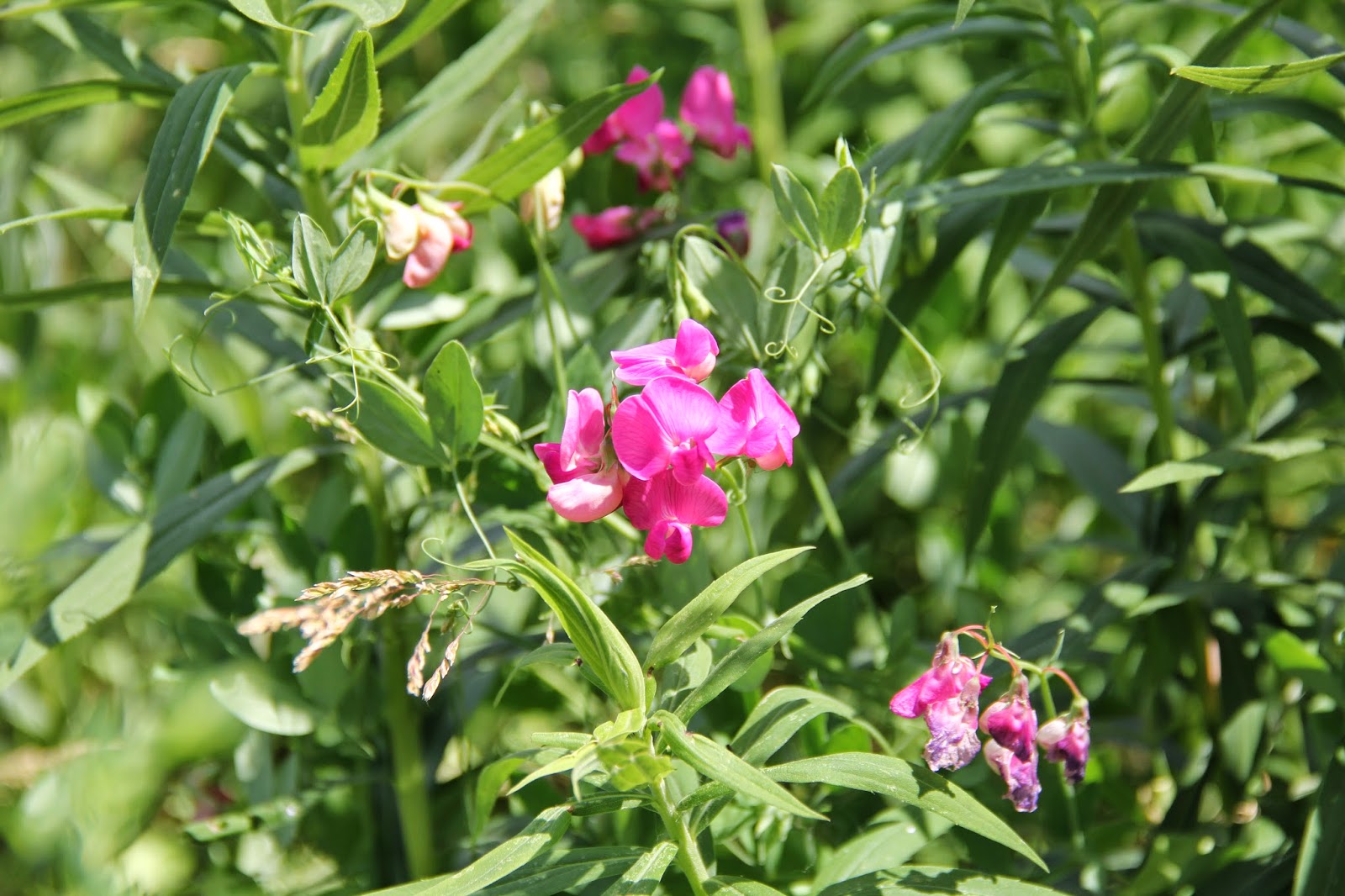
I found Everlasting Pea (Lathyrus latifolius) growing in an open dry area along the Chippewa River.  This non-native vine is also known as Perennial Pea.  It was originally introduced to North America as a decorative plant, being grown for its large (up to 1 1/4 inches), showy, pink flowers.  It is now found in every state except Alaska, North Dakota, and Florida.

Everlasting Pea (Lathyrus latifolius)

Each Everlasting Pea vine can grow up to 6 feet.  The vines either trail along the ground or climb nearby objects with the aid of grasping tendrils which coil around and support the plant's weight.  The compound leaves of Everlasting Pea are arranged alternately along the vine, with each leaf having a single pair of leaflets.

Everlasting Pea - note the typical pea flower shape with banner (petals that looks like a basketball backboard), wings (the two petals beneath the banner) , and keel (hidden under the wings)


Wildflowers of 2014 - #137 Cursed Crowfoot (Ranunculus scleratus)

The sixth wildflower find of the day was  member of the Butercup Family - Cursed Crowfoot (Ranunculus scleratus).  Also knows as Cursed Buttercup or Celery-leafed Buttercup, this is the fourth Ranunculus species on my 2014 list.  Like many of the other Buttercup species, Cursed Crowfoot prefers wet soils; I found this plant growing in a low muddy area within the river's floodplain.  This species is found throughout the Northern Hemisphere and some plants found in North America may have been introduced from Europe. 

Cursed Crowfoot in typical wet habitat


Cursed Crowfoot is fairly easy to identify.  It's leaves are oval or kidney shaped with three deep lobes.  The stems of the plant branch repeatedly.The leaves and the stems are more succulent than other Ranunculus species - this means that that the are very juicy. This juice is considered toxic and may cause blisters.  Use caution if handling.

Cursed Crowfoot - note the lobed leaves

The flowers are small measuring only 1/4 to 3/8 inch across.  Each flower has 5 yellow petals surrounding a tightly-packed cylinder of pistils.  This cylindrical center is distinctive of this species. 

Cursed Crowfoot (Ranunculus scleratus) - note the distinctive cylindrical flower


Wildflowers of 2014 - #138 Rough-fruited Cinquefoil (Potentilla recta)

The next flower that I found is another introduced species - Rough-fruited Cinquefoil (Potentilla recta).  Also known as Sulphur Cinquefoil, this native of Eurasia is now found across most of North America with the exceptions of the Desert Southwest and Canadian Arctic.  It grows on roadsides, in fields and meadows, and other weedy places.

Rough-fruited Cinquefoil (Potentilla recta)

Of the fifteen Potentilla species that are found in Michigan, Rough-fruited Cinquefoil is one of the easier species to identify.  It has pale yellow flowers with five heart-shaped petals.  The compound leaves are the most distinguishing characteristic of this species.  Each leaf has 5-7 leaflets arranged palmately (radiating outward from a central point) with coarsely toothed margins.

Rough-fruited Cinquefoil - note the Hover Fly nectaring at the pale yellow flower

Rough-fruited Cinquefoil - note the distinctive leaf shape


Wildflowers of 2014 - #139 Crown-vetch (Securigera varia)

The final flower of the day was another non-native species.  Crown-vetch (Securigera varia) is commonly planted for erosion control and has naturalized across much of the United States and Canada.

Crown-vetch (Securigera varia)


Crown-vetch is a member of the Legume family and has flowers with the typical pea shape.  The pink and white flowers are arranged in a round dense cluster that resembles a crown.

Crown-vetch - a closer view of the "crown" of flowers

Crown-vetch vines can grow to a height of 1-3 feet.  While the plants may use other vegetation for support, the vines lack climbing tendrils.  The leaves of Crown-vetch are arranged alternately along the stem, with each compound leaf being composed of an odd number (11-25) of leaflets.  The plant can reproduce both by seed and by underground rhizomes.  Because of these dual methods of reproduction, Crown-vetch often forms dense colonies that crowd out other plant species.