Showing posts with label moths. Show all posts

Sunday, August 5, 2018

The Days of Summer - Day Thirty-eight through Day Forty-four

This is part six of my current photography project - The Days of Summer.

In the past, I have had times where I have gone days or even weeks without taking photographs.  This summer I set out to change that tendency.  I gave myself the task of recording images every single day between the Summer Solstice and the Fall Equinox.  Not only do I need to photograph something every day, but I am also sharing a single photo from each day on this blog.

To see the previous installment (part four) check out this link.

Day 38 (28 July 2018) - Lights! Camera! Moths...


The week of 21 - 29 July was National Moth Week.  In celebration, I hosted two mothing events on the nights of 27 July (for the Chippewa Watershed Conservancy) and 28 July (for the Chippewa Valley Audubon Club).  This image is from the latter event at Mission Creek Woodland Park in Mt. Pleasant.  This image was taken shortly after the sun went down as the moths had barely started to come in.  Lots of moths were drawn to the lights, but this image was my favorite of the night.

Day 39 (29 July 2018) - Woodpecker Feather


This picture of a woodpecker flight feather was taken during a hike to the top of Bundy Hill.  This feather belongs to either a Downy Woodpecker or a Hairy Woodpecker.  Although these two species look very much alike, they are not closely related.  The current theory is that the Downy evolved to look more like the Hairy so it wouldn't be harassed by the larger bird.

My general philosophy in regards to photo editing is that "Less is More."  This picture is probably the most heavily edited image I have ever posted on this blog.  It has been rotated 180 degrees from the original - I liked the quill better in the lower left of the image than in the upper right.  The image has also been cropped to better focus on the feather.  Even though I prefer to "crop with my feet" (move closer to the subject), I am usually okay with cropping an image down to better focus on the main subject.   I have also adjusted the brightness of this image.  The picture was taken in direct sunlight and the colors were rather washed out in the original.

Day 40 (30 July 2018) - Oh, Hello!


This picture of a Goldenrod Soldier Beetle (Chauliognathus pensylvanicus) on a Queen Anne's Lace (Daucus carota) was photographed at Forest Hill Nature Area.  The beetle was feeding on pollen and nectar on the small individual flowers.  To highlight the beetle against the sky, I lay on my back in the middle of a trail, leaned against my camera bag for support and, and aimed the camera upward.  I probably shot two dozen images of this beetle as it crawled around the flower, but the pose in this picture made it my favorite.  This image has been cropped slightly to reduce the amount of open space at the top and left of the picture.

 Day 41 (31 July 2018) - Carolina Locust


Unlike the previous two pictures.  This image has not been edited at all.  I photographed this Carolina Locust (Dissosteira carolina) at Chipp-A-Waters Park in Mt. Pleasant.  To get this picture I lay on a slab of limestone along the edge of the Chippewa River and focused tightly on the grasshopper.  I was at the minimum focus distance for the lens on my camera.  By working so close, I lost a little bit of detail on the legs, but check out the veining on the wings and the pattern on the head, thorax, and abdomen!

Day 42 (01 August 2018) - Halloween Pennant
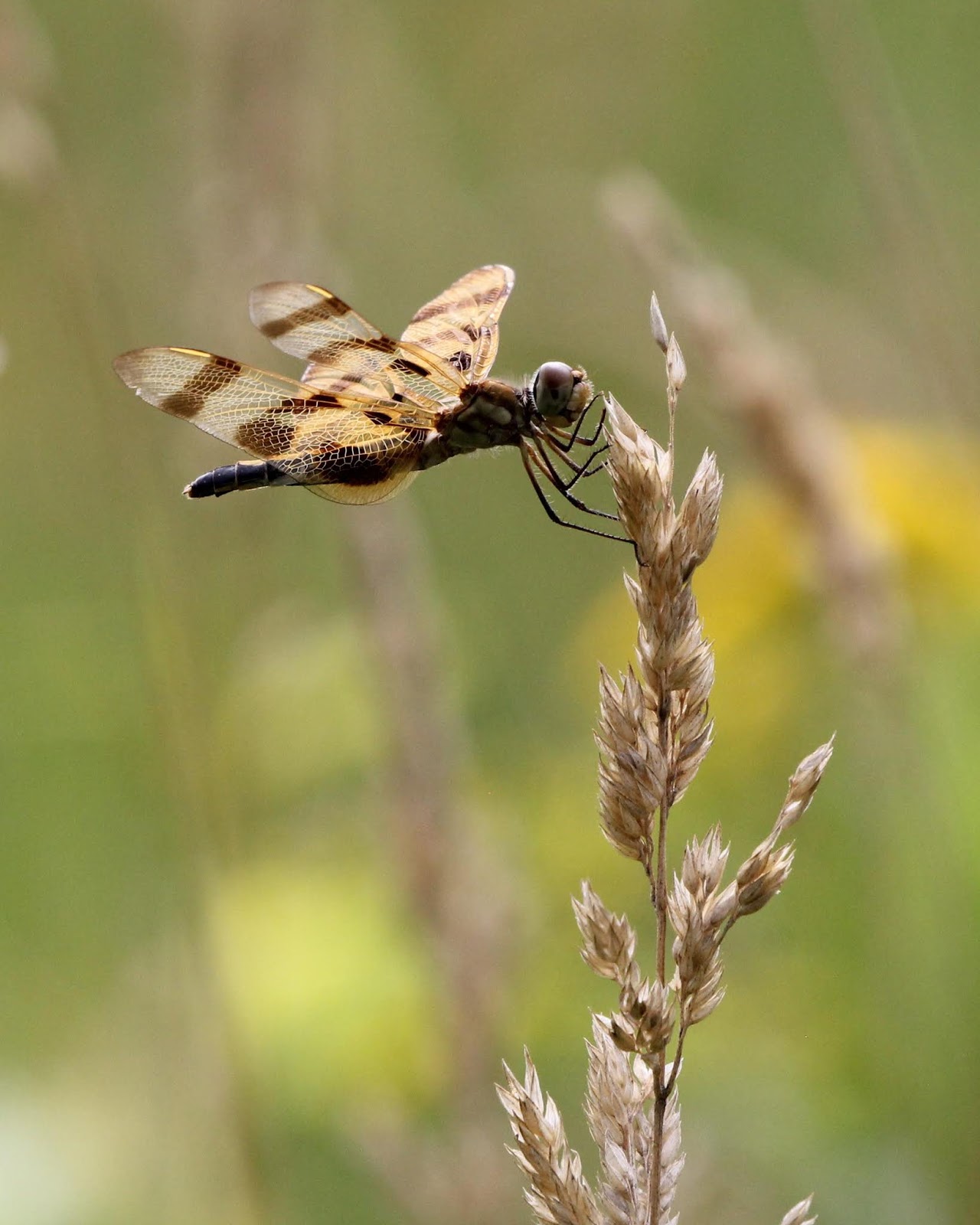

This image was also photographed at Chipp-A-Waters Park.  After photographing the Carolina Locust on the 31st, I noticed a Halloween Pennant (Celithemis eponina) hunting in a grassy area along the riverbank.  Despite repeated attempts, I was never able to get a picture that I made me happy.  I went back the next morning to try again.  I actually arrived too early and had to wait for insects to begin flying.  Eventually this Pennant showed up and I was able to get several photos.  I cropped this from a horizontal to a vertical image.  I liked the original, but I liked the vertical crop just a little bit more.

Day 43 (02 August 2018)


This picture was taken at North Higgins Lake State Park.  I spent the day doing a pair of activities for a summer camp being held by the Saginaw Chippewa Indian Tribe.  Due to stormy weather, we adjusted the schedule a little bit.  This left me with some time before my morning activity.  Although this is not the greatest image, I like the repetition of the spherical water droplets throughout the picture.

Day 44 (03 August 2018)


My final photo for the week was taken at Mission Creek Woodland Park.  Although sometimes I have a plan I go out to take photos (like with the Halloween Pennant pictured above), at other times it pays to just wander and see what happens.  I found these Crown Coral (Clavicorona pyxidata or Artomyces pyxidatus) growing on a rotten log in the middle of the woods.  If I hadn't wandered away from the trail I never would have discovered them.  Coral fungi are some of the coolest looking fungi that grow in Mid-Michigan, but I sometimes find them a challenge to photograph because they are such a start contrast to the dark wood.  I decided to crop this picture as a square eliminating another clump of fungus to the left of the picture.

Tuesday, July 17, 2018

Native Species Profile - Wild Bergamot

Wild Bergamot (Monarda fistulosa), also known as Bee Balm, is the most widespread of four Monarda species found in Michigan.  Nationally it has been recorded in all but four states (AK, HI, CA, FL) and across most of the temperate provinces of Canada.  It can grow in a variety of habitats including open woodlands, savannas, prairies, fields, dunes, etc.  It normally grows in dry habitats but is occasionally found in wetlands.

Bumble bee and Silver-spotted Skipper on Wild Bergamot

Wild Bergamot is a member of the Mint Family (Lamiaceae).  Like all other mints, it has stems with a square cross-section and opposite pairs of leaves.  The plants can grow to a height of 4 feet and are topped with a single rounded flower head.  This flower head measures 1 - 3 inches across.  Flowers begin blooming near the center of the head first and continue outward to the margins.  Flowers are typically pink or lavender colored.  Individual flowers on the head are tubular and may be up to an inch long.  Near the tip, each tubular flower splits into several protruding lips.  The lower lips serve as a landing place for pollinators.

Wild Bergamot - note tubular flowers and opposite pairs of leaves

Wild Bergamot has a distinctive strong scent that reminds some people of mint and others of oregano.  Anyone who drinks Earl Grey tea will recognize this smell, although in Earl Grey tea the smell comes from the peal of the Bergamot Orange.

A Snowberry Clearwing Moth (a bumble bee mimic) prepares to nectar on Wild Bergamot

Wild Bergamot is an important nectar source for many insects including bumble bees, bee flies, hummingbird and bumblebee moths, sphinx moths, skippers, and butterflies.  It is also visited by hummingbirds.  This plant spread by rhizomes and seeds so it often forms large colonies.  Large colonies can easily attract hundreds of pollinators at a time.


Basic Information

Wild Bergamot 
Monarda fistulosa

Height:  2.5 - 4’ tall
Habitat:  dry areas; fields, open woods, prairies, fields, sand dunes, savannas

Flower Color:  lavender to pink

Bloom Time:  July – August

Friday, July 13, 2018

The Days of Summer - Day Seventeen through Day Twenty-three

This part three of my Days of Summer photo project.  To learn more about the inspiration for this project and to see the photos from part one and part two click on the following links:

     The Days of Summer - Day One through Day Nine
     The Days of Summer - Day Ten through Day Sixteen

 Day 17 (07 July 2018) - Snowberry Clearwing Moth


We normally think of moths as nocturnal insects, but many are adapted to daytime living.  This includes a group of sphinx moths known as Clearwings.  In North America, there are four species in the genus Hemaris.  All fly by day.  They mimic the appearance of bumblebees and the feeding behavior of hummingbirds - thus they are often known as Bumblebee Moths or Hummingbird Moths.  This one is specifically known as the Snowberry Clearwing Moth (Hemaris diffinis) after a favorite larval host plant.  This photo was taken at Forest Hill Nature Area.  This probably not the best image from the day, but I cannot resist the subject.

Day 18 (08 July 2018) - Japanese Maple


This image of Japanese Maple leaves was taken in front of our house.  I like the silhouette of the red leaves against the blue sky and the details of the delicate veins in the central leaf.

Day 19 (09 July 2018) - Impression, Michigan Lily


If the previous photo was all about details.  This one is all about impressions.  This Michigan Lily (Lilium michiganense) was photographed at Mission Creek Woodland Park.  This photo reminds me of an Impressionist painting with only the blooms pistil and one or two stamen in sharp focus.  The rest of the flower is clearly visible but much softer.  It's all about the light!

The name given to this photo was inspired by the painting that Impressionism was named after:  Impression, soleil levant (Impression, sunrise) by Claude Monet.

Day 20 (10 July 2018) - Sunlight and Basswood


The photo for Day Twenty is also all about the light.  In this image sunlight filters down through the canopy, shedding light on American Basswood (Tilia americana) leaves.  The sun itself bursts through a gap in the upper right of the image. This image was taken in Mt. Pleasant at Mill Pond Park.

Day 21 (11 July 2018) - Waves of grass


I am constantly drawn to subjects that show pattern and texture.  Choosing a photo for July 11th was difficult.  I traveled north along US 127 to North Higgins Lake State Park for a late afternoon meeting.  Before my meeting I spent a little time exploring the park and came away with images of the lake, pine trees, lichens, etc.  Most of these images focused on pattern and texture.  In the end, I selected this image because of the suggested wavelike motion of the grasses.  I could have easily selected three or four other pictures from the day,

Day 22 (12 July 2018) - Blue Vervain


This photo of Blue Vervain (Verbena hastata) was taken along the Chippewa River at Chipp-A-Waters Park in Mt. Pleasant.  The individual flowers are small, but each plant can have hundreds of blooms over the course of several weeks in mid- to late-summer.  The sheer abundance of blooms makes this an important nectar source for native bees.  Although none appear in this picture, there were dozens buzzing around this colony of plants.

Day 23 (13 July 2018) - White Water Lily with native bee


My final picture of the week shows a native bee collecting pollen from a White Water Lily (Nymphaea odorata).  I took about two dozen of pictures of this exact flower at the beginning of a walk through Mill Pond Park this morning.  I came back near the end of my walk and there was a bee on the flower.  One picture and the bee was gone...


Thursday, August 31, 2017

Never look a gift caterpillar in the mouth

A large caterpillar clasp a Virginia Creeper vine with its fleshy prolegs.

Yesterday while traipsing through the swamp at Mission Creek Park, I happened to look down at just the right time.  Right on the ground, I saw this large reddish brown caterpillar clinging to a Virginia Creeper (Parthenocissus quinquefolia) vine. 

This large caterpillar was about 3 inches long and 3/4 inch across

I immediately recognized it as a sphinx moth caterpillar, did not know which one.  Finding it on a Virginia Creeper helped to identify it;  freshly chewed leaves indicated that Virginia Creeper was probably its host species.  Knowing a host plant made it relatively easy to look up.

Pandorus Sphinx caterpillar - a face only a mother (or insect-lover) could love!

It's a Pandorus Sphinx Moth caterpillar (Eumorpha pandorus).  As a larvae, this species feeds on Virginia Creeper and grapes (Vitis spp.).  This species is found across the eastern half of the United States.  Mid-Michigan is on the northern edge of its range.  It is found as far south as the Gulf Coast and west to a line running from eastern Nebraska to eastern Texas.  It's range roughly coincides with the range of Virginia Creeper.  Pandorus comes from Greek and means "all-giving" or "all-gifted"; the female form of the word is Pandora.  In Greek mythology, Pandora is the first woman.  In the myth, she opens a jar containing all forms of evil releasing them into the world.


Pandorus Sphinx caterpillar (head and thorax to upper left) - note white markings on abdomen

The most distinguishing feature of this caterpillar is the row of white spots on each side of its abdomen.  Five of these oval-shaped spots surround spiracles on the caterpillar's abdomen.  Spiracles are pores or apertures through which an insect breathes.  Insects lack lungs.  Instead, oxygenated air enters the insects bodies through the spiracles and passes through a system of tubes known as trachea before entering directly into the insect's body tissues.  Gases that are produced in the insect's body pass from the body tissues into the trachea and leave the body through the trachea.   Some insects have no control over the flow of gases while others are able to expand and contract abdominal muscles to draw in in or expel air (much like the way we use our lungs).

Wednesday, August 2, 2017

Friday Night Lights at Sylvan Solace Preserve (28 July 2017)

In about three weeks high school football season kicks off here in Mid-Michigan.  Last week the Chippewa Watershed Conservancy's Sylvan Solace Preserve was host to its own version of Friday Night Lights.  But instead of football, this version involved insects - specifically moths.

Six amateur lepidopterists (people who study moths and butterflies) gathered at Sylvan Solace with the goal of attracting and identifying some of preserve's many species of moths (and other insects).  This purpose of this event was to celebrate National Moth Week.  This is not the first time the CWC has celebrated National Moth Week, but unlike past attempts this one did not get cancelled due to weather.

There are many ways to attract moths.  One of the simplest ways is to go out into the woods (or other habitat) with a bright light source and a light colored sheet.  Suspend the sheet between a couple of trees and shine the light on it - the moths will be attracted to (or confused by) the bright light and land on the sheet where they can be identified at your leisure.


Setting for this activity was the (relatively) easy part.  However, Sylvan Solace Preserve does not have a source of power so one had to be brought in.  My lepidopterists will use deep-cycle marine batteries to power their lights.  I don't have any batteries handy, but I did have access to a small generator.  So in addition to the sheets and lights, the generator had to be hauled into and out of the woods.  No one wants to sit right next to a loud, smoky generator while they are trying to enjoy nature - so I also hauled about 300 feet of extension cords so the generator could be placed further away.

Once the lights were turned on and darkness fell, the moths began to arrive almost immediately.  Moth identification can be challenging in the woods, especially since so many of the species are small and nondescript (brown, grey, with few distinguishing marks). We did our best, but were only able to positively identify a couple of the more distinctive species in the field.

Several hours of poring over my photographs and field guides led to these identifications:

Gray Half-spot (Nedra ramosula)

Bog Lygropia (Lygropia rivulalis)

European Corn Borer (Ostrinia nibilalis)

Sweetfern Geometer (Cyclophora pendulinaria)

Painted Lichen Moth (Hypoprepia fucosa)

Banded Tussock Moth (Halysidota tessellaris)
There is a possibility that the above moth is not a Banded Tussock Moth, but rather a Syacamore Tussock Moth (H. harrissii).  However, I do not know of any Sycamore trees in the immediate area of Sylvan Solace Preserve.  Without this host plant, I think that it is more likely the Banded Tussock Moth.

Dark-banded Owlet (Phalaenophana pyramusalis)

Oak Leafroller (Argyrotaenia quercifoliana)

Sigmoid Prominent (Clostera albosigma)

Subgothic Dart (Feltia subgothica)

Common Grey (Anavitrinella pampinaria)

These were not the only moths that came to the party.  A few more hours of effort should probably lead to several more identifications - if I identify more species I will add them in a separate posting.  If you notice any errors in identification, please let me know.  

Tuesday, July 25, 2017

Upcoming Event - Friday Night Moth Hunt (28 July 2017)


This week is National Moth Week!  To celebrate, please join me this Friday night (28 July) at the Chippewa Watershed Conservancy's Sylvan Solace Preserve as we host a moth hunt.  We will be hanging lighted sheets in the woods to draw in moths and other nocturnal insects.

Sylvan Solace Preserve is located on W. Pickard Road (between Littlefield Rd. and Gilmore Rd.) approximately 8.5 miles west of downtown Mt. Pleasant.

This event is scheduled to begin at 9:00PM and will run for at least two hours.  The event is free to the public, but donations to the CWC are always encouraged. 

Tuesday, December 6, 2016

Holiday field guide gift guide - 16 guides for 2016 (part 2)

Field Guides to Insects

5.  Pollinators of Native Plants:  Attract, Observe and Identify Pollinators and Beneficial Insects with Native Plants by Heather Holm (ISBN 9780991356300).


If you already own a bunch of field guides to plant you probably spend a lot of time looking at plants.  If you spend a lot of time looking at plants you probably see lots of insects.  You might even wonder what the insects are and why you see different ones on different flowers.  If this describes you, then you want to own this book.

I heard the author of this book speak at the 2016 Wildflower Association of Michigan Conference and bought the book the same day.  It is the first book that I am aware of that talks specifically about the associations between native plants and their pollinators.  Although the book is limited in scope with only sixty-five plant species being featured, it includes more than 1600 photographs of flowers and insects!


This flower species in this book are arranged by habitat type.  Each species of plant is given a spread of two (or more) pages that includes a description of the plant, range map, flowering period, and habitat requirements, as well as a list of pollinator species (with photographs).  If you want to plant wildflowers as habitat for bees and butterflies, this is a must-have.  The book was published by Pollination Press LLC and retails for about $30.

6.  Butterflies of Michigan Field Guide by Jaret C. Daniels (ISBN9781591930983)


At some point you might want to know more about a specific group of insects.  Butterflies are a great place to start - there are only 147 species that are likely to be found in Michigan. 


I like this book because each species has its own two page spread.  The information provided includes detailed description, as well as a range map, a list of larval host plants, a calendar showing when it can be encountered, and a list of comparable species.  There are also pictures of both adults and larva - several entries in the book to not have larval photographs.  Another feature that I really like about this book is that the butterflies are divided by color - if a species has more than one color morph it is listed in more than one section.  This sensible approach to identification is something that you usually do not see outside of wildflower books, but it works well for butterflies.


Unlike some of the other books on this list, this is a true "field" guide.  It is small enough (about 5 inches by 7 inches) and light enough to stick in your back pocket and carry all day. The book was published by Adventure Publications in 2005.  It retails for under $20.  I highly recommend this book to anyone wanting to learn more about Michigan's butterfly species as well as anyone interested in observing the relationship between insects and native plants.

7.  Peterson Field Guide to Moths of Northeastern North America by David Beadle and Seabrooke Leckie (ISBN 9780547238487).


If butterflies are too easy (There are only 147 Michigan species after all!), it may be time to try your hand at moth identification.  I was really excited back in 2011 when I found out that this book was in development.  I was so excited that I asked for it for Christmas in 2012 - Thanks Shara!


Published by Houghton Mifflin Harcourt, the moths in this book are arranged by family.  There is a color photograph for each species, with arrows pointing to distinguishing marks.  There is also a brief description and range map for each species.  If you are not familiar with all of the different types of moths, the book can be daunting to use - there are nearly 1500 species depicted in this guide.  Even so, this guide is worth having because of the breadth of species that it covers.  At $29 it is a reasonable price for such an extensive resource.

8.  Caterpillars of Eastern North America: A Guide to Identification and Natural History by David L. Wagner (ISBN 9780691121444)


Published by the Princeton University Press in 2005, this book has all the qualities of a book you would expect from a guide published by a well-renowned university.  It is extensive (more than 700 species), well illustrated with photographs of both caterpillar and their adult forms, and well researched.  Each species description includes information information on range, season, and host plants as well as a detailed description of each species.


The book is slightly too large to carry in your pocket (5 inches by 8 inches).  It is also quite heavy - it is printed on a heavy paper and runs more than 500 pages.  It is however the best guide to caterpillars that I own, so I do frequently carry it in my backpack while out in the field.  Priced at under $25, this is a great edition to the bookshelf of any nature nut or gardener who wants to know what is eating their plants.

9.  A Guide to Common Freshwater Invertebrates of North America by J. Reese Voshell, Jr. (ISBN 9780939923878)


If you would rather wade in swamps and river than chase butterflies through fields, this might be the book for you.  I spend much of the spring working with students to catch and identify aquatic insects (and other macroinvertebrates).  Although I can identify most of the things that we find by sight, this is the book that I use if I want more detailed information.


Although much of the book is devoted to aquatic insects, there are also sections on mollusks (clams and mussels), gastropods (snails), annelids (worms), crustaceans (crayfish, shrimp, etc.), and more.  The book starts with a discussion of aquatic ecology and the roles, life histories, and pollution tolerance of various groups of aquatic invertebrates.  It also provides a  description of collection methods for various organisms and habitats.   There is a separate section of color illustrations which is useful for identification.  The main part of the book is devoted to detailed descriptions of the various organisms.


Published by the McDonald & Woodward Publishing Company in 2002, this book currently sells for nearly $40.  It is a valuable resource for citizen ecologists, fishermen, and anyone interested in what is going on beneath the surface of any body of freshwater.  Despite the hefty price, I highly recommend this book.

10.  Beetle of Eastern North America by Arthur V. Evans (ISBN 9780691133041)


Among other things, I am a beetle fanatic.  When I heard that this book was being published in 2014 I could hardly wait to buy it.  I was not disappointed.

Another book by the Princeton University Press, it is simply the best beetle identification book available for the eastern United States and Canada.  By no stretch of the imagination is this a field guide - it measures 8 inches wide by 10 inches long and has over 550 pages.  Photographs and description of more than 1400 species are included in this book.  It is almost as much a coffee table book as it is field guide - the photographs of the individual beetles are often stunning.  I can admit to looking through this book for hours.  At $35, this book is an incredible value for its size and scope.  I cannot recommend it highly enough.  Any naturalist would be excited to receive this as a holiday gift.


The species in the book are arrange by family - all 115 families found east of the Mississippi River are represented in the book.  Each section of the book begins with a general description of the family and is followed by detailed descriptions of individual species.

That's it for field guides to insects and other invertebrates.  Look for Part 3 (field guides to other animals) later this week.

Tuesday, July 5, 2016

Virginia Ctenucha at Forest Hill Nature Area.

On Friday (01 July), I stopped at the Forest Hill Nature Area to try out a new camera lens.  It was a little windy for closeup photography, but I did get a few photos that I liked including this one of a Virginia Ctenucha moth feeding on Common Milkweed nectar.  The Virginia Ctenucha (Ctenucha virginica) is a day-flying moth.  It is one of many moth species that are known as wasp mimics.  Their dark coloration and wasp-like shape affords some measure of protection from predators who avoid them out of fear of being stung.  I saw dozens of these moths flying around during my short visit.

Virginia Ctenucha (Ctenicha virginica) on Common Milkweed (Asclepias syriaca)

Monday, August 3, 2015

Once in a Blue Moon Moth Hunt, Interrupted...

Moth hunters await the arrival of the moths (and rainclouds)

Last Friday night (31 AUG 2015), a group of nature enthusiasts from the Chippewa Watershed Conservancy met at the CWC's Sylvan Solace Preserve for the Once In A Blue Moon Moth Hunt.

Unfortunately, about the same time that the moths started to roll in so did a rain storm.  It started with wind, followed by light sprinkles.  When the rain became heavier, I had to make the decision to shut things down.  Hot lightbulbs and lots of extension cords do not mix very well with cold rains.

We did have a few moths come in before the came came.  Most of them were very skittish (probably due to the changes in the weather) and did not stay long on our sheets.  I was only able to get photos of one moth before we shut down - I know other people did get more pictures.  I think this photograph was enough to identify the species.  It appears to be a One-lined Sparganothis Leafroller (Sparganothis unifasciana). 

One-lined Sparganothis (Sparganothis unifasciana)

I am currently looking at options for rescheduling this rain-shortened outing.  If this event is rescheduled I will post more information here.

UPDATE:  This event has been rescheduled for this Friday (07 August 2015) at 9:00PM.  If you plan on attending please sign up on the Chippewa Watershed Conservancy's website.