We live in town in a residential area. So imagine my surprise when I opened our back door one night last week to see this...
That's an Eastern Screech Owl (Megascops asio) sitting in a large Honey Locust tree less than 25 feet from the house. This species is common across the eastern United States and can be found anywhere mature trees exist including urban or suburban areas.
This owl was probably hanging out in our yard waiting for a mouse to show up under our bird feeders - it was facing directly toward the feeders. This is actually the first screech owl that I have ever seen in the wild. It was pretty amazing to see (and photograph) one in my backyard.
To learn more about the Eastern Screech Owl check out this entry from the Cornell Lab of Ornithology.
Showing posts with label native species. Show all posts
Sunday, February 17, 2019
Tuesday, February 5, 2019
Native Specie Profile - White-breasted Nuthatch
| White-breasted Nuthatch |
One of the most widespread birds in the United States is the White-breasted Nuthatch (Sitta carolinensis). This species is found in portions of every state except Alaska and Hawaii. It also ranges north into southern Canada and south through much of central Mexico. Never found far from trees, the White-breasted Nuthatch prefers wooded habitats, especially deciduous forests. It is also frequently found in parks, yards, and suburban areas with mature trees. Three other Nuthatch species can be found in the United States, but of the three only the Red-breasted Nuthatch (S. canadensis) is also found in mid-Michigan.
The White-breasted Nuthatch is a small bird. An adult White-breasted Nuthatch measures about 5 - 5.5 inches (13 - 14 cm) from beak to tail, with a an 8 - 10.5 inch (20 -27 cm) wingspan. They weigh between 0.6 and 1.1 ounces (18 - 30 grams) or about as much as 3 to 5 quarters.
This species has a blue-grey back and wings, accented with black, and a white breast and belly. The outer feathers of its tail are white, but only noticed when tail feathers are fanned. Another interesting feature that you don't always notice is the patch chestnut colored feathers on its belly and flank. Males and females can be identified by the color of their "cap". Males have a black cap and females grey as seen in the photos below. The nuthatch's beak is strong and straight or slightly upturned.
Although White-breasted Nuthatches have a strong beak they rarely excavate their own nest holes. Instead they will use abandoned woodpecker holes or natural cavities in trees. This species will use artificial nest boxes; I have had a pair nest a few feet away from a window in a nest box that I had placed. Their nest consists of a cup made of fine grasses, shredded bark, feathers, and other soft materials.
| Female White-breasted Nuthatch - not grey cap and elongated rear toe (hallux) |
White-breasted Nuthatches are omnivores. They consume a composed mostly of insects, insect larvae, and other invertebrates such as spiders, but will also readily eat seeds and nuts. They visit feeders readily and consume both seeds (especially sunflower seeds and peanuts) and suet. In the wild, White-breasted Nuthatches often forage in mixed flocks with other nuthatches, chickadees, titmice, and small woodpeckers.
| Female White-breasted Nuthatch - Its unique downward foraging method allows it to find food other birds overlook |
Nuthatches have a unique foraging strategy that is not employed by other birds in mid-Michigan; they can walk head down on a tree trunk. Many birds such as woodpeckers and Brown Creepers (Certhia americana) forage by climbing up a trunk poking their bees into cracks and crevices in the bark. It is thought that the nuthatches method allows them to find food that has been overlooked by these species.
Why can nuthatches climb face-down, but other birds can't? It has to do with their toes. Nuthatches have four toes on each foot; three face forward and one faces backwards. This backward facing toe is known as the hallux. On nuthatches the hallux is elongated and has a strong curved nail. The three forward facing toes, although shorter, also have strong curved nails. This combination allows the nuthatch to grip in such a way as to allow it to walk facedown on a tree trunk. It is our only native bird that is capable of such motion.
| Male White-breasted Nuthatch - note black cap. |
White-breasted Nuthatches are usually found in pairs. A male and female will remain together year-round and aggressively chase other nuthatches out of their territory. The male and female shown in the two pictures directly above were photographed a few feet from each other on the same tree.
Basic Information
White-breasted Nuthatch
Sitta carolinensis
Size: 5.0 - 5.5" long
8.0 - 10.5" wingspan
Habitat: woodlands, woodland edges, parks, suburban areas
Eats: insects, insect larvae, spiders, seeds, nuts
Nest: in natural cavities in trees, abandoned woodpecker nests; a cup made of grass, shredded bark, feathers, other soft materials; will nest in artificial nest boxes
Thursday, January 10, 2019
Teaching about niches and the relationships between species
Back in October I started sharing Michigan species cards and promised that I would show how I used them in the classroom. After much delay, here is an example of their use - I can use the cards to help students understand the relationships between species in a habitat.
If you think of an environment as a giant puzzle, species only fit in a certain place in the environment. They have a role that they belong in. In the same way that a puzzle piece from the edge will not fit into the center and vice versa, a species can only fit in a certain place in the environment. That role or place that a species occupies in its environment is known as its niche. A species locks into its niche by a series of connections with the species around it. Some species will connect with many species while others will only connect with a few.
Let's start by exploring the relationships between two species.
Some species are connected by their shared needs. They might compete for resources such as food, water, shelter, or space. For example a Downy Woodpecker and an Eastern Grey Squirrel may both wish to occupy a hole in a Red Oak tree, but they will not share the space so this makes them competitors. The woodpecker and squirrel might also compete over food as both eat fruit, seeds, and nuts. In times of plenty this may not be an issue, but when foods are scarce there may not be enough for both species to survive. So the relationships between the two species (form the squirrel's perspective) are as follows.
The squirrel also gets food from the Red Oak tree in which it lives. At different times of the year the squirrel may consume leaf and flower buds, acorns, or sap from the tree. Again two relationships can be identified if viewed from both perspectives.
The more species that I add, the better I can define the niche that the squirrel occupies. For example, if I add a Red Fox to the equation, what relationships or connections would that fox have to the squirrel? The fox is an omnivore. It easts fruit, nuts, seeds, birds, eggs, amphibians, reptiles, insects, small to medium-sized mammals, and carrion (dead animals). Based on food alone, the fox has two possible connections to the squirrel both as a competitor and as a predator.
If I expand my thinking beyond the squirrel, I can define how all the other species in the habitat relate and see other degrees of interconnectedness. For instance it may be difficult to see the relationships that exist between the Red Fox and a Black-capped Chickadee, but by digging deeper a couple of relationships emerge - they eat some of the same foods such as fruit, berries, and insects. This makes them competitors (on a small level).
The Gem-studded Puffball has some of the following relationships:
If you think of an environment as a giant puzzle, species only fit in a certain place in the environment. They have a role that they belong in. In the same way that a puzzle piece from the edge will not fit into the center and vice versa, a species can only fit in a certain place in the environment. That role or place that a species occupies in its environment is known as its niche. A species locks into its niche by a series of connections with the species around it. Some species will connect with many species while others will only connect with a few.
Let's start by exploring the relationships between two species.
- The squirrel competes for shelter with the woodpecker.
- The squirrel competes for food with the woodpecker.
We could also state this from the perspective of the woodpecker as thus:
- The woodpecker competes for shelter with the squirrel.
- The woodpecker competes for food with the squirrel.
- The squirrel receives food (eats) the woodpecker.
- The woodpecker provides food (is eaten by) to the squirrel.
The squirrel also gets food from the Red Oak tree in which it lives. At different times of the year the squirrel may consume leaf and flower buds, acorns, or sap from the tree. Again two relationships can be identified if viewed from both perspectives.
- The squirrel receives food from the oak.
- The red oak provides food to the squirrel.
I have already mentioned another relationship between the squirrel and the oak tree. Squirrels find shelter in trees. They live in holes in trees, but they also construct nests made of leaves high in the canopy.
- Squirrel receives shelter from the oak.
- Oak provides shelter to the squirrel.
In addition to the relationships involving food and shelter, the squirrel is connected to the oak tree by a pair of chemical relationships. As a plant capable of producing its own food through the process of photosynthesis, the oak produces oxygen (O2) as a waste product. The squirrel needs that oxygen to survive. Conversely, the tree needs carbon dioxide (CO2) to perform photosynthesis and the squirrel creates carbon dioxide through the process of respiration (breathing).
- Squirrel receives O2 from the oak.
- Squirrel provides CO2 to the oak.
Or from the perspective of the tree:
- Oak provides O2 to the squirrel
- Oak receives CO2 from the squirrel.
The squirrel and oak tree have another potential chemical relationship. The squirrel's urine and dung contain nutrients that the oak tree may need. The urine (diluted by groundwater) may be taken up directly by the oak tree's roots. The dung must be broken down by decomposers before it can taken in by the tree.
- The squirrel provided nutrients to the oak.
- The oak receives nutrients from the squirrel.
A final relationship between the squirrel and the oak involves seed dispersal. The squirrel consumes the seeds (acorns) of the oak tree, but the squirrel cannot eat them all at once. To prevent competitors (other squirrels, deer, turkeys, jays, mice, etc.) from consuming the acorns, the squirrel will hoard them to consume later. The Eastern Grey Squirrel is a "scatter hoarder"; it buries acorns in scattered locations throughout the woods. Not all of these acorns are recovered. Some will sprout and develop into new trees. The tree actually counts on this dispersal, that is why the tree will create so many acorns in a given year, by ensuring an overwhelming supply at least every few years there will be enough seeds to regenerate the forest.
- The squirrel disperses seeds for the oak tree.
- The oak tree's seeds are dispersed by the squirrel.
The more species that I add, the better I can define the niche that the squirrel occupies. For example, if I add a Red Fox to the equation, what relationships or connections would that fox have to the squirrel? The fox is an omnivore. It easts fruit, nuts, seeds, birds, eggs, amphibians, reptiles, insects, small to medium-sized mammals, and carrion (dead animals). Based on food alone, the fox has two possible connections to the squirrel both as a competitor and as a predator.
- The squirrel competes with the fox for food.
- The squirrel provides food to (is eaten by) the fox.
Or these can be expressed from the fox's perspective as:
- The fox competes with the squirrel for food.
- The fox receives food from (eats) the squirrel.
If I expand my thinking beyond the squirrel, I can define how all the other species in the habitat relate and see other degrees of interconnectedness. For instance it may be difficult to see the relationships that exist between the Red Fox and a Black-capped Chickadee, but by digging deeper a couple of relationships emerge - they eat some of the same foods such as fruit, berries, and insects. This makes them competitors (on a small level).
- The fox competes with the chickadee for food.
- The chickadee competes with the fox for food.
Both species will also eat carrion (dead animals). However, a chickadee can only eat carrion if a larger animal has first "opened" the carcass.
For example, if the fox finds a dead White-tailed Deer it can chew through the deer's hide to get to the meat. Once the hide has been opened the chickadee can then begin to feed on small bits of meat and fat. The fox has therefore made the food accessible to the chickadee (and other small birds such as the Downy Woodpecker). Some of the relationships that can be described here include:
- The fox scavenges the remains of the deer.
- The deer provides food (in the form of carrion) to the fox.
- The fox makes food accessible to the chickadee.
- The chickadee scavenges the remains of the deer.
- The chickadee scavenges the remains of the fox's meal.
- The deer provides food (in the form of carrion) to the chickadee.
If look at the deer while it's alive, I can find several other connections in the ecosystem.
- The deer competes with the squirrel for food.
- The deer competes with the fox for food.
- The deer competes with the chickadee for food.
- The deer competes with the woodpecker for food
- The deer receives food from (eats) the oak.
- The deer receives oxygen from the oak.
- The deer provides carbon dioxide to the oak.
- The deer provides nutrients to the oak.
A couple of the relationship of the Fly Agaric include:
- The Fly Agaric provides nutrients to the oak tree.
- The Fly Agaric provides food to (is eaten by) the squirrel.
- The Fly Agaric receives food from the oak tree.
- The puffball receives food (decomposes) the oak.
- The puffball provides food to (is eaten by) the squirrel.
- The puffball receives food from (decomposes) the squirrel's dung.
- The puffball receives food from (decomposes) the deer's dung.
- The puffball provides nutrients to the oak.
So how can all of this information be shown graphically? The way that I use in the classroom is with a puzzle as a graphic organizer. In this example, I have picked the Grey Squirrel to be the central piece in the puzzle. All of the other pieces are described by their relationship(s) to the squirrel. This method could be used with any of the species shown above - I could have the Red Oak be the central species in this puzzle, or the Downy Woodpecker, or any of the other species. The goal of this activity is to get students to realize that species are connected on many different levels.
Instead of using the puzzle pieces, I could also do this with a honeycomb arrangement of hexagons. This allows me to expand beyond one species and the relationships between many species.
In this example I haven't listed every relationship between species, but only a couple that connect any two species together. This activity can be as simple or complex as you want to make, but either way it meets the goal of demonstrating to students the relationships that exist between species in a habitat.
Tuesday, October 9, 2018
Michigan Species to Know - Downy Woodpecker (Piocides pubescens)
Here's the next Michigan species card that I promised - the Downy Woodpecker (Picoides pubescens). This small woodpecker is a common sight around Michigan and visits bird feeders regularly. I have written several times about this species including a species profile from January 2016.
Tomorrow I will share one of the ways that I use cards such as this in the classroom.
Monday, October 8, 2018
Michigan Species to Know - Tree Swallow (Tachycineta bicolor)
Here's the next Michigan species card - the Tree Swallow (Tachycineta bicolor). I've written extensively about this species in the past, including this species profile from 2013. Tomorrow I will post a card for the Downy Woodpecker and then I'll share a way that i use these in the classroom.
Tuesday, October 2, 2018
Michigan Species to Know - Silky Dogwood (Cornus amomum)
The next Michigan species card is here. This time it's for the Silky Dogwood (Cornus amomum). This species is pretty easy to identify when fruit is present, but it can be a challenge early in the year before flowers and fruit are present. In May 2013 I wrote a post about how to tell the difference between Silky Dogwood and the similar Red-Osier Dogwood (Cornus sericea).
Friday, August 31, 2018
The Days of Summer - Day Fifty-nine through Day Sixty-five
Here is installment nine of my Days of Summer photo project - I am trying to catch up, but I have been very busy with scheduling school program I started this project on the Summer Solstice (21 June 2018) with a photo from a sunrise hike at the Chippewa Watershed Conservancy's Bundy Hill Preserve. My plan is to photograph something every day until the Fall Equinox (22 September 2018) and share one image from each day. I am currently in week ten of the project. To see the previous installments click here.
Day 59 (18 August 2018) - American Robin feathers
This image was photographed at my parent's home in Clinton County. While searching for something to photograph, I found a dead American Robin lying on the ground on a mowed path through the woods. This picture shows some of the feathers on its back and wings, with just a tiny bit of orange from its neck at the bottom left of the image.
Day 60 (19 August 2018) - Woodpecker holes in a birch trunk
This picture was taken at the Chippewa Watershed Conservancy's Hall's Lake Natural Area during a stewardship outing. I noticed this log while searching the woods for Autumn Olive (an invasive species) and went back to photograph it later. These holes were probably originally created by a Yellow-bellied Sapsucker. Now a Hairy Woodpecker was taking advantage of the easy access to search for insects in the rotting trunk.
Day 61 (20 August 2018) - Goldenrod Soldier Beetles on Rosinweed
This image was taken in our home native pollinator garden. At any given time (especially during late summer) I can find dozens pollinators in our garden. This year, for the first time, I noticed an influx of Goldenrod Soldier Beetles. This mating pair was crawling around on one of the Rosinweed plants. This image has been cropped from a horizontal to a vertical format.
Day 62 (21 August 2018) - Bombus impatiens on Purple Coneflower
I love bees, especially bumble bees! This image of a Common Eastern Bumble Bee (Bombus impatiens) was taken at the Forest Hill Nature Area. I cropped the image to a square just because I thought it looked best in this format.
Day 63 (22 August 2018) - Storm clouds
This picture was taken at Chipp-A-Waters Park in Mt. Pleasant late in the day. This image reminds me of the froth created by waves crashing on a beach.
Day 64 (23 August 2018) - Monarch caterpillar
This Monarch (Danaus plexippus) on a Common Milkweed (Asclepias syriaca) was photographed in the field next to the Isabella Conservation District office. On days that I spend a lot of time in the office, sometimes I just need to go outside for a few minutes.
Day 65 (24 August 2018) - Native Pollinator Garden at Winn Elementary
The Isabella Conservation District planted and currently helps maintain native pollinator gardens at two local schools and the Mt. Pleasant Discovery Museum. With school starting, I spent a couple hours pulling weeds and moving "volunteer" plants from pathways at the Winn Elementary School Garden. The Leopold bench in the picture was one of six constructed with students back in 2013. They were all recently repainted in the school colors.
Day 59 (18 August 2018) - American Robin feathers
This image was photographed at my parent's home in Clinton County. While searching for something to photograph, I found a dead American Robin lying on the ground on a mowed path through the woods. This picture shows some of the feathers on its back and wings, with just a tiny bit of orange from its neck at the bottom left of the image.
Day 60 (19 August 2018) - Woodpecker holes in a birch trunk
This picture was taken at the Chippewa Watershed Conservancy's Hall's Lake Natural Area during a stewardship outing. I noticed this log while searching the woods for Autumn Olive (an invasive species) and went back to photograph it later. These holes were probably originally created by a Yellow-bellied Sapsucker. Now a Hairy Woodpecker was taking advantage of the easy access to search for insects in the rotting trunk.
Day 61 (20 August 2018) - Goldenrod Soldier Beetles on Rosinweed
This image was taken in our home native pollinator garden. At any given time (especially during late summer) I can find dozens pollinators in our garden. This year, for the first time, I noticed an influx of Goldenrod Soldier Beetles. This mating pair was crawling around on one of the Rosinweed plants. This image has been cropped from a horizontal to a vertical format.
Day 62 (21 August 2018) - Bombus impatiens on Purple Coneflower
I love bees, especially bumble bees! This image of a Common Eastern Bumble Bee (Bombus impatiens) was taken at the Forest Hill Nature Area. I cropped the image to a square just because I thought it looked best in this format.
Day 63 (22 August 2018) - Storm clouds
This picture was taken at Chipp-A-Waters Park in Mt. Pleasant late in the day. This image reminds me of the froth created by waves crashing on a beach.
Day 64 (23 August 2018) - Monarch caterpillar
This Monarch (Danaus plexippus) on a Common Milkweed (Asclepias syriaca) was photographed in the field next to the Isabella Conservation District office. On days that I spend a lot of time in the office, sometimes I just need to go outside for a few minutes.
Day 65 (24 August 2018) - Native Pollinator Garden at Winn Elementary
Thursday, August 23, 2018
The Days of Summer - Day Fifty-two through Day Fifty-eight
It's a little late, but here is installment eight of my Days of Summer photo project. This project started on the Summer Solstice (21 June 2018) and will continue until the Fall Equinox (22 September 2018). The intent of this project is to get outdoors every day and photograph something in nature. I am picking one photograph from each day to share as part of this project. To see the previous installments click here.
On to the photos!
Day 52 (11 August 2018) - My what big ears you have!
This image of a fawn was taken at Forest Hill Nature Area. While photographing bees and butterflies among the wildflowers of Forest Hill's native grassland restoration I noticed a pair of fawn watching me. Sometimes, if you move slowly and carefully, you can walk right up to a deer without scaring it away. Over the course of several minutes i was able to walk to within about 20 yards of this fawn. This picture was taken when it turned to watch a car pass on nearby Rich Road. I picked this image because of the pattern created by the veins on the back of the fawn's ears. They remind me of a butterflies wings. Check the picture for Day 58 (below) if you don't believe me.
Day 53 (12 August 2018) - Perseid Meteor
On August 12, Shara and I went back to Forest Hill to watch the Perseid Meteor Shower (and hopefully to get a few photos). We saw several spectacular fireballs crossing the sky, but unfortunately they were no in the direction that my camera was pointed at the time. I did manage to get several lesser meteors on camera. To see the meteor in this image click on the photo to enlarge it. The meteor is just above the band of clouds near the left side of the image.
Day 54 (13 August 2018) - Lunch
This picture of a Black-and-Yellow Argiope spider (Argiope aurentia) was photographed in its web at Mill Pond Park in Mt. Pleasant. I was actually photographing a different Argiope when I glanced to the right and spotted this lady less than a meter away. This picture shows the underside of the spider as she perches on her web near a silk-wrapped insect that she will make a meal of later. Again, this picture is best viewed by clicking on it. If you look close you can see a line of silk emerging from her spinnerets.
Day 55 (14 August 2018) - A Different Kind of Grasshopper
This is my second grasshopper image that I have shared as part of this project. I photographed a Carolina Locust at Chipp-A-Waters Park on Day 41. This grasshopper was also photographed at Chipp-A-Waters park, but this grasshopper belongs to a different species. This is a Differential Grasshopper (Melanoplus differentialis). This grasshopper allowed me to creep very close and photograph it with my longest lens from just under a meter away (the minimum focusing distance for this lens).
Day 56 (15 August 2018) - Gotcha!
While working on this project, there have been days when I have had a difficult time selecting a picture to share. Sometimes I don't like any of the pictures all that much; other times I have too many photos that I like. On other occasions, I have known right away which photo was going to be the "winner" for the day. This picture of a Jagged Ambush Bug with a European Honeybee was an easy choice. I captured this image at Forest Hill Nature Area late in the day. The sun was almost on the horizon and I was heading back to my truck to meet Shara when I glanced at this Lance-leaf Goldenrod as I was passing it by.
Day 57 (16 August 2018) - Rainy Day Boxelder
This picture was also taken at Forest Hill Nature Area. It is easy to stop here on my way home from Mt. Pleasant. August 16th was kind of a "blah" day for photography. It was cloudy all day and threatened rain while I was at Forest Hill. I probably would have been better off photographing something up close rather than landscapes, but I thought this image of a Boxelder (Acer negundo) against the gray sky best represented the day.
Day 58 (17 August 2018) - Monarch on Rosinweed
The final image in this set was taken in our home native pollinator garden. It seems to be a very good year for Monarch butterflies here in Mid-Michigan. We have repeatedly had one visiting our plants. In the past we have noticed maybe one or two Monarchs in our garden each year. This year they are an almost daily visitor. We do have some milkweed plants (the Monarch's only larval host plant), but right now the main attraction is nectar especially from Cup Plant and Rosinweed. These two plant species are attracting dozens of bumble bees and hundreds of honey bees in addition to the butterfly visitors.
On to the photos!
Day 52 (11 August 2018) - My what big ears you have!
This image of a fawn was taken at Forest Hill Nature Area. While photographing bees and butterflies among the wildflowers of Forest Hill's native grassland restoration I noticed a pair of fawn watching me. Sometimes, if you move slowly and carefully, you can walk right up to a deer without scaring it away. Over the course of several minutes i was able to walk to within about 20 yards of this fawn. This picture was taken when it turned to watch a car pass on nearby Rich Road. I picked this image because of the pattern created by the veins on the back of the fawn's ears. They remind me of a butterflies wings. Check the picture for Day 58 (below) if you don't believe me.
Day 53 (12 August 2018) - Perseid Meteor
On August 12, Shara and I went back to Forest Hill to watch the Perseid Meteor Shower (and hopefully to get a few photos). We saw several spectacular fireballs crossing the sky, but unfortunately they were no in the direction that my camera was pointed at the time. I did manage to get several lesser meteors on camera. To see the meteor in this image click on the photo to enlarge it. The meteor is just above the band of clouds near the left side of the image.
Day 54 (13 August 2018) - Lunch
This picture of a Black-and-Yellow Argiope spider (Argiope aurentia) was photographed in its web at Mill Pond Park in Mt. Pleasant. I was actually photographing a different Argiope when I glanced to the right and spotted this lady less than a meter away. This picture shows the underside of the spider as she perches on her web near a silk-wrapped insect that she will make a meal of later. Again, this picture is best viewed by clicking on it. If you look close you can see a line of silk emerging from her spinnerets.
Day 55 (14 August 2018) - A Different Kind of Grasshopper
This is my second grasshopper image that I have shared as part of this project. I photographed a Carolina Locust at Chipp-A-Waters Park on Day 41. This grasshopper was also photographed at Chipp-A-Waters park, but this grasshopper belongs to a different species. This is a Differential Grasshopper (Melanoplus differentialis). This grasshopper allowed me to creep very close and photograph it with my longest lens from just under a meter away (the minimum focusing distance for this lens).
Day 56 (15 August 2018) - Gotcha!
While working on this project, there have been days when I have had a difficult time selecting a picture to share. Sometimes I don't like any of the pictures all that much; other times I have too many photos that I like. On other occasions, I have known right away which photo was going to be the "winner" for the day. This picture of a Jagged Ambush Bug with a European Honeybee was an easy choice. I captured this image at Forest Hill Nature Area late in the day. The sun was almost on the horizon and I was heading back to my truck to meet Shara when I glanced at this Lance-leaf Goldenrod as I was passing it by.
Day 57 (16 August 2018) - Rainy Day Boxelder
This picture was also taken at Forest Hill Nature Area. It is easy to stop here on my way home from Mt. Pleasant. August 16th was kind of a "blah" day for photography. It was cloudy all day and threatened rain while I was at Forest Hill. I probably would have been better off photographing something up close rather than landscapes, but I thought this image of a Boxelder (Acer negundo) against the gray sky best represented the day.
Day 58 (17 August 2018) - Monarch on Rosinweed
The final image in this set was taken in our home native pollinator garden. It seems to be a very good year for Monarch butterflies here in Mid-Michigan. We have repeatedly had one visiting our plants. In the past we have noticed maybe one or two Monarchs in our garden each year. This year they are an almost daily visitor. We do have some milkweed plants (the Monarch's only larval host plant), but right now the main attraction is nectar especially from Cup Plant and Rosinweed. These two plant species are attracting dozens of bumble bees and hundreds of honey bees in addition to the butterfly visitors.
Sunday, August 5, 2018
The Days of Summer - Day Thirty-eight through Day Forty-four
This is part six of my current photography project - The Days of Summer.
In the past, I have had times where I have gone days or even weeks without taking photographs. This summer I set out to change that tendency. I gave myself the task of recording images every single day between the Summer Solstice and the Fall Equinox. Not only do I need to photograph something every day, but I am also sharing a single photo from each day on this blog.
To see the previous installment (part four) check out this link.
Day 38 (28 July 2018) - Lights! Camera! Moths...
The week of 21 - 29 July was National Moth Week. In celebration, I hosted two mothing events on the nights of 27 July (for the Chippewa Watershed Conservancy) and 28 July (for the Chippewa Valley Audubon Club). This image is from the latter event at Mission Creek Woodland Park in Mt. Pleasant. This image was taken shortly after the sun went down as the moths had barely started to come in. Lots of moths were drawn to the lights, but this image was my favorite of the night.
Day 39 (29 July 2018) - Woodpecker Feather
This picture of a woodpecker flight feather was taken during a hike to the top of Bundy Hill. This feather belongs to either a Downy Woodpecker or a Hairy Woodpecker. Although these two species look very much alike, they are not closely related. The current theory is that the Downy evolved to look more like the Hairy so it wouldn't be harassed by the larger bird.
My general philosophy in regards to photo editing is that "Less is More." This picture is probably the most heavily edited image I have ever posted on this blog. It has been rotated 180 degrees from the original - I liked the quill better in the lower left of the image than in the upper right. The image has also been cropped to better focus on the feather. Even though I prefer to "crop with my feet" (move closer to the subject), I am usually okay with cropping an image down to better focus on the main subject. I have also adjusted the brightness of this image. The picture was taken in direct sunlight and the colors were rather washed out in the original.
Day 40 (30 July 2018) - Oh, Hello!
This picture of a Goldenrod Soldier Beetle (Chauliognathus pensylvanicus) on a Queen Anne's Lace (Daucus carota) was photographed at Forest Hill Nature Area. The beetle was feeding on pollen and nectar on the small individual flowers. To highlight the beetle against the sky, I lay on my back in the middle of a trail, leaned against my camera bag for support and, and aimed the camera upward. I probably shot two dozen images of this beetle as it crawled around the flower, but the pose in this picture made it my favorite. This image has been cropped slightly to reduce the amount of open space at the top and left of the picture.
Day 41 (31 July 2018) - Carolina Locust
Unlike the previous two pictures. This image has not been edited at all. I photographed this Carolina Locust (Dissosteira carolina) at Chipp-A-Waters Park in Mt. Pleasant. To get this picture I lay on a slab of limestone along the edge of the Chippewa River and focused tightly on the grasshopper. I was at the minimum focus distance for the lens on my camera. By working so close, I lost a little bit of detail on the legs, but check out the veining on the wings and the pattern on the head, thorax, and abdomen!
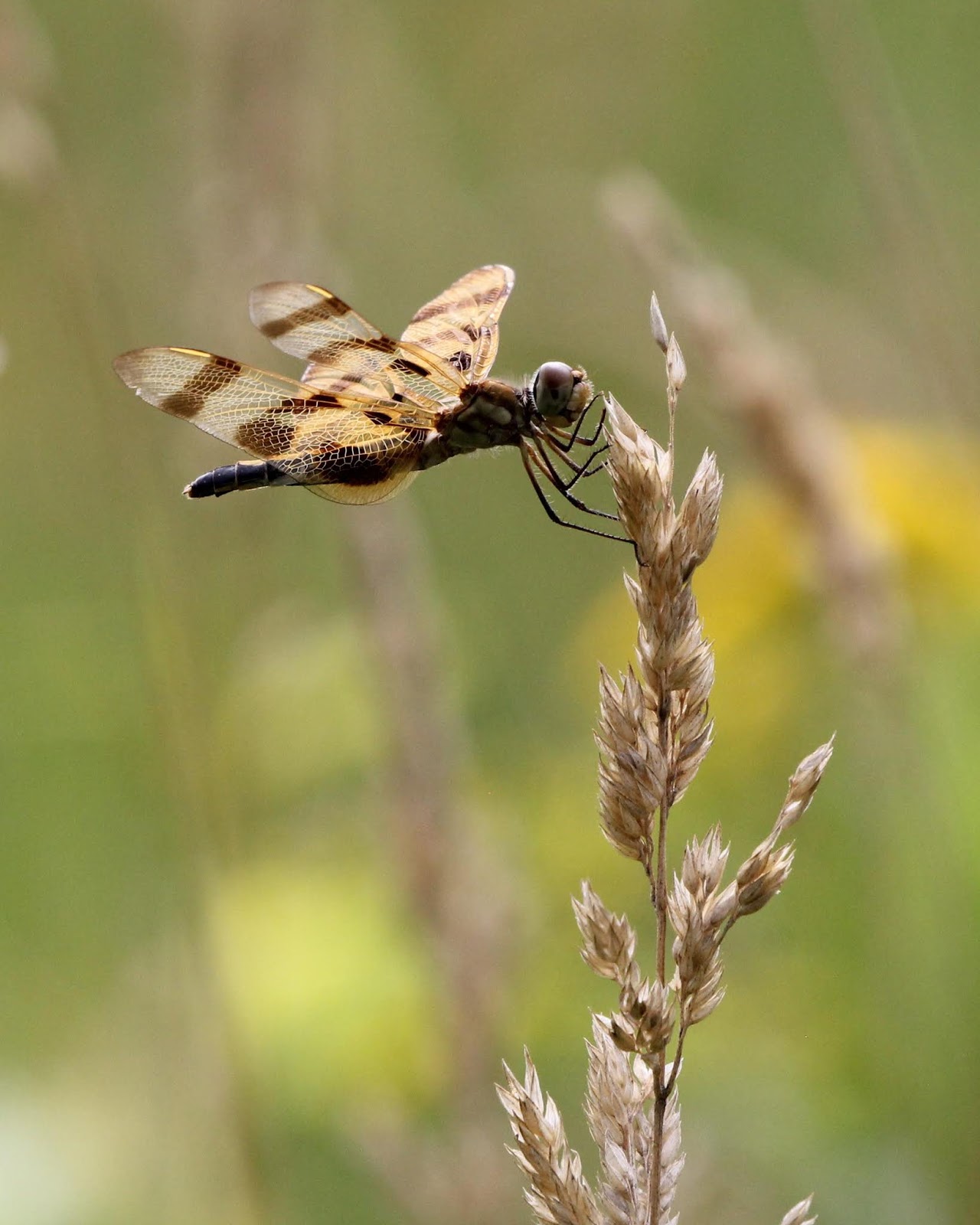
Day 42 (01 August 2018) - Halloween Pennant
This image was also photographed at Chipp-A-Waters Park. After photographing the Carolina Locust on the 31st, I noticed a Halloween Pennant (Celithemis eponina) hunting in a grassy area along the riverbank. Despite repeated attempts, I was never able to get a picture that I made me happy. I went back the next morning to try again. I actually arrived too early and had to wait for insects to begin flying. Eventually this Pennant showed up and I was able to get several photos. I cropped this from a horizontal to a vertical image. I liked the original, but I liked the vertical crop just a little bit more.
Day 43 (02 August 2018)
This picture was taken at North Higgins Lake State Park. I spent the day doing a pair of activities for a summer camp being held by the Saginaw Chippewa Indian Tribe. Due to stormy weather, we adjusted the schedule a little bit. This left me with some time before my morning activity. Although this is not the greatest image, I like the repetition of the spherical water droplets throughout the picture.
Day 44 (03 August 2018)
My final photo for the week was taken at Mission Creek Woodland Park. Although sometimes I have a plan I go out to take photos (like with the Halloween Pennant pictured above), at other times it pays to just wander and see what happens. I found these Crown Coral (Clavicorona pyxidata or Artomyces pyxidatus) growing on a rotten log in the middle of the woods. If I hadn't wandered away from the trail I never would have discovered them. Coral fungi are some of the coolest looking fungi that grow in Mid-Michigan, but I sometimes find them a challenge to photograph because they are such a start contrast to the dark wood. I decided to crop this picture as a square eliminating another clump of fungus to the left of the picture.
In the past, I have had times where I have gone days or even weeks without taking photographs. This summer I set out to change that tendency. I gave myself the task of recording images every single day between the Summer Solstice and the Fall Equinox. Not only do I need to photograph something every day, but I am also sharing a single photo from each day on this blog.
To see the previous installment (part four) check out this link.
Day 38 (28 July 2018) - Lights! Camera! Moths...
The week of 21 - 29 July was National Moth Week. In celebration, I hosted two mothing events on the nights of 27 July (for the Chippewa Watershed Conservancy) and 28 July (for the Chippewa Valley Audubon Club). This image is from the latter event at Mission Creek Woodland Park in Mt. Pleasant. This image was taken shortly after the sun went down as the moths had barely started to come in. Lots of moths were drawn to the lights, but this image was my favorite of the night.
Day 39 (29 July 2018) - Woodpecker Feather
This picture of a woodpecker flight feather was taken during a hike to the top of Bundy Hill. This feather belongs to either a Downy Woodpecker or a Hairy Woodpecker. Although these two species look very much alike, they are not closely related. The current theory is that the Downy evolved to look more like the Hairy so it wouldn't be harassed by the larger bird.
My general philosophy in regards to photo editing is that "Less is More." This picture is probably the most heavily edited image I have ever posted on this blog. It has been rotated 180 degrees from the original - I liked the quill better in the lower left of the image than in the upper right. The image has also been cropped to better focus on the feather. Even though I prefer to "crop with my feet" (move closer to the subject), I am usually okay with cropping an image down to better focus on the main subject. I have also adjusted the brightness of this image. The picture was taken in direct sunlight and the colors were rather washed out in the original.
Day 40 (30 July 2018) - Oh, Hello!
This picture of a Goldenrod Soldier Beetle (Chauliognathus pensylvanicus) on a Queen Anne's Lace (Daucus carota) was photographed at Forest Hill Nature Area. The beetle was feeding on pollen and nectar on the small individual flowers. To highlight the beetle against the sky, I lay on my back in the middle of a trail, leaned against my camera bag for support and, and aimed the camera upward. I probably shot two dozen images of this beetle as it crawled around the flower, but the pose in this picture made it my favorite. This image has been cropped slightly to reduce the amount of open space at the top and left of the picture.
Day 41 (31 July 2018) - Carolina Locust
Unlike the previous two pictures. This image has not been edited at all. I photographed this Carolina Locust (Dissosteira carolina) at Chipp-A-Waters Park in Mt. Pleasant. To get this picture I lay on a slab of limestone along the edge of the Chippewa River and focused tightly on the grasshopper. I was at the minimum focus distance for the lens on my camera. By working so close, I lost a little bit of detail on the legs, but check out the veining on the wings and the pattern on the head, thorax, and abdomen!
Day 42 (01 August 2018) - Halloween Pennant
This image was also photographed at Chipp-A-Waters Park. After photographing the Carolina Locust on the 31st, I noticed a Halloween Pennant (Celithemis eponina) hunting in a grassy area along the riverbank. Despite repeated attempts, I was never able to get a picture that I made me happy. I went back the next morning to try again. I actually arrived too early and had to wait for insects to begin flying. Eventually this Pennant showed up and I was able to get several photos. I cropped this from a horizontal to a vertical image. I liked the original, but I liked the vertical crop just a little bit more.
Day 43 (02 August 2018)
This picture was taken at North Higgins Lake State Park. I spent the day doing a pair of activities for a summer camp being held by the Saginaw Chippewa Indian Tribe. Due to stormy weather, we adjusted the schedule a little bit. This left me with some time before my morning activity. Although this is not the greatest image, I like the repetition of the spherical water droplets throughout the picture.
Day 44 (03 August 2018)
My final photo for the week was taken at Mission Creek Woodland Park. Although sometimes I have a plan I go out to take photos (like with the Halloween Pennant pictured above), at other times it pays to just wander and see what happens. I found these Crown Coral (Clavicorona pyxidata or Artomyces pyxidatus) growing on a rotten log in the middle of the woods. If I hadn't wandered away from the trail I never would have discovered them. Coral fungi are some of the coolest looking fungi that grow in Mid-Michigan, but I sometimes find them a challenge to photograph because they are such a start contrast to the dark wood. I decided to crop this picture as a square eliminating another clump of fungus to the left of the picture.
Sunday, July 29, 2018
The Days of Summer - Day Thirty-one through Day Thirty-seven
This is installment five of my Days of Summer photography project. (Click here to view the photos from part four.) The intent of this project is to get outdoors everyday to photograph something in nature and to pick a single image to represent each day of the summer from the Summer Solstice (21 June 2018) to the Fall Equinox (22 September 2018). Five weeks into summer, this has been a very rewarding project. It takes time, but I think I am producing some of my best photography ever. I am definitely learning more about my camera and lenses.
Enjoy.
Day 31 (21 July 2018) - Raindrops on Rosinweed
This image a raindrops on a Rosinweed (Silphium integrifolium) was photographed at home in our native pollinator garden during a lull between rain showers.
Day 32 (22 July 2018) - Monarch on Purple Coneflower
This photograph was taken at Forest Hill Nature Area during a very windy afternoon. At one point this Monarch Butterfly (Danaus plexippus) nearly blew off the top of this Purple Coneflower (Echinacea purperea). Despite the wind, this was a great day for pollinator photography. I was able to photograph five butterfly species, a couple moths, numerous bees, and several wasp species. Picking a single image for the day was difficult, but I like the position of the butterfly facing into the wind and the grass blades blowing in from the left of the picture.
Day 33 (23 July 2018) -Early Fall Colors
This picture of Red-osier Dogwood (Cornus sericea) berries and leaves was also taken at Forest Hill Nature Area. Many of the dogwood leaves were already changing color. This is not necessarily a sign of fall, but a sign of stress such as too little rain.
Day 34 (24 July 2018) - Green Frog
This picture was taken at Chipp-A-Waters Park in Mt. Pleasant. I heard several Green Frogs (Lithobates clamitans) calling from a small wetland area near the back of the park. Most of the frogs dove into the pond when I approached but this one let me approach to about five or six feet. This image has been cropped from a horizontal to a vertical image.
Day 35 - Yeah, Here Come the Rooster
This image and the next one were actually taken indoors. I spent much of last week at the Isabella County Fair. County fairs are an integral part of summer across much of the United States. This rooster was one of the many animals entered in the fair by 4H members.
If you understand the title of this image, bonus points for you! If you don't...
Day 36 (26 July 2018) - Charolais Steer
Another image from the Isabella County Fair. Raising beef cattle is one of the most popular projects for 4H members in the area. It quite something to watch a nine or ten year old kid weighing maybe 100 pounds walk a full grown steer around the arena and present it for judging. I photographed the Charolais steer in the beef cattle barn as it stared at me from its stall.
Day 37 (27 July 2018) - Stormcloud
The final picture of the week was photographed in southern Isabella County on my way home from work. I watched this storm approached from the west and raced to try to intersect it in a place where I could get a good image. Don't worry, I never went above the speed limit - the gravel road that I was traveling on would not allow for speeds much above 30 mph in most sections. I like this picture because of the contrast between the dark water laden bottom of the cloud and the sun shining through the top.
Enjoy.
Day 31 (21 July 2018) - Raindrops on Rosinweed
This image a raindrops on a Rosinweed (Silphium integrifolium) was photographed at home in our native pollinator garden during a lull between rain showers.
Day 32 (22 July 2018) - Monarch on Purple Coneflower
This photograph was taken at Forest Hill Nature Area during a very windy afternoon. At one point this Monarch Butterfly (Danaus plexippus) nearly blew off the top of this Purple Coneflower (Echinacea purperea). Despite the wind, this was a great day for pollinator photography. I was able to photograph five butterfly species, a couple moths, numerous bees, and several wasp species. Picking a single image for the day was difficult, but I like the position of the butterfly facing into the wind and the grass blades blowing in from the left of the picture.
Day 33 (23 July 2018) -Early Fall Colors
This picture of Red-osier Dogwood (Cornus sericea) berries and leaves was also taken at Forest Hill Nature Area. Many of the dogwood leaves were already changing color. This is not necessarily a sign of fall, but a sign of stress such as too little rain.
Day 34 (24 July 2018) - Green Frog
This picture was taken at Chipp-A-Waters Park in Mt. Pleasant. I heard several Green Frogs (Lithobates clamitans) calling from a small wetland area near the back of the park. Most of the frogs dove into the pond when I approached but this one let me approach to about five or six feet. This image has been cropped from a horizontal to a vertical image.
Day 35 - Yeah, Here Come the Rooster
This image and the next one were actually taken indoors. I spent much of last week at the Isabella County Fair. County fairs are an integral part of summer across much of the United States. This rooster was one of the many animals entered in the fair by 4H members.
If you understand the title of this image, bonus points for you! If you don't...
Day 36 (26 July 2018) - Charolais Steer
Another image from the Isabella County Fair. Raising beef cattle is one of the most popular projects for 4H members in the area. It quite something to watch a nine or ten year old kid weighing maybe 100 pounds walk a full grown steer around the arena and present it for judging. I photographed the Charolais steer in the beef cattle barn as it stared at me from its stall.
Day 37 (27 July 2018) - Stormcloud
The final picture of the week was photographed in southern Isabella County on my way home from work. I watched this storm approached from the west and raced to try to intersect it in a place where I could get a good image. Don't worry, I never went above the speed limit - the gravel road that I was traveling on would not allow for speeds much above 30 mph in most sections. I like this picture because of the contrast between the dark water laden bottom of the cloud and the sun shining through the top.
Tuesday, July 17, 2018
Native Species Profile - Wild Bergamot
Wild Bergamot (Monarda fistulosa), also known as Bee Balm, is the most widespread of four
Monarda species found in Michigan. Nationally it has been recorded in
all but four states (AK, HI, CA, FL) and across most of the temperate
provinces of Canada. It can grow in a variety of habitats including open
woodlands, savannas, prairies, fields, dunes, etc. It normally grows
in dry habitats but is occasionally found in wetlands.
Wild Bergamot is a member of the Mint Family (Lamiaceae). Like all other mints, it has stems with a square cross-section and opposite pairs of leaves. The plants can grow to a height of 4 feet and are topped with a single rounded flower head. This flower head measures 1 - 3 inches across. Flowers begin blooming near the center of the head first and continue outward to the margins. Flowers are typically pink or lavender colored. Individual flowers on the head are tubular and may be up to an inch long. Near the tip, each tubular flower splits into several protruding lips. The lower lips serve as a landing place for pollinators.
Wild Bergamot has a distinctive strong scent that reminds some people of mint and others of oregano. Anyone who drinks Earl Grey tea will recognize this smell, although in Earl Grey tea the smell comes from the peal of the Bergamot Orange.
Wild Bergamot is an important nectar source for many insects including bumble bees, bee flies, hummingbird and bumblebee moths, sphinx moths, skippers, and butterflies. It is also visited by hummingbirds. This plant spread by rhizomes and seeds so it often forms large colonies. Large colonies can easily attract hundreds of pollinators at a time.
Basic Information
Wild Bergamot
Monarda fistulosa
Height: 2.5 - 4’ tall
Habitat: dry areas; fields, open woods, prairies, fields, sand dunes, savannas
Flower Color: lavender to pink
Bloom
Time: July – August
| Bumble bee and Silver-spotted Skipper on Wild Bergamot |
Wild Bergamot is a member of the Mint Family (Lamiaceae). Like all other mints, it has stems with a square cross-section and opposite pairs of leaves. The plants can grow to a height of 4 feet and are topped with a single rounded flower head. This flower head measures 1 - 3 inches across. Flowers begin blooming near the center of the head first and continue outward to the margins. Flowers are typically pink or lavender colored. Individual flowers on the head are tubular and may be up to an inch long. Near the tip, each tubular flower splits into several protruding lips. The lower lips serve as a landing place for pollinators.
| Wild Bergamot - note tubular flowers and opposite pairs of leaves |
Wild Bergamot has a distinctive strong scent that reminds some people of mint and others of oregano. Anyone who drinks Earl Grey tea will recognize this smell, although in Earl Grey tea the smell comes from the peal of the Bergamot Orange.
| A Snowberry Clearwing Moth (a bumble bee mimic) prepares to nectar on Wild Bergamot |
Wild Bergamot is an important nectar source for many insects including bumble bees, bee flies, hummingbird and bumblebee moths, sphinx moths, skippers, and butterflies. It is also visited by hummingbirds. This plant spread by rhizomes and seeds so it often forms large colonies. Large colonies can easily attract hundreds of pollinators at a time.
Basic Information
Wild Bergamot
Monarda fistulosa
Flower Color: lavender to pink
Subscribe to:
Posts (Atom)