Monday, September 9, 2013

Sleeping Bear Dunes - Effects of Budget Sequestration UPDATE

In a previous post, I talked about the effects of budget sequestration on the Sleeping Bear Dunes National Lakeshore.  The National Park Service has issued an update on the operating season for the Pierce Stocking Scenic Drive.  It will now be open until OCTOBER 20th.  This means that you will be able to see scenes like the ones shown below.  If you have never been to the Sleeping Bear Dunes, late September through mid-October is the absolute best time to go.


Sleeping Bear Dunes - Effects of budget sequestration

UPDATE:   The National Park Service has issued an update on the operating season for the Pierce Stocking Scenic Drive.  It will now be open until OCTOBER 20th.  This means that you will be able to see the scenes shown below. 

The post was originally published back in April(?).

One of my favorite trips in Michigan is to Sleeping Bear Dunes National Lakeshore.  Sleeping Bear Dunes is part of the national park system.  Because of the across-the-board budget cuts enacted by the so-called "Sequestration" that went into effect March 1st, 2013, public access to Sleeping Bear will be greatly limited.  Pierce Stocking Scenic Drive will not open until Memorial Day weekend and will close after Labor Day on October 21st; previously this was open from mid-April through mid-November.  In my opinion the best time to go on the scenic drive was after the leaves had changed color in the Fall.  This usually occurs in late-September through early-October.  Some of the fall scenes that will no longer be available include these:

Glen Lake seen from Pierce Stocking Scenic Drive (October 2012)

Glen Lake seen from Pierce Stocking Scenic Drive (October 2010)

Glen Lake seen from Pierce Stocking Scenic Drive (2008)
 
North Bar Lake & Lake Michigan seen from Pierce Stocking Scenic Drive (October 2012)
 
North Bar Lake & Lake Michigan seen from Pierce Stocking Scenic Drive (October 2010)

North Bar Lake & Lake Michigan seen from Pierce Stocking Scenic Drive (October 2008)

The result of this budget cut is that you will be unable to see this part of the park when it is at its most spectacular.  Other parts of the park remain open, but for many people the Scenic Drive is Sleeping Bear Dunes.

So why does the park have to close the Pierce Stocking Scenic Drive during its best season?  The budget Sequestration imposed budget cuts across all federal spending.  Sleeping Bear Dunes National Lakeshore was required to reduce its annual budget by five percent.  About ninety-eight percent of its 2013 budget of $4,676,000 goes toward salaries and fixed costs such as utilities.  There simply is not $234,000 available to cut from the budget without reducing staff.  These cuts will eliminate 5 seasonal positions and shorten the duration of a further 22 seasonal positions.  Seasonal employees are responsible for such tasks as manning gates, leading tours, cleaning restrooms, picking up trash, and other many other tasks.

In addition to limiting access to the Scenic Drive, at most sites in the park restrooms will be closed until Memorial Day and will close after Labor Day and trash cans will not be emptied.  Restrooms and trash services at the visitor center in Empire and at campgrounds will have normal services.

In perhaps the biggest blow, ranger-led education programs will only be available between Memorial Day and Labor Day.  This cut will impact up to 10,000 school kids that annually take part in education program during the school year.  The funds to run these programs are gone.  

Also programs to monitor and protect endangered species such as the Piping Plover will be reduced, as will programs to monitor and control invasive species.

My wife and I love Sleeping Bear Dunes.  We have bought an annual visitors pass for the last half-decade and usually visit 3 or more times per year and plan an annual trip each October.  We will still go to Sleeping Bear Dunes, but one of the highlights of our year has been eliminated and there is nothing that we can do about it.

It is a shame that budget cuts imposed by politics and politicians will limit access to one of Michigan's greatest natural treasures during its most spectacular season.  This will have a negative effect on tourism throughout the northwest Lower Peninsula and will greatly impact local businesses that rely on summer and fall tourism to stay afloat.

So far, none of Michigan's other national parks including Isle Royale, Pictured Rocks, and Keewenaw National Historical Park have announced such drastic cuts to services.

Giant Silkworm Moths

Back on August 11th, I went to a program on Michigan salamanders at Nature Discovery in Williamston, Michigan.  I talked about that program here.  Part of the reason that I went to that program was to pick up a hatchling Black Rat Snake (Elaphe obsoleta obsoleta), but I also brought home five Cecropia Moth (Hyalophora cecropia) caterpillars.

Cecropia Moth (Hyalophora cecropia) caterpillar

One month later, three of those five caterpillars have successfully woven cocoons and pupated inside - unfortunately the other two caterpillars did not successfully metamorphose.  The pupae will overwinter in the cocoons.  If everything goes as planned three adult Cecropia Moths should emerge sometime between late May and July.

Cecropia cocoon #1

Cecropia cocoon #2

Cecropia cocoon #3

In addition to the Cecropia caterpillars, Nature Discovery also had Luna (Actias luna) and Polyphemus (Antheraea polyphemus) caterpillars on hand in August.  I did not bring home samples of either of those species.

Yesterday morning, we went to Forest Hill Nature Area to look for Monarch Butterfly caterpillars.  After an hour of looking, we found zero Monarchs.  Our total of Monarch caterpillars found this year stands at exactly three.  Even though we struck out on Monarch caterpillars, Shara found something even more interesting.

A Polyphemus Moth caterpillar!  The Polyphemus Moth (Antheraea polyphemus) is our second largest moth in Michigan.  When Shara found it, the caterpillar was feeding on the leaves of a small willow tree.  The caterpillar went home with us.  Hopefully it will soon pupate and we will see it as an adult late next spring.

Polyphemus Moth (Antheraea polyphemus) caterpillar

Polyphemus Moth (Antheraea polyphemus) caterpillar

Polyphemus Moth (Antheraea polyphemus) caterpillar

Friday, September 6, 2013

What Causes Hay Fever? "Not I" says the Goldenrod.

In late Summer and early Fall fields and roadsides in Mid-Michigan are covered with several species of Goldenrod (Solidago spp.).  Goldenrods are large showy wildflowers that grow in a wide variety of habitats from coastal dunes, to pine barrens, prairies, old fields, oak savannas, woodlands, and wetlands.  Different species grow in soils that range from wet to dry. 

Canada Goldenrod (Solidago canadensis)
Lance-leafed Goldenrod (Euthamia graminifolia -formerly Solidago graminifolia)

Blue-stemmed Goldenrod (Solidago caesia)

Zigzag Goldenrod (Solidago flexicaulis)
Usually about the same time that the Goldenrod starts to bloom many people begin to suffer from Allergic Rhinitis or "Hay Fever".  Hay Fever is an allergic reaction to airborne pollen.  Symptoms of Hay Fever may include congestion, a runny nose, itchy/watery eyes, headache, an itchy throat, and sneezing.

So does Goldenrod cause Hay Fever?

No!

Like most showy species of flowers, the pollen grains from Goldenrods are much too large to be airborne.  Instead they are carried by bees, flies, wasps, and other pollinators.  Plants with large showy flowers have developed them specifically to attract pollinators.  By enlisting insects (and other pollinators) to perform pollination, these plants have increased the likelihood that they will be successfully pollinated.  Even if a person is allergic to Goldenrod pollen the odds that any of that pollen will find its way into their nasal passages are very small.


So what is the cause of Hay Fever this time of year?

The most common culprit is Annual Ragweed (Ambrosia artemisiifolia).

Annual Ragweed (Ambrosia artemisiifolia)


Annual Ragweed (Ambrosia artemisiifolia)

Plants that rely on the wind for pollination typically have small flowers.  The male flowers of the Annual Ragweed are located on the green spikes that rise above the plant.  Each spike is covered with dozens of small pale green flowers.

Flowering spike of the Annual Ragweed (Ambrosia artemisiifolia)

They produce large amounts of very small pollen.  They produce such large amounts of pollen because without the aid of pollinators, their pollen finds its way to other flowers by chance.  Some of that pollen also finds its way into human nasal passages.  If you are one of the approximately 20% of people in North America (or Western Europe) that is allergic to the pollen from Annual Ragweed you will develop symptoms.

So enjoy the beauty of Goldenrod plants and stop worrying that you are allergic to it.


Thursday, September 5, 2013

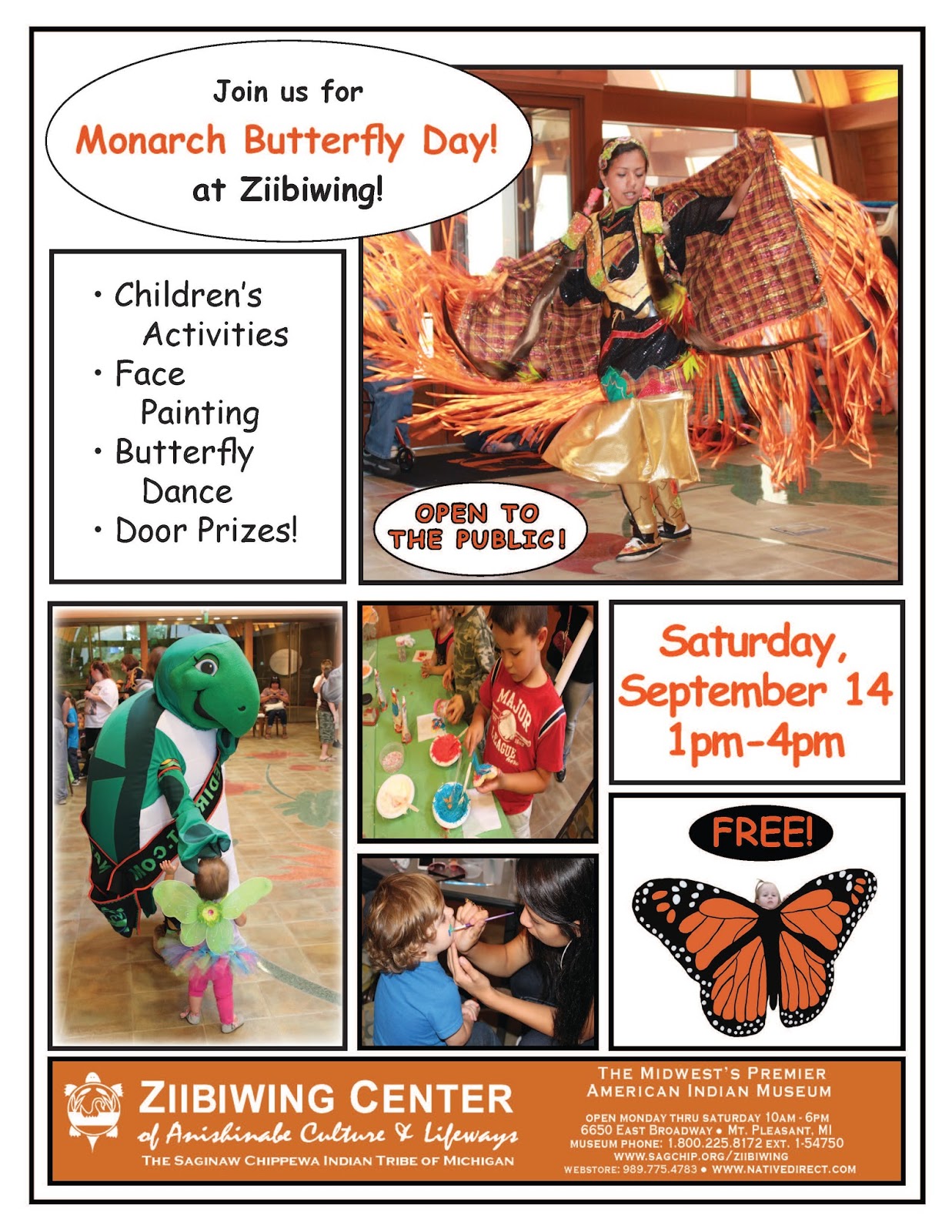
Monarch Butterfly Celebration

Join me next Saturday September 14th at the Ziibiwing Center in Mount Pleasant as we celebrate the Monarch butterfly.  With Monarch numbers near their all-time low, come learn what you can do to help preserve this iconic species. 

Wednesday, September 4, 2013

September Wildflowers

In March, in anticipation of the Spring wildflower season,  I published a partial list of the native wildflowers that could be seen in Mt. Pleasant each month.  Now that fall is rapidly approaching, I think it is time to revisit that list and look at some of the native wildflowers that can be found in September-October. 


I know that I do not have photos of all of the wildflowers on the list but here are most of them in alphabetical order.


Black-eyed Susan (Rudbeckia hirta)

Tuesday, September 3, 2013

Back to School


 Sit up and pay attention!

Welcome back to school!  Today is the first day of classes for schools across Michigan..  I've already started scheduling presentations at several schools.  I hope the 2013-14 School Year is as good as the 2012-13 School Year was.  Here are some final stats from last school year.

  • I presented 260 classroom/outdoor programs to 5,664 students during the last school year.
  • The 2013 Isabella County Environmental Education Day was attended by 602 Third Grade students and over 100 adults.
  • I also presented 10 community programs at libraries in Isabella County, 1 program at the Andawood Senior Facility, 1 program at the Central Michigan University Museum of Cultural and Natural History, co-led an Aquatic Ecology program for the Chippewa Watershed Conservancy, and participated in four other community nature/science events.  Nearly 800 people participated in the events.
I look forward to working with students and staff at all of the school districts in Isabella County again this year.