Showing posts with label fall. Show all posts

Monday, November 19, 2018

Of scattering abroad...

This morning I had a little bit of time free after giving a program at Fancher Elementary.  I hadn't been out in the woods for a few days do I decided to head to Chipp-A-Waters Park and walk the trails.  I didn't have plan, I just wanted to get outdoors and take a few pictures.  Almost immediately I noticed a Common Milkweed (Asclepias syriaca) with a few seeds still hanging to its dried out pods and nearby was Bitter Dock (Rumex obtusifolius) with its flattened seeds.  When I a bit further I noticed the fluffy seeds of a Canada Goldenrod (Solidago canadensis) and a Boxelder's (Acer negundo) winged samara.  At that point I had an idea - how many different fruits, seeds, or nuts could I find?

#1 - Common Milkweed (Asclepias syriaca)

#2 - Bee Balm (Monarda fistulosa)

#3 - Bitter Dock (Rumex obtusifolius)

#4 - Canada Goldenrod (Solidago canadensis)


#5 - Boxelder (Acer negundo)

#6 Queen Anne's Lace (Daucus carota)

#7 - Multiflora Rose (Rosa multiflora)

#8 - Buckthorn (Rhamnus sp.)

#9 - Common Burdock (Arctium minus)

#10 - Virginia Creeper (Parthenocissus quinquefolia)

#11 - Honeysuckle (Lonicera sp.)

#12 - Aster (Symphyotrichum sp.)

#13 - Eastern Poison Ivy (Toxicodendrom radicans)

#14 Blue Cohosh (Caulophyllum thalictroides)

#15 - Orange-fruited Horse-Gentian (Triosteum aurantiacum)

#16 - Buttonbush (Cephalanthus occidentalis)

#17 - Japanese Barberry (Berberis thunbergii)

#18 - American Bladdernut (Staphylea trifolia)

#19 - Black Locust (Robina pseudoacacia)

I spent barely thirty minutes in the park.  My first photograph was taken at 10:46AM and my final photograph was at 11:16AM.  Of the nineteen species that I photographed, seven are not native to Michigan.  Of those seven, five are considered invasive species.  To say that Chipp-A-Waters Park has an invasive species problem would be an understatement.  Birds readily consume the fruit of Buckthorn, Honeysuckle, Multiflora Rose, and Japanese Barberry helping the species spread further.  Eventually, if nothing is done to stop their spread the wooded areas at Chipp-A-Waters Park will be completely overgrown with these species and many of the native species found there now will be choked out.

Is the situation hopeless?  No, of course not.  However it will take planning and effort to reduce and control the invasive species and encourage the native species found there.  

Thursday, November 8, 2018

Early November in the (mostly) native pollinator garden

The growing season is almost over for the year.  Most of the native plants in our home gardens have begun to go dormant.  However, a few are still green - packing away more sugars in their roots to get a jump on next year .  One or two plants are still throwing up a bloom now and then.  The gardens are still a riot of colors, but now they are the subdued colors of fall and not the brilliant flowers of summer.  The biggest theme of the season though is "seeds" - pretty much every species is covered with seeds waiting to be dispersed by animals or by the wind. 

Over the next few months most of the plants will be knocked down by a combination of decay and heavy snows.  The plants that remain in the spring will be trimmed down near ground level.  I don't trim plants in the fall because they provide cover for hibernating insects and the seeds provide food for birds.  Those seeds that the birds don't get will be deposited into the soil to grow into more plants.  The leaves and stalks that fall to the ground form a natural mulch and eventually decay back into the soil - adding a healthy layer of rich organic humus.  I also allow all the leaves that fall into the gardens to remain and don't rake away the leaves that fall on the lawn.  I mulch those up with the mower and allow them to stay on the lawn - it's free fertilizer!

My work in the garden is not entirely done for the year.  I still need to plant a couple hundred tulip and crocus bulbs before the ground freezes.  I love the spring flowering bulbs - they're why I refer to the garden as a (mostly) native pollinator garden.

Here's a few pictures from this evening.

The garden at the back of the house

High-bush cranberries

Blue-stemmed Goldenrod seeds


Tall Coreopsis leaves turn a deep red

Rudbeckia triloba isn't doon yet!

Big-leaf Aster seeds

New England Aster seedheads surround our Monarch Waystation sign

Butterflyweed seeds
 
The view from the street corner

Northern Maidenhair Fern surrounded by fall leaves

Fertile fronds from one of several species of ferns

Japanese maples have finally started to drop their deep red leaves

Friday, November 2, 2018

Fall colors explained (repost from October 2016)

This is post was originally published in October 2016.  I like providing original content on this blog (and not just reposting thing I have previously written), but I have spent a lot of time in recent weeks explaining why leaves change color in the fall so I thought it was worth sharing again.

Fall colors at Sleeping Bear Dunes National Lakeshore
Have you ever wondered why leaves change colors?

It's a simple question with a complex biological answer involving masking, sugars, and pigments.

Normally the leaves of most plants appear green to people with normal color perception.  They are green because they are filled with a pigment called chlorophyll.  Chlorophyll is responsible for photosynthesis - the sugar production in plants and some bacteria (and one weird sea slug that incorporates chlorophyll into its body from an algae - although the mechanism has been called into question by some more recent research). It is also responsible for releasing oxygen in a form that we can use.

When leaves change color in the fall, they do so because the tree stops production of chlorophyll.  During the growing season, chlorophyll is so abundant in leaves that it masks all other colors found in the leaves.  As the level of chlorophyll decreases, the other colors begin to show through the mask.

Leaves, unmasked!

Yellow and orange colors are caused by a group of pigments known as carotenoids.  These colors were present throughout the growing season, but couldn't be seen because of the abundance of chlorophyll.

Thank carotenoids for the golden fall color of Quaking Aspen

Red and purple colors are different.  They are caused by by a group of pigments known as anthocyanins.  These chemicals are produced in the fall when chlorophyll production ceases.  The sugars that are produced by chlorophyll require the presence of several groups of chemicals to help break them down so they can be used as fuel at the cellular level - one of these groups is known as phosphates.  Phosphates are molecules that form around an atom of phosphorus, an important micronutrient.  Because phosphorus is present in limited quantities in the soil, trees can't afford to lose their phosphates when they drop their leaves - instead they transfer the phosphates back into the branches, trunk, and roots. 

The red in these Sumac leaves comes from anthocyanins

When the phosphates are shuffled away from the leaves, the leaves have to use a different process to break down the sugars - this process results in the production of anthocyanins.  When the level of anthocyanins becomes high enough, and the level of chlorophyll low enough, the leaves will appear red or purple.

Sometimes leaves appear red in the early spring.  This happens because the tree also produces anthocyanins in the spring before chlorophyll production ramps up to summer levels.  Once chlorophyll production begins at full scale the anthocyanin production ceases and the chlorophyll masks the reds and purples.

Anthocyanins at work - fall color in a spring leaf of Red Oak

Brown leaves are produced by an entirely different process.  The brown is the color of the cell walls within the leaves - some trees do not produce large quantities of either carotenoids or anthycyanins, so we see the brown of the cell walls instead.  This also the reason why all fallen leaves eventually turn brown - the pigments fade away and we are left seeing the brown cell walls of the leaf.

Sunday, October 28, 2018

Fall Forestry Studies

The best part of my job is getting students outdoors.  I especially enjoy getting them into the woods to study forestry and forest ecology

Want to make a kid's jaw drop?  Tell them that they are going to count how many trees are in a forest.  Even better is to tell them that they have to find out how many leaves can be found on the forest floor or that they have to find out how the leaves weigh!

I always manage to get lots of students outdoors in the spring, but this year I made an effort to schedule more field explorations for the fall.  Over the past three weeks, I was able to get eleven classrooms from four different schools out into the woods.  Two of the classrooms have been out in the woods with me before, but for the other nine classes it was a completely new experience.  It's always interesting to see how the students (and their teachers) react to the independence.

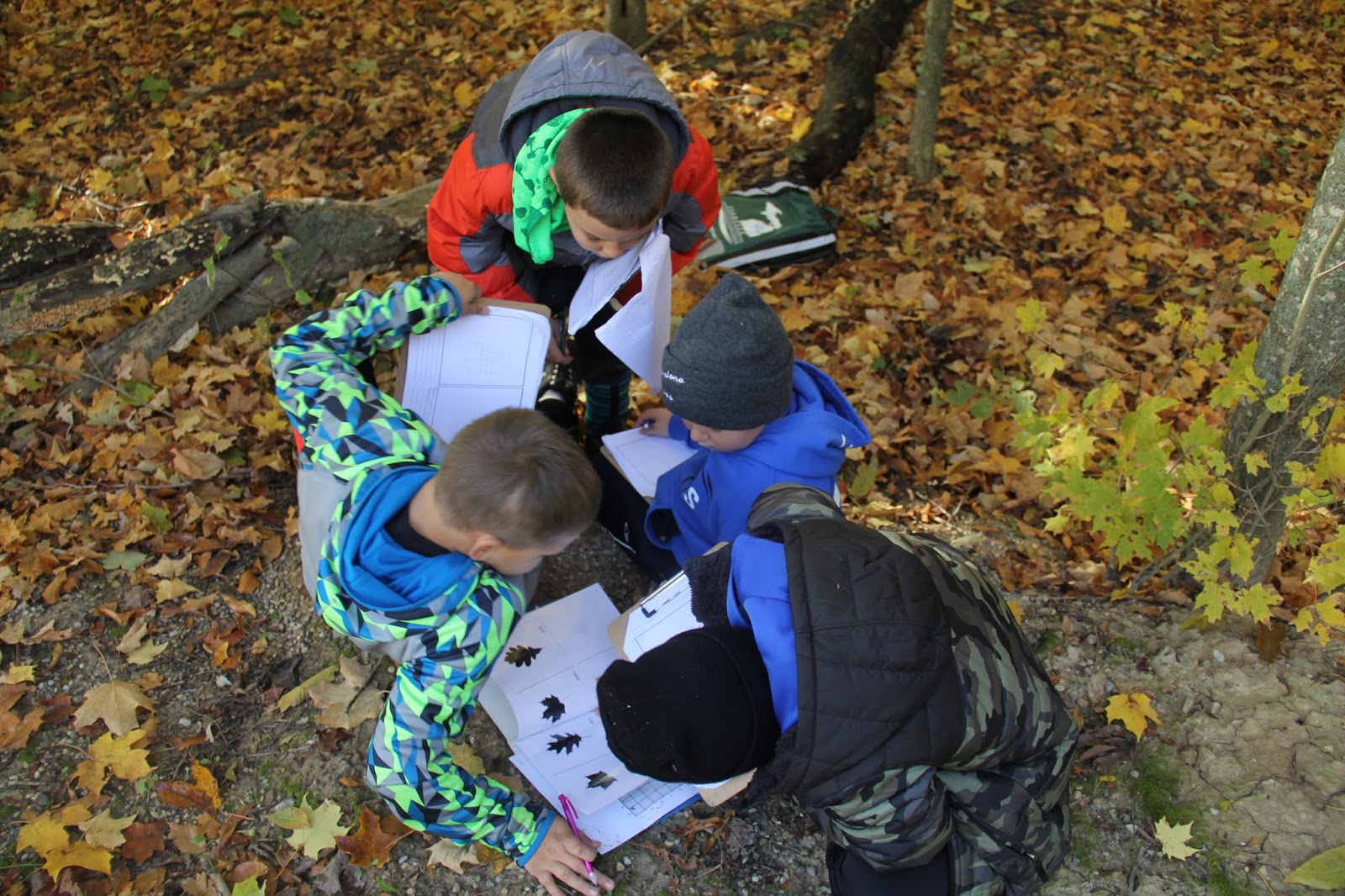
Here are a few pictures from three of the schools.  (Unfortunately, it looks like I did not take any photos of the two classrooms from the fourth school.)  The students in these photos are counting leaves in a square foot plot (or quadrat), collecting leaves to weigh, measuring the forest canopy using a clear grid, and identifying leaves using a guide. 

12 October 2018 - Winn Elementary at Audubon Woods


16 October 2018 and 19 October 2018 - Mary McGuire Elementary at Mission Creek Park


25 October 2018 - Beal City Elementary at Beal City School woodlot