Five.
The number of school years that I have been employed by the Isabella Conservation District.
Forty-eight.
The number of school programs that I did during the first year of the program.
Three hundred nineteen.
The number of programs that I did during this past school year.
Nine hundred sixty-two.
The total number of programs that I presented over the past five school years.
Two thousand forty.
The number of students that have attended our annual environmental education day over the past five years.
Twenty thousand eight hundred forty-seven.
The number of students that participated in the nine hundred sixty-two programs over five years.
Tuesday, June 24, 2014

Monday, June 23, 2014
A Light in the Dark Woods
On Saturday (21 June 2014) a group of seven Chippewa Valley Audubon club members met at Mission Creek Woodland Park for a new experience.

Mothing.
Moth hunting.
Call it whatever you want.
It involved standing around a sheet hanging from a line in the woods, lit by several 100 watt bulbs.

I often turn on my porch light with the purpose of attracting insects. This is the first time I have ever done it with a group of people.
We turned our lights on at about 8:30PM (before the sun had set) and turned them off at 10:45PM (the park closes at 11:00PM).
In our 2 hours 15 minutes of mothing, we had a great time and saw a couple dozen moths as well as lots of other insects (beetles, flies, gnats, mosquitoes, etc.).


Most of the moths that came to the light were small and not easily identified. We are still working on identifying most of them.
However, at about 10:35 a large moth flew in and fluttered around for more than a minute before finally settling on someone's boot.
It was a male Polyphemus (Antheraea polyphemus) Moth.

After letting everyone take several photos, I picked it up for a closer look. You can tell it's a male based on the feathery antennae. It uses these to sense pheromones that are released by the female.


After admiring it for a minute or two, I placed it on a nearby tree.

Even though we could not readily identify most of the moths and other insects that came to our light, the appearance of the Polyphemus Moth made everything worthwhile.
Mothing.
Moth hunting.
Call it whatever you want.
It involved standing around a sheet hanging from a line in the woods, lit by several 100 watt bulbs.
I often turn on my porch light with the purpose of attracting insects. This is the first time I have ever done it with a group of people.
We turned our lights on at about 8:30PM (before the sun had set) and turned them off at 10:45PM (the park closes at 11:00PM).
In our 2 hours 15 minutes of mothing, we had a great time and saw a couple dozen moths as well as lots of other insects (beetles, flies, gnats, mosquitoes, etc.).
Most of the moths that came to the light were small and not easily identified. We are still working on identifying most of them.
However, at about 10:35 a large moth flew in and fluttered around for more than a minute before finally settling on someone's boot.
It was a male Polyphemus (Antheraea polyphemus) Moth.
After letting everyone take several photos, I picked it up for a closer look. You can tell it's a male based on the feathery antennae. It uses these to sense pheromones that are released by the female.
After admiring it for a minute or two, I placed it on a nearby tree.
Even though we could not readily identify most of the moths and other insects that came to our light, the appearance of the Polyphemus Moth made everything worthwhile.
Friday, June 20, 2014
Native Pollinator Garden Update - Saginaw Chippewa Academy
Since I posted photos from the Native Pollinator Garden at the Mt. Pleasant Discovery Museum yesterday, today I am going to share some photos from the Native Pollinator garden at the Saginaw Chippewa Academy. This garden was planted in June 2011 and is in its fourth summer of growth. Because plants in this garden grow very enthusiastically, it sometimes looks a little bit weedy. This garden does need a little bit of maintenance (relocating self-seeded plants, moving wooden ""stepping-stones", etc.).
Regardless, I think this garden is beautiful in it exuberance.
Regardless, I think this garden is beautiful in it exuberance.
 |
| Looking north into the garden |
 |
| Lance-leafed Coreopsis is the foreground |
 |
| The white flowers are Canada Anemone - the path is going to be moved to the open space on the right |
 |
| Coreopsis has self-seeded and is spreading across the garden. The hazy pink plants are Prairie Smoke |
 |
| Hairy Beard-tongue surrounded by Lance-leafed Coreopsis |
 |
| A mouse-eye view of Lance-leafed Coreopsis |
Thursday, June 19, 2014
Native Pollinator Garden Update - Mt. Pleasant Discovery Museum (18 June 2014)
I stopped by the Mt. Pleasant Discovery Museum yesterday to check on their Native Pollinator Garden. Earlier this year I had transplanted a few plants from the garden at the Saginaw Chippewa Academy to the Museum and I wanted to make sure that those plants were doing well. This is really the first full growing season for this garden. It was planted on June 26th of last year with plants left over from another project.
Here is what it looked like as of 30 August 2013:
Here is the same view from this April:
Here was the garden as of yesterday (18 June 2014):
Here is what it looked like as of 30 August 2013:
 |
| Mt. Pleasant Discovery Museum Native Pollinator Garden - 30 August 2013 |
Here is the same view from this April:
 |
| Mt. Pleasant Discovery Museum Native Pollinator Garden - 08 April 2014 |
Here was the garden as of yesterday (18 June 2014):
 |
| Mt. Pleasant Discovery Museum Native Pollinator Garden - 18 June 2014 |
 |
| The paving stones marking the path were added this spring |
 |
| Coreopsis (yellow) and Yarrow (white) in bloom |
 |
| The view from the opposite end of the walkway |
 |
| Ohio Spiderwort in bloom |
Wednesday, June 18, 2014
Wildflowers of 2014 - #132 through #139
Wildflowers of 2014 - #132 Wild Garlic (Allium canadense)
The first species that I found was Wild Garlic (Allium canadense). I had identified this species two weeks ago, but the plants were not in bloom. While crouching down to photograph Oriental Poppy plants (Papaver orientale) on June 3rd I smelled garlic. Looking down, I noticed that I was crouched in the middle of a small colony of Wild Garlic plants. The plants were topped with a cluster of bulblets encased in a papery husk.
 |
| Wild Garlic (Allium canadense) flowers and bulblets |
After two weeks passed, the bulblets had swollen and the papery husks have opened up revealing both the bulblets and several small flowers encased inside. The small flowers have six petals and are usually pink (sometimes white).
Wild Garlic can be found in most states east of the Rocky Mountains. In Michigan, it is found mainly in the southern half of the Lower Peninsula. Wild Garlic grows in a variety of habitats such as woodlands, meadows, and floodplains, in both sun and shade.
Wildflowers of 2014 - #133 Moonseed (Menispermum canadense)
 |
| Moonseed (Menispermum canadense) |
The next plant is another species that is typically found in floodplains and other moist wooded areas. Moonseed (Menispermum canadense) is a native vine with lobed leaves that bears a resemblance to Wild Cucumber (Echinocystis lobata), but while Wild Cucumber climbs with the aid of tendrils that wrap around objects for support, Canada Moonseed uses its main stem to twine around supports. Moonseed vines may grow to a height of 6-20 feet. The small white flowers of Moonseed have six petals and are borne in hanging panicles. After pollination small (1/4-1/3) round berries will develop. These berries are purple-blue to purple-black and are covered with a white waxy bloom. Unfortunately these berries look a lot like wild grapes. I say unfortunately because Moonseed berries are toxic and can be mistaken for edible grapes.
 |
| A closer view of the Moonseed flowers |
Wildflowers of 2014 - #134 Narrow-leafed Cattail (Typha angustifolia)
Mill Pond Park is named because much of the park fits within the former boundaries of the city's mill pond. Water from this pond was once used to power a flour mill and a sawmill. While the dams that formed this pond are now gone, the water that they held protected portions of the Chippewa River's floodplain from being developed. Part of this floodplain is now occupied by a large emergent marsh. The primary plants found growing in this marsh are cattails. There are two species of cattails found growing in this marsh (and possibly hybrids of the two species). On Monday I only found one of the two species in bloom - Narrow-leafed Cattail (Typha angustifolia).
 |
| A colony of Narrow-leafed Cattail (Typha angustifolia) |
Narrow-leafed Cattail is native to North America, but is probably not native to Michigan. It can be aggressive and will often out-compete Common Cattail (T. latifolia) when the two species are found together. Some states list Narrow-leafed Cattail as an invasive species.
 |
| Narrow-leafed Cattail |
Both species have narrow ribbon-like leaves. The width of these leaves is not a reliable way to distinguish between the two species. While Narrow-leafed Cattail generally has narrower leaves than Common Cattail, there is overlap in size.
The most reliable way to decide between the species in the field is to look at their flowers - the "cat tails". The flowers of both species are divided into two parts with the male (staminate) flowers being located near the end of the stalk and the female (pistillate) flowers located further down on the same stalk. On the Common Cattail, the two halves of the flower touch with no gap between them. The male and female flowers of Narrow-leafed Cattail are separated by a gap. Hybrids of the two species probably have a narrower gap, but there is not reliable way to identify hybrids outside the lab.
 |
| Narrow-leafed cattail - note the separation between the male (upper) and female (lower) parts of the flower |
Wildflowers of 2014 - #135 Cow Parsnip (Heracleum maximum)
The next plant is one that I wrote about earlier this Spring - Cow Parsnip (Heracleum maximum). This member of the Carrot Family (Apiaceae) is easy to identify due to its size. Cow Parsnip plants may reach a height between four and nine feet! Like other plants in this family, Cow Parsnip plants are topped with a wide flat cluster of flowers known as an umbel. Individual flowers are small, but the umbels may be up to 8 inches across.
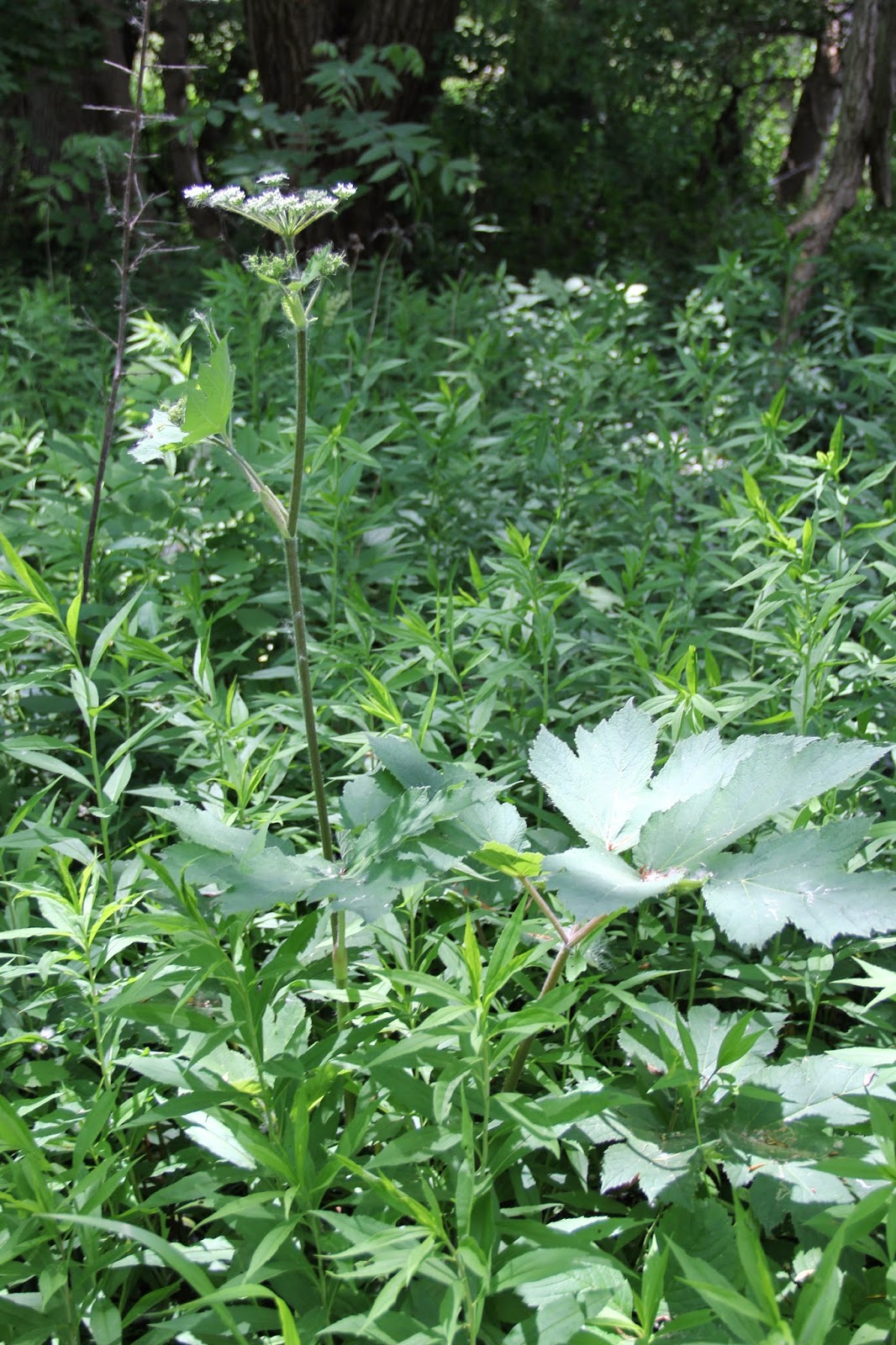 |
| Cow Parsnip rising above the surrounding vegetation |
 |
| Cow Parsnip - a closer view of the flowering umbel |
Cow Parsnip can be found growing in any low wet area including floodplains, swamps, shorelines, roadside ditches , etc..
For more information please see my post about Cow Parsnip from March 25th.
Wildflowers of 2014 - #136 Everlasting Pea (Lathyrus latifolius)
I found Everlasting Pea (Lathyrus latifolius) growing in an open dry area along the Chippewa River. This non-native vine is also known as Perennial Pea. It was originally introduced to North America as a decorative plant, being grown for its large (up to 1 1/4 inches), showy, pink flowers. It is now found in every state except Alaska, North Dakota, and Florida.
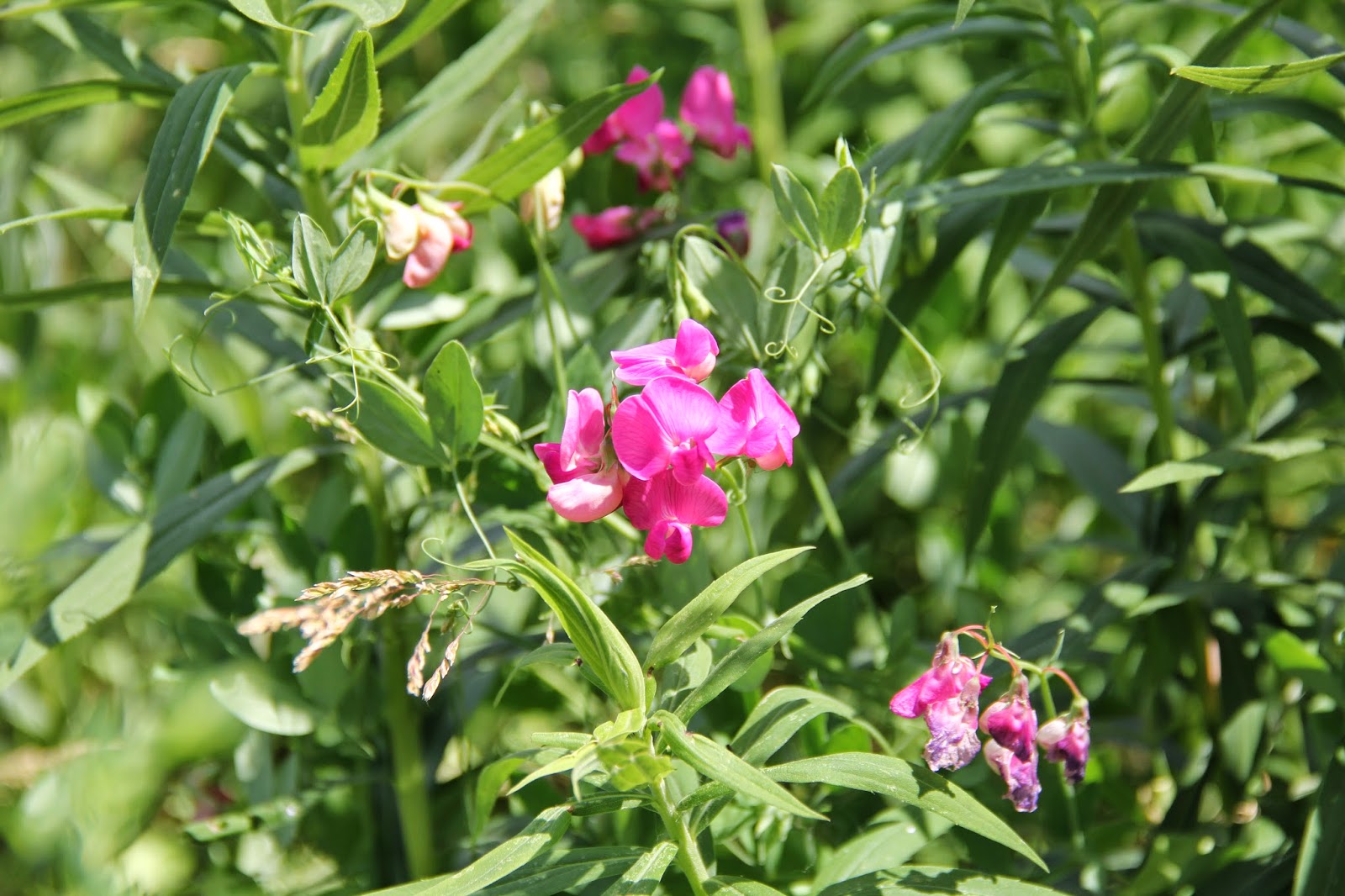 |
| Everlasting Pea (Lathyrus latifolius) |
Each Everlasting Pea vine can grow up to 6 feet. The vines either trail along the ground or climb nearby objects with the aid of grasping tendrils which coil around and support the plant's weight. The compound leaves of Everlasting Pea are arranged alternately along the vine, with each leaf having a single pair of leaflets.
 |
| Everlasting Pea - note the typical pea flower shape with banner (petals that looks like a basketball backboard), wings (the two petals beneath the banner) , and keel (hidden under the wings) |
Wildflowers of 2014 - #137 Cursed Crowfoot (Ranunculus scleratus)
The sixth wildflower find of the day was member of the Butercup Family - Cursed Crowfoot (Ranunculus scleratus). Also knows as Cursed Buttercup or Celery-leafed Buttercup, this is the fourth Ranunculus species on my 2014 list. Like many of the other Buttercup species, Cursed Crowfoot prefers wet soils; I found this plant growing in a low muddy area within the river's floodplain. This species is found throughout the Northern Hemisphere and some plants found in North America may have been introduced from Europe.
 |
| Cursed Crowfoot in typical wet habitat |
Cursed Crowfoot is fairly easy to identify. It's leaves are oval or kidney shaped with three deep lobes. The stems of the plant branch repeatedly.The leaves and the stems are more succulent than other Ranunculus species - this means that that the are very juicy. This juice is considered toxic and may cause blisters. Use caution if handling.
 |
| Cursed Crowfoot - note the lobed leaves |
The flowers are small measuring only 1/4 to 3/8 inch across. Each flower has 5 yellow petals surrounding a tightly-packed cylinder of pistils. This cylindrical center is distinctive of this species.
 |
| Cursed Crowfoot (Ranunculus scleratus) - note the distinctive cylindrical flower |
Wildflowers of 2014 - #138 Rough-fruited Cinquefoil (Potentilla recta)
The next flower that I found is another introduced species - Rough-fruited Cinquefoil (Potentilla recta). Also known as Sulphur Cinquefoil, this native of Eurasia is now found across most of North America with the exceptions of the Desert Southwest and Canadian Arctic. It grows on roadsides, in fields and meadows, and other weedy places.
 |
| Rough-fruited Cinquefoil (Potentilla recta) |
Of the fifteen Potentilla species that are found in Michigan, Rough-fruited Cinquefoil is one of the easier species to identify. It has pale yellow flowers with five heart-shaped petals. The compound leaves are the most distinguishing characteristic of this species. Each leaf has 5-7 leaflets arranged palmately (radiating outward from a central point) with coarsely toothed margins.
 |
| Rough-fruited Cinquefoil - note the Hover Fly nectaring at the pale yellow flower |
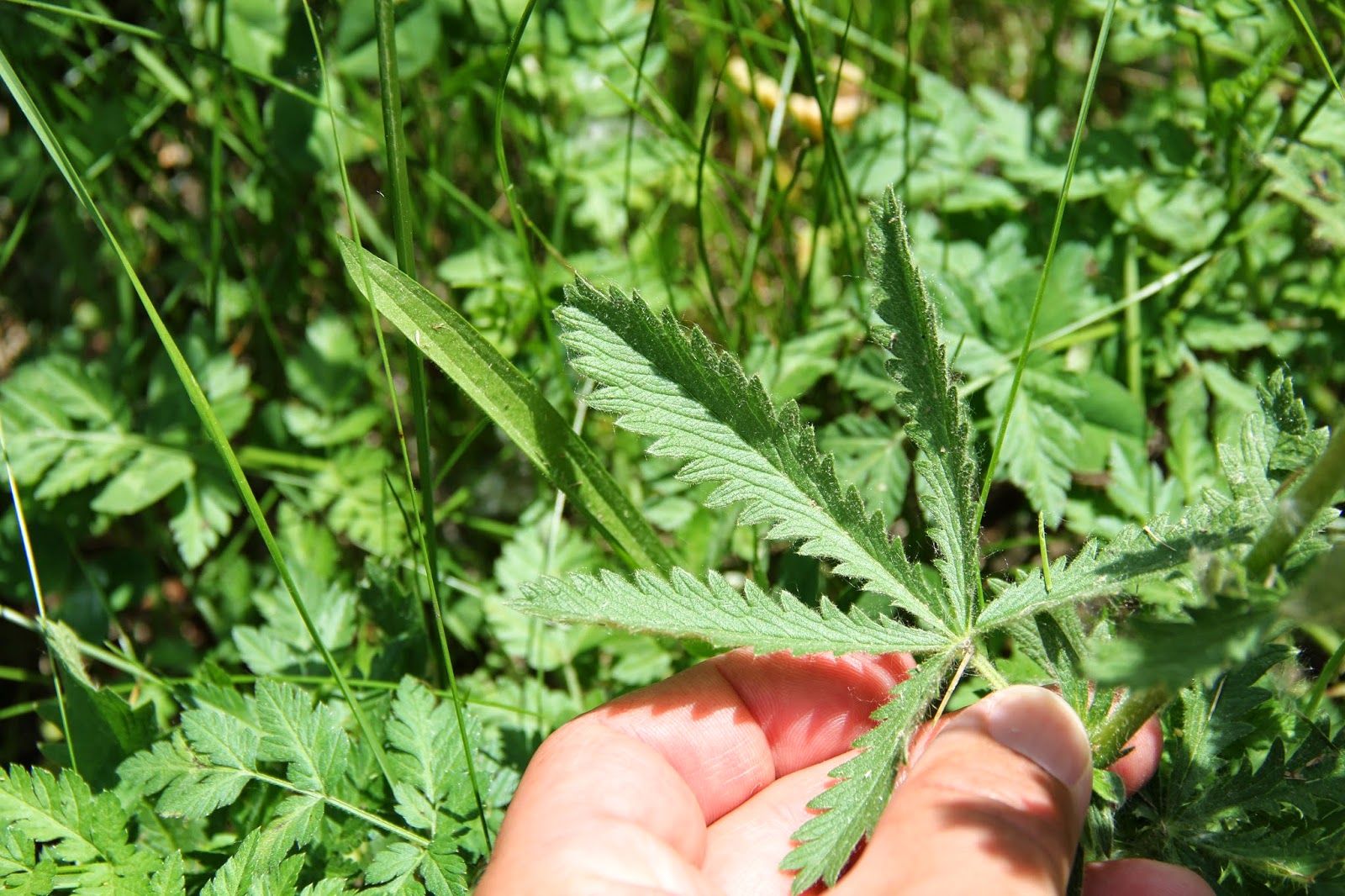 |
| Rough-fruited Cinquefoil - note the distinctive leaf shape |
Wildflowers of 2014 - #139 Crown-vetch (Securigera varia)
The final flower of the day was another non-native species. Crown-vetch (Securigera varia) is commonly planted for erosion control and has naturalized across much of the United States and Canada.
 |
| Crown-vetch (Securigera varia) |
Crown-vetch is a member of the Legume family and has flowers with the typical pea shape. The pink and white flowers are arranged in a round dense cluster that resembles a crown.
 |
| Crown-vetch - a closer view of the "crown" of flowers |
Crown-vetch vines can grow to a height of 1-3 feet. While the plants may use other vegetation for support, the vines lack climbing tendrils. The leaves of Crown-vetch are arranged alternately along the stem, with each compound leaf being composed of an odd number (11-25) of leaflets. The plant can reproduce both by seed and by underground rhizomes. Because of these dual methods of reproduction, Crown-vetch often forms dense colonies that crowd out other plant species.
Tuesday, June 17, 2014
Wildflowers of 2014 - #120 through #131
Still catching up on wildflowers...
Last Thursday (12 June 2014) I posted wildflower species #110 -119 for the year. These ten species were photographed on Sunday June 8th at Mission Creek Woodland Park.
The next five species were also found on Sunday June 8th, but these were photographed at Chipp-A-Waters Park.
The first four species were photographed within feet of the paved trail.
Wildflowers of 2014 - #120 Birdfoot Trefoil (Lotus corniculatus)
The first species that I found was Birdfoot Trefoil (Lotus corniculatus). This non-native species is identifiable by its distinctive yellow pea-like flowers - the plant is a member of the Legume Family (Fabaceae). It was originally introduced to North America as a forage species and is now naturalized across most of the Continental United States and Canada.


Wildflowers of 2014 - #121 Yellow Sweet Clover (Melilotus officinalis)
The next species is another that was originally introduced from Europe as a forage plant - Yellow Sweet Clover (Melilotus officinalis). This large species may grow up to 8 feet tall. It has compound leaves divided into three lobes and elongated clusters of yellow flowers. A closely related species White Sweet Clover (Melilotus albus) has white flowers.
Wildflowers of 2014 - #122 King Devil (Hieracium piloselloides)
The third wildflower is another non-native - King Devil (Hieracium piloselloides). Also known as Yellow Hawkweed or Smooth Hawkweed, King Devil is one of of 15 species of Hieracium found in Michigan. Eight of these species were introduced from Europe and the other seven are native to North America. These species can be very difficult to differentiate. The basal cluster of leaves identify this plant as introduced - the native species have leaves on their stems. I based my identification of this plant based on the hairy basal leaves and hairless branched stems.
Wildflowers of 2014 - #123 Clammy Ground-cherry (Physalis heterophylla)
A short distance down the trail I found the next plant - Clammy Ground-cherry (Physalis heterophylla). This plant is a native relative of both the Chinese Lantern (P. alkekengi), a common garden plant native to Eurasia, and the Tomatillo (P. philadelphica), a vegetable plant native to Mexico.
Although this species is distributed across most of the United States (and the Canadian provinces of Nova Scotia, Ontario, and Quebec), it is most common in the eastern half of the country.
The dangling yellow bell-shaped flowers, when pollinated, will turn into a yellow fruit covered with a papery husk. This fruit is edible when ripe, but the rest of the plant is toxic. The entire plant is covered with a dense coat of sticky white hairs.
Wildflowers of 2014 - #124 Giant Bur-reed (Sparganium eurycarpum)
The final flower from Sunday June 8th was the Giant Bur-reed (Sparganiun eurycarpum). This plant was not nearly as easy to access as the previous three species. I found it growing in the emergent marsh along the edges of the old oxbow at the rear of Chipp-A-Waters Park. These plants were found while wading toward the open water where I took the Yellow Pond-lily photos that I shared last week. These plants were growing throughout the marsh at depths between one and three feet of water.
Also known as Common Bur-reed or Broadfruit Bur-read, this is our most common species of Bur-reed in Michigan. Its range covers most of the United States (with the exception of the Southeast, Alaska, and Hawaii) and Canada. It can be distinguished from other Sparganium species by its size and branching flower stalks.
For more information on Giant Bur-reed please see this species profile from December 2013.
The next two flowers were photographed on Monday June 9th 2014.
Wildflowers of 2014 - #125 White Water Lily (Nymphaea odorata)
Flower #125 for the year is the White Water Lily (Nymphaea odorata). Also know as Sweet-scented Water Lily or Fragrant Water Lily, this plant is found growing in shallow water (down to 7 feet deep) throughout most of North America. White Water Lily is usually found in the open water areas of marshes, in ponds and lakes, and occasionally in backwaters and slow-moving areas of rivers.
The floating round leaves and white flowers with yellow centers make this plant easy to identify. It can be mistaken for no other plant in Mid-Michigan. At night and on cloudy days the flowers will close up and sink beneath the surface of the water. The leaves and flowers are attached by hollow stems to a tuberous root system. The roots, leaves, and stems are consumed by a variety of herbivores ranging in size from Muskrats to Moose.
Wildflowers of 2014 - #126 Purple Meadow Rue (Thalictrum dasycarpum)
The next flower is one that I have been watching for several weeks, waiting for flowers to appear - Purple Meadow Rue (Thalictrum dasycarpum). This plant is often called Tall Meadow Rue, but that name more properly belongs to a species that is found east of Michigan (T. pubescens)

Purple Meadow Rue is the second Thalictrum species that I have found this year. Early Meadow Rue (T. dioicum) was #49 - found on May 21st. The two species can be distinguished by size: Early Meadow Rue grows to a height of only 1-2 feet while Purple Meadow Rue can grow to a height of 3-6 feet.
Another feature that can be used to identify them is the shape of their leaves. Both species have lobed leaved. Those of Early Meadow Rue have five to nine rounded lobes; the leaves of Purple Meadow Rue are more pointed and have three (sometimes five) lobes.
Like other Meadow Rue Species, male and female flowers are found on separate plants. Male plants have dangling flowers on widely branching pyramidal clusters (panicles). Male flowers are whitish with a purple or brown tint. Female flowers are also located on panicles, but the flowers are erect instead of dangling.
On Thursday 12 June 2014, I found an additional five species in bloom. All five flowers belonged to non-native species.
Wildflowers of 2014 - #127 Alfalfa (Medicago sativa)
Alfalfa (Medicago sativa) is another Eurasian legume (Fabaceae) species that was originally planted in North America as a forage crop. It has naturalized across the continent and has been documented in all fifty states and every Canadian province and territory with the exception of Nunavut. It is commonly found along roadsides, in old fields, and in other dry weedy disturbed habitats.

The plant superficially resembles Yellow Sweet Clover (#121), Alfalfa can be identified by its blue-purple flowers and three lobed compound leaves. The flowers resemble those of several other Legume species including Hairy Vetch (#116), but the leaves help narrow down its identity.

Wildflowers of 2014 - #128 Silvery Cinquefoil (Potentilla argentea)
The next species is one of nine non-native Potentilla species found in Michigan - there are also six native species.
Silvery Cinquefoil (Potentilla argentea) is a low-growing plant found in dry fields, roadsides, and other weedy places. It reaches a height of only 4-18 inches. The plant's yellow flowers have five petals and grow in clusters at the ends of branched stems.
The leaves of Silvery Cinquefoil have five lobed leaflets arranged in a palmate fashion (lobes that radiate outward from a central point). The underside of the leaves are covered with a dense coating of hairs giving it a silvery appearance.
Wildflowers of 2014 - #129 Multiflora Rose (Rosa multiflora)
Multiflora Rose (Rosa multiflora) is considered an invasive species or noxious weed by twelve states. It was long planted for erosion control and for wildlife habitat, but has spread when wildlife consume its fruit (hips) and deposit the seeds in their droppings.
Multiflora Rose can be distinguished from other Rose species by its many white flowers - multiflora means "many-flowered". Most native species produce single pink blooms. Many of the other introduced species also produce pink flowers. Individual Multiflora Rose blooms have five petals surrounding a yellow center.
Mutliflora Rose has compound leaves with 5-9 leaflets (sometimes as few as three on the upper part of the stem). The leaflets have serrated edges. The plant's woody stems are covered with curved thorns.
Wildflowers of 2014 - #130 Bitter Dock (Rumex obtusifolius)
The next flower is another weedy introduced species from Europe - Bitter Dock (Rumex obtusifolius). Like many non-native species it prefers disturbed sites such as fields and roadsides where it is able to grow with less competition from native plants.
Bitter Dock initially grows as a basal cluster of leaves. The leaves may be up to six inches wide. Later in the season one or more flowering stalks arise from this basal rosette. The flowers are small and greenish-red. They grow directly along the branching stalks. Smaller leaves may also grow along the stalks.
Wildflowers of 2014 - #131 Common Goat's Beard (Tragopogon pratensis)
The final flower of the week was Common Goat's Beard (Tragopogon pratensis). Also known as Showy Goat's Beard, this is one of two Goat's Beard species that are found in Michigan. This species can be distinguished from Fistulous Goat's Beard (T. dubius) by two features that are present in the latter, but not the former. Fistulous Goat's Beard (#88 on the list) has long bracts that extend out beyond the rays of the composite flower head, these bracts are absent in Showy Goat's Beard. Also, the stalk of T. dubius swells below the flower head, the stalk of T. pratensis is not swollen.
Last Thursday (12 June 2014) I posted wildflower species #110 -119 for the year. These ten species were photographed on Sunday June 8th at Mission Creek Woodland Park.
The next five species were also found on Sunday June 8th, but these were photographed at Chipp-A-Waters Park.
The first four species were photographed within feet of the paved trail.
Wildflowers of 2014 - #120 Birdfoot Trefoil (Lotus corniculatus)
The first species that I found was Birdfoot Trefoil (Lotus corniculatus). This non-native species is identifiable by its distinctive yellow pea-like flowers - the plant is a member of the Legume Family (Fabaceae). It was originally introduced to North America as a forage species and is now naturalized across most of the Continental United States and Canada.
Wildflowers of 2014 - #121 Yellow Sweet Clover (Melilotus officinalis)
The next species is another that was originally introduced from Europe as a forage plant - Yellow Sweet Clover (Melilotus officinalis). This large species may grow up to 8 feet tall. It has compound leaves divided into three lobes and elongated clusters of yellow flowers. A closely related species White Sweet Clover (Melilotus albus) has white flowers.
 |
| Yellow Sweet Clover - note the yellow flowers and three-lobed leaves |
Wildflowers of 2014 - #122 King Devil (Hieracium piloselloides)
The third wildflower is another non-native - King Devil (Hieracium piloselloides). Also known as Yellow Hawkweed or Smooth Hawkweed, King Devil is one of of 15 species of Hieracium found in Michigan. Eight of these species were introduced from Europe and the other seven are native to North America. These species can be very difficult to differentiate. The basal cluster of leaves identify this plant as introduced - the native species have leaves on their stems. I based my identification of this plant based on the hairy basal leaves and hairless branched stems.
 |
| King Devil - note basal cluster of leaves |
 |
| King Devil - note the branched flower stalks. The stalks in this photo are covered with fibers from a Cottonwood Tree. |
Wildflowers of 2014 - #123 Clammy Ground-cherry (Physalis heterophylla)
A short distance down the trail I found the next plant - Clammy Ground-cherry (Physalis heterophylla). This plant is a native relative of both the Chinese Lantern (P. alkekengi), a common garden plant native to Eurasia, and the Tomatillo (P. philadelphica), a vegetable plant native to Mexico.
Although this species is distributed across most of the United States (and the Canadian provinces of Nova Scotia, Ontario, and Quebec), it is most common in the eastern half of the country.
 |
| Clammy Ground-cherry (Physalis heterophylla) |
The dangling yellow bell-shaped flowers, when pollinated, will turn into a yellow fruit covered with a papery husk. This fruit is edible when ripe, but the rest of the plant is toxic. The entire plant is covered with a dense coat of sticky white hairs.
 |
| Clammy Ground-cherry flower |
Wildflowers of 2014 - #124 Giant Bur-reed (Sparganium eurycarpum)
The final flower from Sunday June 8th was the Giant Bur-reed (Sparganiun eurycarpum). This plant was not nearly as easy to access as the previous three species. I found it growing in the emergent marsh along the edges of the old oxbow at the rear of Chipp-A-Waters Park. These plants were found while wading toward the open water where I took the Yellow Pond-lily photos that I shared last week. These plants were growing throughout the marsh at depths between one and three feet of water.
Also known as Common Bur-reed or Broadfruit Bur-read, this is our most common species of Bur-reed in Michigan. Its range covers most of the United States (with the exception of the Southeast, Alaska, and Hawaii) and Canada. It can be distinguished from other Sparganium species by its size and branching flower stalks.
For more information on Giant Bur-reed please see this species profile from December 2013.
 |
| Giant Bur-reed (Sparganium eurycarpum) |
 |
| Giant Bur-reed flowering stalk - male (staminate) flowers are above and female (pistillate) flowers are below on the stalk |
The next two flowers were photographed on Monday June 9th 2014.
Wildflowers of 2014 - #125 White Water Lily (Nymphaea odorata)
Flower #125 for the year is the White Water Lily (Nymphaea odorata). Also know as Sweet-scented Water Lily or Fragrant Water Lily, this plant is found growing in shallow water (down to 7 feet deep) throughout most of North America. White Water Lily is usually found in the open water areas of marshes, in ponds and lakes, and occasionally in backwaters and slow-moving areas of rivers.
 |
| White Water Lily (Nymphaea odorata) - note the floating leaves and floating white flower with a yellow center |
The floating round leaves and white flowers with yellow centers make this plant easy to identify. It can be mistaken for no other plant in Mid-Michigan. At night and on cloudy days the flowers will close up and sink beneath the surface of the water. The leaves and flowers are attached by hollow stems to a tuberous root system. The roots, leaves, and stems are consumed by a variety of herbivores ranging in size from Muskrats to Moose.
 |
| White Water Lily - the round leaves are slit from one side nearly to the center |
Wildflowers of 2014 - #126 Purple Meadow Rue (Thalictrum dasycarpum)
The next flower is one that I have been watching for several weeks, waiting for flowers to appear - Purple Meadow Rue (Thalictrum dasycarpum). This plant is often called Tall Meadow Rue, but that name more properly belongs to a species that is found east of Michigan (T. pubescens)
Purple Meadow Rue is the second Thalictrum species that I have found this year. Early Meadow Rue (T. dioicum) was #49 - found on May 21st. The two species can be distinguished by size: Early Meadow Rue grows to a height of only 1-2 feet while Purple Meadow Rue can grow to a height of 3-6 feet.
Another feature that can be used to identify them is the shape of their leaves. Both species have lobed leaved. Those of Early Meadow Rue have five to nine rounded lobes; the leaves of Purple Meadow Rue are more pointed and have three (sometimes five) lobes.
Like other Meadow Rue Species, male and female flowers are found on separate plants. Male plants have dangling flowers on widely branching pyramidal clusters (panicles). Male flowers are whitish with a purple or brown tint. Female flowers are also located on panicles, but the flowers are erect instead of dangling.
 |
| Male flowers of Purple Meadow Rue (Thalictrum dasycarpum) |
 |
| Female flowers of Purple Meadow Rue (Thalictrum dasycarpum) - also note the three-lobed compound leaves |
 |
| Purple Meadow Rue - note the purple tint of the stem |
On Thursday 12 June 2014, I found an additional five species in bloom. All five flowers belonged to non-native species.
Wildflowers of 2014 - #127 Alfalfa (Medicago sativa)
Alfalfa (Medicago sativa) is another Eurasian legume (Fabaceae) species that was originally planted in North America as a forage crop. It has naturalized across the continent and has been documented in all fifty states and every Canadian province and territory with the exception of Nunavut. It is commonly found along roadsides, in old fields, and in other dry weedy disturbed habitats.
The plant superficially resembles Yellow Sweet Clover (#121), Alfalfa can be identified by its blue-purple flowers and three lobed compound leaves. The flowers resemble those of several other Legume species including Hairy Vetch (#116), but the leaves help narrow down its identity.
Wildflowers of 2014 - #128 Silvery Cinquefoil (Potentilla argentea)
The next species is one of nine non-native Potentilla species found in Michigan - there are also six native species.
Silvery Cinquefoil (Potentilla argentea) is a low-growing plant found in dry fields, roadsides, and other weedy places. It reaches a height of only 4-18 inches. The plant's yellow flowers have five petals and grow in clusters at the ends of branched stems.
The leaves of Silvery Cinquefoil have five lobed leaflets arranged in a palmate fashion (lobes that radiate outward from a central point). The underside of the leaves are covered with a dense coating of hairs giving it a silvery appearance.
 |
| Silvery Cinquefoil (Potentilla argentea) |
 |
| Silvery Cinquefoil - note the flowers with five petals and palmate leaves with five lobes |
Wildflowers of 2014 - #129 Multiflora Rose (Rosa multiflora)
Multiflora Rose (Rosa multiflora) is considered an invasive species or noxious weed by twelve states. It was long planted for erosion control and for wildlife habitat, but has spread when wildlife consume its fruit (hips) and deposit the seeds in their droppings.
Multiflora Rose can be distinguished from other Rose species by its many white flowers - multiflora means "many-flowered". Most native species produce single pink blooms. Many of the other introduced species also produce pink flowers. Individual Multiflora Rose blooms have five petals surrounding a yellow center.
Mutliflora Rose has compound leaves with 5-9 leaflets (sometimes as few as three on the upper part of the stem). The leaflets have serrated edges. The plant's woody stems are covered with curved thorns.
 |
| Multiflora Rose (Rosa multiflora) |
 |
| Multiflora Rose - note the serrated leaflets and many flower buds |
 |
| Multiflora Rose - note the hairless stem and curved thorns |
 |
| Multiflora Rose bloom - note the five white petals and yellow stamen. |
Wildflowers of 2014 - #130 Bitter Dock (Rumex obtusifolius)
The next flower is another weedy introduced species from Europe - Bitter Dock (Rumex obtusifolius). Like many non-native species it prefers disturbed sites such as fields and roadsides where it is able to grow with less competition from native plants.
Bitter Dock initially grows as a basal cluster of leaves. The leaves may be up to six inches wide. Later in the season one or more flowering stalks arise from this basal rosette. The flowers are small and greenish-red. They grow directly along the branching stalks. Smaller leaves may also grow along the stalks.
 |
| Bitter Dock (Rumex obtusifolius) |
 |
| Bitter Dock - a closeup of the flowers |
Wildflowers of 2014 - #131 Common Goat's Beard (Tragopogon pratensis)
The final flower of the week was Common Goat's Beard (Tragopogon pratensis). Also known as Showy Goat's Beard, this is one of two Goat's Beard species that are found in Michigan. This species can be distinguished from Fistulous Goat's Beard (T. dubius) by two features that are present in the latter, but not the former. Fistulous Goat's Beard (#88 on the list) has long bracts that extend out beyond the rays of the composite flower head, these bracts are absent in Showy Goat's Beard. Also, the stalk of T. dubius swells below the flower head, the stalk of T. pratensis is not swollen.
 |
| Showy Goat's Beard - note the grass-like leaves |
 |
| Showy Goat's Beard - note the absence of long bracts that would be found on Fistulous Goat's Beard |
 |
| Showy Goat's Beard - a composite flower composed of disc flowers surrounded by rays |
Subscribe to:
Posts (Atom)