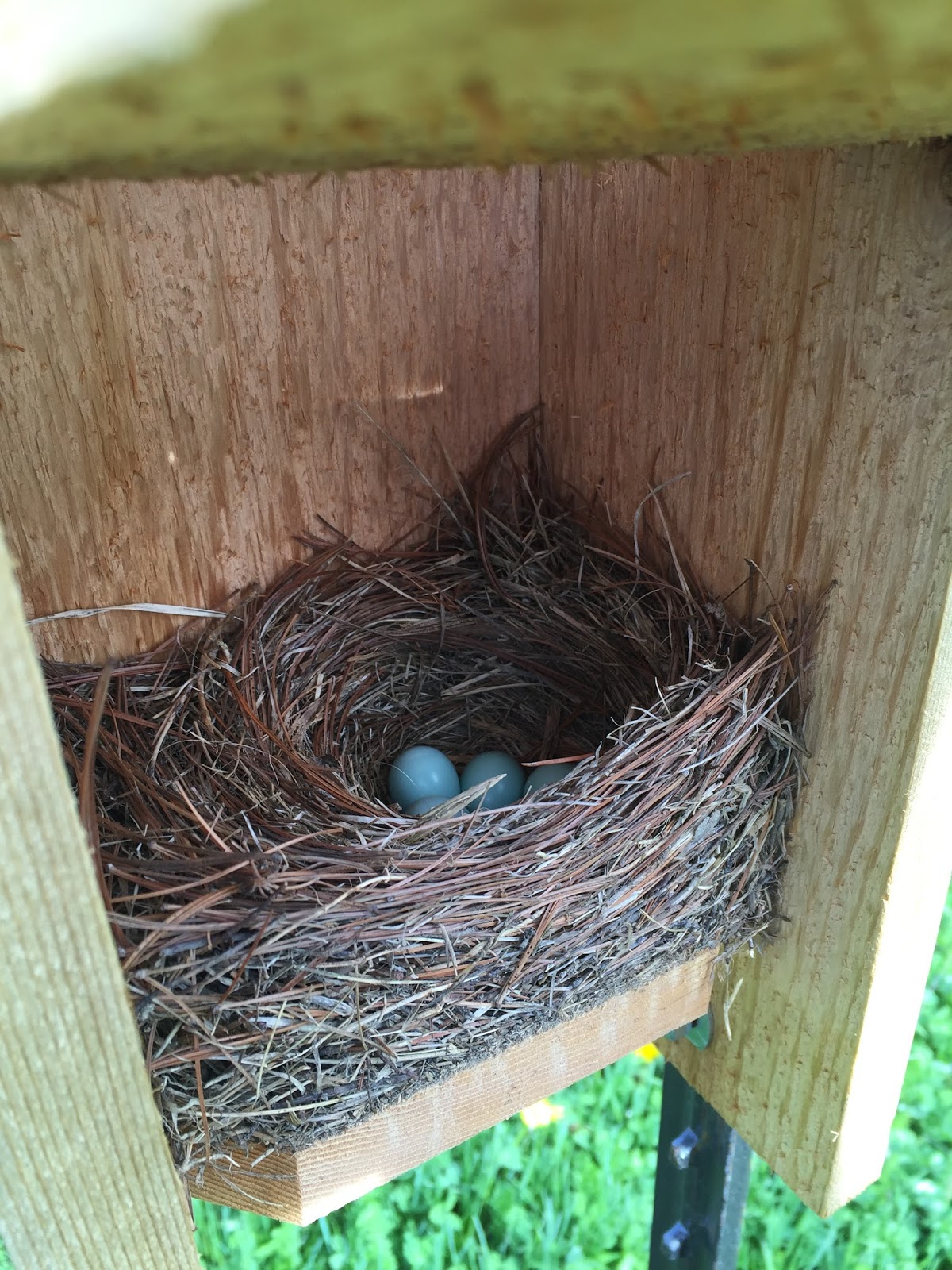
Showing posts with label nest box. Show all posts

Friday, June 21, 2019

Vernal: A Spring Photo Project (Day 61 through Day 70)

To this point I've shared two months worth of spring photographs.  As of today (June 21st) spring has reached its end, but I have a months worth of photographs still to share.  Here are the photos from day 61 through day 70.  To see the previous set of images follow this link.

Day 61 (19 May 2019) - Plum flowers


We have a plum tree right outside our back door.  It rarely produces much fruit, but every spring it is absolutely covered with blossoms.  I photographed these flowers after a light rain covered everything with water and softened the light.

Day 62 (20 May 2019) - Audubon Woods Creek


Another rainy day.  This image was taken in a light drizzle at the Chippewa Watershed Conservancy's Audubon Woods Preserve.  The CWC owns 23 separate properties, but Audubon Woods is my favorite because of the mature trees.  The center of the preserve can often feel ten degrees cooler than the edge.  The water trickling over these rocks helps add moisture to the air cooling it even further.  Even the color of the woods feels cool as the mist in the air diffuses the light making everything glow green as the sunlight penetrates the forest canopy.

Day 63 (21 May 2019) - Dandelions 


Spring wouldn't be spring without dandelions.  Homeowners may not love them, but the bees and other pollinators do.  Some people are taking notice - the Ziibiwing Center of Anishinabe Culture has adopted the policy of not mowing until the dandelions have gone to seed.  I photographed this dandelion bloom in the lawn at the Isabella Conservation District office.

Day 64 (22 May 2019) - Forest Ecology Studies 


Most of the programs that I do are in the classroom out of necessity, but every year I take students from Winn Elementary out to Audubon Woods to explore forestry and forest ecology.  In this photograph the students are measuring the distance from a stake (representing the center a 0.1 acre plot) to a tree in their study plot.  If the tree is within 37 feet of the stake (the radius of a 0.1 acre plot), they will then get an azimuth to the tree, measure the diameter of the tree, and record all of this date on a map of their plot.  I keep copies of all this date in the hope that it can be used to record changes in the forest over time.

Day 65 (23 May 2019) - Look up...


May 23rd was another day of forest ecology studies at Audubon Woods.  I think actually took more photographs of students on this day than I did on the 22nd, but my favorite photo of the day was taken when the students had gone back to school for lunch.  Looking up, I spotted this combination of blue sky, white clouds, dark branches, and yellow-green leaves.  With the sun lighting up the edge of a cloud formation I couldn't resist this photograph.

Day 66 (24 May 2019) - Honey Locust Thorn 


This photograph was taken right outside my back door.  We have a large honey locust (Gleditsia triacanthos) growing only a few feet from the house.  This tree provides lots of shade in the summer and a home for many species of birds and insects (not to mention squirrels).  The most interesting thing about the tree is the large thorns that grow from a few branches.  The honey locust originally developed these thorns as defense against ice age mammals - now they are just a reminder of a time when elephants walked the tundra and forests of North America.

Day 67 (25 May 2019) - Fern Frond 


Another photograph from home.  This fern covered with a layer of fine spider webs was photographed in the garden on the side of the house.  This image has been cropped to a square from its original format.

Day 68 (26 May 2019) - Home, Sweet Home


On May 26th we drove about forty-five minutes from home to visit my parents near Laingsburg, MI.  At one point I took a few minutes to walk around their property looking for something to photograph.  As I walked past this nesting box in a wooded area, a wren popped its head out of the box.  It's not grand architecture, but it's good enough for a wren.  If you look close you can see the wren's toes gripping the entrance hole.  The bird looked at me for a few seconds and then flew off into the underbrush.

Day 69 (27 May 2019) - Iris


When we moved into our house eight years ago there was already a patch of irises planted on the south side of the house.  I think these are Siberian iris, but am not certain.  I love the nectar guides on each large landing pad of a petal directing pollinators toward the nectar (and pollen).  The large serrated leaves in the background belong to cut-leaved coneflower (Rudbeckia laciniata).

Day 70 (28 May 2019) - Wild Columbine 


My final image from this set of photos was taken at the Chippewa Watershed Conservancy's Williams-Blackburn Preserve.  Wild Columbine (Aquilegia Canadensis) is one of my favorite late-spring wildflowers.  It's very photogenic when the flowers are fully mature (like this one), but I often miss out on finding them so it's always exciting to find a perfect bloom.  One really interesting thing to me about these flowers is how hairy they are.  Look close and you can see that the petals, stem, and leaves are all covered with minute hairs.  I like being able to peer in and see that level of detail.

Wednesday, April 18, 2018

Nest Boxes - It's not too late!

On Sunday we noticed  a pair of Black-capped Chickadees (Poecile atricapillus) intently checking out the nesting box located in a tree outside our kitchen window.  One bird would enter the box, stay for a minute or so, and then exit the box.  At this point the other bird of the pair would enter the box and repeat the process.  They went t this for quite some time.  We think they must have found the accommodations to their liking; Shara and I both saw Chickadees entering and exiting the box again on Monday.  

It's not to late to put out a nesting box.  The cold, wet weather seems to have delayed nesting for many species.  I use the plan below for all of my small nesting boxes - I am not sure of the original source of the plan as it is found all over the internet.  They are very easy to construct and can be built in less than an hour even by someone with no woodworking experience. 

One note on construction:  The box outside our window was built specifically for Chickadees so the entrance hole is only 1 1/8 inch diameter.  We live in town and there are lots of House Sparrows - they would quickly take over the box if it had a 1 1/2 hole as shown in the plan below.


https://blogger.googleusercontent.com/img/b/R29vZ2xl/AVvXsEi5vhHwr4weZ8vno_c-9nJYIMoBlI8hCj_788qmTShb1Q5hcgsF2b1hHZPOisjLh_n92sx33-vF4QIG8W7ag0_8KdUdyTtqB0xyPRAdm8p8S93zdjbiadzvMD5x6N783kWhG4Zukh5eiEPk/s1600/eastern+bluebird+box.jpg 


Tuesday, March 27, 2018

Nesting box mice

All of the local schools are on Spring Break right now.  What does that mean for me?  It means that I have a few days of schedule-free time available.  I am using that time to do spring maintenance on pollinator gardens and bluebird nesting boxes. 

One of the hazards of doing maintenance on nesting boxes...

Oh, hello!  Sorry, but this space is occupied!

Mice like to take up residence in the boxes during the winter months.  This is especially true in the boxes that we have at Winn Elementary.  The boxes are in a fencerow and are easy for mice to access.  I think the mouse total this year was only ten (spread between a dozen nest boxes); last years total was fifteen mice.   I expect the mice here, but sometimes a teacher from Winn Elementary cleans out the boxes... 

The mice that take up residence are one of two species, the Deer Mouse (Peromyscus maniculatus) or the the White-footed Mouse (P. leucopus).  The two species are very similar, but I think this one might be a White-footed based on its orange-brown fur - Deer Mice are generally grey-brown.

The sad evictee must now find a new residence...

Tuesday, June 13, 2017

Nestlings and more (12 June 2017)

Shara and I stopped at the Ziibiwing Center last night (12 June) to check on the bluebird nesting boxes.  First up was the single Eastern Bluebird nest.  Here is what they looked like yesterday.


Eastern Bluebird nestlings on 12 June 2017 (photo by Shara LeValley)

For comparison, the same nest on June 6th.  Those little buggers have grown a lot in a week!

Eastern Bluebird nestlings on 06 June 2017 (photo by Shara LeValley)
 We also checked on the four Tree Swallow nests.  One nest had chicks that appeared to have hatched in the last 24 hours.  The chicks in the other three nests are a five to ten days old.  Here is a picture of  one of the older nests.  Unfortunately most of the other photos were too dark and blurry.

Tree Swallow nestlings on 12 June 2017 (photo by Shara LeValley)
The birds were not the only babies that we found.  While walking across the lawn, we noticed a patch of Common Milkweed and out of habit began to search for Monarch eggs and caterpillars.  We found one - our first caterpillar of the year!  Because grounds was at that time mowing the lawn, we knew this caterpillar would not survive where it was found.  We collected it and took it home to rear.  We'll release it once it metamorphoses as an adult.


Monarch caterpillar (photo by Shara LeValley)
Finally, we discovered paper wasps creating a nest on the underside of a sculpture.  Wasps create these nests by chewing up wood fibers and mixing it with their saliva to create a paper-like substance.  The hexagonal shape of each cell allows the wasps to fit the maximum number of cells in a small space.

Paper wasps (photo by Shara LeValley)

Paper wasp nest on coneflower sculpture (photo by Shara LeValley)


Friday, June 2, 2017

Another baby picture

Just one more picture of baby birds...

Yesterday afternoon, Shara and I checked all of the bluebird nesting boxes at the Saginaw Chippewa Academy.  To our surprise, there was very little nesting activity.  We only found two boxes (out of ten) with active nests.  Both were occupied by Tree Swallows. 

Tree Swallow nestlings (photo by Shara LeValley)

If you look closely, there are six nestlings in this picture.  Five of them are obvious while the sixth on is partially obscured by the feather on the bottom right of the image.  At this stage, the nestlings basically do nothing but eat and sleep.  Both parents were fully occupied with catching enough flying insects to feed their growing brood.

We did see an adult male Eastern Bluebird in the field where the nest boxes are located, but did not find a bluebird nest.  He kept flying toward a nearby woodland so it seems likely that this year the bluebirds found a natural cavity to nest in.

Thursday, May 25, 2017

Bluebird and Swallow eggs

Yesterday (24 May), we stopped after work to check on the nesting boxes at the Ziibiwing Center.  Out of seven boxes, we found five active nests - one Eastern Bluebird (Sialis sialis) nest and four Tree Swallow (Tachycineta bicolor) nests.  The remaining two boxes showed evidence of House Sparrows and were cleaned out.

Here are photos of four of the active nests; the fifth nest had a swallow in the box and we didn't open it.

First up is the Bluebird nest.  This box was also used by a pair of Bluebirds in 2016 - last year they successfully raised five young.  The colder weather this spring has delayed nesting for many birds.  At this point last year, the Bluebird chicks were a week old.  As of yesterday they were still eggs.


Eastern Bluebird eggs (photo by Shara LeValley)

Next is a picture of a Tree Swallow nest.  You'll notice the difference in nests right away.  Bluebirds construct their nests of fine grasses.  So do Tree Swallows, but then they line their nests with feathers.
This nest got a late start - the bird have only laid one egg so far.

Tree Swallow nest and egg (photo by Shara LeValley)

The final two active nest both contained six Tree Swallow eggs.

Tree Swallow eggs (photo by Shara LeValley)

Another Tree Swallow nest (photo by Shara LeValley)

We'll check on the boxes again next week - hopefully there will be baby birds to show.

Wednesday, May 24, 2017

Where have all the blog posts gone?

The past two weeks have been some of my busiest weeks of the year.  I had two major events that I was responsible for organizing, the International Migratory Bird Day Celebration at the Ziibiwing Center on Saturday May 13th and our annual Environmental Education Day on Friday May 19th.  Planning for each of these event begins about a year in advance, but the two weeks immediately prior to both events are hectic with last minute details such as confirming presenters and ordering and organizing supplies, not to mention the actual day of the event.  As a result I have had very little time to think about writing new blog posts.  Things are slowly starting to return to normal.

Meanwhile, nature continues with its usual springtime activities.  Flowers continue to bloom.  Trees are mostly leafed out.  A robin built its usual nest on our house, laid eggs, the eggs hatched, and the babies fledged.  And lets not forget that the bluebirds and tree swallows are nesting in natural cavities and man-made nesting boxes.

During the Bird Celebration at the Ziibiwing Center, Shara was able to sneak off for about a half hour to watch the birds at the nesting boxes.  Here are a few of her photographs...

Hey, you kids, get off my lawn!  (Photo by Shara LeValley)

What is that?  (Photo by Shara LeValley)

I've got my eye on you!  (Photo by Shara LeValley)

Oh, you're still here!  Run along, you!  (Photo by Shara LeValley)

Thursday, June 2, 2016

Baby Bluebird Update (31 May 2016)

The baby Eastern Bluebirds at the Ziibiwing Center continue to grow quickly.  They have begun to spill out of the nest cup.  At a minimum these nestlings are 15 days old.  They could fledge (leave the nest) any day.

It's getting crowded in here... (Photo by Shara LeValley)


Baby Eastern Bluebirds (Photo by Shara LeValley)

One of the other nest boxes has a Tree Swallow nest.  When we opened the box, Mama Tree Swallow was sitting inside.

A female Tree Swallow sitting on her nest (Photo by Shara LeValley)

Meanwhile, in one of the nest boxes at the Saginaw Chippewa Academy a clutch of Tree Swallow eggs has hatched.

Tree Swallow nestlings (Photo by Shara LeValley)

Tuesday, May 31, 2016

Baby Bluebird Update (26 May 2016)

Last Thursday (the 26th), we stopped at the Ziibiwing Center to check on the progress of the Eastern Bluebird nestlings.  They look more and more like adult birds every time we check on them.


I've got my eye on you! (Photo by Shara LeValley)

Eastern Bluebird nestlings - that nest is getting pretty full (Photo by Shara LeValley)

Not the greatest photo, but you can see all five nestlings (Photo by Shara LeValley)

Eastern Bluebird nestlings - check out the blue wing feathers (Photo by Shara LeValley)

Monday, May 23, 2016

Baby Bluebird Update (23 May 2016)

The Eastern Bluebird nestlings at the Ziibiwing Center are coming along nicely in their development.  They have their eyes open now and are covered with feathers.  They are beginning to look like birds.


Thursday, May 19, 2016

Baby Bluebird Update

We stopped at the Ziibiwing Center yesterday (18 May) on our way home to check on the nesting boxes.  The baby bluebirds are growing and changing quickly - their feathers are starting to develop.  I expect their eyes to open in the next day or so.

Baby Eastern Bluebirds - there is a fifth one on the bottom of the pile (photo by Shara LeValley)

Tuesday, May 17, 2016

Baby Birds

We stopped yesterday afternoon (16 May) to check on the bluebird nest at the Ziibiwing Center.  Opening it up, here is what we discovered.

Five adorably ugly baby Eastern Bluebirds - photo by Shara LeValley

Look here to see the eggs before they hatched.

Tuesday, May 10, 2016

On the Bluebird Trail

Yesterday afternoon, Shara and I stopped at the Ziibiwing Center to check on the nest boxes along their new Bluebird Trail.  Most of the boxes are unoccupied - it is not unusual for birds to take a while to discover and use new nesting boxes.

However, one of the boxes contained a full clutch of five Eastern Bluebird eggs.

Eastern Bluebird nests are made entirely of grasses - photo by Shara LeValley

Eastern Bluebird eggs - photo by Shara LeValley

There were several pairs of Tree Swallows flying around the nest boxes.  Now that the weather has finally begun to warm up, I expect that they will also begin too nest soon.

Don't forget to come by the Ziibiwing Center this Saturday (May 14th) for the annual Bird Day Celebration.

Thursday, April 21, 2016

If you build a bluebird trail, they will come


Not a great photo, but it does show the male of the Bluebird pair that I saw at the Ziibiwing Center

The new bluebird trail at the Ziibiwing Center is drawing attention from the local birds.  Yesterday afternoon I stopped to see if there was any activity.  I found several pairs of Tree Swallows either perching on or entering boxes.  I also found at least one pair of Eastern Bluebirds staking a claim to one box.  The birds are still very skittish and are best observed from a distance - as they begin to nest and acclimate to attention you should be able to approach a little bit closer.  Out in the field behind the museum I also saw and heard at least two male Eastern Meadowlarks calling back and forth.

Again, not a great picture - Eastern Meadowlark male

Last week I even saw a birder, glassing the open fields with binoculars.

Wednesday, March 30, 2016

A new bluebird trail in Mt. Pleasant

A bluebird nest box with the Ziibiwing Center in the background
 
Yesterday afternoon I stopped at the Ziibiwing Center to install a new bluebird trail.  A bluebird trail is simply a series of nesting boxes arranged in some sort of pattern.  This will be the fourth bluebird trail that I have installed.  The others are at the Saginaw Chippewa Academy, Winn Elementary, and the Morey Public School Academy.  I maintain the boxes at SCA, the other boxes are maintained by teachers at the schools.

Why install bluebird trail at the Ziibiwing Center?  First, the Ziibiwing Center is the host site for our annual International Migratory Bird Day Celebration and I thought this would be a great addition to this year's celebration.  (This year's Bird Day is scheduled for Saturday May 14th - more information will come soon.)  Second, the Ziibiwing Center is surrounded by open grassy fields - good habitat for bluebirds.  Finally,  I have worked with the Ziibiwing staff on a number of projects over the years and though this was a great way to say thank you for their assistance. 

I also want to say thanks to Heather Shaw (wildlife biologist for the Saginaw Chippewa Indian Tribe) for helping me install the boxes.  If you want to learn a little more about Heather and the work she does, check out this post from August 2015.

In total, we placed seven boxes around the perimeter of the Ziibiwing Center.  I plan on going back and adding at least one more box.  There is also the potential to add some boxes at the nearby Andahwod senior center.  While putting up the boxes, we were able to watch hawks hunting in the surrounding fields and I think I saw an Eastern Meadowlark at one point.  I expect both Eastern Bluebirds and Tree Swallows will find these nesting boxes and make use of them in the upcoming years.

For plans to build a bluebird nesting box of your own, look here.

Tuesday, March 29, 2016

Boxes for owls, in trees

Last month (February 2016), I built several nesting boxes for different sized birds.  These included a box intended for Eastern Screech Owls and another intended for Barred Owls.  I gave the two boxes to my parents to put up on their property near Laingsburg.  On Sunday (27 March), I was finally able to see where they placed the boxes.

My parents own about 15 acres of land.  More than half of this land is located in the floodplain for the Looking Glass River.  The rest of their property is above the flood plain and is composed mostly of clay soils.  This property was formerly owned by my maternal grandparents and was once operated as a small farm.

Since my parents purchased the property they have been slowly planting trees to reforest much of the land.  This task has been complicated by the fact that many of their trees were ash trees and have been killed off by the invasive Emerald Ash Borer beetle.  As a consequence, there has been increased urgency for the past several years.

Many of the first trees planted on the property were a combination of pine and spruce species.  Some of these trees are now more than 30 feet tall and provide a dense overhead cover.

A stand of twenty year old pines

Over the past two years, they have found several dozen owl pellets under these trees.  This seemed like a good location to place one of the two owl nesting boxes.

The screech owl nesting box is located in the pine tree just left of center

A closer view of the nesting box.

This box has already been occupied, but not by owls.  It seems that a Red Squirrel (Tamiasciurus hudsonicus) has taken up residence in this box.

The other nesting box is placed in one of the largest trees on the property.


Placed nearly twenty feet up in a large oak tree, this box overlooks an area of mixed hardwood swamp.  This is exactly the place that I envisioned when I made this nesting box.  It seems like the right place to find a Barred Owl - the only drawback being that there may not be enough mature trees in the area.  I guess only time will tell.


I didn't see any owls, but I did manage to see something just as wild.  While walking along the edge of the flooded marsh, I surprised a large Mink (Neovison vison).  The mink quickly began to swim away and I was able to only get a couple of pictures as it swam away.  Even though it was only a brief sighting, it's always exciting to see a mink.