Showing posts sorted by relevance for query Audubon Woods. Sort by date Show all posts

Tuesday, May 8, 2018

Forestry for Fifth Graders (07 & 08 May 2018)

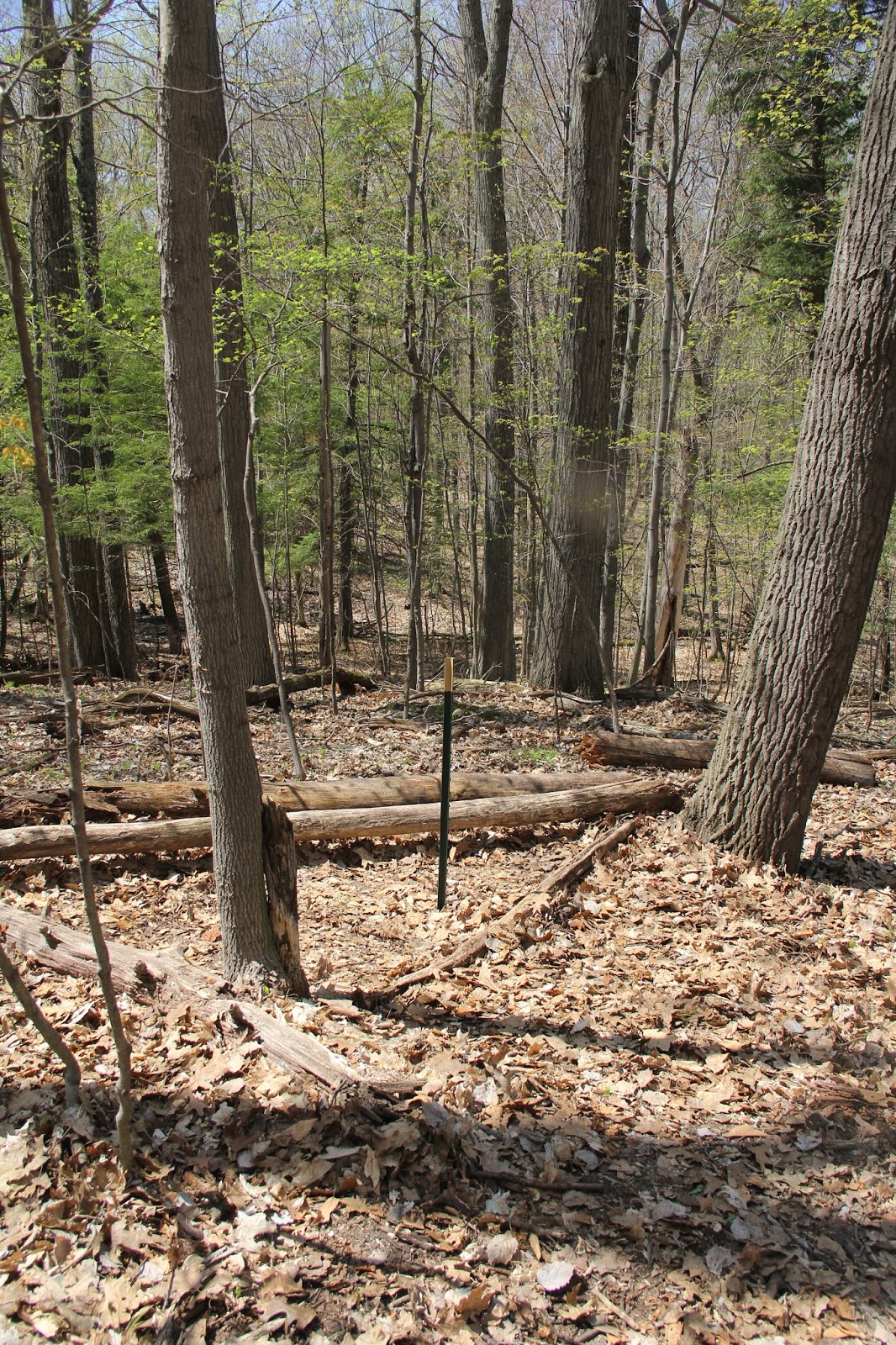
If you have visited the Chippewa Watershed Conservancy's Audubon Woods Preserve in the past week you may have noticed some metal T-posts that weren't there before.

A metal T-post standing alone at Audubon Woods Preserve

Why are these posts at Audubon Woods?  What are they for?

For the past seven years, I have used Audubon Woods as an outdoor science classroom for local elementary students.  The T-posts are meant to be semi-permanent education stations.  In the past, every time I took students to Audubon Woods I would set up temporary stations at somewhat random points in the woods.  There is a lot that can be done by using temporary points, but more can be learned long term if students use the same locations time after time.

With permission, I set about placing posts along a series of transects (lines) throughout the woods.  I set up three transects at regularly spaced intervals in the woods and placed six evenly-spaced posts along each transect.  Now with semi-permanent locations, data that the students collect can be compared over time.

So what kinds of data are the students collecting?

Over the past two day (07 & 08 MAY 2018) I have been working with fifth grade students from Shepherd Elementary.  These classes were able to travel to Audubon Woods because last fall their teachers applied for and received a Wheels To Woods field trip grant. 

Students are measuring the circumference of trees in their study plot and using that to calculate diameter.

Measuring a tree's circumference

Measuring large trees takes teamwork


Students are also counting trees at their study plot to determine the number of trees in one acre of forest and in the entire forest.  Audubon Woods is 40 acres in size - at 43,560 sq. ft/acre, that means Audubon Woods is 1,742,400 sq. ft!  Counting all of the trees in an area this size would be an impossible task.  Luckily, it is easy to count the number of trees in a much smaller area and then use that number to estimate the total number of trees in the forest.  A circle with a radius of approximately 37 feet will have an area of 1/10 acre.   Remember those T-posts?  Students counted every tree within 37 feet of the post and used multiplied that number by 10 to find the number of trees in one acre and then again by 40 to find the total number of trees in Audubon Woods.

Tape measures are an important forestry tool

Measuring trees to make sure they fit in their plot

Students then calculated the number of leaves on the forest floor by counting the number of leaves in one square foot and then multiplying by 43,560 to get the number of leaves in one acre, and then by 40 to get the total number of leaves on the floor of Audubon Woods.  Imagine if a single square foot holds exactly 100 leaves, this would calculate out to over 172 million leaves in the forest!

Students had a square made from PVC pipe to make their task easier

Counting leaves from a single square foot of forest

Re-calculating...

Students also calculated the weight of all the leaves in the forest, identified and sketched leaves, and drew a sketch of the forest near their study plot.  Perhaps just as important as the science, this field trip allowed students to get out of the classroom for a few hours.  The months of April and May are testing time in Michigan.  Students spend hours taking state-mandated assessments and even more hours taking tests required by their local school district.  A field trip like this exposes them to sights, sounds, and smells that thy can never experience in the classroom.

Large-flowered Trillium

 
Trillium surrounded by Mayapple


Spring Beauty flowers


Bloodroot

Skunk Cabbage

Wood Frogs were everywhere hidden among the leaves

Another Bloodroot flower

The maples and other trees are just starting to leaf out

Tuesday, October 17, 2017

Fall Forest Ecology at Audubon Woods Preserve

Whenever I can, I like to get students out of the classroom and into local woods or wetlands.  Last Friday, I had the opportunity to meet Third, Fourth, and Fifth Grade students from Winn Elementary at the Chippewa Watershed Conservancy's Audubon Woods Preserve.


Winn Elementary students are no strangers to Audubon Woods.  Located only a few miles from the school, Audubon Woods is a great place for them to put science concepts into action.  For the the Third Graders, this was their first trip to Audubon Woods as a class; Fourth and Fifth Graders have made multiple trips the preserve, beginning in Third Grade.

It was homecoming for Shepherd Public Schools - that explains all the blue and yellow (including the hair)


Before the trip to Audubon Woods, I had visited each grade in the classroom at least once.  Third Grade began the year learning about trees - their parts and adaptations, how to age a tree and measure diameter, and learning to classify leaves.  My Fourth Grade presentation focused on plant adaptations and how plants use adaptations to overcome challenges.  The Fifth Grade program repeated much of the information from Third Grade, but with a deeper emphasis on adaptations and using growth ring patterns to analyze past growing conditions.

In the woods, the focus shift a little.  Here I ask all three groups of students to measure diameter of trees.  While in the classroom this was easy - students simply measured the distance across prepared slices of tree trunk (AKA "tree cookies").  In the woods this is not an option.  Instead students must measure the circumference (distance around) of the tree and divide that by pi (approx. 3.14) to find diameter.

Measuring circumference with a tape measure

For Third Grade students this can be quite a challenge.  They have to be able to measure the circumference with a tape measure, convert that that circumference from feet and inches to all inches, and finally use a calculator to divide by pi to find the diameter.  We do one tree as a whole group before the students measure two more trees on their own.

Calculating diameter

Fourth Graders should be able to do all of these things on their own.  Just as a refresher, we go over one tree as a group and then they measure three trees on their own.

Fifth Graders have already done this activity as Third and Fourth Graders.  They measure three trees on their own without a demonstration.  This might seem like overkill, but in the Spring when the students return, the Fifth Grade students will learn a shortcut to estimating diameter - the Biltmore Stick.  I just want them to have a firm understanding of how to calculate diameter before they learn the tricks to make it easier.

During this Fall visit, the classrooms have a very limited amount of time in the woods (about 1 hour to 1.25 hours for each class).  This means that they have a limited amount of work to accomplish.  For Third Graders, tree measurement and diameter calculation may take all of the available time.  If they finish this activity, they are also given the assignment of finding, drawing, identifying, and classifying leaves.  Most students do one or two leaves in the time allowed.  If time is short (as it was this time), Fourth Grade students are assigned the same work, but are expected to accomplish more.

Student drawing of an American Beech leaf

Fifth Grade students are given two additional activities to complete.  First they are asked to determine the total number of leaves to be found on the forest floor.  Audubon Woods is forty acres!  This seems impossible, but it is a much less daunting task if broken into parts.

Counting every leaf in one square foot section of forest

Instead of counting every leaf on the forest floor, students are asked to count the number of leaves in a single square foot of the forest.  This number is then multiplied by the number of square feet in an acre.  An acre measures 43,560 square feet.  Then that number is multiplied by the number of acres in the forest.


Using this method, six groups of students came up with estimates ranging from 179 million to 390 million leaves on the floor of Audubon Woods.  The average of the six groups was approximately 254 million leaves!

Once students have found an estimate of the number of leaves, they are then tasked with finding the weight of all the leaves on the forest floor.  This is accomplished by determining the average weight of a single leaf and multiplying by the number of leaves in the forest.

To find the weight of a single leaf, students count out 100 random leaves from the forest floor.  The leaves are placed in a plastic bag and weighed (in grams).  Next the weight of the bag (already known) is subtracted.  This number is then divided by 100 to find the average weight of an individual leaf.


Estimates for the weight of the leaves on the floor of Audubon Woods ranged from 100 thousand kilograms to 241 thousand kilograms with an average of approximately 138 thousand kilograms of leaves!  Converted to pounds this more than 304 thousand pounds.  (If you had the equivalent weight in $1 bills, you would have approximately $138 million dollars!)

Why are all of  these leaves important?  They provide the organic matter (humus) that is providing food and homes for billions of bacteria, fungi, and invertebrates such as insects.  These organisms break down the organic matter into forms that can be taken up by plants (including trees).  Essentially by releasing their leaves, the trees are providing food for themselves.

Here are a few more photographs from the day.
Tuesday, October 31, 2017

Visiting four CWC preserves in one day (Part Two)


Yesterday I started to share a bunch of photographs from my Sunday (29 October 2017) trip to four Chippewa Watershed Conservancy Preserves.  I entered the first preserve (Sylvan Solace) at approximately 9:00AM and left the final preserve (Audubon Woods) at 3:45PM.  Add in driving to and from my home in Alma and the trip took nearly eight hours and covered 78 miles by car and (probably) 10 miles on foot.

Here are the photos from the second half of my trip.


Hall's Lake Natural Area


The Hall's Lake Natural Area is actually comprised of three connected preserves (the Schaftenaar, Kabana, and Neely Preserves) on the north and east sides of Hall's Lake.  A fourth, unconnected, Preserve (Fox Run) is located on the southwest side of the lake.  My trip took me mostly through the Schaftenaar and Kabana Preserves, with a short dip into the Neely Preserve.  Hall's Lake Natural Area is only three miles (as the crow flies) from Bundy Hill.  However, it takes six miles of driving to get from one preserve to the other.

Small American Beech sapling grows along the edge of a shrub swamp.

Lycopodium (a relative of ferns) will remain green throughout the winter.

A Tamarack sapling turns golden yellow before losing its needles.  It is the onlylocal conifer to lose its needles every fall.

In the previous post I mentioned that I found deer scrapes at every preserve I visited.  I probably found a dozen scrapes in total.  This scrape at Hall's Lake was the only one that I photographed with its overhead "licking branch".  Located directly over a heavily used trail, deer will both lick this branch and rub it with scent glands located on their nose and forehead.  The scrape acts like a sign drawing attention to the overhead branch.

A deer scrape located underneath an overhanging branch provides a place for deer to leave scent signals.

Located just a few short feet away, I found another type of deer sign known as a "rub'.  Rubs are formed by bucks scraping their antlers against a small tree.  Early in the fall, rubs are used to scrape velvet off the deer's fully developed antlers.  Later in the fall they are used much like the licking branch as a place to leave scent information for other deer.

A freshly rubbed sapling shows that one or more bucks has passed this way.

In this image both a scrape (left) and rub (right) can be seen. 

Green pine saplings and drying ferns add their own colors to the fall leaf palette.

Amanita mushrooms are toxic to humans.

Paper Birch trunks stand out in any fall forest.

Several benches provide a place to sit and view Hall's Lake.

Birch trunks rot within only a few years - the watertight bark holds moisture in!

Bronze American Beech leaves against a slowly decaying tree trunk

Winterberry (Ilex verticillata) adds its own color to the woods.

A miniature forest of Ground Pine sprouts in the larger forest.

 
Bittersweet Nightshade (Solanum dulcamara) leaves can turn a shocking shade of purple in the fall.

Water flows north out of Hall's lake into Pony Creek.

An old shelf fungus slowly decays, as does the log it grew on.

A bolete mushroom rises from the forest floor.

The bark on this tree formed an interesting pattern of cracks and fissures.

The preserve boundaries at Hall's Lake are well marked.

A large wetland divides the Schaftenaar and Kabana preserves.  An osprey nest platform can be seen in the distance.

Sometime in the recent past, beavers felled a large number of aspen trees at the northern edge of the preserve.

Red Oak leaves living up to their name for once.

Most of the canopy has fallen by now.

Audubon Woods Preserve

Audubon Woods Preserve is approximately 10 miles from the Hall's Lake Natural Area.  Audubon Woods is definitely the CWC preserve that I am most familiar with.  I have made many trips to Audubon Woods with school groups over the past few years and have written about that experience  several times.  Audubon Woods is a mature hardwood forest located on the banks of the Chippewa River.  The entire preserve slopes downhill toward the river's high banks.  Because I have spent so much time at this preserve, I decided to spend most of my time wandering off trail in hopes of finding something new.

Looking down the trail toward the river.

A small intermittent stream divided the property.

Northern Maidenhair Fern grows along the stream.
 
A pile of scat shows that a White-tailed Deer passed this way.


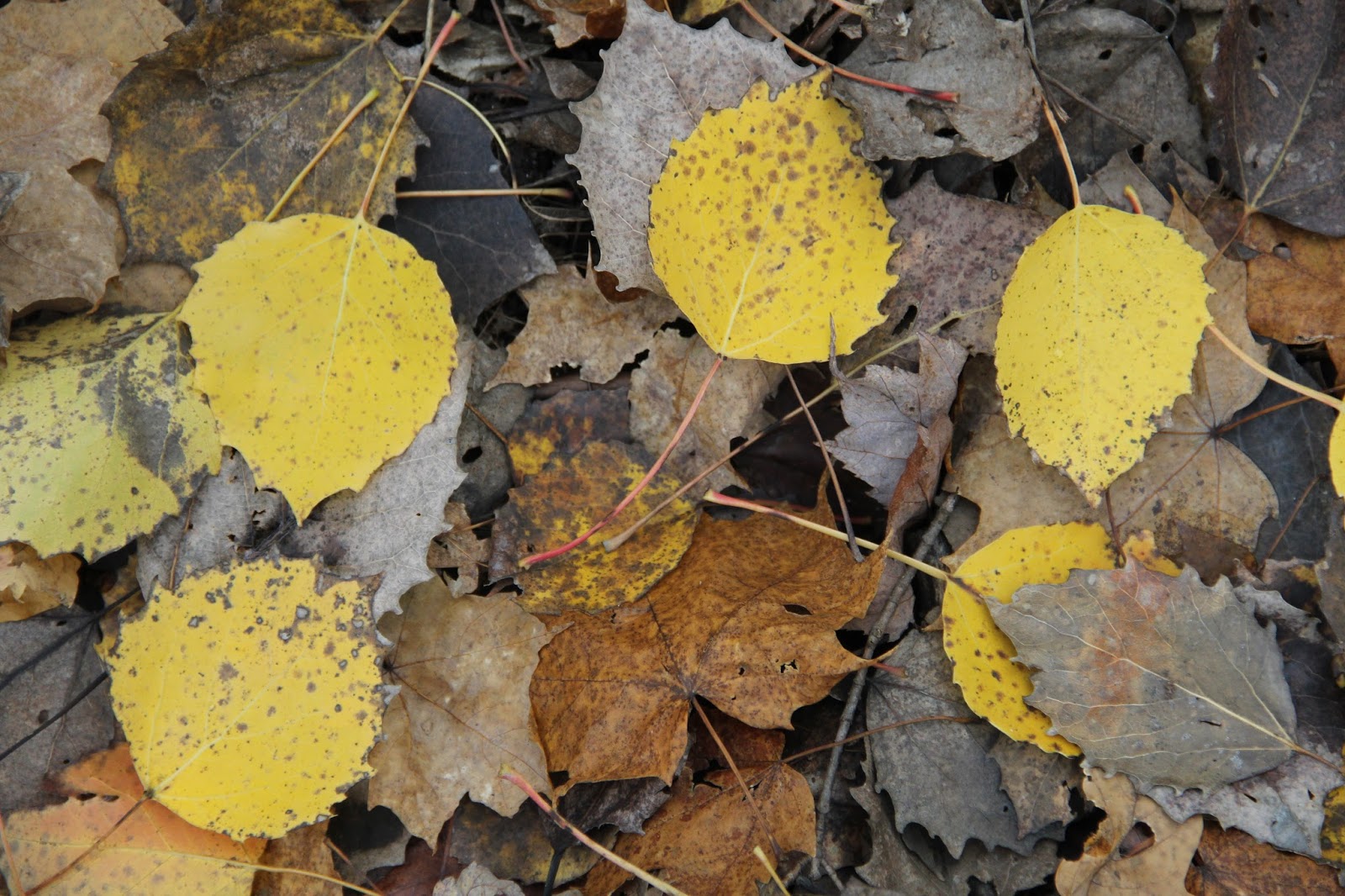
Bigtooth Aspen leaves turn golden yellow, but quickly fade to brown.

Looking up at Bigtooth Aspen leaves caught in an Eastern Hemlock.

A small fern grows deep in Audubon Woods.


Eastern hemlock forms several groves within Audubon Woods

Burls are irregular growths caused by damage to the tree.

Wild Grapes climb an Eastern Hemlock to the canopy.

This Sassafras seedling is near the northern limit of its range in Michigan.


Was it worth it?  I spent an entire day driving between preserves and hiking around.  I could have probably spent all day at any one of the preserves and still came away with the same number of photographs.  I did this mostly for the challenge - maybe other people have done something like this in the CWC preserves, but if they have I'm not aware of it.  I already have a more ambitious round of preserve visits mapped out in my mind, but that will have to wait until next summer when there is more available daylight.

Hopefully someone will see this and be inspired to challenge themselves to a similar photography project.