Today (January 28th) marks the thirty-second anniversary of the Space
Shuttle Challenger disaster. On January 28th, 1986 at 11:39:13 EST, the
Challenger broke apart 73 seconds after liftoff when an O-ring in one
of the solid rocket boosters failed. All seven crew members died in the
accident.
I remember watching the accident at school. I was in 5th Grade at the
time. I don't remember if we were supposed to watch the launch or if
the teacher brought in a television after the accident happened.
Officially titled STS-51L, this mission of the Challenger was scheduled
to be a special one. STS-51L was carrying a teacher into space. In
1984, NASA began the Teacher in Space Project (TISP) to inspire students
and ignite interest in math, science, and space exploration. More than
11,000 teachers applied for the program. Sharon "Christa" McAuliffe
was selected to be the first Teacher in Space (with Barbara Morgan as
her backup). McAuliffe (and Morgan) trained for 5 months for the
mission. Once the Challenger reached space, McAuliffe was scheduled to
teach two lessons to students back on Earth. On here return back to
Earth, McAuliffe was supposed to go back to teaching in the classroom.
The destruction of the Challenger and the death of seven crew members
was a big blow to NASA. Because of the presence of a non-professional
(McAuliffe) on the flight, Challenger had received more press attention
than most previous Shuttle flights. NASA cancelled flights of the
remaining Space Shuttles for nearly three years to examine safety issues
and determine the cause of the accident. The Teacher in Space Project
was officially replaced with the Educator Astronaut Project in the
1990s.
Barbara Morgan would eventually make it to space. She retired from
teaching in 1998 and went to work at NASA as a full-time employee. She
flew as a mission specialist on STS-118 in August 2007.
For more information on STS-51L please visit the official NASA website. Information on Christa McAuliffe and Barbara Morgan can be found on their official NASA bios.
Showing posts with label NASA. Show all posts
Monday, January 28, 2019
Tuesday, February 20, 2018
First American in Orbit - 20 February 1962
On 20 February 1962, Astronaut John Herschel Glenn, Jr. became the first American to orbit the Earth in the "Friendship 7" spacecraft. Two Soviet cosmonauts had previously orbited the earth in Vostok spacecraft. The first human in space, Yuri Gagarin made one orbit in the Vostok 1 and Gherman Titov made 17 orbits in the Vostok 2.
Born 20 July 1921 in Cambridge, Ohio, John Herschel Glenn, Jr. served in the United States Marine Corps as a fighter pilot during both World War II and the Korean War. After the Korean War, he remained in the service as a test pilot. In 1959, we was named as one of the first seven American astronauts (the Mercury Seven).
Glenn was the third American to be launched into space as part of NASA's Project Mercury - flights by Alan Shepherd (Freedom 7) and Virgil "Gus" Grissom (Liberty Bell 7) each lasted approximately 15 minutes.
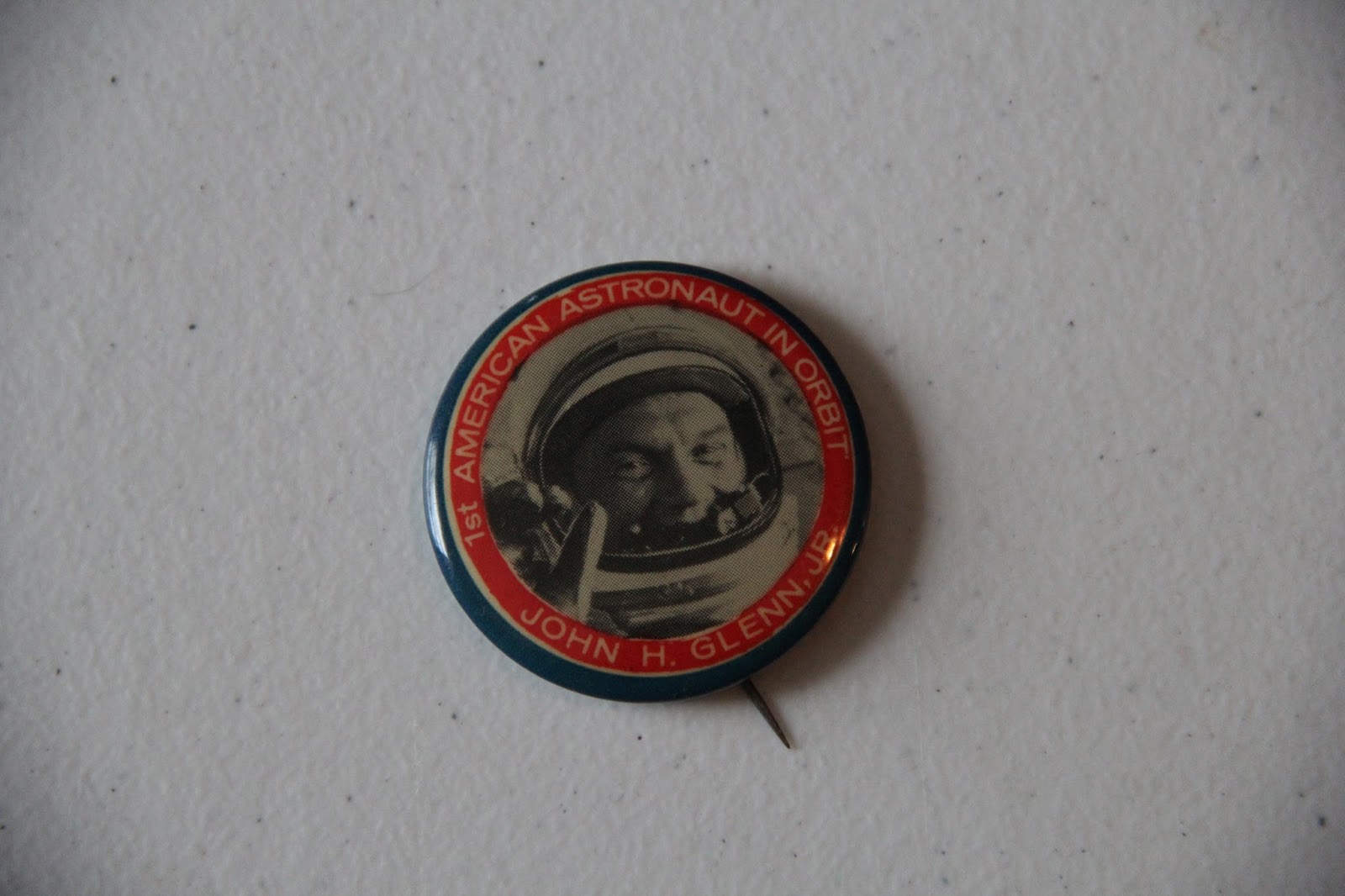
When John Glenn safely landed he instantly became a national hero. His flight was commemorated by dozens (probably hundreds) of different souvenir items (including the buttons shown in this post).
In 1964, Glenn resigned from NASA to run for the United States Senate. He withdrew from the race due to symptoms of a concussion that did not allow him to campaign. After losing a second senate campaign in 1970, he was finally elected to the office in 1974. Glenn would go on to serve in the Senate until 1999.
While serving in the Senate, Glenn returned to space one more time aboard the the Space Shuttle Discovery. As a trained engineer, Glenn's role during STS-95 (29 October - 07 November 1998) was to participate in experiments that tested the effects of weightlessness on the elderly. It also allowed NASA the opportunity to study the effects of space flight on an individual at points in life more than three decades apart.
With this flight, John Glenn added another milestone to space travel. In addition to being the first American to orbit the Earth, he is also the oldest person to travel into space.
John Glenn passed away 08 December 2016 in Columbus, Ohio at the age of ninety-five.
Thursday, January 25, 2018
The Space Shuttle Challenger - 32 Years Later
This weekend marks the 32nd anniversary of the Space Shuttle Challenger disaster.
On January 28th, 1986 at 11:39:13 EST, the Challenger broke apart 73 seconds after liftoff when an O-ring in one of the solid rocket boosters failed. All seven crew members died in the accident.
Officially titled STS-51L, this mission of the Challenger was scheduled to be a special one. STS-51L was carrying a teacher into space. In 1984, NASA began the Teacher in Space Project (TISP) to inspire students and ignite interest in math, science, and space exploration. More than 11,000 teachers applied for the program. Sharon "Christa" McAuliffe was selected to be the first Teacher in Space (with Barbara Morgan as her backup). McAuliffe (and Morgan) trained for 5 months for the mission. Once the Challenger reached space, McAuliffe was scheduled to teach two lessons to students back on Earth. On her return back to Earth, McAuliffe was supposed to go back to teaching in the classroom.
The destruction of the Challenger and the death of seven crew members was a big blow to NASA. Because of the presence of a non-professional (McAuliffe) on the flight, Challenger had received more press attention than most previous Shuttle flights. NASA cancelled flights of the remaining Space Shuttles for nearly three years to examine safety issues and determine the cause of the accident. The Teacher in Space Project was officially replaced with the Educator Astronaut Project in the 1990s.
Barbara Morgan would eventually make it to space. She retired from teaching in 1998 and went to work at NASA as a full-time employee. She flew as a mission specialist on STS-118 in August 2007. Barbara Morgan retired from NASA in 2010.
Earlier this month NASA announced that astronauts orbiting the Earth in the International Space Station would complete and film several of the lessons that were originally planned to be conducted by McAuliffe aboard the Challenger.
For more information on STS-51L please visit the official NASA website. Information on Christa McAuliffe and Barbara Morgan can be found on their official NASA bios.
On January 28th, 1986 at 11:39:13 EST, the Challenger broke apart 73 seconds after liftoff when an O-ring in one of the solid rocket boosters failed. All seven crew members died in the accident.
Officially titled STS-51L, this mission of the Challenger was scheduled to be a special one. STS-51L was carrying a teacher into space. In 1984, NASA began the Teacher in Space Project (TISP) to inspire students and ignite interest in math, science, and space exploration. More than 11,000 teachers applied for the program. Sharon "Christa" McAuliffe was selected to be the first Teacher in Space (with Barbara Morgan as her backup). McAuliffe (and Morgan) trained for 5 months for the mission. Once the Challenger reached space, McAuliffe was scheduled to teach two lessons to students back on Earth. On her return back to Earth, McAuliffe was supposed to go back to teaching in the classroom.
The destruction of the Challenger and the death of seven crew members was a big blow to NASA. Because of the presence of a non-professional (McAuliffe) on the flight, Challenger had received more press attention than most previous Shuttle flights. NASA cancelled flights of the remaining Space Shuttles for nearly three years to examine safety issues and determine the cause of the accident. The Teacher in Space Project was officially replaced with the Educator Astronaut Project in the 1990s.
Barbara Morgan would eventually make it to space. She retired from teaching in 1998 and went to work at NASA as a full-time employee. She flew as a mission specialist on STS-118 in August 2007. Barbara Morgan retired from NASA in 2010.
Earlier this month NASA announced that astronauts orbiting the Earth in the International Space Station would complete and film several of the lessons that were originally planned to be conducted by McAuliffe aboard the Challenger.
For more information on STS-51L please visit the official NASA website. Information on Christa McAuliffe and Barbara Morgan can be found on their official NASA bios.
Monday, January 27, 2014
The Space Shuttle Challenger - Twenty-eight years later
Tomorrow (January 28th) marks the twenty-eighth anniversary of the Space Shuttle Challenger disaster. On January 28th, 1986 at 11:39:13 EST, the Challenger broke apart 73 seconds after liftoff when an O-ring in one of the solid rocket boosters failed. All seven crew members died in the accident.
I remember watching the accident at school. I was in 5th Grade at the time. I don't remember if we were supposed to watch the launch or if the teacher brought in a television after the accident happened.
Officially titled STS-51L, this mission of the Challenger was scheduled to be a special one. STS-51L was carrying a teacher into space. In 1984, NASA began the Teacher in Space Project (TISP) to inspire students and ignite interest in math, science, and space exploration. More than 11,000 teachers applied for the program. Sharon "Christa" McAuliffe was selected to be the first Teacher in Space (with Barbara Morgan as her backup). McAuliffe (and Morgan) trained for 5 months for the mission. Once the Challenger reached space, McAuliffe was scheduled to teach two lessons to students back on Earth. On here return back to Earth, McAuliffe was supposed to go back to teaching in the classroom.
The destruction of the Challenger and the death of seven crew members was a big blow to NASA. Because of the presence of a non-professional (McAuliffe) on the flight, Challenger had received more press attention than most previous Shuttle flights. NASA cancelled flights of the remaining Space Shuttles for nearly three years to examine safety issues and determine the cause of the accident. The Teacher in Space Project was officially replaced with the Educator Astronaut Project in the 1990s.
Barbara Morgan would eventually make it to space. She retired from teaching in 1998 and went to work at NASA as a full-time employee. She flew as a mission specialist on STS-118 in August 2007.
For more information on STS-51L please visit the official NASA website. Information on Christa McAuliffe and Barbara Morgan can be found on their official NASA bios.
Wednesday, October 30, 2013
Five Science Things - Firsts in American Space Flight
My wife has a growing collection of space exploration memorabilia, including a number of buttons commemorating American space missions. I thought I would share five of these buttons.
The first button commemorates the first earth orbit by an American astronaut. Lt. Colonel John Glenn orbited the earth three times on 20 February 1962 aboard the Friendship 7. Glenn was the third American (and 5th human) successfully launched into space. John Glenn was one of the original seven American astronauts (Mercury 7) and is the last surviving member of that group. In addition to being the first American in orbit, John Glenn later became the oldest person in space when he participated flew aboard the Space Shuttle Discovery on STS-95 (29 October - 07 November 1998).
The second button commemorates the flight of the Gemini 3 spacecraft. Nicknamed "Molly Brown", Gemini 3 was the first flight of the Gemini space program and launched on 23 March 1965. Crewed by astronauts Virgil I "Gus" Grissom and John W. Young, Gemini 3 was the first American space flight crewed by two men. Gemini 3 was also the first spacecraft to perform an orbital maneuver - using rockets to maneuver the craft in space. Gus Grissom would later die in a fire aboard the Apollo 1 capsule during a training exercise (27 January 1967). John Young would remain with NASA until the 1980s and fly in a total of 6 space missions. He would land on the moon during the Apollo 16 mission (16 - 27 April 1972) and command the first Space Shuttle Mission STS-1 (12 April 1981).
The third button commemorates the Gemini 4 mission (3 June - 7 June 1965). This mission was crewed by astronauts James McDivitt and Edward White. This mission saw the first American walk in space when floated outside the exited the Gemini capsule and floated alongside for approximately 20 minutes. White (like Gus Grissom) died aboard the Apollo 1 capsule. McDivitt would fly in space one more time during the Apollo 9 mission. Later McDivitt became Manager of the Apollo Spacecraft Program before retiring from NASA in 1972.
The fourth button commemorates the flight of Apollo 8 (21 - 28 December 1968). Crewed by astronauts Frank Borman, Jim Lovell, and William Anders, Apollo 8 was the first manned flight to orbit the moon. The craft orbited the moon 10 times over the course of 20 hours before returning back to Earth. This marked the last space flight for Frank Borman - he also commanded the Gemini 7 flight (4 - 18 December 1965). Apollo 8 was the only space flight for William Anders. Apollo 8 was the third space flight of Jim Lovell. He had previously flown on Gemini 7 and Gemini 12. Later he would command the Apollo 13 mission (11 - 17 April 1970). Apollo 13 was supposed to land on the moon, but the mission was aborted due to an explosion on the command module. Lovell and the other two astronauts (Jack Swigert and Fred Haise) were able to safely pilot the Apollo 13 lunar module safely back to Earth.
The fifth and final button commemorates the Apollo 11 mission (16 -14 July 1969). This was the first manned space flight to land successfully on the moon. At 10:56AM on July 20th, Neil Armstrong became the first person to step foot on the moon's surface. Later he was joined by Edwin E. "Buzz" Aldrin on the moon's surface. Armstrong and Aldrin spent approximately 2 hours walking on the moon's surface. Armstrong and Aldrin remained on the surface of the moon in the lunar module for 20 hours before reuniting with the orbiting command module. Michael Collins orbited the moon in the command module during the mission, but did not land on the surface. Apollo 11 was the second (and last) space flight for all three astronauts. Armstrong had previously flown on the Gemini 8 mission, Aldrin on Gemini 12, and Collins on Gemini 10. The US would return astronauts to the moon only five more times, the last time in 1972 (Apollo 17). A total of only 24 humans have orbited the moon and of those 24, twelve have stood on the surface of the moon. There are no current plans for the United States to return astronauts to the moon.
The first button commemorates the first earth orbit by an American astronaut. Lt. Colonel John Glenn orbited the earth three times on 20 February 1962 aboard the Friendship 7. Glenn was the third American (and 5th human) successfully launched into space. John Glenn was one of the original seven American astronauts (Mercury 7) and is the last surviving member of that group. In addition to being the first American in orbit, John Glenn later became the oldest person in space when he participated flew aboard the Space Shuttle Discovery on STS-95 (29 October - 07 November 1998).
The second button commemorates the flight of the Gemini 3 spacecraft. Nicknamed "Molly Brown", Gemini 3 was the first flight of the Gemini space program and launched on 23 March 1965. Crewed by astronauts Virgil I "Gus" Grissom and John W. Young, Gemini 3 was the first American space flight crewed by two men. Gemini 3 was also the first spacecraft to perform an orbital maneuver - using rockets to maneuver the craft in space. Gus Grissom would later die in a fire aboard the Apollo 1 capsule during a training exercise (27 January 1967). John Young would remain with NASA until the 1980s and fly in a total of 6 space missions. He would land on the moon during the Apollo 16 mission (16 - 27 April 1972) and command the first Space Shuttle Mission STS-1 (12 April 1981).
The third button commemorates the Gemini 4 mission (3 June - 7 June 1965). This mission was crewed by astronauts James McDivitt and Edward White. This mission saw the first American walk in space when floated outside the exited the Gemini capsule and floated alongside for approximately 20 minutes. White (like Gus Grissom) died aboard the Apollo 1 capsule. McDivitt would fly in space one more time during the Apollo 9 mission. Later McDivitt became Manager of the Apollo Spacecraft Program before retiring from NASA in 1972.
The fourth button commemorates the flight of Apollo 8 (21 - 28 December 1968). Crewed by astronauts Frank Borman, Jim Lovell, and William Anders, Apollo 8 was the first manned flight to orbit the moon. The craft orbited the moon 10 times over the course of 20 hours before returning back to Earth. This marked the last space flight for Frank Borman - he also commanded the Gemini 7 flight (4 - 18 December 1965). Apollo 8 was the only space flight for William Anders. Apollo 8 was the third space flight of Jim Lovell. He had previously flown on Gemini 7 and Gemini 12. Later he would command the Apollo 13 mission (11 - 17 April 1970). Apollo 13 was supposed to land on the moon, but the mission was aborted due to an explosion on the command module. Lovell and the other two astronauts (Jack Swigert and Fred Haise) were able to safely pilot the Apollo 13 lunar module safely back to Earth.
The fifth and final button commemorates the Apollo 11 mission (16 -14 July 1969). This was the first manned space flight to land successfully on the moon. At 10:56AM on July 20th, Neil Armstrong became the first person to step foot on the moon's surface. Later he was joined by Edwin E. "Buzz" Aldrin on the moon's surface. Armstrong and Aldrin spent approximately 2 hours walking on the moon's surface. Armstrong and Aldrin remained on the surface of the moon in the lunar module for 20 hours before reuniting with the orbiting command module. Michael Collins orbited the moon in the command module during the mission, but did not land on the surface. Apollo 11 was the second (and last) space flight for all three astronauts. Armstrong had previously flown on the Gemini 8 mission, Aldrin on Gemini 12, and Collins on Gemini 10. The US would return astronauts to the moon only five more times, the last time in 1972 (Apollo 17). A total of only 24 humans have orbited the moon and of those 24, twelve have stood on the surface of the moon. There are no current plans for the United States to return astronauts to the moon.
Subscribe to:
Posts (Atom)