Showing posts with label history. Show all posts

Monday, January 28, 2019

Space Shuttle Challenger - Thirty-two Years Later

Today (January 28th) marks the thirty-second anniversary of the Space Shuttle Challenger disaster.  On January 28th, 1986 at 11:39:13 EST, the Challenger broke apart 73 seconds after liftoff when an O-ring in one of the solid rocket boosters failed.  All seven crew members died in the accident.


I remember watching the accident at school.  I was in 5th Grade at the time.  I don't remember if we were supposed to watch the launch or if the teacher brought in a television after the accident happened.

Officially titled STS-51L, this mission of the Challenger was scheduled to be a special one.  STS-51L was carrying a teacher into space.  In 1984, NASA began the Teacher in Space Project (TISP) to inspire students and ignite interest in math, science, and space exploration.  More than 11,000 teachers applied for the program.  Sharon "Christa" McAuliffe was selected to be the first Teacher in Space (with Barbara Morgan as her backup).  McAuliffe (and Morgan) trained for 5 months for the mission.  Once the Challenger reached space, McAuliffe was scheduled to teach two lessons to students back on Earth.  On here return back to Earth, McAuliffe was supposed to go back to teaching in the classroom.


The destruction of the Challenger and the death of seven crew members was a big blow to NASA.  Because of the presence of a non-professional (McAuliffe) on the flight, Challenger had received more press attention than most previous Shuttle flights.  NASA cancelled flights of the remaining Space Shuttles for nearly three years to examine safety issues and determine the cause of the accident.  The Teacher in Space Project was officially replaced with the Educator Astronaut Project in the 1990s.  

Barbara Morgan would eventually make it to space.  She retired from teaching in 1998 and went to work at NASA as a full-time employee.  She flew as a mission specialist on STS-118 in August 2007.

For more information on STS-51L please visit the official NASA website.  Information on Christa McAuliffe and Barbara Morgan can be found on their official NASA bios.

Saturday, November 10, 2018

When the gales of November came early...


Today marks the 43rd Anniversary of the wreck of the S.S. Edmund Fitzgerald, the most famous shipwreck in the Great Lakes.

On the evening of 10 November 1975, the freighter S.S. Edmund Fitzgerald was approaching Whitefish Point, MI with a full load of taconite (iron ore) in a Lake Superior storm.   Despite the hurricane force winds, the 729 foot ship did not appear to be under distress before it sank suddenly at 7:10 PM.  All twenty-nine men aboard the Edmund Fitzgerald perished.  To this day, the exact cause of the ship's sinking is unknown, but a rogue wave (or series of rogue waves) is the prime suspect.

 The ship was commemorated by Canadian singer/songwriter Gordon Lightfoot in his 1976 song "The Wreck of the Edmund Fitzgerald".

The wreck site was visited by dive teams in 1989, 1995, and 1995 to survey the site and collect artifacts.  The ship's bell was recovered during the 1995 dive.  The bell was restored and now rests at the Great Lakes Shipwreck Museum at Whitefish Point, MI. For more information on the Edmund Fitzgerald visit the Great Lakes Shipwreck Museum website.

Although the Edmund Fitzgerald is the Great Lakes' most famous shipwreck, 1975 was not the first time that "the gales of November" turned deadly.  A November storm in 1913 claimed the lives of approximately 250 sailors, sank 12 ships, and foundered approximately 30 more ships across the Great Lakes.  This massive storm which lasted for nearly five days became known as the "Big Blow" or the "White Hurricane' among other names.

On 11 November 1940, a storm known as the "Armistice Day Blizzard" sank three freighters in Lake Michigan with the loss of 66 lives.  The same storm caused the deaths of dozens of duck hunters along the Mississippi River.

Sunday, October 21, 2018

Birch Bark Canoe Build

The Ziibiwing Center of Anishinabe Culture & Lifeways (6650 E. Broadway, Mt. Pleasant) is currently hosting a community project to build a birch bark canoe (wiigwassi-jiiman).  The goal is not just to build a canoe, but also to keep the knowledge and teaching related to canoe- building alive in the community.  Anyone is welcome to participate in the build - just show up at the Ziibiwing Center during.  The Ziibiwing Center is normally open 10:00AM to 6:00PM, but is open at 9:00AM for the duration of this project.  They expect to be working on the canoe for at least the next week, but may continue into another week if the project is not finished by next Saturday.


I stopped on Thursday to snap a few pictures of the progress.  At this point they were using wooden pegs to sandwich birch bark (wiigwas) between the pieces of wood that would form the gunwales (pronounced gunnels) and were beginning to stitch the bark to the gunwales with lengths of split spruce root (wadap).


Rocks are used to hold everything in place until the gunwales are stitched to the birch bark hull

It takes many pieces of bark to make the hull - these must be stitched together

Traditional canoe-making tools include axes and crooked knives

Many hands speed up the process - for many this is their first time building a canoe

A detail showing the spruce root lashings

Young and old are all learning together


On Friday, I went back after work.  This time I took Shara (Mrs. LeValley) with me - she jumped right in to split a length of spruce root and use it to stitch part of the hull of the canoe to the gunwales.

Most of the hull has been stitched to the gunwales and the supporting framework has been removed.

The thwarts that brace the gunwales must also be stitched.

Work has really progress in the past day.

Shara (Mrs. LeValley) learns how to split the spruce roots for lashings.


A hole must be punched through the birch bark with an awl...

Then the spruce root can be laced through the hole and wrapped around the gunwale.


Shara finished the last stitch of the day


As this build will continue for about another week, I plan on stopping in several more times to check on the progress.  I'll post more pictures later this week.

Friday, June 29, 2018

The Days of Summer - Day One through Day Nine

I've given myself a photo project.  I love nature photography, but sometimes everything else in life gets in the way and I don't take time to get outdoors and take pictures.  So this summer I decided to do something about it.  Starting with the first day of Summer (21 June) I am going to take at least one photo every day of the season and share it here.  I wish this was an original idea, but it's not.  One of my favorite nature photographers is Jim Brandenburg.  For one season (in this case Autumn), Brandenburg took only one photo per day.  A personal project to reignite his love of photography and to connect with his home ground, these photos were not originally meant to be published but they resulted in the book called Chased By The Light: A 90-Day Journey (1998).  Five years later he published a companion book titled Looking for Summer (2003).  For Looking Brandenburg did not take one photo per day as he did for Chased, but the goal was the same to connect with a place and a time. Both Chased and Looking are sitting in our living room right now - they are among the books I turn to for photographic inspiration. 

So I'm inspired... I sit typing these words on June 29th, the ninth day of summer and I have nine photographs to share.  I am not taking a single photo a day as per Chased By The Light, but I am picking a single image to represent each day.  Collectively, I hope these photos represent the season as I experience it.  Expect updates on a weekly basis from here out.

Day One (21 June 2018) - Summer Solstice


I started summer with a sunrise hike at the Chippewa Watershed Conservancy's Bundy Hill Preserve.  While I took over 200 photos that morning, this image of a pair of brightly lit broadleaf trees in a dark pine forest is my favorite.

Day Two (22 June 2018) - Mare's Tails


I am drawn to clouds - I photograph them over and over again.  A good cloud always merits a photograph.  This image of cirrus clouds was taken on the Saginaw Chippewa Reservation just east of Mt. Pleasant on my way home from work.  I noticed the clouds and pulled into a parking lot to get this image. Cirrus clouds are often referred to as Mare's Tails because of their resemblance to the curling hairs of a horse's tail.  The word cirrus actually means "a curl of hair" in Latin.

Day Three (23 June 2018) - Baby Birds


A Boston Fern on our front porch is currently home to a nest full of baby House Finches (Haemorhous mexicanus).  When I took this picture, the nestlings were several days old but had yet to open their eyes.

Day Four (24 June 2018) - Raindrops on Butterflyweed


Sunday June 24th found us leaving for a trip to Chicago for a graduation party, and then on to Wisconsin and Iowa for a mini-vacation. I photographed this Butterflyweed (Asclepias tuberosa) in our home pollinator garden while I was packing for the truck for our trip.  It had just started to rain and the flowers were covered with hundreds of tiny water droplets. 

Day Five (25 June 2018) - Wading Whooper


One of my favorite places is the International Crane Foundation in Baraboo, Wisconsin.  We originally visited there in July 2015.  When we decided to head back to Wisconsin this summer, ICF was at the top of our list of places to visit.  During our first trip the pair of Whooping Cranes (Grus americana) stayed toward the back of their exhibit space and we barely saw them.  That almost happened again this time, but we hung around the exhibit and the birds decided it was time to feed in the pond near the viewing area.  This is not the closest image that I took, but it is my favorite of the bird in action stalking something in the pond.

Day Six (26 June 2018) -  A Row of Mounds


Our next day found us in eastern Iowa at Effigy Mounds National Monument.  I am fascinated by Native American earthworks, especially mounds.  In 2016 we visited Great Serpent Mound in Ohio and Cahokia Mounds in Illinois.  Effigy Mounds was next on my list.  These mounds are attributed to the Hopewell Culture that existed in the area approximately 1500-2000 years ago.  Although the site is best know for its effigy mounds (earthen mounds in the shapes of animals or humans) I was equally impressed by the rows of conical mounds such as this group leading up the the area known as Fire Point.


Day Seven (27 June 2018) -  Bufflehead Drake


Shara firmly believes that if a city you are visiting has an aquarium it must be visited; I tend to agree.  That's how we ended up at the National Mississippi River Museum and Aquarium in Dubuque, Iowa. My favorite thing was the American Paddlefish feeding (daily at 10:30AM), but my favorite photo was this one of a Bufflehead (Bucephala albeola) drake at the Backwater Marsh exhibit. 


Day Eight (28 June 2018) - Moonrise


The photo for June 28th was taken back home in Michigan at the Forest Hill Nature Area.  After driving home from Iowa earlier in the day, I decided to go out to Forest Hill to watch the sun set and the full moon rise.  There were not enough clouds for a spectacular sunset, but just enough to prevent really clear photos of the moon.  Even so I really like this yellow moon in the inigo sky as barely rises above the black treeline.

Day Nine (29 June 2018) - Hope is a tree with seeds


Emily Dickinson famously wrote that '"Hope" is the thing with feathers-', but to me this tree represents hope.  It's a Green Ash (Fraxinus pennsylvanica).  Why does this tree give me hope?  Do you see all the dead trees in the background?  Those are also Green Ash trees.  They were killed by the Emerald Ash Borer, an invasive species that has obliterated ash populations in Michigan and across the Midwest.  Entire forests were wiped out in a few short years.

But...

The Emerald Ash Borer didn't get every tree.  Trees that were small when the Ash Borer arrived in an area were sometimes passed over as Ash Borer populations moved on to more promising feeding grounds.  These small trees are now reaching a size where they are capable of reproducing.  In a short walk at Mill Pond Park I discovered several 15 - 25 foot Green Ash trees.  The best part of the discovery; they all had seeds (hundreds of them)!  These seeds represent hope for the survival of the species as a viable component of our forests.

Monday, May 28, 2018

Memorial Day 2018

Officially founded on 04 July 1776, The United States of America has existed for nearly two hundred forty-two years.  During that span of time more than one million military service members, both men and women, have died in the service of the United States.  This Memorial Day please remember the reason for the holiday is to honor and remember those who have given their life in the service of this country. 


Although the exact origin of the holiday is debated, the first national celebration of Memorial Day, or Decoration Day as it was then known, dates to 1868.  Below are the words of the original Memorial Day proclamation issued by General John A. Logan of the Grand Army of the Republic on May 5th, 1868 to commemorate and remember the fallen from the American Civil War.  (The Grand Army of the Republic was the largest veterans' organization representing soldiers who served the Union cause.)

HEADQUARTERS GRAND ARMY OF THE REPUBLIC

General Orders No.11, WASHINGTON, D.C., May 5, 1868

  1. The 30th day of May, 1868, is designated for the purpose of strewing with flowers or otherwise decorating the graves of comrades who died in defense of their country during the late rebellion, and whose bodies now lie in almost every city, village, and hamlet church-yard in the land. In this observance no form of ceremony is prescribed, but posts and comrades will in their own way arrange such fitting services and testimonials of respect as circumstances may permit.
    We are organized, comrades, as our regulations tell us, for the purpose among other things, "of preserving and strengthening those kind and fraternal feelings which have bound together the soldiers, sailors, and marines who united to suppress the late rebellion." What can aid more to assure this result than cherishing tenderly the memory of our heroic dead, who made their breasts a barricade between our country and its foes? Their soldier lives were the reveille of freedom to a race in chains, and their deaths the tattoo of rebellious tyranny in arms. We should guard their graves with sacred vigilance. All that the consecrated wealth and taste of the nation can add to their adornment and security is but a fitting tribute to the memory of her slain defenders. Let no wanton foot tread rudely on such hallowed grounds. Let pleasant paths invite the coming and going of reverent visitors and fond mourners. Let no vandalism of avarice or neglect, no ravages of time testify to the present or to the coming generations that we have forgotten as a people the cost of a free and undivided republic.

    If other eyes grow dull, other hands slack, and other hearts cold in the solemn trust, ours shall keep it well as long as the light and warmth of life remain to us.

    Let us, then, at the time appointed gather around their sacred remains and garland the passionless mounds above them with the choicest flowers of spring-time; let us raise above them the dear old flag they saved from hishonor; let us in this solemn presence renew our pledges to aid and assist those whom they have left among us a sacred charge upon a nation's gratitude, the soldier's and sailor's widow and orphan.

  2. It is the purpose of the Commander-in-Chief to inaugurate this observance with the hope that it will be kept up from year to year, while a survivor of the war remains to honor the memory of his departed comrades. He earnestly desires the public press to lend its friendly aid in bringing to the notice of comrades in all parts of the country in time for simultaneous compliance therewith. 
  3. Department commanders will use efforts to make this order effective.

    By order of

    JOHN A. LOGAN,
    Commander-in-Chief

    N.P. CHIPMAN,
    Adjutant General

    Official:
    WM. T. COLLINS, A.A.G.


Tuesday, February 20, 2018

First American in Orbit - 20 February 1962

 
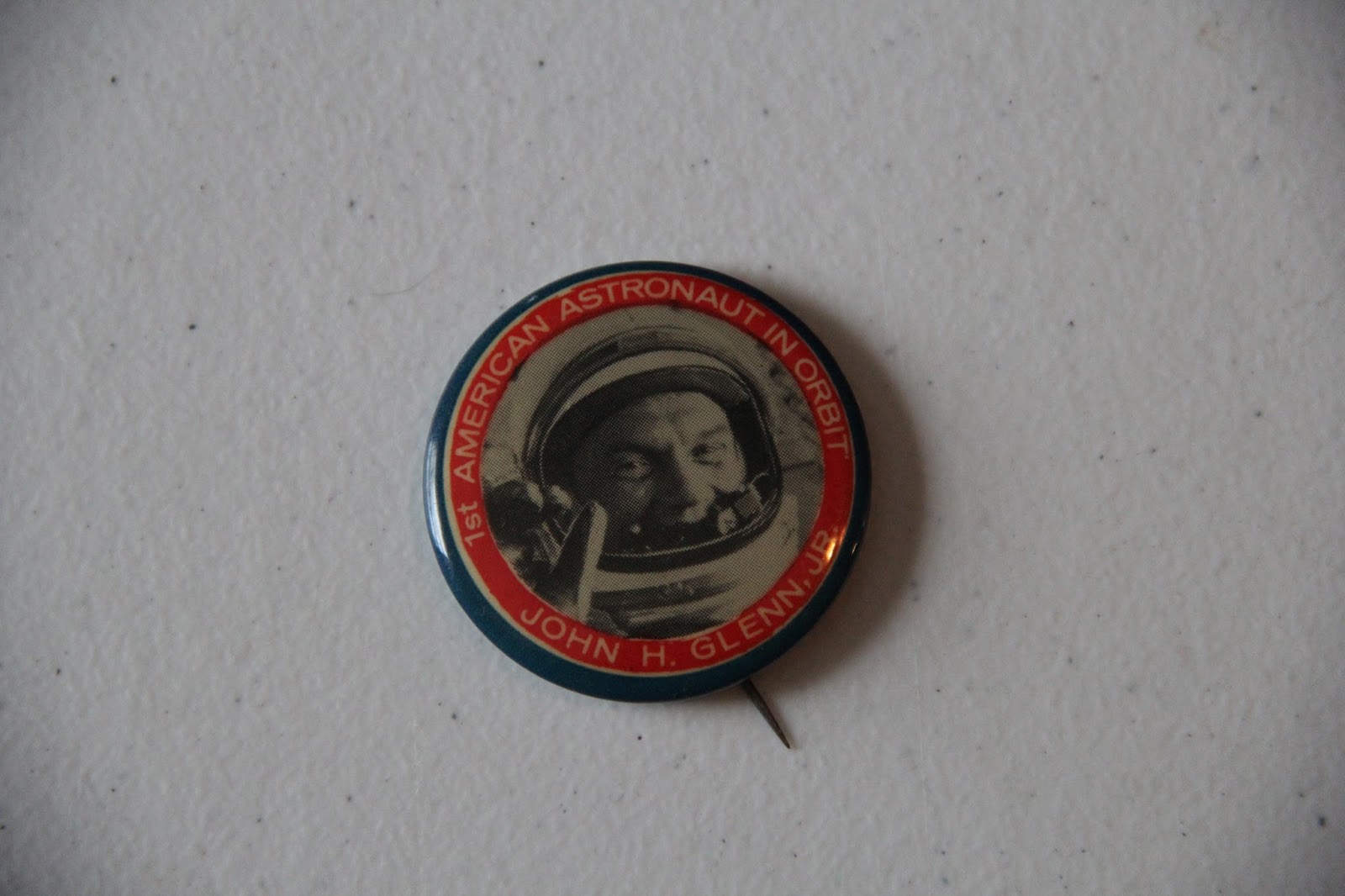
On 20 February 1962, Astronaut John Herschel Glenn, Jr. became the first American to orbit the Earth in the "Friendship 7" spacecraft.  Two Soviet cosmonauts had previously orbited the earth in Vostok spacecraft.  The first human in space, Yuri Gagarin made one orbit in the Vostok 1 and Gherman Titov made 17 orbits in the Vostok 2.

Born 20 July 1921 in Cambridge, Ohio, John Herschel Glenn, Jr. served in the United States Marine Corps as a fighter pilot during both World War II and the Korean War.  After the Korean War, he remained in the service as a test pilot.  In 1959, we was named as one of the first seven American astronauts (the Mercury Seven).

Glenn was the third American to be launched into space as part of NASA's Project Mercury - flights by Alan Shepherd (Freedom 7) and Virgil "Gus" Grissom (Liberty Bell 7) each lasted approximately 15 minutes. 

When John Glenn safely landed he instantly became a national hero.  His flight was commemorated by dozens (probably hundreds) of different souvenir items (including the buttons shown in this post).


In 1964, Glenn resigned from NASA to run for the United States Senate.  He withdrew from the race due to symptoms of a concussion that did not allow him to campaign.  After losing a second senate campaign in 1970, he was finally elected to the office in 1974.  Glenn would go on to serve in the Senate until 1999.

While serving in the Senate, Glenn returned to space one more time aboard the the Space Shuttle Discovery.  As a trained engineer, Glenn's role during STS-95 (29 October - 07 November 1998) was to participate in experiments that tested the effects of weightlessness on the elderly.  It also allowed NASA the opportunity to study the effects of space flight on an individual at points in life more than three decades apart.

With this flight, John Glenn added another milestone to space travel.  In addition to being the first American to orbit the Earth, he is also the oldest person to travel into space.

John Glenn passed away 08 December 2016 in Columbus, Ohio at the age of ninety-five.

Thursday, January 25, 2018

The Space Shuttle Challenger - 32 Years Later

This weekend marks the 32nd anniversary of the Space Shuttle Challenger disaster.

On January 28th, 1986 at 11:39:13 EST, the Challenger broke apart 73 seconds after liftoff when an O-ring in one of the solid rocket boosters failed.  All seven crew members died in the accident.


Officially titled STS-51L, this mission of the Challenger was scheduled to be a special one.  STS-51L was carrying a teacher into space.  In 1984, NASA began the Teacher in Space Project (TISP) to inspire students and ignite interest in math, science, and space exploration.  More than 11,000 teachers applied for the program.  Sharon "Christa" McAuliffe was selected to be the first Teacher in Space (with Barbara Morgan as her backup).  McAuliffe (and Morgan) trained for 5 months for the mission.  Once the Challenger reached space, McAuliffe was scheduled to teach two lessons to students back on Earth.  On her return back to Earth, McAuliffe was supposed to go back to teaching in the classroom.


The destruction of the Challenger and the death of seven crew members was a big blow to NASA.  Because of the presence of a non-professional (McAuliffe) on the flight, Challenger had received more press attention than most previous Shuttle flights.  NASA cancelled flights of the remaining Space Shuttles for nearly three years to examine safety issues and determine the cause of the accident.  The Teacher in Space Project was officially replaced with the Educator Astronaut Project in the 1990s.  

Barbara Morgan would eventually make it to space.  She retired from teaching in 1998 and went to work at NASA as a full-time employee.  She flew as a mission specialist on STS-118 in August 2007.  Barbara Morgan retired from NASA in 2010.


Earlier this month NASA announced that astronauts orbiting the Earth in the International Space Station would complete and film several of the lessons that were originally planned to be conducted by McAuliffe aboard the Challenger.

For more information on STS-51L please visit the official NASA website.  Information on Christa McAuliffe and Barbara Morgan can be found on their official NASA bios.

Friday, November 10, 2017

The witch of November come stealin'

 
Today marks the 42nd Anniversary of the wreck of the S.S. Edmund Fitzgerald, the most famous shipwreck in the Great Lakes.

On the evening of 10 November 1975, the freighter S.S. Edmund Fitzgerald was approaching Whitefish Point, MI with a full load of taconite (iron ore) in a Lake Superior storm.   Despite the hurricane force winds, the 729 foot ship did not appear to be under distress before it sank suddenly at 7:10 PM.  All twenty-nine men aboard the Edmund Fitzgerald perished.  To this day, the exact cause of the ship's sinking is unknown.

 The ship was commemorated by Canadian singer/songwriter Gordon Lightfoot in his 1976 song "The Wreck of the Edmund Fitzgerald".

The wreck site was visited by dive teams in 1989, 1995, and 1995 to survey the site and collect artifacts.  The ship's bell was recovered during the 1995 dive.  The bell was restored and now rests at the Great Lakes Shipwreck Museum at Whitefish Point, MI. For more information on the Edmund Fitzgerald visit the Great Lakes Shipwreck Museum website.


Although the Edmund Fitzgerald is the Great Lakes' most famous shipwreck, 1975 was not the first time that "the gales of November" turned deadly.  A November storm in 1913 claimed the lives of approximately 250 sailors, sank 12 ships, and foundered approximately 30 more ships across the great lakes.  This massive storm which lasted for nearly five days became known as the "Big Blow" or the "White Hurricane' among other names.


On 11 November 1940, a storm known as the "Armistice Day Blizzard" sank three freighters in Lake Michigan with the loss of 66 lives.  The same storm caused the deaths of dozens of duck hunters along the Mississippi River.

Wednesday, October 4, 2017

Sputnik 1 (04 October 1957)

Today is the sixtieth anniversary of the launch of the first human-made object into orbit.


On 04 October 1957 the Soviet Union launched Sputnik 1 into low Earth orbit.  Sputnik would transmit radio signals for 21 days and orbit Earth 1440 times.  It eventually dipped out of orbit on 04 January 1958 and burned up on reentry to the atmosphere.

This full-size replica of Sputnik 1 can be viewed at the Armstrong Air and Space Museum in Wapakoneta, OH

This launch began the Space Race between the United States and the Soviet Union.  The US would follow the Sputnik launch with its first satellite Explore I on 01 February 1958.

There are currently 2,271 active satellites orbiting Earth.

Thursday, February 23, 2017

Logging Images

During the winter, in addition to the science programs that I present at schools, I also spend a couple of months presenting two different programs on Michigan history.  One of these programs focuses on Michigan's logging history.

Logging was one of the first major industries in Michigan and products from Michigan's forests were used to build much of the nation's cities during the period after the American Civil War. For nearly half a century Michigan could lay claim to the title of the logging capital of the world.  While other a few other states may dispute this claim, it is hard to argue with a place where one river system alone produced over 22 Billion board feet of lumber during its run!

Recently I purchased a new lot of logging postcards.  Most of these are from Michigan, but unfortunately some of the photo locations are not documented on the images.


These postcards show vignettes of logging life. Most images are posed, with little action portrayed in the photograph.  One of my favorite images shows a crew of four with a team of horses (used to skid or drag the logs through the woods).  Two of the men lean on cant hooks used for rolling logs.  A third man leans on a double-bit axe.  I especially like the fact that two of the men in the picture have cut off the bottom of their overalls so they don't get soaked with snow.

A crew of men ready and equipped to move logs through the snowy woods. (Unknown location)
This next picture is a later image - it dates to probably the 1950s.  What I like about this picture is that it shows how teams of oxen (or horses) would be used to skid the logs.  A close look at the picture reveals the skidding tongs clamped onto each log.  The two sharp points of the tongs would bite into the log so it could be pulled through the snow.  Oxen were sometimes used in the camps because of their brute strength, but horse were both faster and required less feed so most camps preferred to use horses.

Oxen skidding logs (Newaygo County, MI)

I think this next picture is another later image.  The cleared land and fences give the impression that this photo was not taken during the early days of logging in Michigan.  I like that this image shows how multiple teams of horses would be connected in tandem to pull a load uphill.  When going downhill, a chain was often connected to the back of the sleigh and wrapped around a tree at the top of the hill where a team of horses would be used to help slow the sleigh down.

Three teams pulling a sleigh uphill (Oceana County, MI)

I have several pictures in my collection showing crews loading logging sleighs.  The men who stacked the logs on the sleighs were known as top loaders.  This was one of the most difficult and dangerous jobs in a lumber camp.  A good top loader would receive higher pay than many other members of a crew.


One common feature of many logging postcards is lumber camps showing off by loading the biggest sleigh-load of logs imaginable.  Sleighs loaded were not loaded like this on a daily basis.  Loads of this size are highly impractical.  They take too long to load and are really too large of a burden for the horses.
Loads like this were used to show off - they were not practical. (Wexford County, MI)

Despite the label on the postcard, this is not a "typical lumber scene".  While many lumbering images show full logs that would eventually be cut into boards, another side of logging was the cutting of railroad ties and fence posts.  Men who cut posts and ties were often paid by the piece rather than being paid by the day as they were in camps that cut large logs.

A forgotten part of logging was the cutting of ties and posts (Alpena County, MI)

I think this is another later image (sometime in the 20th Century).  It would have been highly unusual to use a sleigh to haul a single log.

Hauling a single log on a sleigh (Location unknown)

The next photograph shows a crew of "river hogs".  Also known as "river pigs", these men would float down the river during the spring log drives.  Corked boots (boots with spikes on the soles) allowed the to keep their footing as they walked on the floating logs.  They used pike poles (the long-handled tools) and peaveys (the short-handled tools) to keep the logs moving downstream.

River hogs use pike poles and peaveys to control the movement of logs on a river drive (Antrim County, MI)

By the 1880s, railroads became an important part of logging operations.  Trains allowed lumber crews to work far away from rivers.  The first image shows a train loaded with logs.  At the back of the train is a steam jammer.  This steam-powered winch and boom, pivoted on a central axis and allowed crews to lift logs to load them on the train cars.

Logging trains allowed companies to efficiently log far from rivers (Location unknown)

In this image, train cars are being loaded by the simpler method of cross-hauling.  In this process chain attached to a team of horses (or a powered winch) is used to drag logs up a ramp onto the train where they would be chained in place.  If you click on the image, both the chain and team of horses can be seen in the photo.

Crosshauling logs onto a Grand Trunk rail car at the Coopersville Depot (Ottawa County, MI)

After World War One, gasoline powered equipment such as this Holt tractor became available for logging.  These strong engines could pull long trains consisting of ten or more loaded sleighs across the snow.  In this picture, a second tractor with an additional train of sleighs can be seen at the left rear.

Gasoline tractors greatly reduced the need for horses in logging (Location unknown)

The piles of logs waiting for sawing at mills are a common feature of many logging photographs.  Logs would be stockpiled at the mills after the spring river drives and remain there until thy could be cut up into boards and other products such as shingles, barrel staves, etc..

Logs at a mill in Alpena. The ship in the middle ground is probably a lumber schooner. (Alpena County, MI)


The amount of logs could be truly staggering (Charlevoix County, MI)

The development of small steam-powered circular saws allowed portable mills to be set up almost anywhere.  Boards sawn at these mills would often used locally instead of being shipped for use out of state.

Portable mills often sawed lumber for local use (Location unknown)

Information on the back of the next image identifies it as Phipps Mill.  It was sent from Henderson, MI and I assume the image was taken near there.  I like that you can see the steam engine to the left of the photo and the belt drives that would power the mill.  I love seeing how the men are dressed in those old photos - I only wish they were in color.

Portable mill - note the steam engine and belt drives (Shiawassee County, MI)

The next picture shows a group of men outside a mill - a circular saw can be seen in the building at the rear.  I am going to presume that they are sawing wood  to lengths that would later be split into shingles.  The wood could also be used to feed the boiler that would provide steam power to the mill.  I like this image because it shows a clear picture of a two-man bucking saw.  Bucking saws are used to cut logs into lengths.  A man to the left rear holds a single-bit axe over his shoulder, and the man to the far right holds the handle of a cant hook (or peavey) for rolling logs.

A crew processing logs into short lengths probably for shingles (Location unknown)

The final picture shows an area of land after logging.  The stumps, snags, and slash on the ground would do little to hold the sandy soil in place.  Later, during the Great Depression, much of this area would be replanted by members of the Civilian Conservation Corps.

Large areas of the Great Lakes State were completely deforested during the latter half of the 19th Century          (Roscommon County, MI)

For more logging images check out these four posts.

Logging Photos - Getting Logs out of the Woods

More Logging Photographs

Michigan Logging Photos

Days Gone By - Logging Photos