Showing posts with label beaver. Show all posts

Friday, February 9, 2018

A Winter day at Mill Pond Park (08 February 2018)

Yesterday, during the middle of the day, I was able to spend a little more than an hour walking through Mill Pond Park.  This 90 acre park is located along the Chippewa River right in the middle of Mt. Pleasant.


Despite its location, this park is home to a diverse collection of wildlife.  Although I saw only a few birds and one squirrel (plus a feral cat), I did find lots of evidence of animals including tracks and evidence of feeding.

Tracks on ice at the river's edge

Ice flows in the Chippewa River

A Fox Squirrel high in a tree at Mill pond Park

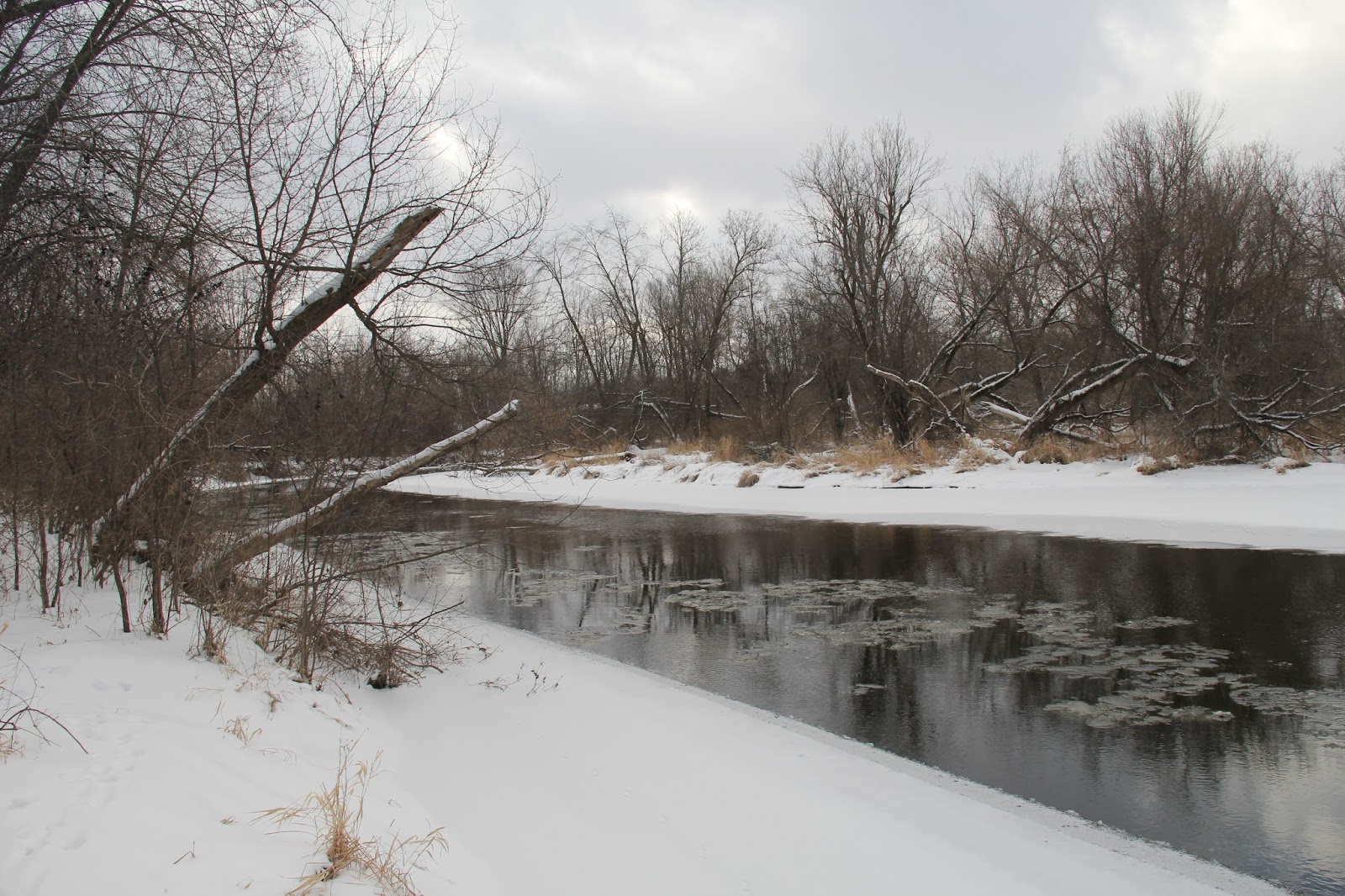
A gentle curve of the Chippewa River

Like other parks in the city, Mill Pond Park has lost large numbers of trees due to an Emerald Ash Borer infestation.  As these trees fall it can be very difficult to travel off trail within the park.


Fungi on a dead tree


A deer trail through the woods


 A clump of reeds along the edge of the marsh

Looking south over the marsh

Dramatic clouds

I was surprised to find several trees that showed evidence of beavers.  There have been beavers in the park many times, but these trees were nearly one hundred yards from the river.  Despite this distance, it was obvious that the beaver had visited this site multiple times


Vole of shrew tracks on the ice


Looking down at the spillway of the Mill Pond dam

Trees and ice on the Chippewa River

Ice formed in patches on one of the weirs that slow the rivers drop

I like how the shape of the trees is repeated by the shape of the clouds

Thursday, May 1, 2014

Scenes from Spring (14 April - 29 April)


One goal that I set for myself this year was to take photographs of as many species of wildflowers as I can in Mt. Pleasant.  I chose to do this because I have a long list of flowers that I have found in town over the past twelve years.  I want to see how many I can find in one growing season.  This means, that as flowers have begun blooming over the past two weeks, I have been spending as much time in the woods as possible.

This does not mean that wildflower pictures are the only photographs that I am taking.  Here a few of my other photos from the past two weeks.

A pile of wood chips and a chewed log - a beaver has been chewing on this downed cottonwood.

A windy, cloudy April day.  This picture was taken on the day that the Chippewa River began flooding.

Can you find the nesting Canada Goose?

A male Red-winged Blackbird sways on a cattail stalk

The first warbler of the year - a Yellow-rumped Warbler

A Mallard hen sits watching me as her mate swims away

Last Autumn's oak leaves

Black squirrels are a color phase of Gray Squirrel


A Black-capped Chickadee foraging for food and nesting sites


This Downy Woodpecker prefers to make its own nest cavity


A carpet of Wild Leek


A Six-spotted Tiger Beetle running along an asphalt trail

Map Turtles sunning themselves along the Chippewa River

A trio of Brown-headed Cowbirds

Vibrant green leaves of Skunk Cabbage are beginning to open

A curl of birch bark


Tuesday, September 24, 2013

What Do I Eat? - Herbivores

The word "herbivore" means plant-eater.  It derives from the Latin words herba (plant or grass) and vorarae (devour).

The teeth of herbivorous mammals have evolved to eat a diet that is mainly composed of plants.  Often herbivores have upper and lower incisors are quite sharp and shaped like chisels.  In some mammals like rodents and rabbits these incisors meet or nearly meet and allow them to bite cleanly through plant stems. 

Muskrat (Ondotra zibethicus) skull showing the large incisors

The incisors of these animals grow throughout their lives and are worn down through constant chewing.  Only the front surface of their incisors is covered with hard enamel - causing the back of their teeth to wear faster and giving their incisors that chisel-shaped profile.

North American Beaver (Castor canadensis) skull showing chisel-shaped profile of incisors

This sharp tooth profile allows them to cut easily through non-woody plants and even woody stems.

Branch showing marks from beaver teeth

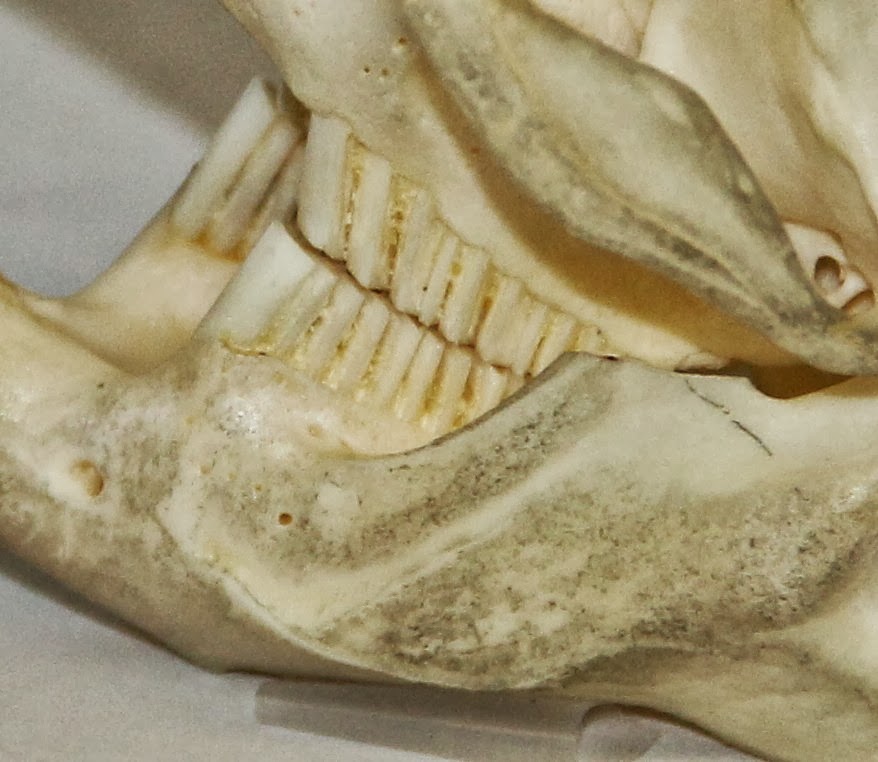
The molars of herbivorous mammals are generally flat with a chewing surface that is covered with several ridges.  These ridges allow the teeth to be used to grind leaves, stems, bark, etc. so that they may be more easily digested.  In some animals (such as rodents) the surface of the molars is quite flat and the ridges are small.

Beaver molars
 
Muskrat molars

Other herbivores such as White-tailed Deer (Odocoileus virginianus) have molars that while generally flat have much larger ridges.


White-tailed Deer (Odocoileus virginianus) molars

There is something interesting about the teeth of White-tailed Deer.  White-tailed Deer (and all other deer) do not have top incisors.  This means that they are unable to bite directly through plants like those species that have opposing incisors.


White-tailed Deer (Odocoileus virginianus) skull - note the lack of upper incisors

Instead their bottom incisors come in contact with a rough pad on their upper jaw, enabling them to tightly grab onto plants which they then tear or twist off.  Branches that are browsed by White-tailed Deer are often cut on one side (by the lower incisors) and roughly torn on the other rather than being neatly cut like plants chewed by rodents.

White-tailed Deer (Odocoileus virginianus) skull - Lower incisors meet up with a rough pad on the upper jaw.

Monday, February 25, 2013

Nature's Lumberjack

The North American Beaver (Castor canadensis) is one of nature's greatest engineers and its greatest lumberjack.  Beavers cut down trees for building materials for dams and lodges and for food.  They do this without the help of tools, using only their teeth.  The incisors on a beaver are perfect cutting tools, kept sharp by constant use.  Their teeth grow throughout their life.  Each incisor is made of two materials that wear at different rates, the front of the tooth is covered with a hard enamel, the back of the tooth is made of softer dentin.  The softer dentin wears away faster than the enamel, creating a wedge-shaped profile on the tooth.


Beaver Skull

Close-up of incisors.  Enamel is orange, dentin is white.  Note the wedge profile.