Showing posts with label rodents. Show all posts

Friday, February 9, 2018

A Winter day at Mill Pond Park (08 February 2018)

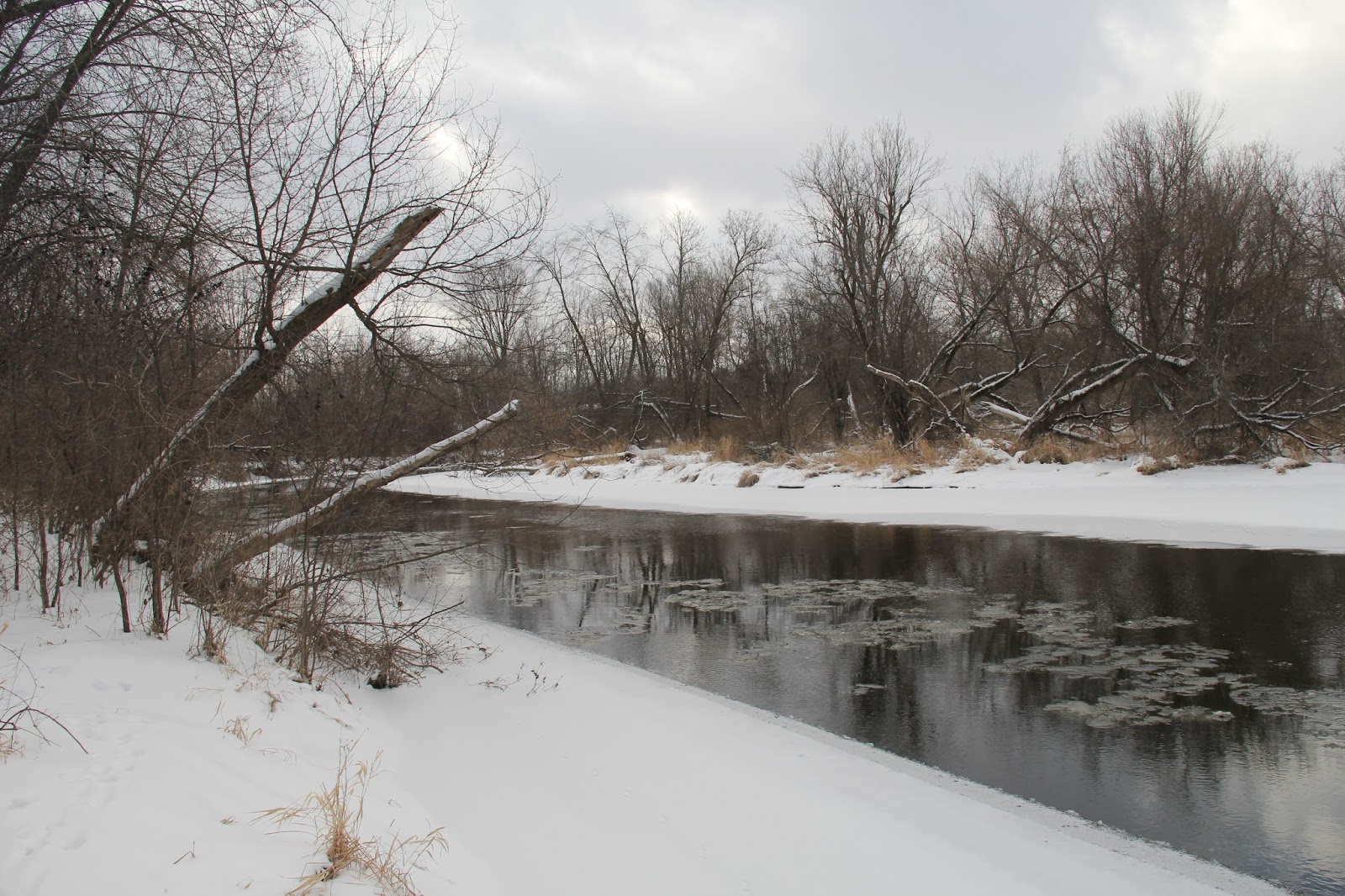
Yesterday, during the middle of the day, I was able to spend a little more than an hour walking through Mill Pond Park.  This 90 acre park is located along the Chippewa River right in the middle of Mt. Pleasant.


Despite its location, this park is home to a diverse collection of wildlife.  Although I saw only a few birds and one squirrel (plus a feral cat), I did find lots of evidence of animals including tracks and evidence of feeding.

Tracks on ice at the river's edge

Ice flows in the Chippewa River

A Fox Squirrel high in a tree at Mill pond Park

A gentle curve of the Chippewa River

Like other parks in the city, Mill Pond Park has lost large numbers of trees due to an Emerald Ash Borer infestation.  As these trees fall it can be very difficult to travel off trail within the park.


Fungi on a dead tree


A deer trail through the woods


 A clump of reeds along the edge of the marsh

Looking south over the marsh

Dramatic clouds

I was surprised to find several trees that showed evidence of beavers.  There have been beavers in the park many times, but these trees were nearly one hundred yards from the river.  Despite this distance, it was obvious that the beaver had visited this site multiple times


Vole of shrew tracks on the ice


Looking down at the spillway of the Mill Pond dam

Trees and ice on the Chippewa River

Ice formed in patches on one of the weirs that slow the rivers drop

I like how the shape of the trees is repeated by the shape of the clouds

Friday, February 2, 2018

It's Woodchuck Weather Prediction Day!

Happy Marmota monax Day!


Or you might know it better as Groundhog Day.  On Groundhog Day, communities across North America drag a sleepy Groundhog (Marmota monax) out of hibernation to see if it casts a shadow.  If the groundhog sees its shadow, this means that six more weeks of winter will follow; if it does not see its shadow, spring will supposedly come early.

No matter what the groundhogs "predict", winter is scheduled to end approximately 6 1/2 weeks from now at 12:15PM EST on March 20th.

Given the lack of forecasting accuracy from groundhogs, perhaps we should give some other ground squirrel species auditions for the job?

I'm ready for my closeup, Mr. DeMille!

Thursday, June 15, 2017

Trail Camera Pictures (29 May - 14 June 2017)

Yesterday I retrieved memory cards from my trail cameras.  Here are pictures from one of the two cameras.

As always, there were dozens of pictures of squirrels on this camera.

Black phase Grey Squirrel

Fox Squirrel


There were also many White-tailed Deer of all ages and sizes.


One morning a Red Fox (Vulpes vulpes) showed up.  Frustratingly, it was too close to the camera so only its ears and the top of its head showed up in the picture!

Red Fox (just the ears are visible at the bottom of the picture)

A pair of fawns showed up on camera several times, both with their mother and on their own.  I assume the mother was just off camera when the fawns appeared on their own.


White-tailed doe and fawns


White-tailed fawns with no doe in sight

In addition to fawns, bucks showed up on a couple of occasions.  At this point their antlers are just developing.  One of the bucks (last year's fawn) had just little buttons, but the second buck (shown below) has antlers that are already beginning to fork.


White-tailed buck licking its hoof


The lighting in some of these photos is pretty incredible, especially in the early morning and evening when it slants in at a fairly low angle, lighting up the more open background and leaving much of the middle-ground and foreground in shade.  This combination of light and shadow adding depth to an image is know as chiaroscuroIn Italian chiaro means "light" and scuro means "dark". 

Portrait of a Fox Squirrel - this image demonstrates the principle of chiaroscuro.


I did have one new species appear on the camera during this time period - a Woodchuck (Marmota monax) showed up on two consecutive days.


A Woodchuck crosses from right to left

A woodchuck perched on a log at the center of the frame


My favorite photos this time are this series of six pictures of one a fawn (one of a pair).  I really like the chiaroscuro effect of these pictures - it adds a feeling of drama as the fawn advances from the dark toward the light.




Monday, June 5, 2017

Oh, Hello!


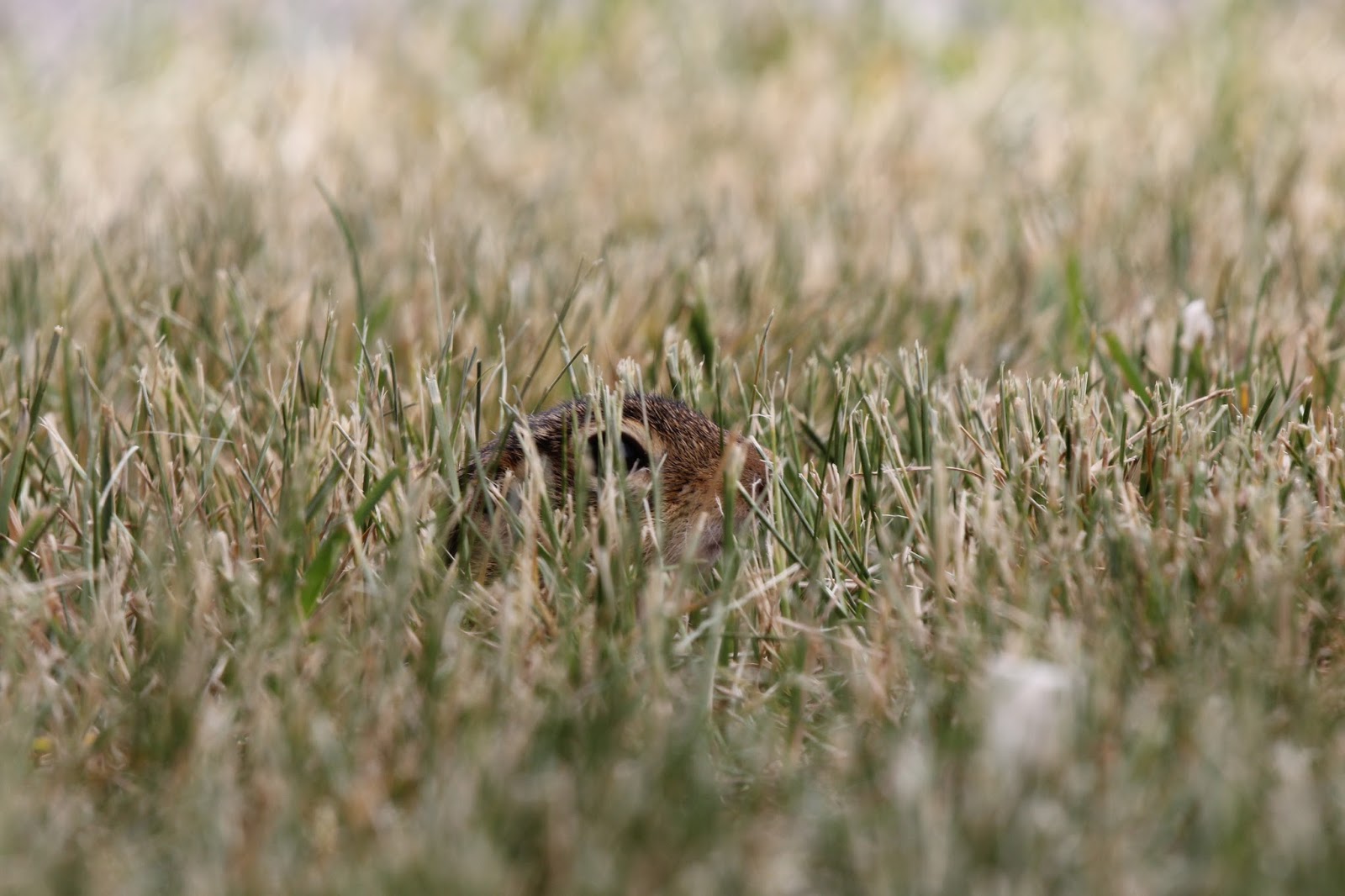
Saturday I stopped at Winn Elementary to check on the native pollinator garden.  While there, I noticed this little fellow running across the lawn.  It's a Thirteen-lined Ground Squirrel (Spermophilus tridecemlineatus). I love Thirteen-line Ground Squirrels.  They are extremely photogenic and curious little creatures.  I grabbed my camera and walked to within about 15 feet of its burrow.  I got down on my belly and waited for it to pop its head back up.  Within seconds of lying down, there it was peering at me over the grass.
 

I took a few pictures and it ducked back down into its burrow.  This was my chance to move closer.  I quickly closed the distance to about 8 feet.  Soon, the top of its head and an eye appeared through the grass.


The head appeared and disappeared a few times before emerging completely.  It watched me for a minute or two before disappearing again.


Why would a ground squirrel keep popping up from its burrow to watch a potential predator? 

It makes sense to keep an eye on a predator rather than disappearing into its burrow.  If it drops into its burrow at the first sight of a predator, the predator may close the distance to the burrow and then wait in ambush for the squirrel to come out - this happens frequently.  By keeping an eye on the predator, the squirrel is able to see if the predator poses an actual threat or if it is merely passing by.  This doesn't always work out, but ground squirrels are prolific breeders having an average of ten young per year. 

Thursday, February 2, 2017

How many more weeks of winter weather could a woodchuck predict, if a woodchuck could predict weeks of winter weather?

Happy Marmota monax Day!


You might know it better as Groundhog Day.  On Groundhog Day, communities across North America drag a sleepy Groundhog (Marmota monax) out of hibernation to see if it casts a shadow.  If the groundhog sees its shadow, this means that six more weeks of winter will follow; if it does not see its shadow, spring will supposedly come early.

I wonder, does it have to be a groundhog or could any hibernating ground squirrel be used to predict spring?  Anyone interested in celebrating Thirteen-lined Ground Squirrel Day?


No matter what happens to the Groundhog, I predict that Spring will begin in 6 1/2 weeks, on March 20th, just like it says on the calendar.

Tuesday, February 2, 2016

Giant Squirrel Prediction Time!

Happy Marmota monax Day!


Or you might know it better as Groundhog Day.  On Groundhog Day, communities across North America drag a sleepy Groundhog (Marmota monax) out of hibernation to see if it casts a shadow.  If the groundhog sees its shadow, this means that six more weeks of winter will follow; if it does not see its shadow, spring will supposedly come early.

No matter what the groundhogs "predict", winter is scheduled to end approximately 6 1/2 weeks from now on March 20th.

Wednesday, January 27, 2016

More Animal Sign

This morning I took a short wander around the field beside the Conservation District office with hope of finding some more animal sign to photograph.  Here is what I found...

When I arrived at the office this morning I noticed a domestic cat at the edge of the parking lot.  With several nearby homes this was not much of a surprise.  


The cats are drawn to the area by the presence of small mammals (voles and rabbits) and birds in the nearby field.  I decided to follow one set of cat tracks to see where they led.  The tracks meandered all over through the field.  At one point I did see where a cat had paused to examine a tunnel going down through the snow.  Freezing rain earlier this month transformed the surface of the snow into a thick layer of ice.  This ice protects the mice and voles that us the space below (called the subnivean zone) quite secure from predators above the snow - for more info on the subnivean zone check out "Next stop, the subnivean zone!" from February 2014


Nearby I noticed a single Black-capped Chickadee preening itself in an Autumn Olive bush.  Chickadees have several winter survival strategies including bulking up with fatty foods, puffing up, and even entering a state of torpor - see "Chickadees in Winter" (January 2013) for more information.


Many of the Autumn Olive shrubs in the field have been severely damaged by rabbits (and to a lesser extent, voles) over the past few winters.  This year is no different.  Because rabbits are almost exclusively vegetarian, their food options are limited during the winter months.  One reliable food source that is available is the tender buds, bark, and small branches of trees and shrubs.  Rabbits snip off the buds and branches and strip the bark with their sharp chisel-like incisors.  If enough bark is removed the tree or shrub can potentially die.  This can be a problem for people that own orchards or have recently planted small trees.  It's not a problem when the rabbits are munching on invasive species like the Autumn Olive.


Did I find anything more exciting?  No, not really.  I did see a vole scurry under the snow near a shrub, but was unable to get a picture.  I keep checking the snow in this field hoping to find a coyote track or even a deer track, but so far I have been disappointed.  That's really okay.  I got to get outside and away from my desk for a few minutes and was able to interact with nature.  It gave me a slight recharge that I needed.