Showing posts with label math. Show all posts

Thursday, March 14, 2019

Pi Day 2019

Happy "Pi Day"!  Not pie the pastry, but pi the number.  

The number pi is symbolized by the Greek letter π . We use pi to figure the circumference and area of circles and the volume of spheres and cylinders. The circumference of any circle is its diameter times pi.  The area of any circle is its radius squared time pi.  So what does that have to do with today?

Today is the 14th of March.  Otherwise expressed as 3/14 or 3.14.   Just like the number pi
But, pi doesn't end at 3.14.  The number is thought to be infinite and non-repeating - no one has found the last digit of pi (currently at over one trillion digits and counting) and there is no sequence of numbers that repeats itself within pi!  Written to 100 decimal points pi is...

3.14159265358979323846264338327950288419716939937510582097494459230

78164062862089986280348253421170679...

In celebration of Pi Day, I bought two pies (the pastry) to share at work.  One blueberry pie
and one apple pie.
We are eating pie for mathematics!  This is not just because pi(e) is delicious!
Look at all that math!
Now for a little Pie (pi) related math.  The diameter (the distance across a circle from one side to the opposite side, passing through the center of the circle) of each of these pies is 8.5 inches.  To calculate the circumference (the distance around the perimeter of a circle) we just need to multiply 8.5 inches by pi (3.14).

                  Circumference  = π x diameter

                  Circumference = 3.14 x 8.5 inches

                  Circumference =  26.69 inches


I eat this pie in the name of mathematics!

To calculate the area of the pie we need to know the radius.  Radius is the distance from the center of a circle to the edge of the circle.  This number is one half of the diameter - so if the diameter of these pies is 8.5 inches, the radius would be 8.5 inches divided by 2, which equals 4.25 inches.  The formula for calculating the area of a circle is Area = pi times the radius squared (the radius times the radius). Expressed as a mathematical formula this is A= πr2.

                 Area = πr2
           
                 Area = π x (radius x radius)

                 Area = 3.14 x (4.25 inches x 4.25 inches)

                 Area = 3.14 x (18.0625 inches2)

                 Area = 56.71625 inches2

That's 56.71625 square inches of delicious per pie!

If I eat 1/6th of the blueberry pie I am eating 9.4527 square inches of pie (56.71625 x 1/6 = 9.4527 inches2)!  

Math can be delicious!

Remember!  This is for the cause of furthering mathematical knowledge!


Tuesday, May 8, 2018

Forestry for Fifth Graders (07 & 08 May 2018)

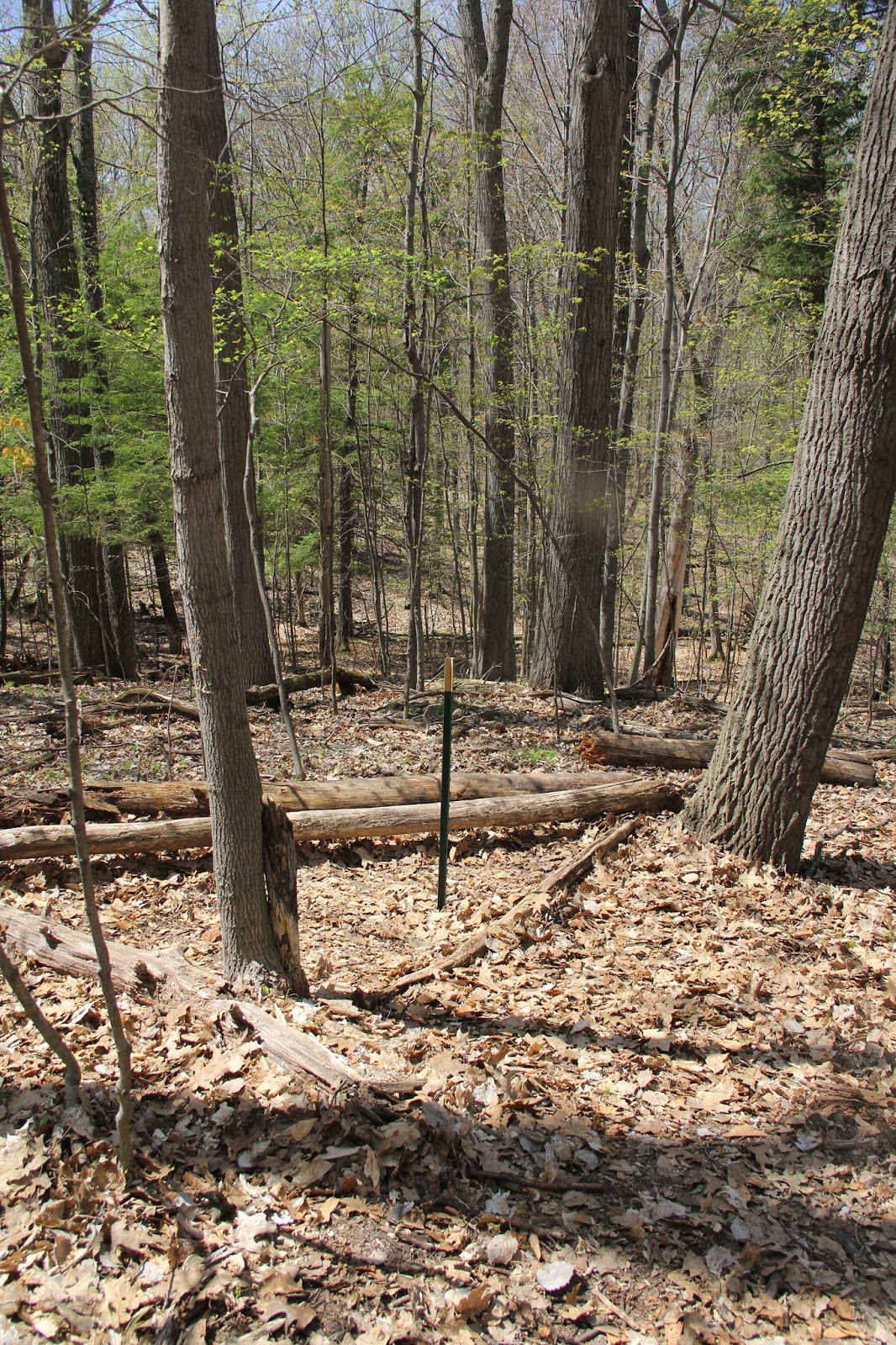
If you have visited the Chippewa Watershed Conservancy's Audubon Woods Preserve in the past week you may have noticed some metal T-posts that weren't there before.

A metal T-post standing alone at Audubon Woods Preserve

Why are these posts at Audubon Woods?  What are they for?

For the past seven years, I have used Audubon Woods as an outdoor science classroom for local elementary students.  The T-posts are meant to be semi-permanent education stations.  In the past, every time I took students to Audubon Woods I would set up temporary stations at somewhat random points in the woods.  There is a lot that can be done by using temporary points, but more can be learned long term if students use the same locations time after time.

With permission, I set about placing posts along a series of transects (lines) throughout the woods.  I set up three transects at regularly spaced intervals in the woods and placed six evenly-spaced posts along each transect.  Now with semi-permanent locations, data that the students collect can be compared over time.

So what kinds of data are the students collecting?

Over the past two day (07 & 08 MAY 2018) I have been working with fifth grade students from Shepherd Elementary.  These classes were able to travel to Audubon Woods because last fall their teachers applied for and received a Wheels To Woods field trip grant

Students are measuring the circumference of trees in their study plot and using that to calculate diameter.

Measuring a tree's circumference

Measuring large trees takes teamwork


Students are also counting trees at their study plot to determine the number of trees in one acre of forest and in the entire forest.  Audubon Woods is 40 acres in size - at 43,560 sq. ft/acre, that means Audubon Woods is 1,742,400 sq. ft!  Counting all of the trees in an area this size would be an impossible task.  Luckily, it is easy to count the number of trees in a much smaller area and then use that number to estimate the total number of trees in the forest.  A circle with a radius of approximately 37 feet will have an area of 1/10 acre.   Remember those T-posts?  Students counted every tree within 37 feet of the post and used multiplied that number by 10 to find the number of trees in one acre and then again by 40 to find the total number of trees in Audubon Woods.

Tape measures are an important forestry tool

Measuring trees to make sure they fit in their plot

Students then calculated the number of leaves on the forest floor by counting the number of leaves in one square foot and then multiplying by 43,560 to get the number of leaves in one acre, and then by 40 to get the total number of leaves on the floor of Audubon Woods.  Imagine if a single square foot holds exactly 100 leaves, this would calculate out to over 172 million leaves in the forest!

Students had a square made from PVC pipe to make their task easier

Counting leaves from a single square foot of forest

Re-calculating...

Students also calculated the weight of all the leaves in the forest, identified and sketched leaves, and drew a sketch of the forest near their study plot.  Perhaps just as important as the science, this field trip allowed students to get out of the classroom for a few hours.  The months of April and May are testing time in Michigan.  Students spend hours taking state-mandated assessments and even more hours taking tests required by their local school district.  A field trip like this exposes them to sights, sounds, and smells that thy can never experience in the classroom.

Large-flowered Trillium

 
Trillium surrounded by Mayapple


Spring Beauty flowers


Bloodroot

Skunk Cabbage

Wood Frogs were everywhere hidden among the leaves

Another Bloodroot flower

The maples and other trees are just starting to leaf out

Wednesday, March 14, 2018

Happy Pi Day 2018!

Happy "Pi Day"!  Not pie the pastry, but pi the number.  

The number pi is symbolized by the Greek letter π . We use pi to figure the circumference and area of circles and the volume of spheres and cylinders. The circumference of any circle is its diameter times pi.  The area of any circle is its radius squared time pi.  So what does that have to do with today?

Today is the 14th of March.  Otherwise expressed as 3/14 or 3.14.   Just like the number pi!  
But, pi doesn't end at 3.14.  The number is thought to be infinite and non-repeating - no one has found the last digit of pi (currently at over one trillion digits and counting) and there is no sequence of numbers that repeats itself within pi!  Written to 100 decimal points pi is...

3.14159265358979323846264338327950288419716939937510582097494459230 78164 
062862089986280348253421170679...

Just for fun I bought two pies to celebrate Pi Day.

It's about the math, not the deliciousness!

Now for a little Pie (pi) related math.  The diameter (the distance across a circle from one side to the opposite side, passing through the center of the circle) of each of these pies is 8.5 inches.  To calculate the circumference (the distance around the perimeter of a circle) we just need to multiply 8.5 inches by pi (3.14).

                  Circumference  = π x diameter

                  Circumference = 3.14 x 8.5 inches

                  Circumference =  26.69 inches

To calculate the area of the pie we need to know the radius.  Radius is the distance from the center of a circle to the edge of the circle.  This number is one half of the diameter - so if the diameter of these pies is 8.5 inches, the radius would be 8.5 inches divided by 2, which equals 4.25 inches.  The formula for calculating the area of a circle is Area = pi times the radius squared (the radius times the radius). Expressed as a mathematical formula this is A= πr2.

                 Area = πr2
           
                 Area = π x (radius x radius)

                 Area = 3.14 x (4.25 inches x 4.25 inches)

                 Area = 3.14 x (18.0625 inches2)

                 Area = 56.71625 inches2

That's 56.71625 square inches of delicious per pie!

Check out all that delicious math!


I hate to admit it , but I can never remember pi past five decimal points.  I only remember that much because of a chant that I learned in college.  From 1993 to 1997 I attended the Illinois Institute of Technology.  One of the school chants was:

Tangent, secant, cosine, sine
3.14159
i, pi, cube root 3
Rock 'em, sock 'em IIT!


Go Scarlet Hawks! 

To learn more about Pi Day and how to celebrate the event please visit Pi Day's official website.

Tuesday, March 14, 2017

Happy Pi Day 2017!

Happy Pi Day!  What is that you ask?


Pi is a number - expressed to the ten-thousandths place it read as 3.1415.  The circumference of any circle is its diameter times pi.  The area of any circle is its radius squared time pi.  So what does that have to do with today?


Today is the 14th of March.  Otherwise expressed as 3/14 or 3.14.   Just like the number pi


Just for fun I bought two pies to celebrate Pi Day.

Celebrating Pi Day with blueberry pie (left) and caramel apple pie (right)
 
Now for a little Pie (pi) related math.  The diameter (the distance across a circle from one side to the opposite side, passing through the center of the circle) of each of these pies is 8.5 inches.  To calculate the circumference (the distance around the perimeter of a circle) we just need to multiply 8.5 inches by pi (3.14).


                  Circumference  = π x diameter

                  Circumference = 3.14 x 8.5 inches

                  Circumference =  26.69 inches

To calculate the area of the pie we need to know the radius.  Radius is the distance from the center of a circle to the edge of the circle.  This number is one half of the diameter - so if the diameter of these pies is 8.5 inches, the radius would be 8.5 inches divided by 2, which equals 4.25 inches.  The formula for calculating the area of a circle is Area = pi times the radius squared (the radius times the radius). Expressed as a mathematical formula this is A= πr2.

                 Area = πr2
           
                 Area = π x (radius x radius)

                 Area = 3.14 x (4.25 inches x 4.25 inches)

                 Area = 3.14 x (18.0625 inches2)

                 Area = 56.71625 inches2

That's 56.71625 square inches of delicious per pie!

Math makes pie more delicious!
To learn more about Pi Day and how to celebrate the event please visit the official website of Pi Day.

Friday, March 14, 2014

Happy Pi Day!

Happy "Pi Day"!  Not pie the pastry, but pi the number.  

π.

We use pi to figure the circumference and area of circles and the volume of spheres and cylinders.

Written to two decimal points it equals 3.14, like 3/14 or March 14th.

Written to 100 decimal points...

3.14159265358979323846264338327950288419716939937510582097494459230 78164 
062862089986280348253421170679...

I never learned pi past five decimal points.  I only remember it because of a chant that I learned in college.  From 1993 to 1997 I attended the Illinois Institute of Technology.  One of the school chants was:


"Tangent, secant, cosine, sine
3.14159
i, pi, cube root 3
Rock 'em, sock 'em IIT!"


Go Scarlet Hawks!