Showing posts with label outdoor science. Show all posts

Tuesday, May 8, 2018

Forestry for Fifth Graders (07 & 08 May 2018)

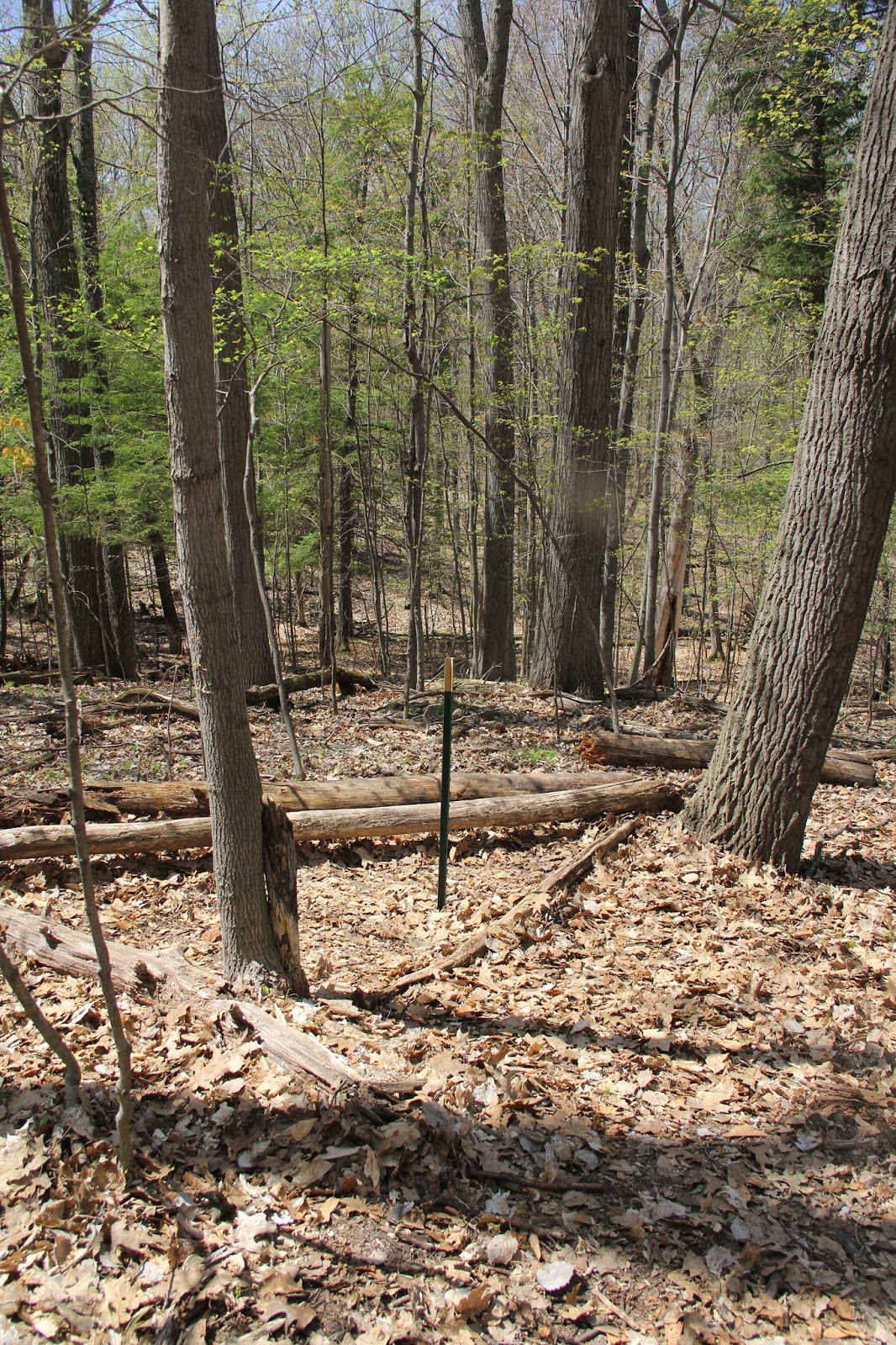
If you have visited the Chippewa Watershed Conservancy's Audubon Woods Preserve in the past week you may have noticed some metal T-posts that weren't there before.

A metal T-post standing alone at Audubon Woods Preserve

Why are these posts at Audubon Woods?  What are they for?

For the past seven years, I have used Audubon Woods as an outdoor science classroom for local elementary students.  The T-posts are meant to be semi-permanent education stations.  In the past, every time I took students to Audubon Woods I would set up temporary stations at somewhat random points in the woods.  There is a lot that can be done by using temporary points, but more can be learned long term if students use the same locations time after time.

With permission, I set about placing posts along a series of transects (lines) throughout the woods.  I set up three transects at regularly spaced intervals in the woods and placed six evenly-spaced posts along each transect.  Now with semi-permanent locations, data that the students collect can be compared over time.

So what kinds of data are the students collecting?

Over the past two day (07 & 08 MAY 2018) I have been working with fifth grade students from Shepherd Elementary.  These classes were able to travel to Audubon Woods because last fall their teachers applied for and received a Wheels To Woods field trip grant

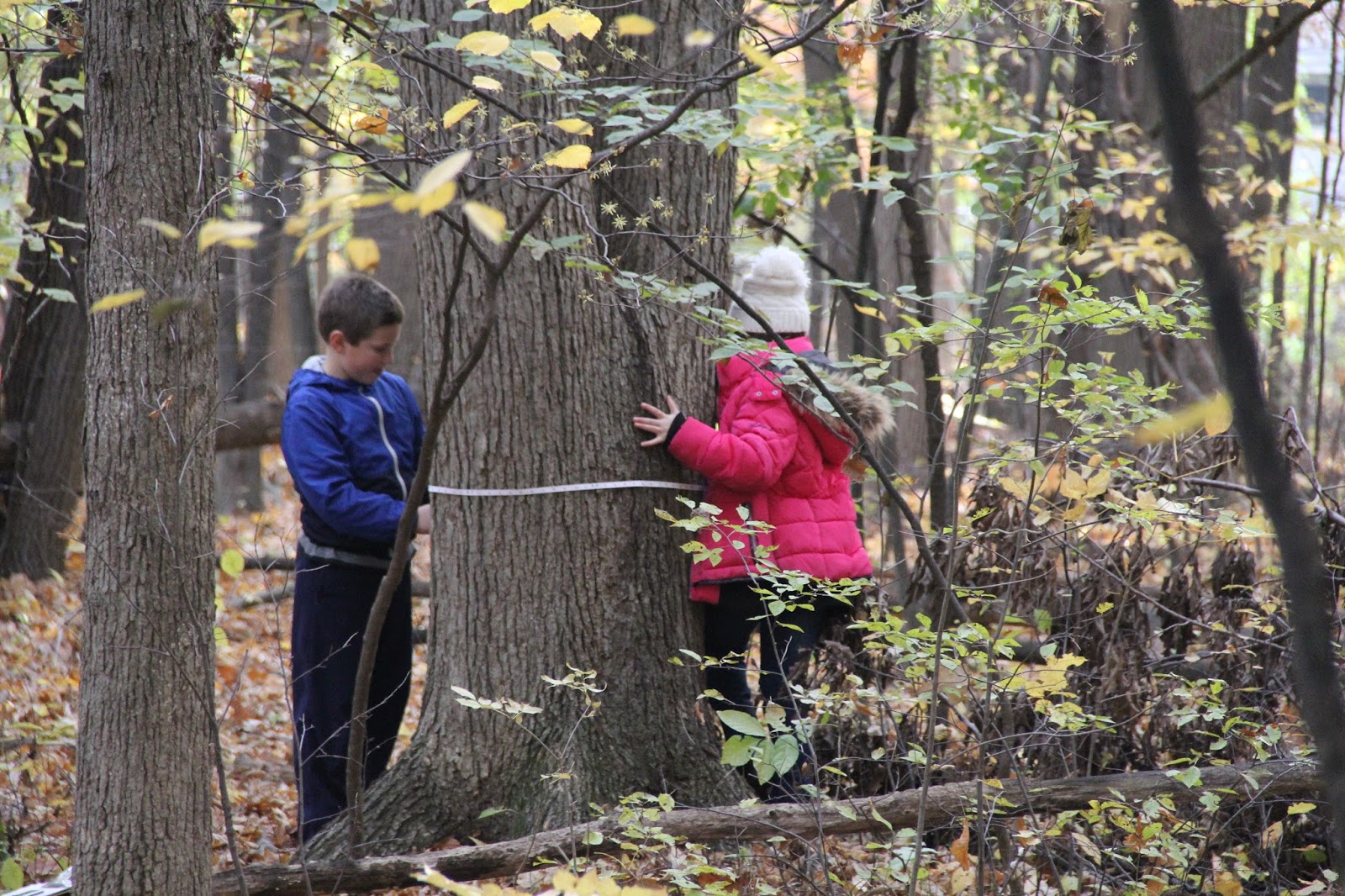
Students are measuring the circumference of trees in their study plot and using that to calculate diameter.

Measuring a tree's circumference

Measuring large trees takes teamwork


Students are also counting trees at their study plot to determine the number of trees in one acre of forest and in the entire forest.  Audubon Woods is 40 acres in size - at 43,560 sq. ft/acre, that means Audubon Woods is 1,742,400 sq. ft!  Counting all of the trees in an area this size would be an impossible task.  Luckily, it is easy to count the number of trees in a much smaller area and then use that number to estimate the total number of trees in the forest.  A circle with a radius of approximately 37 feet will have an area of 1/10 acre.   Remember those T-posts?  Students counted every tree within 37 feet of the post and used multiplied that number by 10 to find the number of trees in one acre and then again by 40 to find the total number of trees in Audubon Woods.

Tape measures are an important forestry tool

Measuring trees to make sure they fit in their plot

Students then calculated the number of leaves on the forest floor by counting the number of leaves in one square foot and then multiplying by 43,560 to get the number of leaves in one acre, and then by 40 to get the total number of leaves on the floor of Audubon Woods.  Imagine if a single square foot holds exactly 100 leaves, this would calculate out to over 172 million leaves in the forest!

Students had a square made from PVC pipe to make their task easier

Counting leaves from a single square foot of forest

Re-calculating...

Students also calculated the weight of all the leaves in the forest, identified and sketched leaves, and drew a sketch of the forest near their study plot.  Perhaps just as important as the science, this field trip allowed students to get out of the classroom for a few hours.  The months of April and May are testing time in Michigan.  Students spend hours taking state-mandated assessments and even more hours taking tests required by their local school district.  A field trip like this exposes them to sights, sounds, and smells that thy can never experience in the classroom.

Large-flowered Trillium

 
Trillium surrounded by Mayapple


Spring Beauty flowers


Bloodroot

Skunk Cabbage

Wood Frogs were everywhere hidden among the leaves

Another Bloodroot flower

The maples and other trees are just starting to leaf out

Monday, May 15, 2017

Aquatic Ecology with Shepherd Elementary students

Last week I spent two days at the Little Salt River with students from Shepherd Elementary students. 

Why were we at the river? 

The students were collecting and identifying aquatic macroinvertebrates. 

Shepherd 5th graders use a dip net to sample aquatic macroinvertebrates from the Little Salt River


What exactly is an aquatic macroinvertebrate? 

Let's break that into parts.  Aquatic means that a plant or animal lives in or around water.  It comes from the Latin word aqua which means "water".  The word invertebrate comes from the Latin root word vertebra which means "joint" - normally refering to the joints of the spine.  Invertebrate means that an animal lacks a spine.  The prefix macro- means large or large scale.  It comes from the Greek word makros meaning "large or long".  Therefore, a macroinvertebrate is a large animal that lacks a spine - large in the sense that it is big enough to see without magnification.  Add it all together and an aquatic macroinvertebrate is an animal that lives in water, lacks a spine, and is large enough to see with the naked eye.

This crayfish is an aquatic macroinvertebrate.

So is this gilled snail.


Why were students trying to collect aquatic macroinvertebrates?

Many aquatic macroinvertebrate species have varying tolerances for water pollution.  The absence of certain species may indicate low water quality.  The presence of a wide range of species usually indicates higher water quality.

Students complete a biological monitoring sheet to determine water quality

Overall the students found a wide variety of aquatic macroinvertebrates including mayfly larvae, caddisfly larvae, gilled and pouch snails, damselfly larvae, dragonfly larvae, scuds or amphipods, crayfish, freshwater clams and mussels, leaches, and midge larvae.  Vertebrate lifeforms collected included fish and tadpoles.  The wide variety (and number) of animals collected indicated that at this site, the Little Salt River has excellent water quality.

Here are a few more photos of the students sampling...
Tuesday, November 1, 2016

STEAMing outdoors...

It's the first of November and the weather is still warm enough and dry enough that I am able get students outdoors for activities.  Granted, I think that it is (almost) never too cold to take students outside if they are dressed properly, but wet weather makes it difficult to do outdoor projects - especially when papers must be completed.

Yesterday, I met two 4th Grade classrooms at Vowles Elementary to do a forest ecology activity.  Vowles is fortunate to have its own small woodlot right next to the school.  Unfortunately, it doesn't get utilized - for most students, this was the first time they had ever entered it.

Officially this is the McNeel Weber Woods

The woods is surrounded by chain link fence with a single entrance.

The trail into the Vowles woodlot

A big push in academics right now is STEAM education - formerly known as STEM (Science, Technology, Engineering, and Math), but with the addition of Art.  Many conferences and workshops focus on how teachers can incorporate STEM/STEAM in the classroom.  The activity that I had students engaged in incorporated several different aspects of STEAM. 

Science - Students identified and described the leaves of various species of trees.
Technology - Students used calculators to perform difficult (for 4th Grade) math problems.
Engineering - Ok, nothing about this activity was engineering.
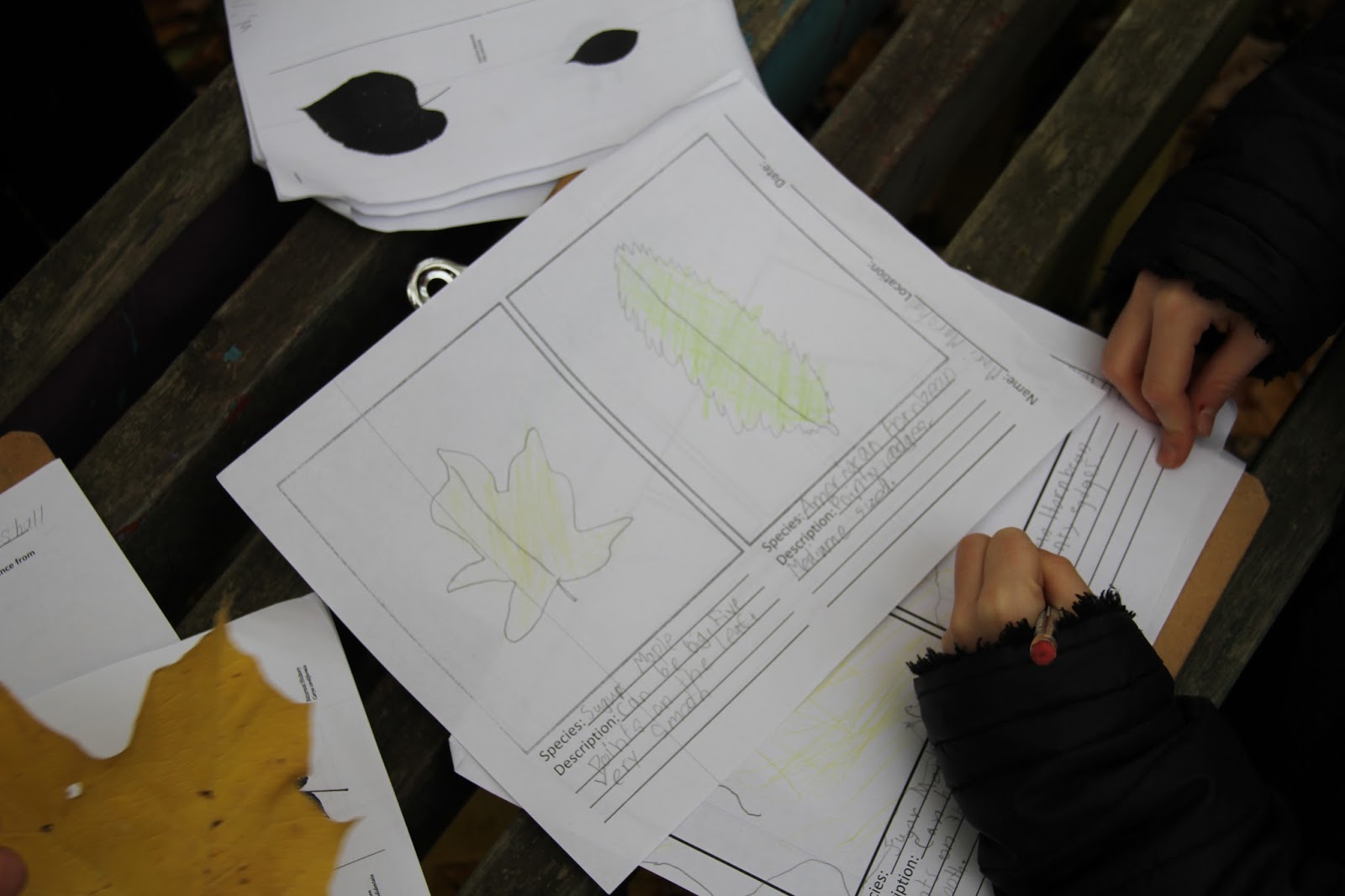
Art - Students not only had to identify and describe leaves, they also had to make detailed drawings.
Math - Students measured the circumference of trees and used that data to calculate diameter

Measuring circumference of a tree

Calculating...
Working out the math...


Calculating diameter
 
The Art and Science of leaf identification

Two groups of students draw and identify leaves