Showing posts with label preserves. Show all posts

Friday, June 21, 2019

Vernal: A Spring Photo Project (Day 61 through Day 70)

To this point I've shared two months worth of spring photographs.  As of today (June 21st) spring has reached its end, but I have a months worth of photographs still to share.  Here are the photos from day 61 through day 70.  To see the previous set of images follow this link.

Day 61 (19 May 2019) - Plum flowers


We have a plum tree right outside our back door.  It rarely produces much fruit, but every spring it is absolutely covered with blossoms.  I photographed these flowers after a light rain covered everything with water and softened the light.

Day 62 (20 May 2019) - Audubon Woods Creek


Another rainy day.  This image was taken in a light drizzle at the Chippewa Watershed Conservancy's Audubon Woods Preserve.  The CWC owns 23 separate properties, but Audubon Woods is my favorite because of the mature trees.  The center of the preserve can often feel ten degrees cooler than the edge.  The water trickling over these rocks helps add moisture to the air cooling it even further.  Even the color of the woods feels cool as the mist in the air diffuses the light making everything glow green as the sunlight penetrates the forest canopy.

Day 63 (21 May 2019) - Dandelions 


Spring wouldn't be spring without dandelions.  Homeowners may not love them, but the bees and other pollinators do.  Some people are taking notice - the Ziibiwing Center of Anishinabe Culture has adopted the policy of not mowing until the dandelions have gone to seed.  I photographed this dandelion bloom in the lawn at the Isabella Conservation District office.

Day 64 (22 May 2019) - Forest Ecology Studies 


Most of the programs that I do are in the classroom out of necessity, but every year I take students from Winn Elementary out to Audubon Woods to explore forestry and forest ecology.  In this photograph the students are measuring the distance from a stake (representing the center a 0.1 acre plot) to a tree in their study plot.  If the tree is within 37 feet of the stake (the radius of a 0.1 acre plot), they will then get an azimuth to the tree, measure the diameter of the tree, and record all of this date on a map of their plot.  I keep copies of all this date in the hope that it can be used to record changes in the forest over time.

Day 65 (23 May 2019) - Look up...


May 23rd was another day of forest ecology studies at Audubon Woods.  I think actually took more photographs of students on this day than I did on the 22nd, but my favorite photo of the day was taken when the students had gone back to school for lunch.  Looking up, I spotted this combination of blue sky, white clouds, dark branches, and yellow-green leaves.  With the sun lighting up the edge of a cloud formation I couldn't resist this photograph.

Day 66 (24 May 2019) - Honey Locust Thorn 


This photograph was taken right outside my back door.  We have a large honey locust (Gleditsia triacanthos) growing only a few feet from the house.  This tree provides lots of shade in the summer and a home for many species of birds and insects (not to mention squirrels).  The most interesting thing about the tree is the large thorns that grow from a few branches.  The honey locust originally developed these thorns as defense against ice age mammals - now they are just a reminder of a time when elephants walked the tundra and forests of North America.

Day 67 (25 May 2019) - Fern Frond 


Another photograph from home.  This fern covered with a layer of fine spider webs was photographed in the garden on the side of the house.  This image has been cropped to a square from its original format.

Day 68 (26 May 2019) - Home, Sweet Home


On May 26th we drove about forty-five minutes from home to visit my parents near Laingsburg, MI.  At one point I took a few minutes to walk around their property looking for something to photograph.  As I walked past this nesting box in a wooded area, a wren popped its head out of the box.  It's not grand architecture, but it's good enough for a wren.  If you look close you can see the wren's toes gripping the entrance hole.  The bird looked at me for a few seconds and then flew off into the underbrush.

Day 69 (27 May 2019) - Iris


When we moved into our house eight years ago there was already a patch of irises planted on the south side of the house.  I think these are Siberian iris, but am not certain.  I love the nectar guides on each large landing pad of a petal directing pollinators toward the nectar (and pollen).  The large serrated leaves in the background belong to cut-leaved coneflower (Rudbeckia laciniata).

Day 70 (28 May 2019) - Wild Columbine 


My final image from this set of photos was taken at the Chippewa Watershed Conservancy's Williams-Blackburn Preserve.  Wild Columbine (Aquilegia Canadensis) is one of my favorite late-spring wildflowers.  It's very photogenic when the flowers are fully mature (like this one), but I often miss out on finding them so it's always exciting to find a perfect bloom.  One really interesting thing to me about these flowers is how hairy they are.  Look close and you can see that the petals, stem, and leaves are all covered with minute hairs.  I like being able to peer in and see that level of detail.

Monday, February 25, 2019

Random photos with the same name

Here is a seemingly random collection of thirteen photos from the past five years.  The only thing these pictures have in common is their name IMG_0225.  Why?  Because its February 25th or if you prefer 02/25.  To see a similar random collection of photos here is a post celebrating IMG_0115 from January 15th of 2018.

The best thing about these photos is that they were all taken in locations open to the public - public gardens, nature preserves, local parks, state parks, national lakeshores, national monuments, and national parks.

Dow Gardens, Midland, Michigan (August 2018)

North Higgins Lake State Park, Michigan (July 2018)

Bundy Hill Preserve, near Remus, Michigan (June 2018)

Chipp-A-Waters Park, Mt. Pleasant, MI (November 2017)

Teddy Roosevelt National Park, North Dakota (July 2017)

Devil's Tower National Monument, Wyoming (July 2017)

Hall's Lake Natural Area, near Remus, Michigan (October 2016)

Tahquamenon Falls State Park, Michigan (October 2015)

Lake Michigan seen from Lake Bluff Bird Sanctuary, Manistee, Michigan (September 2015)

Peterson Natural Area, Stanwood, Michigan (August 2015)

The Garden Door, Sturgeon Bay, Wisconsin (July 2015)

Sleeping Bear Dunes National Lakeshore, Michigan (September 2014)

Ludington, Michigan (August 2018)


Tuesday, January 1, 2019

New Year's Day 2019

Happy 2019!

As I have for the past two years (2017 and 2018), I greeted the new year by leading a hike at the Chippewa Watershed Conservancy's Bundy Hill Preserve.  This year I actually led two hikes, a "sunrise" hike at 7:30AM and a more leisurely hike at 10:00AM for the late-risers.


Despite an overnight storm that made roads treacherous (and contributed to many accidents overnight) I was joined by a crew of six hardy souls with the goal of being the first people to top Bundy Hill in 2019.


The trees at Bundy Hill were covered in a layer of ice and snow that created a beautiful backdrop for out hike.  Unfortunately, cloudy skies meant that we did not get to see the sunrise.  My record for new Year's Day sunrise hikes is now one-for-three (0.333 is a great batting average in baseball, but not so great for sunrise hikes).

No sunrise to see, but we made it to the summit!

After the first group of hikers departed, I had about an hour to kill before the second hike was scheduled to begin.  I had planned ahead - I brought a book to read and boiled a kettle of water for tea on the tailgate of my truck.


I was joined by eleven people for the second hike (including a family of 5). For the first hike, we had taken the most direct route (the McNeel Trail) up the hill so we could be on top before sunrise; for the second hike we took the more leisurely path (the Summit Trail) around the west side of the preserve.  Both trails climb approximately 170 feet from the parking area to the summit, but the second trail is a more gradual climb.  This is important when the climbers include young children and a dad carrying one of the kids most of the way up the hill!


The view from the top was worth the climb.  Bundy Hill has two summits; the main (east) summit has no view as it is surrounded by trees, but the west summit offers views facing south.  The sky was still clear as we approached the west summit, but there was enough light to make the view of snow-covered trees dazzling against a steel grey sky.  As with so many things in life, picture do not do it justice.

Love the brooding skies...

We snapped a couple of group photos in this location (with the gorgeous trees in the background) and then proceeded to the real summit for another group picture to prove that we made it to the top.

Near the false summit

On the summit
After reaching the summit, we took the McNeel trail back to our parked vehicles.  This trail is a little steeper and we had a couple of slip-and-fall incidents.  Fortunately the only thing injured was pride. Everyone seemed to enjoy the hike and it was a great way to kick off 2019!


Mark you calendar for Wednesday January 1st 2020 to join my for my 4th Annual New Year's Day hike - I'll be there for sunrise!  Until then, get outdoors and, if your schedule allows, join me for more hikes with the Chippewa Watershed Conservancy.  Keep an eye on the CWC website or facebook page for upcoming events.

Sunday, August 5, 2018

The Days of Summer - Day Thirty-eight through Day Forty-four

This is part six of my current photography project - The Days of Summer.

In the past, I have had times where I have gone days or even weeks without taking photographs.  This summer I set out to change that tendency.  I gave myself the task of recording images every single day between the Summer Solstice and the Fall Equinox.  Not only do I need to photograph something every day, but I am also sharing a single photo from each day on this blog.

To see the previous installment (part four) check out this link.

Day 38 (28 July 2018) - Lights! Camera! Moths...


The week of 21 - 29 July was National Moth Week.  In celebration, I hosted two mothing events on the nights of 27 July (for the Chippewa Watershed Conservancy) and 28 July (for the Chippewa Valley Audubon Club).  This image is from the latter event at Mission Creek Woodland Park in Mt. Pleasant.  This image was taken shortly after the sun went down as the moths had barely started to come in.  Lots of moths were drawn to the lights, but this image was my favorite of the night.

Day 39 (29 July 2018) - Woodpecker Feather


This picture of a woodpecker flight feather was taken during a hike to the top of Bundy Hill.  This feather belongs to either a Downy Woodpecker or a Hairy Woodpecker.  Although these two species look very much alike, they are not closely related.  The current theory is that the Downy evolved to look more like the Hairy so it wouldn't be harassed by the larger bird.

My general philosophy in regards to photo editing is that "Less is More."  This picture is probably the most heavily edited image I have ever posted on this blog.  It has been rotated 180 degrees from the original - I liked the quill better in the lower left of the image than in the upper right.  The image has also been cropped to better focus on the feather.  Even though I prefer to "crop with my feet" (move closer to the subject), I am usually okay with cropping an image down to better focus on the main subject.   I have also adjusted the brightness of this image.  The picture was taken in direct sunlight and the colors were rather washed out in the original.

Day 40 (30 July 2018) - Oh, Hello!


This picture of a Goldenrod Soldier Beetle (Chauliognathus pensylvanicus) on a Queen Anne's Lace (Daucus carota) was photographed at Forest Hill Nature Area.  The beetle was feeding on pollen and nectar on the small individual flowers.  To highlight the beetle against the sky, I lay on my back in the middle of a trail, leaned against my camera bag for support and, and aimed the camera upward.  I probably shot two dozen images of this beetle as it crawled around the flower, but the pose in this picture made it my favorite.  This image has been cropped slightly to reduce the amount of open space at the top and left of the picture.

 Day 41 (31 July 2018) - Carolina Locust


Unlike the previous two pictures.  This image has not been edited at all.  I photographed this Carolina Locust (Dissosteira carolina) at Chipp-A-Waters Park in Mt. Pleasant.  To get this picture I lay on a slab of limestone along the edge of the Chippewa River and focused tightly on the grasshopper.  I was at the minimum focus distance for the lens on my camera.  By working so close, I lost a little bit of detail on the legs, but check out the veining on the wings and the pattern on the head, thorax, and abdomen!

Day 42 (01 August 2018) - Halloween Pennant


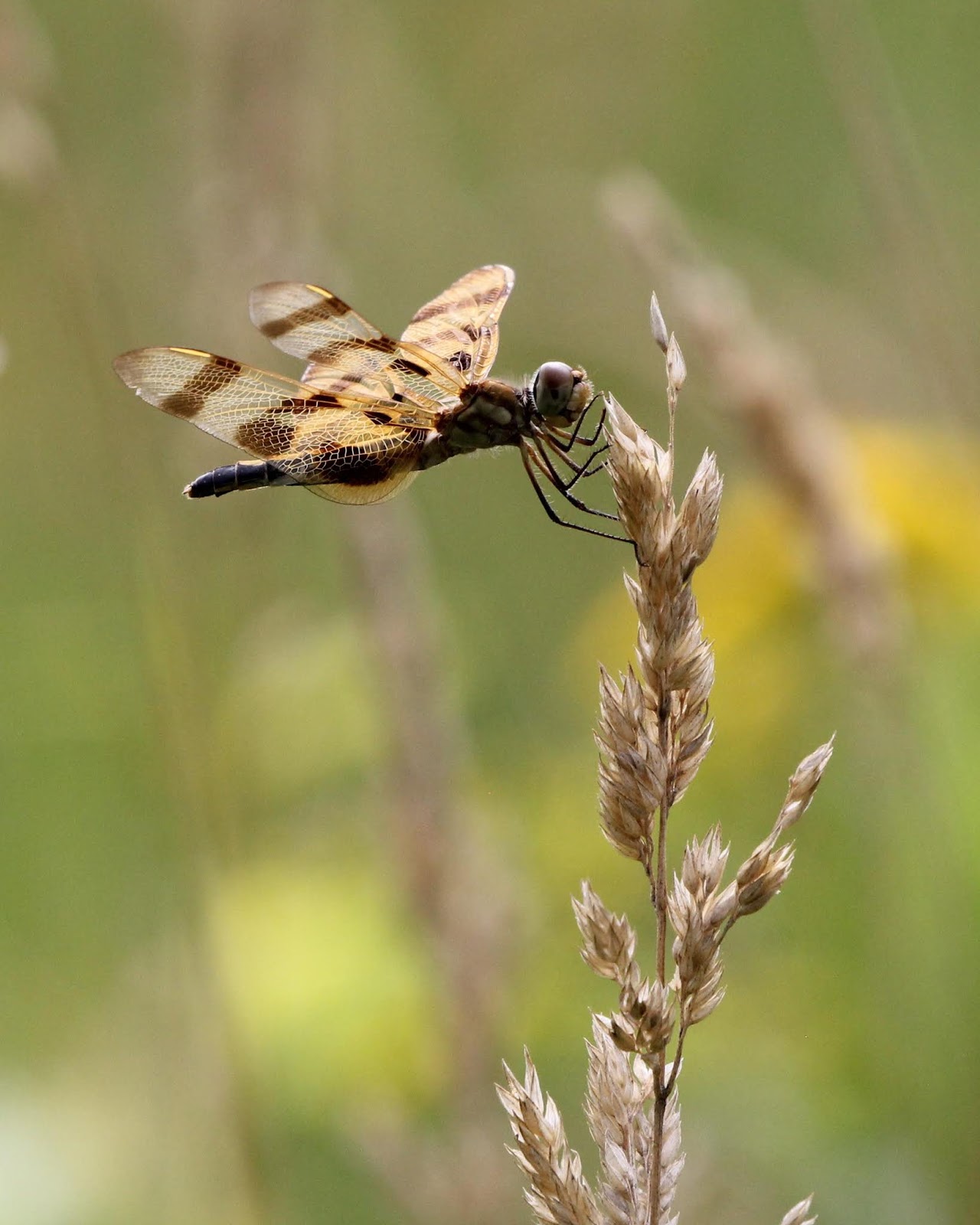
This image was also photographed at Chipp-A-Waters Park.  After photographing the Carolina Locust on the 31st, I noticed a Halloween Pennant (Celithemis eponina) hunting in a grassy area along the riverbank.  Despite repeated attempts, I was never able to get a picture that I made me happy.  I went back the next morning to try again.  I actually arrived too early and had to wait for insects to begin flying.  Eventually this Pennant showed up and I was able to get several photos.  I cropped this from a horizontal to a vertical image.  I liked the original, but I liked the vertical crop just a little bit more.

Day 43 (02 August 2018)


This picture was taken at North Higgins Lake State Park.  I spent the day doing a pair of activities for a summer camp being held by the Saginaw Chippewa Indian Tribe.  Due to stormy weather, we adjusted the schedule a little bit.  This left me with some time before my morning activity.  Although this is not the greatest image, I like the repetition of the spherical water droplets throughout the picture.

Day 44 (03 August 2018)


My final photo for the week was taken at Mission Creek Woodland Park.  Although sometimes I have a plan I go out to take photos (like with the Halloween Pennant pictured above), at other times it pays to just wander and see what happens.  I found these Crown Coral (Clavicorona pyxidata or Artomyces pyxidatus) growing on a rotten log in the middle of the woods.  If I hadn't wandered away from the trail I never would have discovered them.  Coral fungi are some of the coolest looking fungi that grow in Mid-Michigan, but I sometimes find them a challenge to photograph because they are such a start contrast to the dark wood.  I decided to crop this picture as a square eliminating another clump of fungus to the left of the picture.

Thursday, June 21, 2018

Summer Solstice 2018

The sun rises through the trees about twenty minutes past official sunrise.

If you were to arise at dawn every day of the year and record the point on the horizon where the sun rises you would be able to track the progression from the Summer Solstice (in which the sun rises furthest North) to the Winter Solstice (in which the sun rises furthest South) and back again.  Tracking the position of the rising sun was one of the earliest astronomical observations.  Many ancient monuments were constructed to act as solar observatories, recording the longest and shortest days of the year.  These observations were used to plan planting dates for various agricultural crops.
Today the sun reached its northernmost point on the horizon.  Officially, at 6:07 AM EST Spring ended and Summer began in the Northern Hemisphere.  This moment of change is known as the Summer Solstice.  At the same time, the Southern Hemisphere was experiencing its Winter Solstice as their Fall ended and Winter began. The word solstice comes from the Latin words sol (sun) and sistere (to stand still).  On the days surrounding the solstice, the sun appears to "stand still" for several days as it progresses neither north nor south along the horizon. 

Dawn atop Bundy Hill


Today on the Summer Solstice, with the sun at its highest position in the northern sky, we celebrate our longest day of the year.  With the sunrise at 5:58 AM and sunset at 9:24 PM, mid-Michigan will experience approximately 15 hours 26 minutes of daylight today.  By comparison, Christchurch, New Zealand (which is approximately the same latitude south of the equator as Mid-Michigan is north of the equator), will have only 8 hours 56 minutes of sunlight today.


Why does the length of daylight vary at different locations on the globe? 

It has to do with three factors:  rotation, revolution, and a tilt of 23.5 degrees.  The Earth rotates around its axis approximately once every 24 hours.  However this axis is tilted at 23.5 degrees from the vertical.  The points on the globe that the axis rotates around are referred to as the North and South Poles.  The axis is always pointed toward the same location in the sky.  The North Pole points toward the "North Star" - Polaris.

At any given time, fifty percent of the earth is in sunlight (Day) and the other fifty percent is in darkness (Night).  However, as previously mentioned, the Earth is tilted on its axis.  Because of this tilt, sunlight does not always strike the Earth at the same angle.  This means that during different seasons different parts of the Earth will receive varying amounts of sunlight and darkness.
As the earth revolves around the sun, sometimes the North Pole is closer to the sun, sometimes the South Pole is closer to the sun. 

A golden glow...

When the North Pole is at its closest, the sun lights a larger portion of the Northern Hemisphere than it does the Southern Hemisphere.  When this happens, we experience Summer in Mid-Michigan and the Southern Hemisphere experiences Winter.  During our Northern Summer, not only does the sun light more of the Northern Hemisphere, but the sun also lights every Northern Hemisphere location for a higher percentage of the day than a comparable Southern Hemisphere location. 


When the North Pole is at its furthest from the sun, we experience Winter and the Southern Hemisphere experiences Summer.  During our Northern Winter, the sun is striking a larger portion of the Southern Hemisphere than it is the Northern Hemisphere, and consequently the sun lights every Southern Hemisphere location for a higher percentage of the day than a comparable Northern Hemisphere location.  On two days of the year, the Spring and Fall Equinoxes, the sun lights the Northern and Southern Hemispheres equally and the length of day for will be the same for both. 

Waiting for the sunrise atop Bundy Hill

So how did I celebrate the Summer Solstice?  In the oldest way possible, by greeting the rising sun!  I led a sunrise hike to the top of the tallest hill around.  At 1276 feet above sea level, Bundy Hill is the tallest point in Isabella County.  It is has been protected as a nature preserve by the Chippewa Watershed Conservancy since 2016.  Unfortunately, the surrounding forest made it impossible to see the actual sunrise from atop Bundy Hill, but the trip to the top is always worth it.  When the sun finally did get above the trees I was able to capture the photos seen above.

Tuesday, May 29, 2018

Forestry with Winn Elementary (23 & 24 May 2018)

Last week I spent two days (Wednesday 23 May & Thursday 24 May 2018) working with students from Winn Elementary at Audubon Woods Preserve.  On Wednesday the Third and Forth Grade classrooms each spent half a day at the preserve.  On Thursday the Fifth Grade class spent the entire day (minus a break for lunch back at the school) in the woods.

The students were doing a variety of activities related to forestry and forest ecology.  Activities included measurement of tree diameter, using a compass and measuring tape to map trees in 1/10th acre plots, estimating the number of leaves on the forest floor, estimating the weight of all the leaves, measuring canopy cover, identifying and sketching leaves; and sketching the layers in the forest.

This might seem like a lot of work, but this is not the first time these students have visited Audubon Woods.  Third Grade students visited once last fall, and the other two grades have visited at least once a year since they were in Third Grade.  By now the Fifth Graders are quite familiar with the preserve and the activities they are being asked to accomplish.  The lower grades have less time available on site and less experience so they correspondingly do less work.

Here are a few images of the students hard at work as well as some nature photos from the two days.

Wednesday 23 May 2018


The compass is an important forestry tool

Mapping the location and size of trees