Showing posts with label raptors. Show all posts

Wednesday, April 25, 2018

Nature Happens - On A Cell Tower

I have stated repeatedly on this site that I am not a birder, but sometimes birds seem to come to me in bunches.  Whether it's Snowy Owls along the road or Peregrine Falcons on a water tower, I seem to spend a lot of time devoted to looking at, photographing, or writing about birds.  This week it's a pair of Osprey (Pandion haliaetus) nesting on a cellular communications tower at the City of Mt. Pleasant Waste Water Treatment Plant.  I was tipped off to this nest by an email from Tammy Bow at the City's Department of Public Works - Tammy and I have corresponded in the past about recycling and she casually mentioned that she liked one of my photos of a Red-tailed Hawk.  (It pays to be nice to people, they will tell you about cool things.)  Her email didn't state that the nest belonged to an Osprey, but I had my suspicions - Osprey are well known for nesting on man-made structures including cell towers.

So with a little time to kill I set out to see an Osprey yesterday morning (24 April 2018).  The Wastewater Treatment plant is located on N. Washington north of Pickard Rd.  As I approached the plant from the east I could easily see one Osprey atop the tower from several hundred yards away.  I did stop on one side street to look at the bird through binoculars.

Eventually I made my way to Washington St. and parked a short distance away from the tower - far enough away to be able to get photographs from a good angle.  It is illegal to disturb nesting birds (as per the Migratory Bird Treaty Act of 1918);  I doubt my presence had any impact on this pair.  The nest is located right next to the Waste Water Treatment plant, with people going in and out, and right next to a road with lots of traffic from the City's Street Department.  When I got out of my truck and looked up this is what I saw...


We claim this tower under the Migratory Bird Treaty Act!

Not just one Osprey, but both birds of the pair were perched atop the tower preening their feathers.  Their nest is clearly visible beneath them, supported by the system of braces that hold up the various cellular communications antennas.

And we're preening...

I hung around for a few minutes taking photos, but the drab sky and flat light discouraged me from hanging around too long.  I planned to go back when the sky was blue and the sun was shining.

So back I went this morning (25 April 2018).  Unlike yesterday, only one adult Osprey was visible.  The other bird may have been sitting on the nest or it may have been off hunting.  Like yesterday, this bird preened much of the time I was watching.  It also kept scanning the sky - this made me think that its mate was indeed off hunting.  I stuck around for about 15 minutes, waiting for the second Osprey to appear


Scanning the sky


As so often the case, the Osprey was facing away from me most of the time I was trying to photograph it.

Shaking vigorously is part of preening

The nest can be seen on the upper platform with many sticks fallen to the platform below


A cropped image - note the brown stripe through the eye.  This is one of the keys to identification.

If the nest is successful, I expect the pair to be around for several more months a the young mature.  Also if the nest is successful, it is likely that the pair will be back again next year to nest in the same location.  I look forward to the opportunity to observe this pair more as the year progresses.

Monday, April 23, 2018

A preening hawk

This afternoon as I returned to the office from a school program a Red-tailed Hawk (Buteo Jamaicensis) landed on the utility pole closest to the building and began to preen itself.


What is preening and why do birds do it?


Preening is a bird's way of taking care of its feathers.  Birds preen by running their beaks or feet over their feathers.  Birds will preen several times each day to may sure their feathers are in tip-top condition.   Preening has several goals
  • removal of dirt and dust that has accumulated on feathers
  • removal of parasites such as fleas and mites
  • rearrangement/realignment of feathers in relationship to the nearby feathers
  • removing the sheathes from new feathers
  • spreading oil from the uropygial gland to condition and waterproof and waterproof its feathers


 The uropygial gland is located at the base of the tail and requires a bit of contortion to reach.


The whole process of preening seems to require a lot of awkward posing, but without clean feathers a bird would have a hard time flying, staying warm and dry, and staying healthy.  Besides, preening probably just feels good to birds.  It's sort of like scratching an itch!


As a bird preens it will often shake its feathers vigorously before settling them back into place.


This hawk stayed on the utility pole for more than five minutes preening before taking flight.  Within a minute of taking flight it was joined in the air by its mate.  This pair has a nest somewhere nearby - probably in one of several woods located within a half-mile of the District Office.  It is not unusual for me to see one or both of these birds several times each day.  It is rare for me to see one perched for so long.  Usually when one perches nearby it attracts the attention of crows or smaller birds that will mob it until it leaves the area.

Thursday, February 15, 2018

Sunset and Hawk (14 February 2018)

Red-tailed Hawk at sunset

I spied this Red-tailed Hawk (Buteo jamaicensis) outside the Saginaw Chippewa Academy last evening.  It lined up perfectly with the sunset and allowed me to take several photos.

Another view of a Red-tailed Hawk silhouetted against the sunset

A closer view of the hawk
Looking back at older posts, I photographed a Red-tailed Hawk outside of the Academy almost exactly three years ago.  I wonder of it could be the same bird?

Wednesday, February 7, 2018

A Peregrine Falcon in Mt. Pleasant

I have said repeatedly in the past that I am not a birder, but I seem to have spent a fair amount of time lately looking for specific birds.  In January I shared photos of several Snowy Owls from around Mid-Michigan.  This is not the only uncommon bird to show up in the area this winter.  For the past month, there has been a Peregrine Falcon (Falco peregrinus) hanging out in Mt. Pleasant.  This is only the sixth Peregrine Falcon reported on eBird for Isabella County all since 2014. 


This bird has chosen to hang out on the City of Mt. Pleasant water tower located north of Pickard Road, between Mission Road. and Kinney Avenue.  When I saw the Falcon it was perched on a metal seam along the center of the tower.  Others have seen it perched on the railing above the catwalk at the base of the tank. 


Good luck searching for this bird.  I saw it on my first attempt, but I know of one birder that has made at least four unsuccessful attempts to find it.

Monday, November 20, 2017

Native Species Profile - Turkey Vulture

I started this post back in April, but never finished it.  It's time to do so... 


People have all sorts of signs that they indicate to note the passing of Winter and the arrival of Spring: the first flowers, the sound of frogs calling, the return of certain species of birds such as the American Robin, Tree Swallow, and Red-winged Blackbird.  Another bird that marks the changing of the seasons with its return is the Turkey Vulture (Cathartes aura).  Turkey Vultures are noticeably absent from Mid-Michigan from November to February.  In fact there are zero listing on eBird for Isabella County during the months of December and January.  November (2 sightings) and February (3 sightings) are not much better.

A soaring Turkey Vulture uses columns of warm air to soar.

Turkey Vultures are carrion eaters.  They typically feed on dead animals and will almost never kill their own prey.  They beak is quite weak and although they prefer fresh carcasses, they must usually wait for decay to soften their food enough to pierce the skin of larger animals.

They locate their meal largely by smell - they seem to be one of the few bird species with highly tuned senses of smell.  This sense of smell has proven somewhat useful to humans; turkey vultures will often circle over the locations of gas line leaks, attracted by the smell.  Somewhat morbidly, Turkey Vultures are also attracted by the smells of hospitals and can often be seen flying slowly overhead.


Turkey Vultures are very good at soaring.  They use updrafts of warm air to keep aloft and rarely need to flap their wings.  Instead they appear to wobbly back and forth slowly in the air, maintaining altitude with the slightest updrafts.  They can easy be identified by their slow sometimes wobbly flight.  Another thing that can help identify them in flight is the wide v-shaped position of their wings.

Turkey Vulture - note shallow V-shape made by its wings.

The Turkey Vulture is a fairly large bird, weighing approximately 4 pounds (2 kilograms) and having a wingspan measuring up to 70 inches (1.77 meters).   From beak to tail it measures up to 32 inches (0.81 meters).  It is not a beautiful bird, its reddish head is mostly bare of feathers so that the bird can easily keep it clean - bits of carrion are less likely to stick to bare skin than feathers. ( The bare heads may also help with regulating the bird's body temperature.)  The bird's body is covered with dark brown and black feathers.  It has a pale beak and legs.


Turkey Vultures have a very extensive range.  They are found year-round from the southeastern united States down to the Tip of South America.  In Summer their range carries them as far north as the prairie provinces of Canada.  A few birds make it as far north as James Bay.  Turkey Vulture's can be found in habitats ranging from open woodlands, to fields, mountains, deserts, and cities.

A Turkey Vulture sniffs around the remains of a deer carcass.

Basic Information
Turkey Vulture
Cathartes aura
Size:  25-32” long,
          66-70” wingspan

Habitat:  open woodlands, fields, mountains, deserts, cities

Eats:  mostly carrion (dead mammals, birds, fish), insects, decaying fruit; typically does not kill own prey

Nest:  on the ground, cliffs, mammal burrows, hollow logs, abandoned hawk or heron nests, abandoned buildings

Tuesday, April 21, 2015

A Visit With Some Special Birds

On Sunday, Shara and I were fortunate enough to tour the Wings of Wonder raptor sanctuary with WoW founder and director Rebecca Lessard.  Wings of Wonder is not open to the public, but we were able to arrange a private tour.  In two weeks Rebecca will be bringing several of the WoW "ambassador birds" to Mid-Michigan for the Bird Day Celebration at the Ziibiwing Center on May 2nd.  Birds from WoW also appeared at the 2014 Bird Day Celebration.

The goal of WoW (and any rehabilitation facility) is to treat injuries and release healthy raptors back into the wild.  Unfortunately there are some birds, while otherwise healthy, have injuries that prevent them from being able to survive in the wild.  A few of these birds are lucky enough to call Wings of Wonder their home and Rebecca Lessard their caretaker.  There are currently eleven birds that have permanent homes at Wings of Wonder.

Here are some photos of most of those birds.

Florence the Long-eared Owl

Eoin the Great-horned Owl

Zenon the Snowy Owl

Golda the Golden Eagle

Gilda the Eastern Screech Owl - Gilda shares an enclosure with Arlo (a red colored male Screech Owl).  He was in their roosting box when we visited.

Jaeda the American Kestrel - Note how her left wing droops, this is a result of a broken wing suffered by falling out of the nest as a nestling

Pearl the Red-tailed Hawk

Another photo of Pearl

We observed the majority of the birds through the mesh of their flight enclosures, but there were couple of cases where we were able to enter the enclosures with Rebecca and observe the birds closer.  One of these birds was Ned the Saw-whet Owl.  Like several of the other permanent residents of Wings of Wonder, Ned was hit by a car.  This left him with a broken wing that did not heal well enough to allow him to be released back into the wild.

Ned the Saw-whet Owl

Another shot of Ned

Two of the birds provided a bit of comic relief during our visit.  Rita Mae the Peregrine Falcon decided that she wanted one of Rebecca's work gloves while we were in here enclosure.  A tug-of-war resulted between the bird and her caretaker.  Finally the glove was exchanged for a stuffed animal. 

Rita Mae the Peregrine Falcon


Rita-Mae with the stolen work glove

Rebecca and Rita Mae vying for control of the stolen glove
The final bird that we saw at Wings of Wonder was Doolin the Turkey Vulture.  Doolin is a very inquisitive bird.  Unfortunately he was stolen from his nest when he was very young and is completely habituated to humans.  He is too trusting of people and can never be released to the wild.  While we were there, he took quite an interest in Shara and was preening and showing off for her.

Doolin the Turkey Vulture eating a snack

Doolin showing his bare head and iridescent feathers.

To learn more about these wonderful birds check out their profiles on the Wings of Wonder web page and if possible make a donation to support their care.  Also come out the see some of them on Saturday May 2nd at the Ziibiwing Center in Mt. Pleasant.


Monday, February 9, 2015

Birds, "Buteo"ful Birds

Birds of prey are a common sight in Mid-Michigan throughout the year, but during winter they seem especially abundant.  Lately I have been especially seeing lots of Red-tailed Hawks (Buteo jamaicensis) , such as this one near the Saginaw Chippewa Academy.


For more information on the Red-Tailed Hawk, visit this species profile from February 2013.

Monday, November 24, 2014

Raptors and Niches

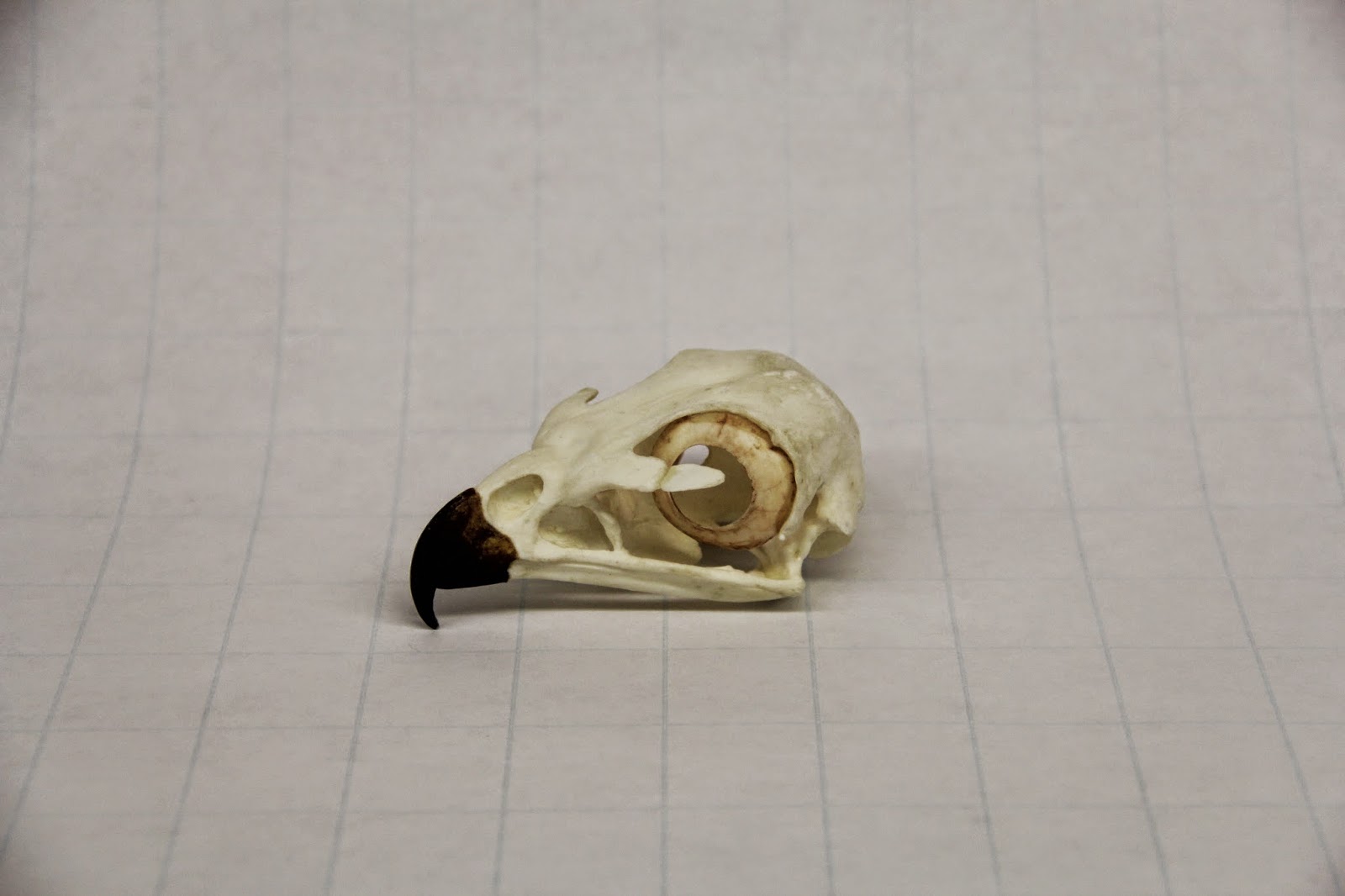
One of the programs that I do for 4th and 6th grade student is on animal adaptations.  One of the concepts that is discussed during this presentation is that animal adapt and evolve to fill an ecological niche.  The concept of an ecological niche is essentially that a species has a certain position or role in its natural community.  One way that I have been demonstrating this concept is with the skulls of a number of species of raptors (birds of prey) - these skulls are all replicas.

I like using the raptor skulls to explain the concept of a niche because the students can see the obvious similarities between the species - large hooked beak,  large forward facing eyes, and presence a prominet supraorbital ridge (brow bone) in most species.  The students can also easily notice the differences between species, especially size.  This size difference makes it easy to explain that each raptor species occupies a specific role or niche in the environment.

Here are the nine replica raptor skulls that I use.


The skulls in this photo include:  (front row) American Kestrel, Peregrine Falcon, Osprey; (middle row) Red-tailed Hawk, Golden Eagle, Bald Eagle; (back row) Barn Owl, Barred Owl, Great Horned Owl.

It is easy to see the similarities among these birds.  It is also easy to see the difference in size among these species - the grid-lines on the paper background are at one inch intervals.

While these birds all exhibit similar characteristics, the skulls in the above photo represents three different orders and five different families.  The three different orders evolved separately toward a common form and function - this is known as convergent evolution.  Within each order the birds have evolved to fill different niches; they vary in size, shape, and in the species of prey that they prefer.  During this process they have become separate species - this process is known as divergent evolution.

Right now, I don't want to discuss the specific ecological niche of each species, but merely focus on the size difference between the species.  This size difference clearly indicates that each species fills a different place in the environment.

American Kestrel and Peregrine Falcon

The first two species are both in the Order Falconiformes and the Family Falconidae - the American Kestral (Falco sparverius) and Peregrine Falcon (Falco peregrinus).

Osprey

The third species is in the Order Accipiteriformes and the Family Pandionidae - the Osprey (Pandion haliaetus).  The Osprey is the only species in its Family.

Red-tailed Hawk

Golden Eagle and Bald Eagle

The three species in the middle row are all in the Order Accipiteriformes and the Family Accipitridae -  the Red-tailed Hawk (Buteo jamaicensis), Golden Eagle (Aquila chrysaetos), and Bald Eagle (Haliaeetus leucocephalus).

Barn Owl

Barred Owl and Great Horned Owl

The three owls are all in the Order Strigiformes, but represent two different families.  The Barn Owl (Tyto alba) is in the Family Tytonidae.  The Barred Owl (Strix varia) and Great Horned Owl (Bubo virginianus) are both in the Family Strigidae.