Wednesday, June 11, 2014

Wildflowers of 2014 - #101 through #109

Time to catch up a little bit on wildflowers...

Last Tuesday (03 June 2014) I photographed my 99th and 100 species of wildflowers for the year.  On the same day, I found and photographed an additional five species.  All of these flowers belong to non-native plants.

Wildflowers of 2014 - #101 Winged Euonymus (Euonymus alatus)

Beginning the second hundred flowers of 2014 is Winged Euonymus (Euonymus alatus).  Also known as Burning Bush for its red fall foliage, Winged Euonymus is a common landscape shrub that has escaped into the wild throughout the eastern United States.  Like most escaped shrubs, it is spread when birds consume its fruit and leave the seeds in their droppings.  This shrub was found growing along the Chippewa River behind the Mt. Pleasant City Hall.

Winged Euonymus - note the flowers with four petals

This species is named Winged Euonymus for the cork-like wings that project off the sides of its branches and trunks.  These wings can be seen on several of the twigs in the photo below.

Winged Euonymus branches - note the cork-like wings projecting off several of the twigs


Wildflowers of 2014 - #102 Amur Maple (Acer ginnala)

The next species was found growing alongside the Winged Euonymus.  Amur maple (Acer ginnala) is a small tree species that is native to northeast Asia.  Like most Maple species it produces large numbers of seeds and can grow rapidly, because of these factors it is potentially invasive.  It is currently found growing wild in sixteen northern states and three Canadian provinces.  As of right now, it is only found near areas of human habitation.
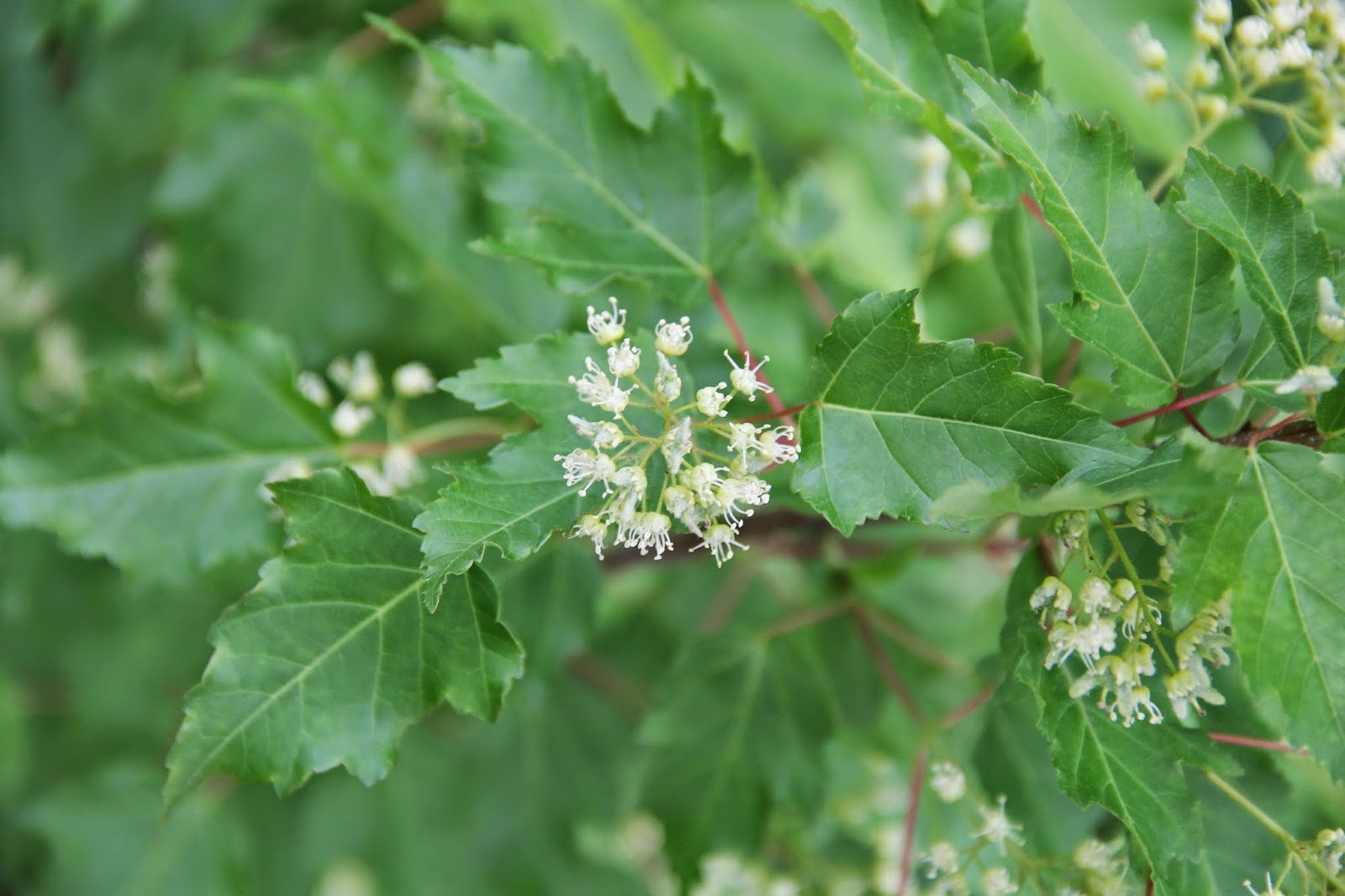
Amur Maple (Euonymus ginnala)

Amur Maple - note the lobed leaves typical of Maple species


Wildflowers of 2014 - #103 Black Locust (Robinia pseudoacacia)

The next species is one that I have found growing wild in four of Mt. Pleasant's parks - Black Locust (Robinia pseudoacacia).  Native to North America, but not native to Michigan, this species has been extensively planted as a landscape tree.  It has since spread into natural areas and may be considered invasive in some areas for this spreading tendency.  It frequently grows to a height of 30 to 50 feet, but occasionally tops out at 70 feet.  It is currently found in all US states except Hawaii and Alaska and six Canadian provinces.

A Black Locust tree

Black Locust can be identified by its large compound leaves, thorns, white pea-like flowers, and flat seed pods.  The flower shape identifies this plant as a member of the Legume Family (Fabaceae).  Like other legumes, Black Locust forms a symbiotic relationship with certain nitrogen-fixing soil bacteria.

Black Locust - note large compound leaves and pea-like flowers

Black locust - a closer view of the flowers

Black Locust - a closer view of the irregularly shaped flowers


Wildflowers of 2014 - #104 Oriental Poppy (Papaver orientale)

Like Winged Euonymus and Amur Maple, the fourth flower of June 3rd was another native of Asia - Oriental Poppy (Papaver orientale).  This plant is a garden escapee cultivated for its large attractive red-orange flowers.  I found these flowers growing alongside the paved trail in Mill Pond Park.  There are several plants growing in an area of a couple square yards and one separate plant growing in an area approximately 20 yards away on the opposite side of the trail.  I am not sure how this population got established, but it has been stable for more than three years and is possibly expanding.

Oriental Poppy (Papaver orientale)

Oriental Poppy - the bulblike shapes in the foreground belong to Meadow Garlic (Allium canadense)


Oriental Poppy - a closer view of one bloom

Wildflowers of 2014 - #105 Red Clover (Trifolium pratense)

The final species of the day was Red Clover (Trifolium pratense).  A native of Eurasia and northwest Africa, this species is commonly planted as a forage crop and has naturalized across most of North America.


Last week was my final week of programs for the 2013-14 School Year.  Over the course of the week I met with 11 different classrooms at four different sites around Isabella County for programs on Aquatic Ecology and Forest Ecology.  This busy schedule left little time for blooming wildflowers, but I did manage to squeeze in two more short trips.  On Thursday June 5th, while returning from programs at the Audubon Woods Preserve, I stopped at Mill Pond Park for a very short walk and found one new species for the year.

Wildflowers of 2014 - #106 Bittersweet Nightshade (Solanum dulcamara)

Bittersweet Nightshade  (Solanum dulcamara) was originally native to Eurasia but is naturalized across most of North America.  The plant grows as a vine that either trails along the ground or twines its way upward using other plants as supports.  It can grow in a variety of soil types, but prefers wet soils and is often found along stream and in wetlands.  Bittersweet Nightshade can be identified by its lobed leaves, purple flowers that resemble shooting stars, and later by its bright red berries.  These berries are consumed by birds (which spread the seeds in their droppings), but are considered toxic to humans.

Vines of Bittersweet Nightshade (twining upward from lower left) - the other vines belong to Riverbank Grape

Bittersweet Nightshade flowers

Another trip to Mill Pond Park and Pickens Field on Friday June 6th yielded a further three species, bringing the year total to one hundred nine species.

Wildflowers of 2014 - #107 Riverbank Grape (Vitis riparia)

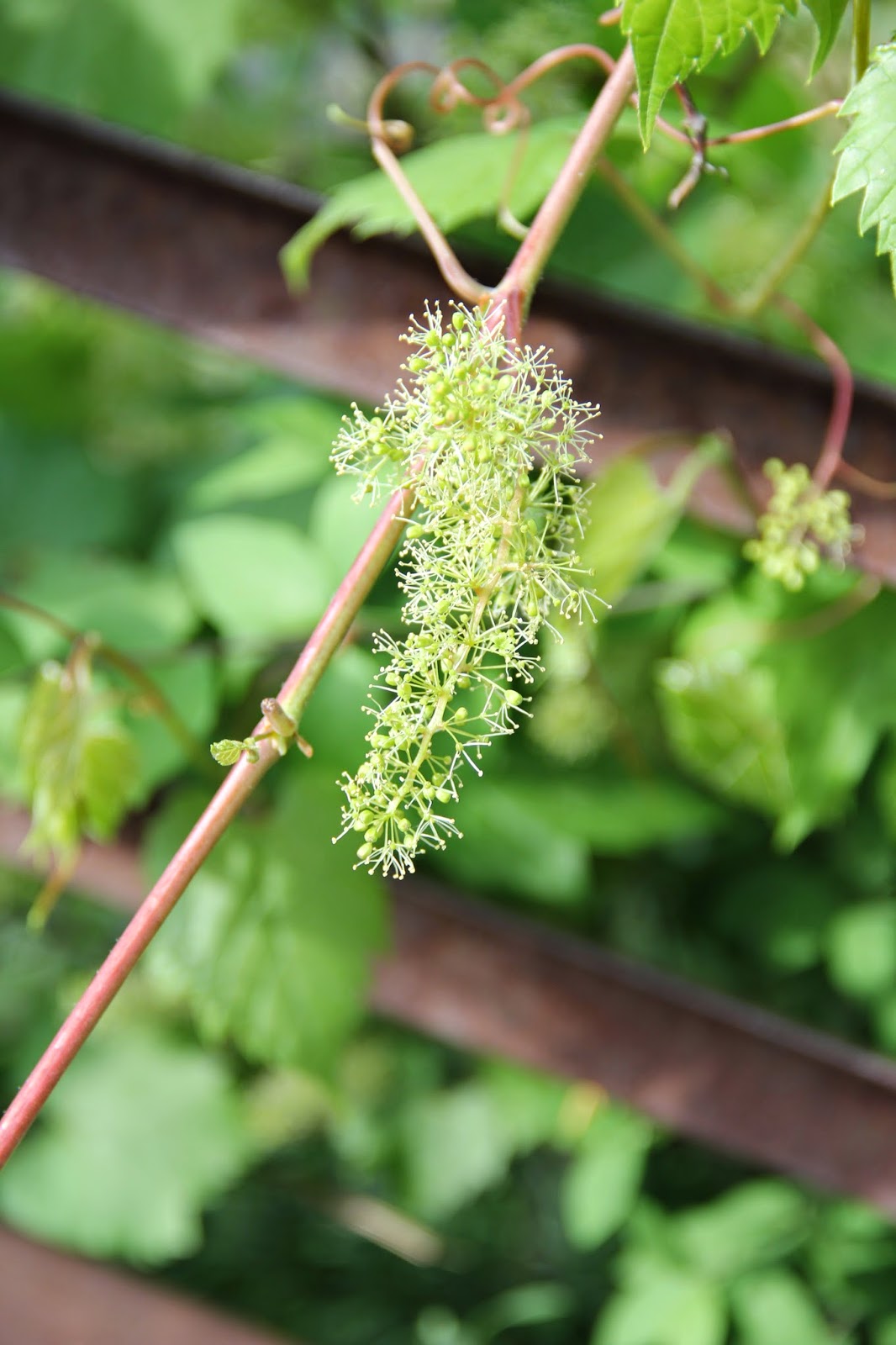
The first species of the day was Riverbank Grape (Vitis riparia).  This is the most common species of wild grape in Michigan.  As its name suggests this sun-loving species commonly grows along riverbanks, but is also found in other forest openings, along forest edges, and in fields.  It can be distinguished from the other three other Michigan grape species by the shape of its leaves - lobes that point toward the tip and coarsely serrated margins.  The flowers grow in elongated clusters that when pollinated will grow into the typical grape bunches.  The small purple fruit of Riverbank Grape are sour and contain a large seed.

Riverbank Grape (Vitis riparia)

Riverbank Grape - a closer view of the flowers

Wildflowers of 2014 - #108 Silky Dogwood (Cornus amomum)

The next species that I found was Silky Dogwood (Cornus amonum).  This is the second Dogwood species that I have identified this year.  Red-osier Dorgwood (C. sericea) was species #80For more information about how to distinguish between these two species read this post from 2013.

Silky Dogwood (Cornus amomum)


Wildflowers of 2014 - #109 Carpet Bugle (Ajuga reptans)

The third wildflower of the day was another non-native species Carpet Bugle (Ajuga reptans).  This species is commonly planted as a groundcover.  The blue flowering spikes can grow up to a foot in height.  The plant spreads by sending out stolons (horizontal stems) that take root where they contact the soil.

Tuesday, June 10, 2014

A Polyphemus goes on an Odyssey

Last September I wrote a post about several giant silkworm moths that were going into cocoons at my house.  This weekend one of the moths emerged from it cocoon - the Polyphemus Moth (Antheraea polyphemus).

A female Polyphemus Moth - the thin antennae and expanded abdomen identify her as female


When this moth spreads its wings it shows a pair of large eye-spots.  This is a type of mimicry.  If the moth is threatened by a predator such as a bird it can show its eye-spots to appear like a much larger creature.  The Polyphemus Moth was named because of these eye-spots.  Polyphemus is the mythical Cyclops that is blinded by Odysseus in the epic poem The Odyssey.

Polyphemus Moth with wings open exposing her eye-spots.

Polyphemus Moths are Mid-Michigan's second largest species of moth - only the Cecropia Moth (Hyalophora cecropia) is larger.  We are waiting on three Cecropia Moths to emerge from their cocoons any day.

The Polyphemus on my hand for scale

Last evening we took a few photographs of the Polyphemus Moth (a female) before releasing her in a local park.  Hopefully she will be able to attract a mate and a new generation can start this Summer.

Shara holding the Polyphemus before it was released

The Polyphemus Moth sitting in a Silver Maple tree

Friday, June 6, 2014

D-Day Anniversary

There was a time when schoolchildren were made to remember important dates from history.  Our schools today rarely emphasize this type of knowledge, but there are still dates that should be remembered.  

Today is June 6th 2014.

Seventy years ago on this date, June 6th 1944, forces from the United States, Great Britain, Canada, Free France and other Allied Nations landed on the beaches and fields of Normandy to begin the reconquest of Northwest Europe from Nazi occupation. 

General Eisenhower's Address to the troops - from the National Archives

The young men who participated in this invasion are now old men  - the youngest are in their late eighties.  Someday, in the not too distant future, they will all be gone. It is important to remember and honor those that are still alive and those that have passed on for the sacrifices that they made not only for the people of their own nations, but also for the people of nations that were not their own.

To learn more about the invasion of Normandy please visit the US Army D-Day website.

Thursday, June 5, 2014

There's something in the water...

I have a new animal that I am taking care of right now - a Giant Water Bug (probably Lethocerus Americanus).  Actually I have two of them.  One is an aquarium at work.  The other is at home.  One of the two was collected while I was dipping up aquatic invertebrates for a school program.  The second was collected by a student from Winn Elementary last week.

Giant Water Bug feeding on a small goldfish
So why am I keeping two Giant Water Bugs in aquariums?

I want to use them in a couple of programs over the summer - I am doing several programs on animal appearances for the Chippewa River District Library Summer Reading Program


Also, they are just incredibly cool!  An insect that can eat fish and tadpoles ( and even turtles)!  That can be kept alive for a year or longer and doesn't take much work other than feeding it and changing its water once in a while.  And can grow to be over 2 inches long!

Sounds like a fun animal to keep as a pet.

In the picture above, my Giant Water Bug  is busy eating.  To learn more about how they eat check out this post from 2010 (Christine Goforth is an entomologist who blogs at thedragonflywoman.com and also for the North Carolina Museum of Natural Sciences).

Wednesday, June 4, 2014

Wildflowers of 2014 - #99 and #100 (Plus the Complete List from #1 to #100)

Yesterday I found my 99th and 100th wildflower species of the 2014 growing season. 

Last year I started thinking about the idea of taking photographs of every wildflower species that I could find in one growing season.  For many years I have been keeping a list of all the flower species that I find in the Mt. Pleasant city parks.  With a list of over 200 species, I realized that I lacked photos for many species and I was pretty certain that I had misidentified some species.

So for 2014 I set about to refine my list of flowers and to fill in the gaps in my photographic record.

Here are the self-imposed rules that I set for myself for this challenge:

  •  Any native or non-native plant (including trees) can be photographed if it meets two conditions
    • It must be growing in a wild population - it cannot be in a location where it was planted.
    • It must be growing in one of the parks or other city properties within the city of Mt. Pleasant, Michigan.
  • I have to photograph the plant on the day I first find the flower - but I can photograph any flower of the species that I find on that day.
  • I have to be able to identify the species for it to count - unknown specimens do not count.
I found my first species on April 10th and fifty-five days later I hit #100.

Wildflowers of 2014 - #99 American Highbush Cranberry (Viburnum Trilobum)

Wildflower #99 for the year was found growing on the banks of the Chippewa River behind the Mt. Pleasant City Hall.  American Highbush Cranberry (Viburnum Trilobum) is a native shrub that prefers moist soils along shorelines, floodplains, wet woodlands, and deciduous and conifer swamps.

Flowering American Highbush Cranberry along the Chippewa River

The white flower clusters of American Highbush Cranberry consist of a round cluster of small fertile flowers surrounded by a ring of larger sterile flowers.  The shrub's leaves resemble small maple leaves.

American Highbush Cranberry - note maple-like leaves and white flowers

American Highbush Cranberry - note small sterile flowers surrounded by large sterile flowers


Wildflowers of 2014 - #100 Common Buttercup (Ranunculus acris)

The 100th wildflower species of the year is the non-native Common Buttercup (Ranunculus acris).  This native of Europe has been introduced throughout most of North America.  It has glossy yellow flowers with five petals and deeply lobed leaves.  Common Buttercup can be found in fields, pastures, and meadows, along roadsides, and along shorelines.  I found it growing in moist soil along the Chippewa River.  Individual Common Buttercup plants may flower any time between May and August. 


Common Buttercup - note the glossy yellow flower


Here is the complete list of the first 100 wildflowers of 2014:

Tuesday, June 3, 2014

Wildflowers of 2014 - #83 through #98

It's time to get caught up on wildflowers that I have found in the past five days. 

The next five species were found on Thursday May 29th.

Wildflowers of 2014 - #83 Feathery False Solomon's Seal (Mainthemum racemosum)

Earlier in the list I showed at #44 I shared  Star-flowered False Solomon's Seal (Maianthenum stellatum).  Number Eighty-four is its close relative Feathery False Solomon's Seal (Mainthemum racemosum).  While Star-flowered False Solomon's Seal has only a few large flowers (measuring 1/3 inch across), Feathery False Solomon's Seal has many small flowers (1/8 inch) arranged in a spike or raceme at the end of the stalk.  The feathery appearance of the flowers has also given the plant the alternate name of Solomon's Plume.

Feathery False Solomon's Seal (Maianthenum stellatum)
 
Feathery False Solomon's Seal grows between 1 and 3 feet tall.  The stem forms a gentle arc, bending down under its own weight and then rising again at the flower.

The stalk of Feathery False Solomon's Seal arcs gently before bending curving upward at the bloom

Feathery False Solomon's Seal prefers moist soils and shade, but it will also grow in drier open locations.  These photos were taken in a section of woods dominated by American Beech and Sugar Maple at Chipp-A-Waters Park.

Feathery False Solomon's Seal - not zig-zagging stem and alternate leaves


Feathery False Solomon's Seal - note the plume of small white flowers

Wildflowers of 2014 - #84 Indian Strawberry (Potentilla indica)

Also found at Chipp-A-Waters park was Indian Strawberry (Potentilla indica - also known as Duchesnea indica).  This non-native plant is originally from South and East Asia.  The "Indian" part of its name refers to the nation of India.

The three-lobed leaves bear a resemblance to those of native and domestic strawberry plants, but Indian Strawberry has yellow flowers instead of white.  It does produce a small red fruit.  While the fruits of Wild Strawberry (#47) and Woodland Strawberry (#32) are both sweet and juice, the fruit of Indian Strawberry is dry and bland.

The leaves resemble those of Wild and Woodland Strawberry, but the yellow flower identifies this as Indian Strawberry

Indian Strawberry - a closer view of the five notched petals

Wildflowers of 2014 - #85 Common Fleabane (Erigeron philadelphicus)

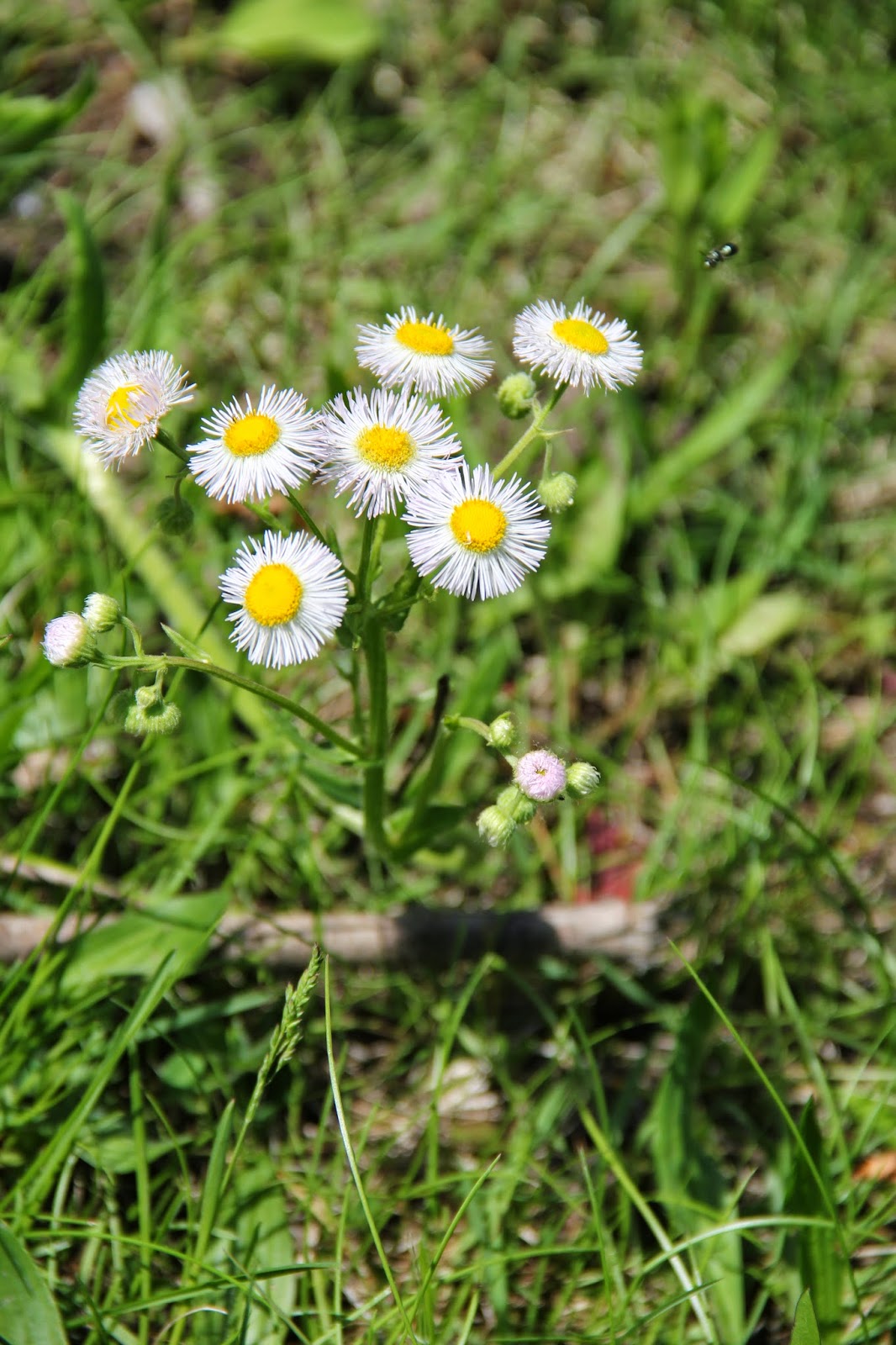
The third flower of the day was found at Mill Pond Park.  Common Fleabane (Erigeron philadelphicus) is a native plant with composite flowers.  This means its "flowers" are made up of many smaller flowers clustered together in a disc, while what appear to be petals are actually individual flowers called ray flowers.
While there are seven Erigeron species in Michigan, Common Fleabane can be distinguished from other species by the number of rays on the flower (150 - 400) and the leaves which clasp the stem.

As its name implies Common Fleabane is "common".  It can be found in 46 states (not Utah, Arizona, Alaska, or Hawaii) and most of Canada (except Nunavut and Labrador).  In Michigan it is listed in all but eleven counties.  I suspect that it is found in those counties but no herbarium specimens have been collected.

Common Fleabane - note how the leaves clasp the stem

Common Fleabane blooms may have 150 to 400 rays - more than other Fleabane species
 
Wildflowers of 2014 - #86 Wild Black Cherry (Prunus serotina)

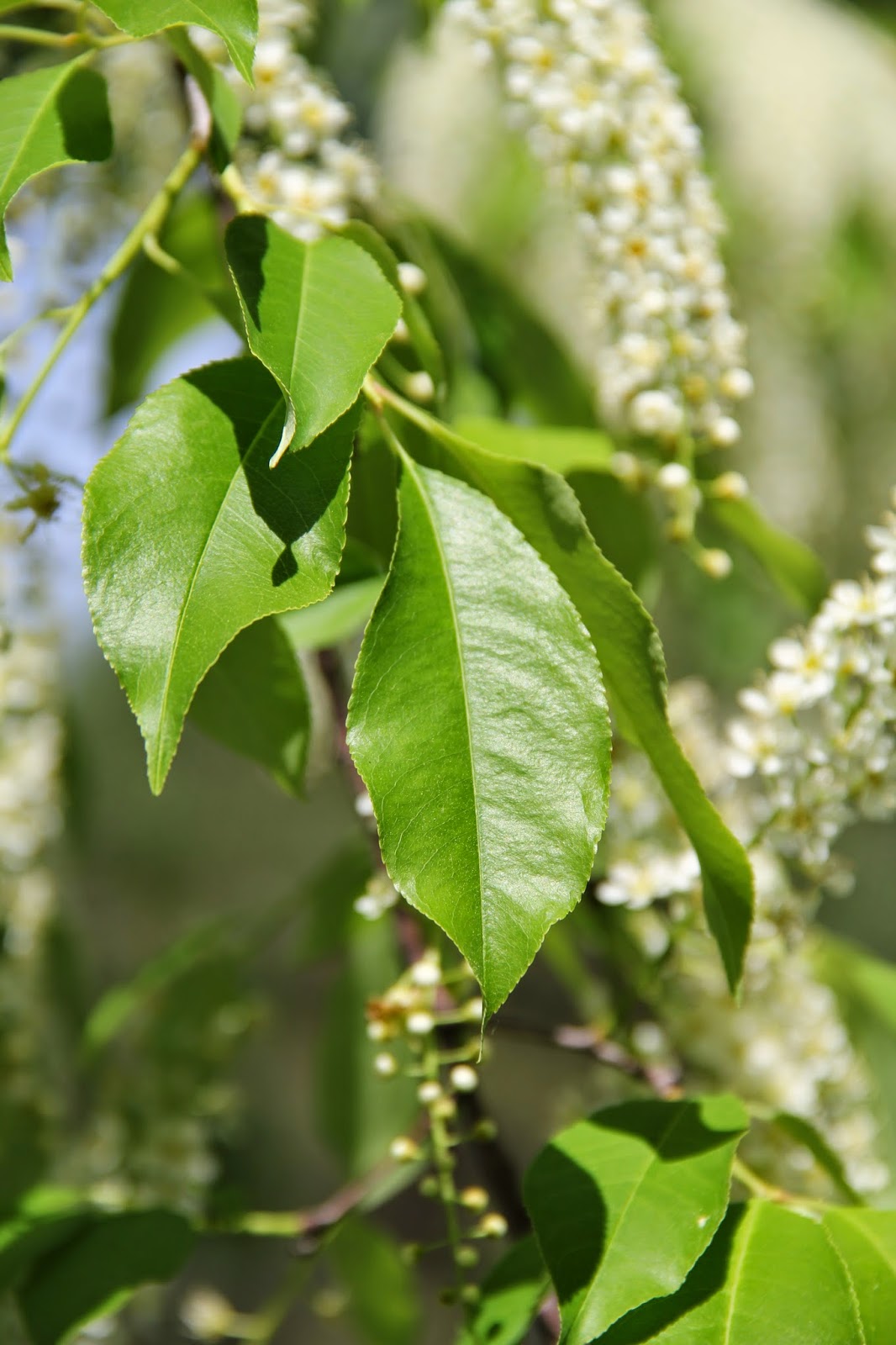
After spending part of the afternoon at Mill Pond Park, I returned to Chipp-A-Waters Park to look for several more species of flowers.  While I did not find the flowers that I was searching for I found this tree in bloom - Wild Black Cherry (Prunus serotina).  This is the second Cherry on the list - Choke Cherry (Prunus virginiana) was #58.  Wild Black Cherry may grow as a shrub, but is more often found as a canopy tree.  While both Choke Cherry and Wild Black Cherry both have drooping elongated clusters of white flower, the two species can be easily separated by their leaves.  The leaves of Choke Cherry have serrations with sharply pointed teeth; the serrated leaves of Wild Black Cherry have teeth that are rounded off.

Wild Black Cherry blooms

Wild Black Cherry - note how the serrated leaves have rounded teeth

Wildflowers of 2014 - #87 Black Medick (Medicago lupulina)

The next flower from Chipp-A-Waters Park was Black Medick (Medicago lupulina).  This plant was introduced from Eurasia to all 50 states and all Canadian provinces and territories except Yukon, Nunavut, and Labrador.  Black Meddick is often found as a weed in lawns and fields, along roadsides, and in other disturbed spaces.  It has small yellow flowers in the form of a globe or cylinder.  The plant can grow to nearly 3 feet, but is frequently much smaller.

Black Medick is often found as a weed in lawns and fields.

Small yellow flowers and clover-like leaves of Black Medick

Monday, June 2, 2014

Two Ponds in Two Days - Aquatic Macroinvertebrate Sampling

One of the best things about my work is having the opportunity to get kids outside and expose them to the habitats and wildlife in their own hometown.  Last week I was able to get five classes off of school grounds to explore a couple of local ponds.  Here are a few pictures.

The first pictures were taken at Mill Pond Park in Mt. Pleasant on Thursday May 29th.  Two 3rd grade classes from Ganiard Elementary walked down the street from their school to join me in searching for aquatic macroinvertebrates.  The other two 3rd grade classes from the school will be doing the same thing later this week.


On Friday May 30th, the 3rd - 5th grade classrooms from Winn Elementary met me at a private pond near their school.  We were lucky to receive permission from the land owner to use this pond.  This meant that the students were able to walk to this site, instead of having to take a bus to a location far from their school.  Many students pass this pond every day on their bus ride to school.  Now they know what kinds of animals can be found swimming around in it.