Tuesday, May 29, 2018

Forestry with Winn Elementary (23 & 24 May 2018)

Last week I spent two days (Wednesday 23 May & Thursday 24 May 2018) working with students from Winn Elementary at Audubon Woods Preserve.  On Wednesday the Third and Forth Grade classrooms each spent half a day at the preserve.  On Thursday the Fifth Grade class spent the entire day (minus a break for lunch back at the school) in the woods.

The students were doing a variety of activities related to forestry and forest ecology.  Activities included measurement of tree diameter, using a compass and measuring tape to map trees in 1/10th acre plots, estimating the number of leaves on the forest floor, estimating the weight of all the leaves, measuring canopy cover, identifying and sketching leaves; and sketching the layers in the forest.

This might seem like a lot of work, but this is not the first time these students have visited Audubon Woods.  Third Grade students visited once last fall, and the other two grades have visited at least once a year since they were in Third Grade.  By now the Fifth Graders are quite familiar with the preserve and the activities they are being asked to accomplish.  The lower grades have less time available on site and less experience so they correspondingly do less work.

Here are a few images of the students hard at work as well as some nature photos from the two days.

Wednesday 23 May 2018


The compass is an important forestry tool

Mapping the location and size of trees

Monday, May 28, 2018

Memorial Day 2018

Officially founded on 04 July 1776, The United States of America has existed for nearly two hundred forty-two years.  During that span of time more than one million military service members, both men and women, have died in the service of the United States.  This Memorial Day please remember the reason for the holiday is to honor and remember those who have given their life in the service of this country. 


Although the exact origin of the holiday is debated, the first national celebration of Memorial Day, or Decoration Day as it was then known, dates to 1868.  Below are the words of the original Memorial Day proclamation issued by General John A. Logan of the Grand Army of the Republic on May 5th, 1868 to commemorate and remember the fallen from the American Civil War.  (The Grand Army of the Republic was the largest veterans' organization representing soldiers who served the Union cause.)

HEADQUARTERS GRAND ARMY OF THE REPUBLIC

General Orders No.11, WASHINGTON, D.C., May 5, 1868

  1. The 30th day of May, 1868, is designated for the purpose of strewing with flowers or otherwise decorating the graves of comrades who died in defense of their country during the late rebellion, and whose bodies now lie in almost every city, village, and hamlet church-yard in the land. In this observance no form of ceremony is prescribed, but posts and comrades will in their own way arrange such fitting services and testimonials of respect as circumstances may permit.
    We are organized, comrades, as our regulations tell us, for the purpose among other things, "of preserving and strengthening those kind and fraternal feelings which have bound together the soldiers, sailors, and marines who united to suppress the late rebellion." What can aid more to assure this result than cherishing tenderly the memory of our heroic dead, who made their breasts a barricade between our country and its foes? Their soldier lives were the reveille of freedom to a race in chains, and their deaths the tattoo of rebellious tyranny in arms. We should guard their graves with sacred vigilance. All that the consecrated wealth and taste of the nation can add to their adornment and security is but a fitting tribute to the memory of her slain defenders. Let no wanton foot tread rudely on such hallowed grounds. Let pleasant paths invite the coming and going of reverent visitors and fond mourners. Let no vandalism of avarice or neglect, no ravages of time testify to the present or to the coming generations that we have forgotten as a people the cost of a free and undivided republic.

    If other eyes grow dull, other hands slack, and other hearts cold in the solemn trust, ours shall keep it well as long as the light and warmth of life remain to us.

    Let us, then, at the time appointed gather around their sacred remains and garland the passionless mounds above them with the choicest flowers of spring-time; let us raise above them the dear old flag they saved from hishonor; let us in this solemn presence renew our pledges to aid and assist those whom they have left among us a sacred charge upon a nation's gratitude, the soldier's and sailor's widow and orphan.

  2. It is the purpose of the Commander-in-Chief to inaugurate this observance with the hope that it will be kept up from year to year, while a survivor of the war remains to honor the memory of his departed comrades. He earnestly desires the public press to lend its friendly aid in bringing to the notice of comrades in all parts of the country in time for simultaneous compliance therewith. 
  3. Department commanders will use efforts to make this order effective.

    By order of

    JOHN A. LOGAN,
    Commander-in-Chief

    N.P. CHIPMAN,
    Adjutant General

    Official:
    WM. T. COLLINS, A.A.G.


Wednesday, May 23, 2018

Let's twist again...

I spent most of yesterday at the Little Salt River Park in Shepherd.  My reason for being at the park was to collect aquatic invertebrates with 5th grade students from Shepherd Elementary.  I worked with one class in the morning and a second class in the afternoon with a hour-long break for lunch.  While I was waiting for the second class to arrive I tried photographing some of the Barn Swallows that were swooping low over the river to catch flying insects.  Many of these insects were the adult form of insects that students were trying to catch in the water. 

Photographing individual swallows in flight is not impossible, but it is not easy.  Most photos that you see of flying swallows are probably taken either as the swallow slows down to approach a nest or shot using some sort of automatic trigger on a camera.  I was trying to follow the birds with my camera as they swooped low over the river.

My success rate was not very high. 


The photos could have been better if it had been a sunny day.  The photo with the clearest focus on the swallow was this one in which swallow has almost exited the frame of the photo - chopping off its head.


My favorite picture is this one.  The swallow is just an inch or two above the surface of the water, but that's not why I like this picture.


If you look closer you can see some of the incredible flexibility of the swallow as it executes a turn.  As you looked at the other photos above you might have noticed that the upper surfaces of a Barn Swallow's back and tail are a solid dark blue.  In this photo you can see the lower surface of the tail and the upper surface of the back and wings. 


Basically this bird has twisted at the hips/waist to change direction.  It's hips are rotated as much as 120 degrees- 1/3 of the way around.  It's this flexibility that allows swallows to change direction almost instantly while in flight.  It's pretty amazing adaptation that allows swallows to feed almost exclusively on flying insects.


Sunday, May 20, 2018

2018 Isabella County Environmental Education Day

Friday was our 9th annual Environmental Education Day.  This event takes months of planning and requires the effort of dozens of people to be a success.  Six months prior to the date I start contacting a variety of government agencies and environmental organizations to participate.  My goal is to have around twenty different educational stations (including the Isabella Conservation District) set up for the students that attend.  This year the following groups participated:

Why do we need so many different activities? 

It's because of the number of students that attend.  We invite every third grade classroom in Isabella County to attend the Environmental Education Day.  This year 28 different classes were able to attend.  That meant that we had almost 600 students in attendance this year!  Luckily, the students don't all come at once.  Half of the students come for a morning session and the other half come for the afternoon - 300 students at one time is still whole lot of kids!  We need so many different activities to make sure the students have something to do the entire time they are at the event.

Here are a few scenes from Environmental Education Day.

Creating a "tree cookie" necklace with Isabella County Parks

Learning about Ojibwe culture with the Ziibiwing Center

Chippewa Watershed Conservancy Executive Director Jon Breithaupt talks preserves with students and chaperones

Everyone wanted photos!

Learning about the life span of materials from the CMU Museum staff

Reptiles always amaze

Every kid received a backpack from us (and elk antlers from the DNR)

Crafting a radish seed necklace with MSU Extension

Celebrating 100 year of elk in Michigan with the DNR

Learning about Anishinaabe culture from the Elijah Elk Cultural Center

Rocks and minerals at the Isabella Conservation District table - such a tactile experience!

Ask me about bees, please!

Searching for aquatic life

Saginaw Chippewa Environmental Team teaching about water quality

Just a few of the students - learning about archaeology from Alma College

Kids love to learn about and from Michigan Department of Natural Resources conservation officers

Bicycle-powered smoothies with GreenTree Grocery

Pheasant Forever had pheasant chicks on site - a huge hit with the students!

Monday, May 14, 2018

Adaptations - Mobbing

Have you ever observed small birds harassing or diving after a much larger bird?

Then you have witnessed a behavioral adaptation known as mobbing.  Adaptations are physical traits or behaviors that helps an organism survive in its habitat.  Mobbing is a behavior that birds use to chase away predators.  When mobbing small birds will often gang up on their target.  The idea is that although a predator might be able to catch a single small bird diving after it, the predator will be overwhelmed by sheer numbers and leave to avoid further harassment. 

Why are small birds acting this way?  The answer depends.  Sometimes small birds become more aggressive (and territorial) during mating season and they will chase away any bird that flies over their territory.  Birds also use mobbing to protect themselves and their young from predators.  When young birds are still in the nest adult birds will often fly after any large bird that strays "too close" to the nest.  This "too close" distance is arbitrary and a bird may chase a predator hundreds of yards if feeling particularly feisty.  Mammals (including people) are also lumped into this danger category - walk too close to a Red-winged Blackbird nest and you are likely to be mobbed.

Small  birds don't discriminate.  Besides people, mobbing targets include hawks, eagles, owls, herons, and crows.  Crows themselves will often mob hawks and owls.  Did you ever wonder why owls are camouflaged?  You would be too if you had to avoid being mobbed all day when you just want to sleep!

The large poplar trees outside our office are the frequent perch of a pair of Red-tailed Hawks (Buteo jamaicensis).  I am often alerted to the presence of the hawks by the sounds of mobbing birds.  Last week it was a pair of Blue Jays (Cyanocitta cristata). 


The jays took turns diving on the hawk.  I don't think they ever made contact, but the hawk kept having to duck to avoid the jays.


After several minutes, the hawk had enough and flew away pursued by the jays.

Sunday, May 13, 2018

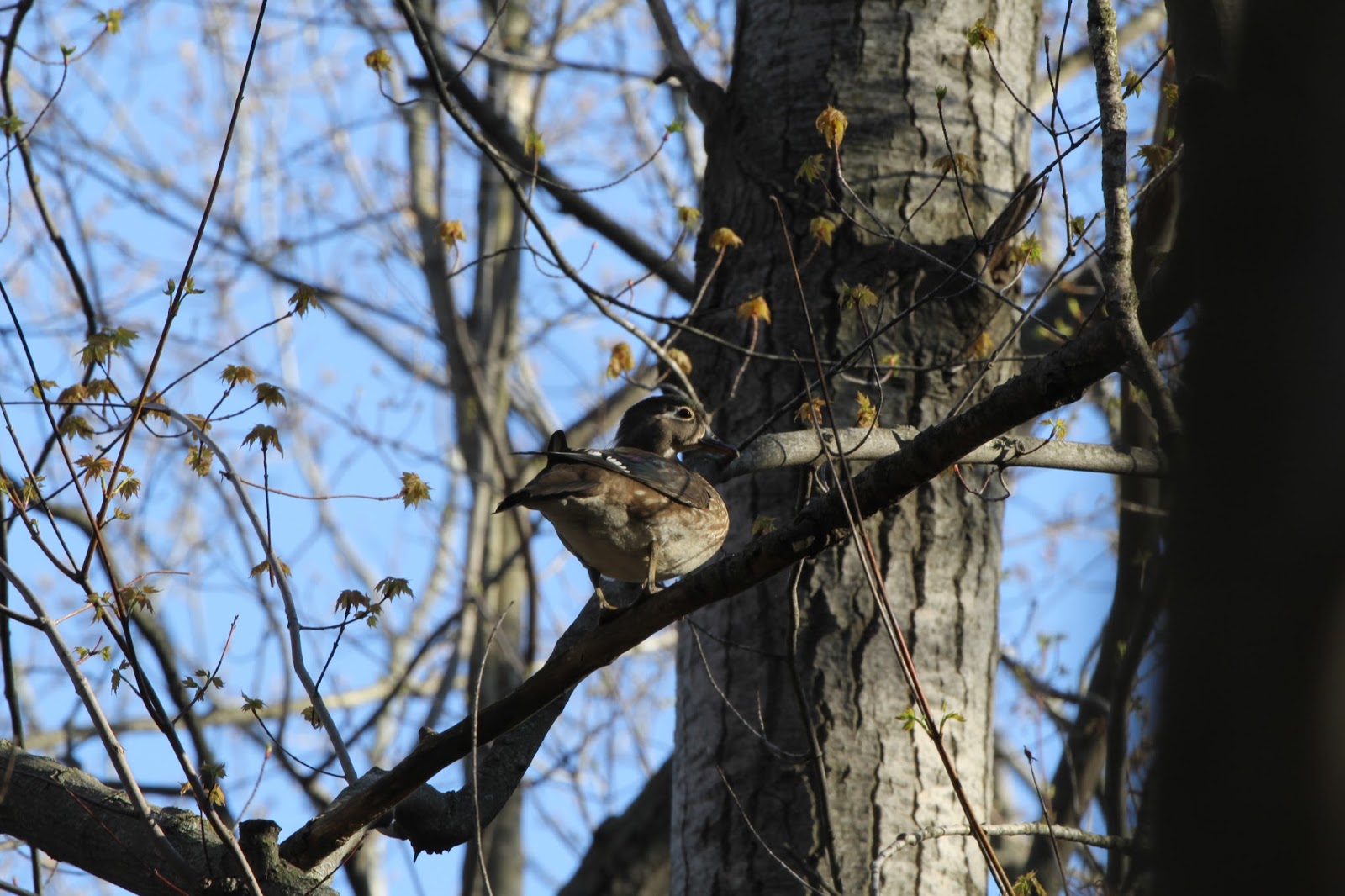
Ducks in Trees?

Ducks in trees?

A pair of Wood Ducks at Audubon Woods Preserve

Absolutely!  Several species of Michigan ducks can commonly be found in trees - not only do they perch in trees, but they also nest in cavities in trees!. 

Cavity-nesting duck species include the Bufflehead (Bucephala albeola), Common Goldeneye (Bucephala clangula), Common Merganser (Mergus merganser), Hooded Merganser (Lophodytes cucullatus) and Wood Duck (Aix sponsa).  Of these five species, only the final two species are year round residents.  The first three species are migrants and winter visitors to Mid-Michigan, but migrate further north to nest.   

Of the two year-round residents, I have never seen a Hooded Merganser in a tree.  I have seen Wood Ducks in trees many times, including last week at Audubon Woods Preserve.  While waiting for students to arrive I observed a pair of Wood Ducks landing in a nearby tree.  The ducks were aware of me, but didn't startle and fly away immediately. 
 
Instead, they remained in the tree for several minutes.  Long enough for me to retrieve my camera and photograph them for nearly two minutes.  There were many tree branches in the way, but I still managed to get several clear shots of both the male and female before they startled and flew deeper into the woods.

A Wood Duck drake is much more colorful than the drab colored hen.
 
The hen's dull colors help camouflage it much better than the bright plumage of the drake.

These two Wood Ducks were probably searching for a nesting site such as an old woodpecker hole.

Friday, May 11, 2018

Green-striped Trilliums

While working with the Shepherd fifth graders at Audubon Woods Preserve earlier this week I noticed dozens of Large-Flowered Trillium blooms.  Most of these were the standard white variety.


But, there were a few flowers with a green stripe down the center of each white petal.

The green stripe is a sign of mycoplasma infection

These flowers have been infected by something called a mycoplasma.  A mycoplasma is a form of bacteria that lacks a cell wall.  This infection will first be noted as a green stripe near the center of each petal.  As the infection spreads in successive years the stripe widens until the whole petal may be green.  This infection can also cause deformed petals or even double blooms (so each flower would have six instead of three petals).  This infection eventually impairs the reproductive ability of the infected plant and prevents successful seed production.

This Trillium bloom is almost entirely green and its leaves also show signs of infection.

A mycoplasma infected Trillium