As of yesterday (28 April 2019) I'm forty days into my Spring photography project. My plan is to photograph something in nature every single day. This means that I have to go outdoors every single day no matter how busy I am. Sometimes I only have ten minutes available, on other days I may spend a couple of hours. No matter how much time I have it's always worth it. You can check out the first three sets of images at the following links:
Day 1 through Day 10
Day 11 through Day 20
Day 21 through Day 30
Over the last ten days spring has finally begun to look like spring. There are so many more things to photograph now - insects, birds, gardens, wildflowers, unfurling leaves, and more! The challenge now become choosing which photograph will be used to represent each day. Tough choices need to be made, some photographs that I really loved just didn't make the cut... Here are the next ten images that did.
Day 31 (19 April 2019) - Bud Burst
This photograph was taken at Chipp-A-Waters Park in Mt. Pleasant. Much of the park is in the floodplain of the Chippewa River. Boxelder (Acer negundo) is one of the common trees found in the floodplain. It is also one of the first trees species in the area to develop leaves. I love the pale green of this stage as well as the overall "fuzziness" of the newly forming leaves.
Day 32 (20 April 2019) - Mission Point Beach
Over the weekend of April 19th - 21st, we took a trip to Traverse City to celebrate Shara's birthday. One of our favorite locations in the area is Lighthouse Park at the tip of the Old Mission Peninsula. We visit this park almost every time we are in Traverse City love photographing the lighthouse and the lake. The lake looks appealing right now, but the water is still COLD...
Day 33 (21 April 2019) - Bloodroot
This photograph was taken in our home (mostly) native pollinator garden. Bloodroot (Sanguinaria canadensis) is one of the earliest woodland wildflowers in mid-Michigan. We have it planted along the porch on the east side of our house - it gets lots of morning sun, but it shaded by midday. This clump started as a single plant. Our early native bees are very successful at pollinating and then ants help disperse the seeds. The ants consume a fleshy coating on the seed (known as an eliasome) and then discard the seed itself in their garbage heaps.
I tried several formats for this picture, but I think the square crop looks the best. I did adjust the brightness on this image to tone down the whites a little bit. The same adjustment allows the greens to become more prominent.
Day 34 (22 April 2019) - Sleepy bee
This photograph was taken during a walk at Mission Creek Woodland Park. This queen common eastern bumblebee (Bombus impatiens) had only recently emerged from hibernation. She was busy foraging for nectar on wildflowers and searching for the perfect site to establish her nesting colony. All that work is tiring on a cool spring day. Sometimes the best thing to do is to nap in the sun and recharge. That's what this lady is doing in the picture, snuggling up to that downed branch and waiting for the annoying human to go away so she could sleep in peace.
Day 35 (23 April 2019) - The Boys' Club
I noticed this trio of mallard (Anas platyrhynchos) drakes cavorting together on the Chippewa River at Chipp-A-Waters Park. Either these three drakes have not paired up with hens or their hens were sitting on nests somewhere nearby as these enjoyed some time male bonding time. As I watched them they repeated splashed themselves with water, groomed their feathers and scratched themselves. I took about a dozen photos of the group with this being my favorite. I did crop this down to a widescreen (16:9) format to remove the far riverbank at the top of the picture and some open water at the bottom.
Day 36 (24 April 2019) - Gooseberry
I photographed this gooseberry plant (Ribes sp.) at the Chippewa Watershed Conservancy's Sylvan Solace preserve. Without flowers or fruit I can't be exactly sure which species it is, but my guess is prickly gooseberry (Ribes cynosbati). I like this image because of the way the backlighting shows off the hairs on the leaves and the overall simplicity of the image. I do wish the background had been all dark. Again this image seemed to work best as a square crop.
Day 37 (25 April 2019) - Spring Beauty
These spring beauty (Claytonia virginica) flowers were photographed at Mission Creek Woodland Park. From a distance the overall impression of spring beauty is that the flowers are white or pale pink. Up close you can make out the pink or purple stripes on the petals (nectar guides) and the pink tipped stamen.
Day 38 (26 April 2019) - Flying Dutchmen
I photographed these Dutchman's breeches (Dicentra cucullaria) flowers at Chipp-A-Waters Park. This park has long been my favorite location for spring woodland wildflowers. It's name comes from the shape of the flowers - they look like little pairs of pants hanging upside down from the ankles.
Day 39 (27 April 2019) - Norway Maple Flowers
Norway maples (Acer platanoides) is not native to Michigan, but it has naturalized across the state. It is currently flowering throughout mid-Michigan. I photographed these flowers at Mill Pond Park. Yesterday I noticed a flock of cedar waxwings feeding on the flowers in the to Norway maples in my front yard - amazingly that picture didn't make the list.
Day 40 (28 April 2019) - Beetles are pollinators too!
Picking a photograph for yesterday was tough. I had a photo of cedar waxwings feeding on maple flowers. I also photographed a bronzed tiger beetle on the trail at Chipp-A-Waters Park and a closeup of a bloodroot flower. Any of these could have been selected, but my favorite image of the day was this one of a beetle on a yellow trout lily (Erythronium americanum).
Showing posts with label leaves. Show all posts
Monday, April 29, 2019
Thursday, January 17, 2019
Trail cam pics and a walk in the January woods.
In late December I placed my trail cameras in the woods for the first time in nearly a year. Today I went to switch out the memory cards. Although I managed to get pictures of red fox, raccoon, squirrels, and deer (including several bucks) I was disappointed by the results and ended up moving both cameras.
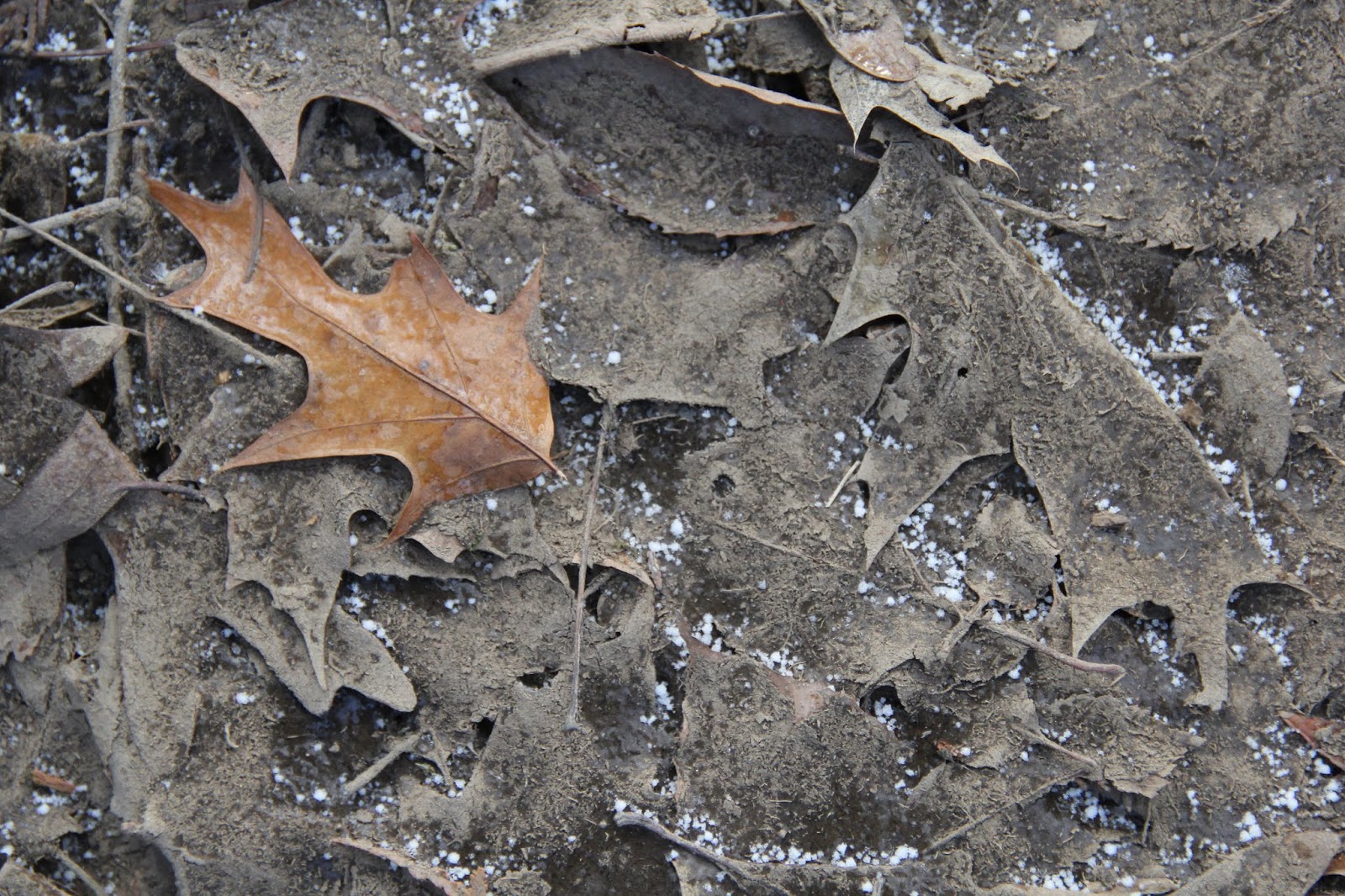
After moving the cameras I used the opportunity to take a walk through the woods and take some photographs. There was no snow on the ground, but lots of ice. My favorite photos of the day were probably those showing leaves locked in ice. Here are a few of the images that I captured.
| A fox runs in front of the camera |
| Part of a herd of deer, including two bucks, passing by the camera |
After moving the cameras I used the opportunity to take a walk through the woods and take some photographs. There was no snow on the ground, but lots of ice. My favorite photos of the day were probably those showing leaves locked in ice. Here are a few of the images that I captured.
| Bright sunlight has been a rare sight in recent days |
| This picture was not planned - the plane flew over just as I was taking the picture. |
| Flowing water carved this channel down through the ice |
| Many shades of brown |
| Living and dead trees stand bare in the winter swamp |
| Oak leaves trapped in ice |
| Coyote scat on top of a pile of deer scat |
| Water levels have dropped several inches since this ice formed |
| Eastern Hemlock |
| Silt covered leaves, topped by a single clean oak leaf |
| A boardwalk crosses an eroded area on the trail |
| Northern White Cedar |
| The bright trunks of aspen trees glow in the sunlight |
Thursday, November 8, 2018
Early November in the (mostly) native pollinator garden
The growing season is almost over for the year. Most of the native plants in our home gardens have begun to go dormant. However, a few are still green - packing away more sugars in their roots to get a jump on next year . One or two plants are still throwing up a bloom now and then. The gardens are still a riot of colors, but now they are the subdued colors of fall and not the brilliant flowers of summer. The biggest theme of the season though is "seeds" - pretty much every species is covered with seeds waiting to be dispersed by animals or by the wind.
Over the next few months most of the plants will be knocked down by a combination of decay and heavy snows. The plants that remain in the spring will be trimmed down near ground level. I don't trim plants in the fall because they provide cover for hibernating insects and the seeds provide food for birds. Those seeds that the birds don't get will be deposited into the soil to grow into more plants. The leaves and stalks that fall to the ground form a natural mulch and eventually decay back into the soil - adding a healthy layer of rich organic humus. I also allow all the leaves that fall into the gardens to remain and don't rake away the leaves that fall on the lawn. I mulch those up with the mower and allow them to stay on the lawn - it's free fertilizer!
My work in the garden is not entirely done for the year. I still need to plant a couple hundred tulip and crocus bulbs before the ground freezes. I love the spring flowering bulbs - they're why I refer to the garden as a (mostly) native pollinator garden.
Here's a few pictures from this evening.
Over the next few months most of the plants will be knocked down by a combination of decay and heavy snows. The plants that remain in the spring will be trimmed down near ground level. I don't trim plants in the fall because they provide cover for hibernating insects and the seeds provide food for birds. Those seeds that the birds don't get will be deposited into the soil to grow into more plants. The leaves and stalks that fall to the ground form a natural mulch and eventually decay back into the soil - adding a healthy layer of rich organic humus. I also allow all the leaves that fall into the gardens to remain and don't rake away the leaves that fall on the lawn. I mulch those up with the mower and allow them to stay on the lawn - it's free fertilizer!
My work in the garden is not entirely done for the year. I still need to plant a couple hundred tulip and crocus bulbs before the ground freezes. I love the spring flowering bulbs - they're why I refer to the garden as a (mostly) native pollinator garden.
Here's a few pictures from this evening.
| The garden at the back of the house |
| High-bush cranberries |
| Blue-stemmed Goldenrod seeds |
| Tall Coreopsis leaves turn a deep red |
| Rudbeckia triloba isn't doon yet! |
| Big-leaf Aster seeds |
| New England Aster seedheads surround our Monarch Waystation sign |
| Butterflyweed seeds |
| The view from the street corner |
| Northern Maidenhair Fern surrounded by fall leaves |
| Fertile fronds from one of several species of ferns |
| Japanese maples have finally started to drop their deep red leaves |
Friday, November 2, 2018
Fall colors explained (repost from October 2016)
This is post was originally published in October 2016. I like providing original content on this blog (and not just reposting thing I have previously written), but I have spent a lot of time in recent weeks explaining why leaves change color in the fall so I thought it was worth sharing again.
Fall colors at Sleeping Bear Dunes National Lakeshore
|
Have you ever wondered why leaves change colors?
It's a simple question with a complex biological answer involving masking, sugars, and pigments.
Normally the leaves of most plants appear green to people with normal color perception. They are green because they are filled with a pigment called chlorophyll. Chlorophyll is responsible for photosynthesis - the sugar production in plants and some bacteria (and one weird sea slug that incorporates chlorophyll into its body from an algae - although the mechanism has been called into question by some more recent research). It is also responsible for releasing oxygen in a form that we can use.
When leaves change color in the fall, they do so because the tree stops production of chlorophyll. During the growing season, chlorophyll is so abundant in leaves that it masks all other colors found in the leaves. As the level of chlorophyll decreases, the other colors begin to show through the mask.
Leaves, unmasked!
|
Yellow and orange colors are caused by a group of pigments known as carotenoids. These colors were present throughout the growing season, but couldn't be seen because of the abundance of chlorophyll.
Thank carotenoids for the golden fall color of Quaking Aspen
|
Red and purple colors are different. They are caused by by a group of pigments known as anthocyanins. These chemicals are produced in the fall when chlorophyll production ceases. The sugars that are produced by chlorophyll require the presence of several groups of chemicals to help break them down so they can be used as fuel at the cellular level - one of these groups is known as phosphates. Phosphates are molecules that form around an atom of phosphorus, an important micronutrient. Because phosphorus is present in limited quantities in the soil, trees can't afford to lose their phosphates when they drop their leaves - instead they transfer the phosphates back into the branches, trunk, and roots.
The red in these Sumac leaves comes from anthocyanins
|
When the phosphates are shuffled away from the leaves, the leaves have to use a different process to break down the sugars - this process results in the production of anthocyanins. When the level of anthocyanins becomes high enough, and the level of chlorophyll low enough, the leaves will appear red or purple.
Sometimes leaves appear red in the early spring. This happens because the tree also produces anthocyanins in the spring before chlorophyll production ramps up to summer levels. Once chlorophyll production begins at full scale the anthocyanin production ceases and the chlorophyll masks the reds and purples.
![]() |
Anthocyanins at work - fall color in a spring leaf of Red Oak
|
Brown leaves are produced by an entirely different process. The brown is the color of the cell walls within the leaves - some trees do not produce large quantities of either carotenoids or anthycyanins, so we see the brown of the cell walls instead. This also the reason why all fallen leaves eventually turn brown - the pigments fade away and we are left seeing the brown cell walls of the leaf.
Labels:
chlorophyll,
color,
fall,
leaves,
photosynthesis,
pigments,
seasons,
trees
Thursday, September 27, 2018
It's classified...
At the start of the school year I give lots of classroom presentations about trees. The students learn about the jobs that different parts of the tree do and about the process of photosynthesis. The favorite parts of the presentation for the students (and me) are the hands-on activities involving dendrochronology (the study of tree growth rings) and leaf classification. I've written about both subjects multiple times - look here and here for dendrochronology posts; leaf classification posts can be found here and here.
Today I thought I would share a little bit more about leaf classification. The following few images are basically the same as the introduction to leaf classification/identification that I give in class.
With this information you should now be able to classify the leaves of Michigan trees as well as any third grader!
Here are the leaves of forty Michigan species. Where do you think they fi tin the classification system? Needle-leaf or broadleaf? If its a broadleaf, is it simple or compound?
Subscribe to:
Posts (Atom)