Sunday, July 23, 2017

At home in the (Mostly) Native Pollinator Garden - 23 July 17

Last week I shared some photos of two of the native pollinator gardens that we maintain (and the story of why I am digging up a third garden).

I am going to start off this week by sharing some photos from our home garden.  I always refer to it a (Mostly) Native Pollinator Garden.  It is probably about 75 per cent native plants, but there are many domestic plants included in the garden.  Some of these (spiderwort, irises, hostas, etc.) were already here when we moved in in 2011.  Other plants (garden phlox, Turk's Cap Lily, Shasta Daisy, sedum, etc.) we added to the garden.  We have also planted several hundred tulip bulbs.  Nowadays, when we add plants they are almost always native species.

The result is that we have a garden that blends the native and non-native.  Although I advocate for the use of native plants, there is nothing wrong with using a mixture.  I know my garden is not a wild habitat, but it is close in function.  I frequently see hundreds of insects each day - especially native bees.  They are drawn by the abundant pollen and nectar of the blooming plants as well as the nesting sites that we provide for them.

One of the things that I like about our garden is the layering.  It almost never needs weeding because of a layer of low plants that act as groundcover.  Above that there are flowering plants in several layers up to eight feet tall!

The view of the southeast corner of the house

Further along the south side of the house

The garden as seen from the street

Here are few of the wildflower species that can be found in the garden:

Red Baneberry grows in the shade at the front of the house

Northern Maidenhair Fern is another shade-loving species


Rosinweed is one of the giants in the garden at nearly 8 feet

Purple Conflower adds a change from all the yellow flowers

Green Coneflower is up to 5 feet tall - it needs other plants to keep it from flopping over

Cup Plant is another giant in the garden.  This one is growing right next to the corner of the porch.

A closer view of a Cup plant flower

Cup Plant leaves hold rainwater at their base.  This water is used by bees, wasps, other insects, and even small birds!

Big-leafed Aster

Blue-eyed Grass

Our garden is certified as a Monarch Waystation.

Our garden is home to home to dozens of native bees.  We have several nesting sites for several cavity-nesting species including mason. leafcutter, and small carpenter bees.  The holes that the bees nest in are quickly filling up.

One of our bee nesting boxes

These drilled holes are about 5 - 6 inches deep.  Filled holes are capped with sections of leaves or mud.

Another nesting block up close.  Each hole contains as many as six bee larvae and enough food for them to mature to adulthood.

Because we have so many bees, we need to provide plenty of food in the form of pollen and nectar.  Our goal is to have something in bloom from April to October.  Here are a few more of the native plants that help us achieve that goal.  These plants are all growing in the shaded areas at the rear of th house.

Culver's Root - even though this plant prefers full sun, it is thriving in partial shade

Woodland Sunflower

Ground-cherry came up on its own this year.  Thanks birds!

False Sunflower - another one in partial shade

Highbush Cranberry provides winter food for birds.

Thursday, July 20, 2017

Native Pollinator Garden Updates (19 & 20 July 2017)

Since 2011, the Isabella Conservation District has helped design, plant, and maintain four native pollinator gardens.  These gardens are located at the Saginaw Chippewa Academy, Winn Elementary, the Mt. Pleasant Discovery Museum, and the Morey Public School Academy.  On June 19th, a decision was made to close the Morey PSA, effective immediately.

What does that mean for the garden at the school?

Once the school announced it closure, we made the decision to rescue and transplant as many of the plants from the garden as possible.  This means that for the past four days I have been digging up plants from that garden, placing them into totes, and transporting them elsewhere for replanting.

Here is what the Morey PSA pollinator garden looked like on Monday (17 July) morning.

Morey native pollinator garden (17 July 2017)

This is what the garden looked like as of this morning.  You can see a lot of plants have been removed, but many still remain.

Morey native pollinator garden (20 July 2017)


Here a view from the opposite side of the garden. This photo was taken yesterday - the grasses on the left are now gone, as are many of the plants in the background.

There should be a 3 ft wide walkway running from this point through the tree all the way to the other side - some milkweed and coreopsis have grown up in the walkway this year.  Both sides of the walkway were full of plants.

It may not seem like much has been removed, but so far I have dug up four full pick-up truck loads of plants and removed them from the site.

The second of three truck loads removed so far.
So what is happening to all the plants that I remove from the Morey native pollinator garden?

Some of them went to Winn Elementary.  The garden at Winn was planted in 2012 and is full of mature plants at this stage.  However there are some areas of the garden where plants have failed to thrive or even died out completely.  This garden is on a challenging site - compacted clay soil, full morning shade and full afternoon sun, lots of roof runoff but most of the water draining away from the site.

I have already added more than a truck load of plants to the Winn Elementary garden, but you would hardly know it unless you know what to look for - these plants are just being used to fill in the blanks.  I will be visiting this garden daily for about a week to make sure the new plants are well watered as they establish roots in their new soil; then they are on their own.

Winn Elementary native pollinator garden (19 July 2017)

A second view of the Winn Elementary Garden

More of the Winn Elementary garden - lots of weeding was done in this section to remove Canada Tick-trefoil

Could you tell where plants have been added to the garden at Winn Elementary?

No?  That's sort of the point.  Remember this is just filling in the blanks, not starting from scratch.

Obviously, not all of the plants from the Morey PSA garden have gone to Winn Elementary.  The rest of them are going the Mt. Pleasant Discovery Museum.  The Discovery Museum already has a native pollinator garden.  It was planted in 2013, with plants left over from planting the Morey garden.  The garden itself doesn't need a lot more plants.


Mt. Pleasant Discovery Museum native pollinator garden

Mt. Pleasant Discovery Museum native pollinator garden - not Rattlesnake Master, Black-eyed Susan, and Hoary Vervain

There are blank spaces in this garden, but the plants are doing a good job of filling in those spaces on their own.  Barring a die-off, in just a couple more years, I expect this garden to be almost completely filled with plants.

So instead of using the plants in the garden, they are going to be used here...

The new home for most of the plants from the Morey Pollinator Garden

The west side of the Discovery Museum property is bordered by a series of retention ponds.  These ponds hold water that drains from the museum's parking lot.  The ponds are home to a surprising variety of wildlife species - frogs, dragonflies and other aquatic insects, Red-winged Blackbirds, and (as of this spring) a muskrat.  The ponds support a number of aquatic plant species including cattails, rushes, sedges, willows, and a many wildflower species.

The museum is committed to using more of its outdoor space.  Last fall I helped them design a series of interpretive signs (seen in the picture above) so visitors can learn more about the wetlands.  The museum director also expressed a desire to create a more natural border along the wetlands.  Previously the lawn was mowed all the way to the edge of the wetland - the first step to creating a natural border was simply to stop mowing.  Second, the museum scattered wildflower seed in the unmown area - unfortunately I don't see a lot of evidence that this was successful.

To speed the process of naturalization along, many of the plants from the Morey PSA garden are going to end up here. 

Awaiting trnsplant

While it is disappointing to have to dig up a garden just as it was maturing, I am glad that we have a ready home for the plants.


Friday, July 14, 2017

Wild Canids of Mt. Pleasant

Michigan is home to four species of wild canines (Family Canidae):  Gray Wolf (Canis lupus), Coyote (Canis latrans), Red Fox (Vulpes vulpes), and Gray Fox (Urocyon cinereoargenteus).  Of the four, three can be found in Mid-Michigan; the Gray Wolf is currently found only in the Upper Peninsula.  Although I have seen Gray Fox in Isabella County, I have yet to see one in the city of Mt. Pleasant.  I have also not personally seen a Coyote in Mt. Pleasant.  (I have seen at least two in Alma near my house.)  I have witnessed Red Fox in Mt. Pleasant on several occasions.

Red Fox and Coyote have both become infrequent, but regular, sightings on my trail camera.  On the most recent batch of pictures (14 June - 10 July) a Coyote showed up on two separate dates and a Red Fox appeared three separate time.

Coyote pictures:

Although a Coyote showed up on two separate dates, I have only included pics from June 20th.  The Coyote passed through in low light at approximately 4:30AM and then either the same animal (or possible a different one) returned at a little after 7:00AM.


Red Fox pictures:

The Red Fox showed up on camera three times (June 29th, July 2nd, and July 10th). 


I really like how these photos show the size difference between the two species.  If you look at these next two images, the Fox and the Coyote are standing in essentially the same place.  


The Coyote is 1.5 to 2 times the height of the Fox (23-26 inches vs. 14-20 inches).  It might be two or even three times the Fox's weight; average weight for a Coyote is 18-44 lbs vs. 5-30 lbs for a Red Fox.  

Both animals are omnivores and often compete for many food sources.  Despite their size difference, it is rare for a Coyote to kill and eat an adult Red Fox.  They will however eat Fox pups on occasion.

I've finally gotten them to walk in front of the camera during daylight hours, now if I could just get them to turn and face the camera once in a while.

Wednesday, July 12, 2017

Nature Geek Vacation Destination - Devil's Tower National Monument (Crook County, WY)

On Monday I wrote about how a visit to Badlands National Park left me completely awestruck.  There was one other location that we visited during our vacation that had the same effect on me - Devil's Tower National Monument.

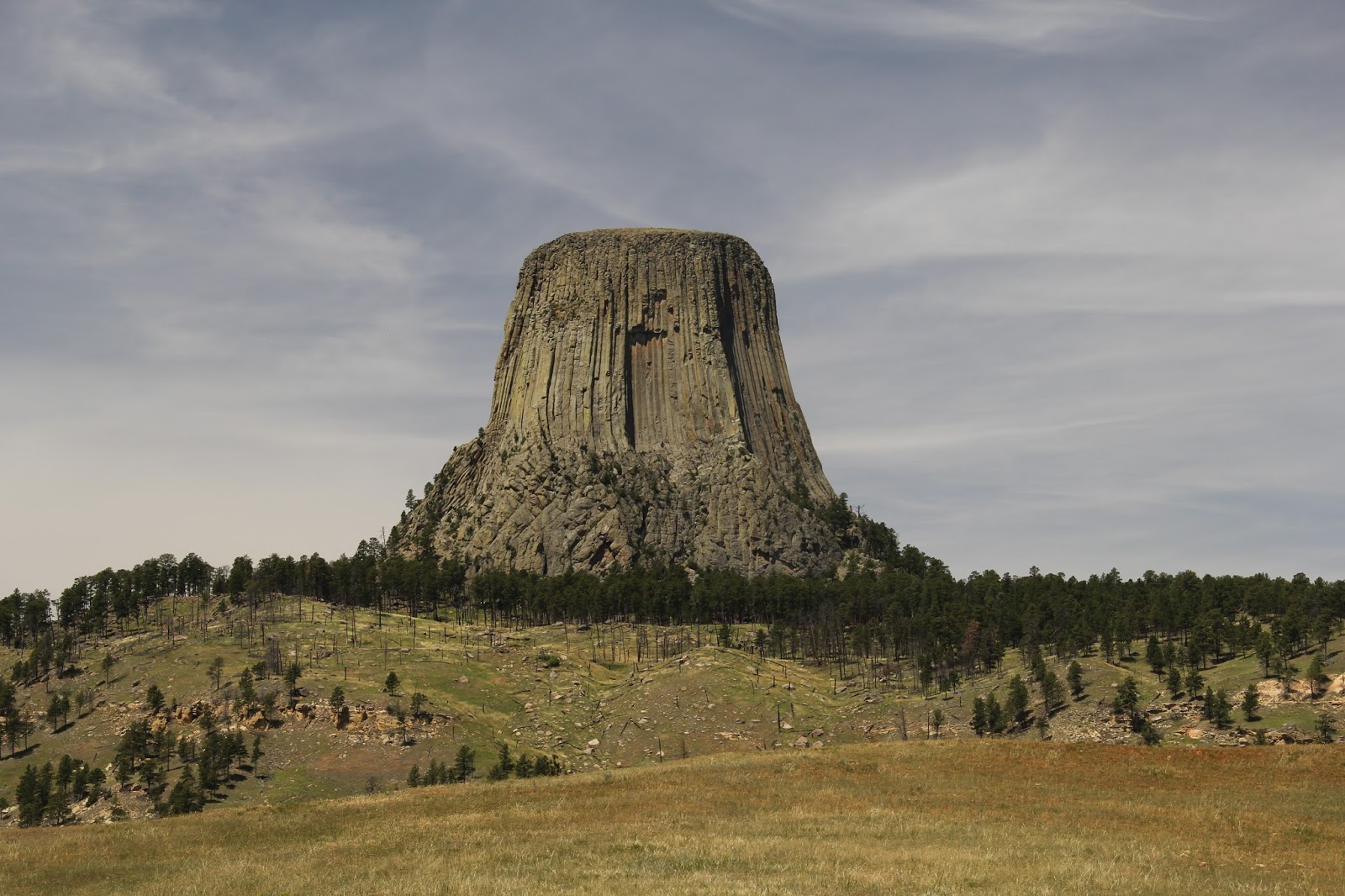
Devil's Tower as seen from the road entering the Monument
Devils Tower a monolithic rock structure composed primarily of an igneous rock known as phonolite porphyry.  Like granite, phonolite forms when magma below the surface of the earth cools slowly allowing visible crystals to form.  Phonolite contains many of the same minerals as granite, but largely lacks quartz (a prime component of granite).  Instead, the bulk of phonolite is composed of potassium feldspars.  The phonolite at Devil's Tower is a type known as phonolite porphyry.  To say that a rock is porphyritic means that it has both small and large crystals.  At Devil's Tower, the phonolite porphyry cooled at a rate that caused it to contract and form vertical columns of hexagon rock up to 15 feet across.  These columns give the surface of Devil's Tower its unique look.

Devil's Tower - note columns of igneous rock and boulders littering its base

There are several theories of how Devil's Tower formed.  The simplest theory is that a column of magma pushed up from the earth's mantle through overlying layers of sedimentary rock.  This magma probably cooled and solidified before it broke the surface - there is no evidence to suggest it reached the surface.  Over time the layers of sedimentary rock eroded away, exposing the harder igneous rock that forms Devil's Tower.  The tower itself is slowly eroding away as evidenced by the broken boulders of phonolite porphyry scattered around its base. 

Devil's Tower rises 867 feet (265 meters) from its base to its summit.  Completely isolated from any other peaks, it rises above the surrounding prairie and pine forests.  Awesome (in the sense of causing or inspiring awe; inspiring an overwhelming feeling of reverence, admiration or fear) barely begins to describe Devil's Tower.  It is little wonder that all Native American Tribes from the region consider it a sacred place.  Many of the trees at the base of  the tower are tied with prayer bundles.

Devil's Tower - note the prayer bundles tied to the tree at the right of the image

Because of the site's sacred nature and its unique geology, in 1906 President Theodore Roosevelt used the newly passed Antiquities Act to declare Devil's Tower our nation's first national monument.  Administered by the National Park Service, Devil's Tower National Monument protects the tower and approximately 1374 acres (a little over two square miles) of surrounding prairie and Ponderosa Pine forest.

If you want to visit Devil's Tower, from Mid-Michigan it is approximately one thousand two hundred eighty mile (or nearly nineteen hours) of driving away.  Obviously, this is not a weekend trip, but when combined with other sites such as the Badlands and Black Hills this is a can't miss vacation destination for any nature geek!

If you do choose to travel to Devil's Tower, here's a little hint:  the best views of the tower are not the one's you get by visiting the base of the tower.  The base of the tower is crowded, with approximately 400,000 visitors each year.  Do yourself a favor and after leaving the visitor center parking lot, turn onto a gravel road that lead to the Joyner Ridge Trail.  This road lead to a gravel parking lot about one mile northwest of Devil's Tower.  When we arrived there, there were only two other cars in the lot.  Here is the view you are rewarded with...


Here are a few more Devil's Tower photos from the Joyner Ridge trailhead.  I like how the clouds in these images look like a puff of smoke coming out of the Tower.  Enjoy.


This final picture is probably my favorite on of Devil's Tower with the lone Ponderosa Pine, grasses, and the Tower off in the distance surrounded by more pines.


Tuesday, July 11, 2017

Trail camera photos - 2017 Isabella County floods edition

This morning I went to retrieve the memory cards from my two trail cameras. These cameras have not been touched since 14 June.  I was anxious to see if they recorded any images of the flooding that happened around 22- 25 June.  Both cameras are located in high areas of a swamp/floodplain forest and I knew that there was the potential that they would be in flooded areas.  Because we left for vacation right after the flooding happened this was my first chance to see these pictures.

This first picture is from before the flooding.  This area sits about 2 or 3 feet above the surrounding swamp.  Usually by the end of June large areas of the swamp are dry.


At approximately 5:00AM on 23 June, after a night of heavy rain, there is some puddling visible in this area.


By 5:45AM the water level had risen drastically and there is almost no dry land in sight, with the exception of the immediate foreground.


By 11:15AM even the foreground is covered with a shallow layer of flood waters.


By 12:00 noon, the water had risen several more inches.  This wet fawn does not seem to be enjoying the overabundance of water.


The water continued to rise until at least 4:38PM.


By 5:00AM on the 24 June the waters had receded a foot or more.  The only water remaining was trapped in low spots.  This family of Norther Raccoons (Procyon lotor) was taking advantage of the increased foraging opportunities brought about by the flooding.


This water continued to drain away over the next twenty-four hours.


By 7:30PM on 25 June, this area was essentially back to normal.  The surrounding low areas still retain more water than is typical for this time of year.


Monday, July 10, 2017

Nature Geek Vacation Destination - Badlands National Park (Interior, SD)

awesome
adj.
Causing or inspiring awe; inspiring an overwhelming feeling of reverence, admiration or fear

awful (archaic)
adj.
inspiring reverential wonder or fear

awestruck
adj.
filled with or revealing awe


The word awesome is overused.  People use it when they mean something is good.  For instance, someone might say their strawberry-banana-kale-chia smoothie is "Awesome!"  Or a waiter at a restaurant my respond to my order of nachos with "Awesome!"

I just returned from a two week vacation.  Shara and I drove three thousand eight hundred miles and visited nine states.  In that time I saw two places that I could literally describe as awesome in the sense that they inspired an overwhelming feeling of reverence, admiration, or fear.  The first of these places was the Badlands of South Dakota.  The Badlands are a place of truly awful (inspiring reverential wonder or fear) beauty.  Shara commented while were standing on an overlook that she felt very insignificant - that is a very good thing to say about the Badlands. I have no words to describe them - I was literally awestruck by their grandeur.

The Badlands were formed by two geologic processes, deposition and erosion.  Over the course of tens of millions of years layers of sediment (sand, mud, volcanic ash, etc.) were deposited in the area that is today known as the Badlands.  For the past approximately 500,000 years wind and water have been eroding those sediments, creating the gullies, hills, and outcrops that we see today.  Geologists predict that in another 500,000 years the Badlands will be completely eroded away.  For more information on the Geology of Badlands Nation Park please visit this National Park Service webpage

Although photographs cannot do the Badland justice, here are a few of hundreds of pictures that I took during our visit.  If you want to visit the Badlands, they are almost due west of Mid-Michigan approximately one thousand one hundred miles (or sixteen hours) of driving away.  From the Badlands it is only another ninety minutes of driving to the Black Hills area (more on this later).

For now, here are my Badlands photos.  Enjoy.