Showing posts with label Monarchs. Show all posts

Friday, June 21, 2019

Vernal: A Spring Photo Project (Day 71 through Day 80)

Here come more photographs from my spring photography project.  To see the previous set of photos click this link.

Day 71 (29 May 2019) - Green Frog 


This image of a male green frog (Lithobates clamitans) was taken in Mt. Pleasant at Chipp-A-Waters Park.  Earlier in the spring I shared a photograph of an American toad taken in the same pond - both species breed in this pond, but at different times.  The fact that this is a male frog can be determined by the size of its tympanum (the circle behind its eye).  Female green frogs will have a tympanum the same size as their eye while the tympanum of a male frog is larger than the eye.  These frogs are often heard before they are seen as they announce their presence with a loud PLUNK! sounding like someone plucking a single out-of-tune guitar string.  This photograph has been cropped to a widescreen (16:9) format to eliminate some distracting elements at the top of the image.

Day 72 (30 May 2019) - Wild Geranium 


I selected this image of wild geranium (Geranium maculatum) because of color.  I like how the pink of the flowers contrasts with the varying shades of green from the geranium itself and surrounding plants.  This photograph was taken at the Chippewa Watershed Conservancy's Sylvan Solace Preserve.  Wild Geranium has long been one of my favorite wildflowers to photograph.

Day 73 (31 May 2019) - Mayapple 


This photograph was taken at Mill Pond Park in Mt. Pleasant.  Mayapple (Podophyllum peltatum) produces a single large while flower beneath as pair of large umbrella-like leaves.  From above its almost impossible to see the flowers, but from below...  This image was taken by holding the camera at ground level and using the moveable digital viewer to compose the image.

Day 74 (01 June 2019) - White-tailed Fawn 


June 1st was National Trails Day.  I was scheduled to lead hikes at four CWC preserves, but the weather was horrible almost the entire day.  We dodged thunderstorms and rain all morning with even heavier rain due early afternoon.   Everyone bailed on the hike scheduled for 1:00 except me and Shara.  Despite the rain we went for a short hike at Hall's Lake Natural Area.  I kept my camera tucked inside my raincoat for most of the hike, but I did bring it out when we spotted this white-tailed deer fawn.  Despite the rain, the hike was worth it for this picture.

Day 75 (02 June 2019) - Portrait of an Iris


In the last set of photographs I shared an image of a Siberian iris photographed in our home flower garden.  This iris image comes from our gardens too, but this is a bearded iris.  I deliberately shot this image to focus on the iris' beard.

Day 76 (03 June 2019) - Monarch Egg 


On June 3rd I decided to stop at Forest Hill Nature Area on the way home.  Large parts of the property were mowed down last fall and then (apparently) sprayed with herbicide this spring.  I can only assume the intent is to replant these areas with native seed sometime this year.  Right now walking through these areas is rather depressing.

However, I did notice that the herbicide did not kill all of the common milkweed (Asclepias syriaca).  On a whim I decided to search the milkweed plants for a monarch butterfly egg.  I found this one on the second plant I searched.  This image has been cropped down to about 30% of the original size and has been the brightness of the image has been adjusted.


Day 77 (04 June 2019) - Impressions of grass @ icd office


The photograph for Day 77 was taken at the Isabella Conservation District Office.  The wind was constantly creating waves in the grassy field behind the office.  I decided to work with the wind and create an Impressionist photograph of the scene.  The image above was shot at 1/6 second at f/32 to capture the blur of the grass as the wind moved it around.  This image reminds me a bit of some of the landscapes in Frederick Remington's later paintings that were heavily influenced by Impressionism.  Of this set of ten photographs, this is my favorite image.

Day 78 (05 June 2019) - Dead Man's Fingers


A trip to Mission Creek Woodland Park yielded this photograph of the appropriately-named Dead Man's Fingers fungus poking out of the ground.  I like this image more for the subject than I do for the composition.

Day 79 (06 June 2019) - Common Whitetail


I love photographing dragonflies... when they will sit still for more than a few seconds. 

This female common whitetail (Plathemis lydia) perched on a blade of grass a few inches off the ground at Chipp-A-Waters Park in Mt. Pleasant.  She sat still as I approached to within about 4 feet and stayed there long enough for me to snap several dozen photos from more than one angle.  This picture has been cropped from a horizontal to a vertical image.

Day 80 (07 June 2019) - Raindrops on Spiderwort leaf @ Saginaw Chippewa academy 


The final image of this set was taken at 7:30 in the morning at the Saginaw Chippewa Academy's native pollinator garden.  The garden has reached its early summer glory with hordes of coreopsis, penstemon, Canada anemone, and spiderwort bursting into bloom.  On this morning the star of the show as not the flowers but rather the thousands of water droplets left by an overnight rain shower.  My favorite image of the day was of this single large droplet poised on the end of a spiderwort leaf.  A couple of smaller drops sit further back along the leaf and droplets in the background refract circular globes of light.  If you look closely at the central water drop you can see an inverted image of the background plants and sky.

Sunday, July 29, 2018

The Days of Summer - Day Thirty-one through Day Thirty-seven

This is installment five of my Days of Summer photography project.  (Click here to view the photos from part four.)  The intent of this project is to get outdoors everyday to photograph something in nature and to pick a single image to represent each day of the summer from the Summer Solstice (21 June 2018) to the Fall Equinox (22 September 2018).  Five weeks into summer, this has been a very rewarding project.  It takes time, but I think I am producing some of my best photography ever.  I am definitely learning more about my camera and lenses.

Enjoy.

Day 31 (21 July 2018) - Raindrops on Rosinweed


This image a raindrops on a Rosinweed (Silphium integrifolium) was photographed at home in our native pollinator garden during a lull between rain showers.

Day 32 (22 July 2018) - Monarch on Purple Coneflower


This photograph was taken at Forest Hill Nature Area during a very windy afternoon.  At one point this Monarch Butterfly (Danaus plexippus) nearly blew off the top of this Purple Coneflower (Echinacea purperea).  Despite the wind, this was a great day for pollinator photography.  I was able to photograph five butterfly species, a couple moths, numerous bees, and several wasp species.  Picking a single image for the day was difficult, but I like the position of the butterfly facing into the wind and the grass blades blowing in from the left of the picture.

Day 33 (23 July 2018) -Early Fall Colors


This picture of Red-osier Dogwood (Cornus sericea) berries and leaves was also taken at Forest Hill Nature Area.  Many of the dogwood leaves were already changing color.  This is not necessarily a sign of fall, but a sign of stress such as too little rain.

Day 34 (24 July 2018) - Green Frog


This picture was taken at Chipp-A-Waters Park in Mt. Pleasant.  I heard several Green Frogs (Lithobates clamitans) calling from a small wetland area near the back of the park.  Most of the frogs dove into the pond when I approached but this one let me approach to about five or six feet.  This image has been cropped from a horizontal to a vertical image.

Day 35 - Yeah, Here Come the Rooster


This image and the next one were actually taken indoors.  I spent much of last week at the Isabella County Fair.  County fairs are an integral part of summer across much of the United States.  This rooster was one of the many animals entered in the fair by 4H members.

If you understand the title of this image, bonus points for you!  If you don't...

Day 36 (26 July 2018) - Charolais Steer


Another image from the Isabella County Fair.  Raising beef cattle is one of the most popular projects for 4H members in the area.  It quite something to watch a nine or ten year old kid weighing maybe 100 pounds walk a full grown steer around the arena and present it for judging.  I photographed the Charolais steer  in the beef cattle barn as it stared at me from its stall.

Day 37 (27 July 2018) - Stormcloud


The final picture of the week was photographed in southern Isabella County on my way home from work.  I watched this storm approached from the west and raced to try to intersect it in a place where I could get a good image.  Don't worry, I never went above the speed limit - the gravel road that I was traveling on would not allow for speeds much above 30 mph in most sections.  I like this picture because of the contrast between the dark water laden bottom of the cloud and the sun shining through the top.

Wednesday, September 6, 2017

A bunch of "almost" butterfies...

Monarch chrysalis in the wild

I photographed this Monarch (Danaus plexippus) chrysalis last night at the home of John and Jean Mitchell.  John is the president of board of directors for the Chippewa Watershed Conservancy.  I was at John's home for a committee meeting.  The board of the CWC often breaks into smaller committees to handle matters that do not require the attention of the entire board of directors.  The meeting last night was to discuss land acquisition and stewardship.  Before the meeting John asked me about some insect burrows along the edge of their driveway.  I didn't see any insects, but from what he described and the shape of the burrows I am pretty confident that they have mining bees.  Right above the mining bee nests, John pointed out the Monarch chrysalis hanging in a juniper.  I rarely find chrysalises in the wild so this was a rare treat for me.

Meanwhile, at home...

We have thirty-two Monarchs is some stage of development.

Monarch chrysalis

We have eleven chrysalises (or chrysalids).

Monarch hanging in a J

Three are in the J stage where they hang upside sown from a "button" of silk attached to the tip of their abdomen.  In this stage they are close to sloughing off their exoskeleton and becoming a chrysalis.  They may remain in a J for a day or more before becoming a chrysalis.

"buttoning" caterpillar and chrysalises

We currently have two caterpillars that are "buttoning".  In this stage they are adhering their abdomen to a solid surface with a web of sticky silk.  This button has to be strong enough to support their weight when they hang from it.  In the picture above you can see not only a caterpillar buttoning, but also several chrysalises attached by silk buttons.

Monarch caterpillars

Finally, we still have sixteen caterpillars (or more - I may have missed a couple) still munching away happily on Common Milkweed (Asclepias syriaca) leaves.  Many of these are in their third or fourth instar.  An instar is a growth phase that a caterpillar goes through.  At the end of each instar the caterpillar must shed its exoskeleton for a newer more flexible exoskeleton that will stretch as it grows.  Monarch caterpillars go through five instars before shedding their exoskeleton on final time to become a chrysalis.

Monarch caterpillars on Common Milkweed in our rearing container.  How many can you see in this photo?
On September 16th, we will have all of our Monarchs at the Ziibiwing Center for their annual Monarch Butterfly Celebration.  If you are in the Mt. Pleasant area be sure to stop by between noon and 4:00PM.

Tuesday, August 22, 2017

Field Trip to Peterson Natural Area (12 August 2017)

Field trip participants (Cathy Murray, Dick and Diana Moreau, and Ruth Chapman) pose by the preserve sign
 
On Saturday August 12th, I led a field trip to the Chippewa Watershed Conservancy's Peterson Natural Area.  At 79 acres, Peterson NA is one of the largest preserves in the CWC's inventory.  It is also (probably) one of the least visited.  Located in Mecosta County, Peterson NA is much closer to Big Rapids (less than 10 miles) than it is to Mt. Pleasant (approximately 40 miles).  This distance from Mt. Pleasant puts off the radar for most CWC supporters - if you are going to Peterson Natural Area you are making a time commitment.

Despite the distance from Mt. Pleasant (or in my case from Alma), visiting Peterson Natural Area is worth the effort.  Here are a few pics from that visit.

Ruth was wearing a walking cast and needed a helping hand to navigate a couple stretches

Goldenrod Soldier Beetle (Chauliognathus pensylvanicus) on Great Blue Lobelia (Lobelia siphilitica)

The surprise of the day was finding a Wood Turtle (Glyptemys insculpta) in the wet meadow that runs down the center of the property.  The Wood Turtle is considered a Species of Special Concern by the State of Michigan so it is always a thrill to see one.  Wood Turtles do frequently spend much of the summer in upland areas, but I didn't suspect that the small stream running through Peterson Natural Area would bring one to the property from the nearby Muskegon River.  I actually found this turtle with my feet - while walking through the tall grass of the meadow, I stepped on what initially I thought was a rounded rock.  Surprise!


Cathy photographing the Wood Turtle

Who wouldn't love that face!

Joe-pye Weed (Eutrochium maculatum) was growing everywhere along the stream.

Swamp Milkweed (Asclepias incarnata) adds its magenta hues to the landscape mosaic.

Mating Yellow-collared Scape Moths (Cisseps fulvicollis) on Common Boneset (Eupatorium perfoliatum)

Giant Swallowtail (Papilio cresphontes) nectaring on Swamp Milkweed
The upland parts of the property (northwest quarter) is very different from the low area along the stream.  It is very dry and sandy.  The Michigan Natural Features Inventory pre-settlement vegetation map indicates that Peterson Natural Area was once covered with Beech-Sugar Maple-Hemlock Forest, but the vegetation on this hill is currently more like that found on a Dry Sand Prairie or Oak-Pine Barren.  Pre-settlement maps indicate that two areas of  Oak-Pine Barren could be found within two miles of Peterson NA in the past.


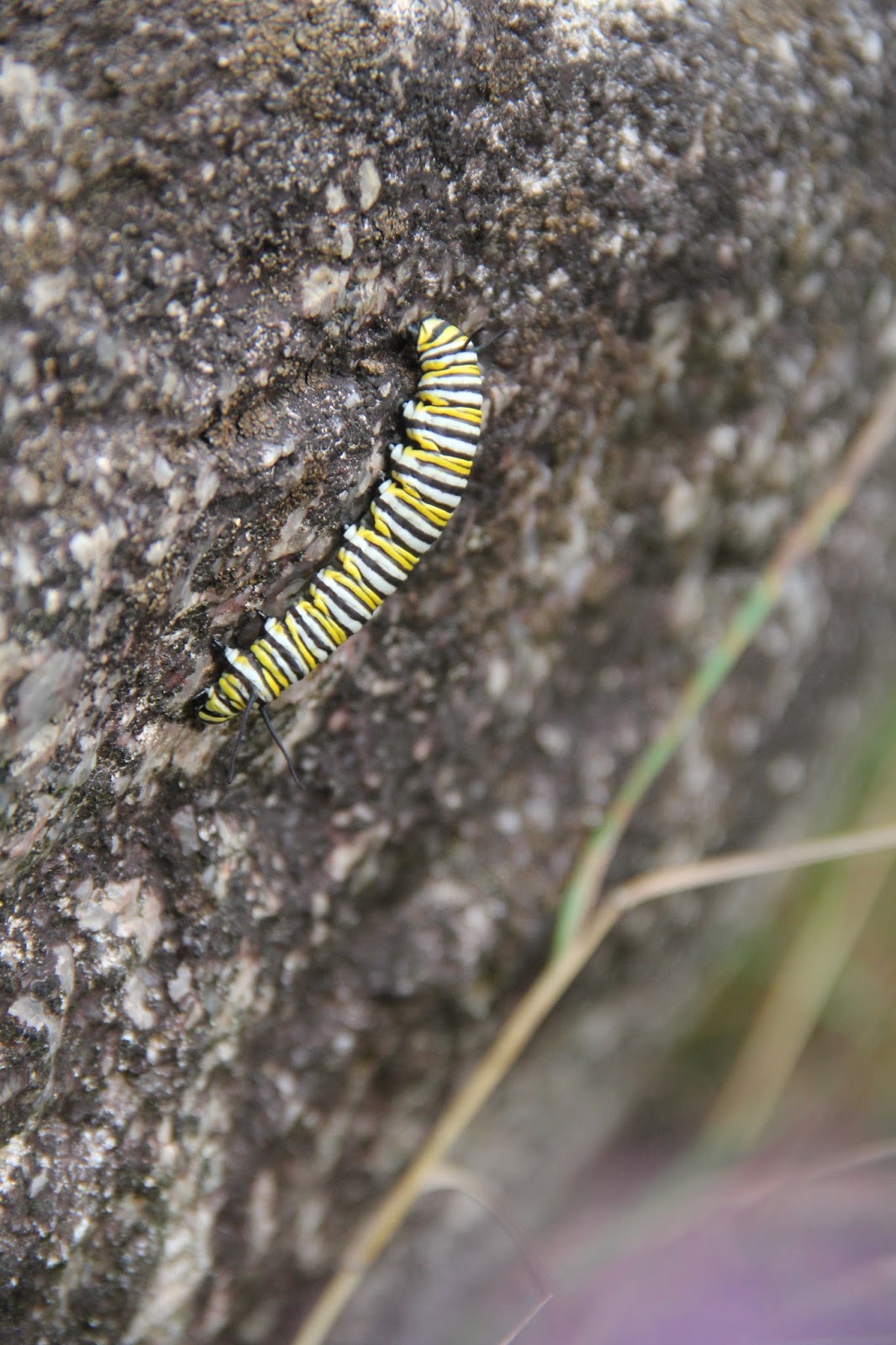
Near the end of our walk, we found three Monarch caterpillars.  All three were in their 5th instar and were almost ready to enter the chrysalis stage.  The first two caterpillars were feeding on Common Milkweed plants.


Ruth zooms in on a Monarch caterpillar


The third caterpillar was crawling around on the side of a large rock.  In the hours before forming a chrysalis, Monarch caterpillars (and those of other butterfly species) often wander far from their host plant.


If you are interested in visiting Peterson Natural Area, this is the best time of year to do so.  The late summer wildflowers in the wet meadow are at their peak and the fall asters and goldenrods will be blooming soon.  If time allows, I may try to take one more trip over before the bloom is done.

Thursday, August 17, 2017

Upcoming Event - Monarch Butterfly Celebration (Saturday 16 September 2017)


Join me on Saturday September 16th from 1:00PM to 4:00PM for the annual Monarch Butterfly Celebration at the Ziibiwing Center of Anishinabe Culture & Lifeways.  The Ziibiwing Center is located at 6650 E. Broadway, Mt. Pleasant.


I will  have information about ways to help Monarchs (and other pollinators) and free posters at this event.  I hope to have Monarch butterflies to tag and release at the celebration - I have been seeing lots of adult Monarchs this week and will begin collecting caterpillars next week.

Tuesday, June 20, 2017

A caterpillar at breakfast

Earlier this morning, Shara sent me a photograph from the Saginaw Chippewa Academy's native pollinator garden.

Monarch caterpillar on Common Milkweed (photo by Shara LeValley)

Woohoo!

That's a Monarch (Danaus plexippus) caterpillar munching on a Common Milkweed (Asclepias syriaca) flower.  It's nice to see the garden being used by wildlife, especially Monarchs.  I am hopeful that we will find more Monarchs in the garden as the summer progresses further.

Tuesday, June 13, 2017

Nestlings and more (12 June 2017)

Shara and I stopped at the Ziibiwing Center last night (12 June) to check on the bluebird nesting boxes.  First up was the single Eastern Bluebird nest.  Here is what they looked like yesterday.


Eastern Bluebird nestlings on 12 June 2017 (photo by Shara LeValley)

For comparison, the same nest on June 6th.  Those little buggers have grown a lot in a week!

Eastern Bluebird nestlings on 06 June 2017 (photo by Shara LeValley)
 We also checked on the four Tree Swallow nests.  One nest had chicks that appeared to have hatched in the last 24 hours.  The chicks in the other three nests are a five to ten days old.  Here is a picture of  one of the older nests.  Unfortunately most of the other photos were too dark and blurry.

Tree Swallow nestlings on 12 June 2017 (photo by Shara LeValley)
The birds were not the only babies that we found.  While walking across the lawn, we noticed a patch of Common Milkweed and out of habit began to search for Monarch eggs and caterpillars.  We found one - our first caterpillar of the year!  Because grounds was at that time mowing the lawn, we knew this caterpillar would not survive where it was found.  We collected it and took it home to rear.  We'll release it once it metamorphoses as an adult.


Monarch caterpillar (photo by Shara LeValley)
Finally, we discovered paper wasps creating a nest on the underside of a sculpture.  Wasps create these nests by chewing up wood fibers and mixing it with their saliva to create a paper-like substance.  The hexagonal shape of each cell allows the wasps to fit the maximum number of cells in a small space.

Paper wasps (photo by Shara LeValley)

Paper wasp nest on coneflower sculpture (photo by Shara LeValley)


Thursday, September 1, 2016

Upcoming Event - Monarch Butterfly Celebration (Saturday 17 September 2016)


Join me on Saturday September 17th from 1:00PM to 4:00PM for the annual Monarch Butterfly Celebration at the Ziibiwing Center of Anishinabe Culture & Lifeways.  The Ziibiwing Center is located at 6650 E. Broadway, Mt. Pleasant.


As always, I will  have information about ways to help Monarchs (and other pollinators) and free posters at this event.  I hope to have butterflies to tag and release at the event - unfortunately I am not having much luck finding caterpillars this year.

Thursday, May 26, 2016

First Monarch and eggs of 2016

A bonus post today.

I went out in the field behind the office to check on the growth of milkweed plants.  To my surprise, a Monarch Butterfly (Danaus Plexippus) popped up from behind a clump of grapevines.  I ran across the field to follow it.  When it finally landed on a Common Milkweed (Asclepias syriaca), I could see that it was a female.  Of course, I was violating the First Rule of Photography (TAKE YOUR CAMERA WITH YOU.) so I didn't get any pictures of her.

After she took off, I saw that she had laid two eggs on the plant.  After getting my camera, I photographed them and then found a third egg in the area where I originally spotted the Monarch.

A pair of Monarch eggs on a Common Milkweed plant (26 May 2016)
TAKE YOUR CAMERA WITH YOU!

Friday, January 22, 2016

Native Pollinator Garden Update - Winn Elementary (22 January 2016)

Earlier this week I shared some photographs of the Native Pollinator Garden at the Mt. Pleasant Discovery Museum.  Today I visited Winn Elementary to do a couple of presentations and decided to take a few photographs of their Native Pollinator Garden.

Looking into the garden from the school entrance

The view from the far end of the garden.  The bee nesting box is waiting for residents.

This garden is certified as a Monarch Waystation and Native Plant Butterfly Garden

Butterflyweed is a Monarch host plant

Nodding Wild Onion

Bird Bath and Leopold bench

Sky Blue Aster
 
Purple Coneflowers provide winter food for birds

I am starting to really look forward to spring.  I am excited to see what surprises will happen in the gardens this year!