Showing posts with label frog. Show all posts

Friday, June 21, 2019

Vernal: A Spring Photo Project (Day 71 through Day 80)

Here come more photographs from my spring photography project.  To see the previous set of photos click this link.

Day 71 (29 May 2019) - Green Frog 


This image of a male green frog (Lithobates clamitans) was taken in Mt. Pleasant at Chipp-A-Waters Park.  Earlier in the spring I shared a photograph of an American toad taken in the same pond - both species breed in this pond, but at different times.  The fact that this is a male frog can be determined by the size of its tympanum (the circle behind its eye).  Female green frogs will have a tympanum the same size as their eye while the tympanum of a male frog is larger than the eye.  These frogs are often heard before they are seen as they announce their presence with a loud PLUNK! sounding like someone plucking a single out-of-tune guitar string.  This photograph has been cropped to a widescreen (16:9) format to eliminate some distracting elements at the top of the image.

Day 72 (30 May 2019) - Wild Geranium 


I selected this image of wild geranium (Geranium maculatum) because of color.  I like how the pink of the flowers contrasts with the varying shades of green from the geranium itself and surrounding plants.  This photograph was taken at the Chippewa Watershed Conservancy's Sylvan Solace Preserve.  Wild Geranium has long been one of my favorite wildflowers to photograph.

Day 73 (31 May 2019) - Mayapple 


This photograph was taken at Mill Pond Park in Mt. Pleasant.  Mayapple (Podophyllum peltatum) produces a single large while flower beneath as pair of large umbrella-like leaves.  From above its almost impossible to see the flowers, but from below...  This image was taken by holding the camera at ground level and using the moveable digital viewer to compose the image.

Day 74 (01 June 2019) - White-tailed Fawn 


June 1st was National Trails Day.  I was scheduled to lead hikes at four CWC preserves, but the weather was horrible almost the entire day.  We dodged thunderstorms and rain all morning with even heavier rain due early afternoon.   Everyone bailed on the hike scheduled for 1:00 except me and Shara.  Despite the rain we went for a short hike at Hall's Lake Natural Area.  I kept my camera tucked inside my raincoat for most of the hike, but I did bring it out when we spotted this white-tailed deer fawn.  Despite the rain, the hike was worth it for this picture.

Day 75 (02 June 2019) - Portrait of an Iris


In the last set of photographs I shared an image of a Siberian iris photographed in our home flower garden.  This iris image comes from our gardens too, but this is a bearded iris.  I deliberately shot this image to focus on the iris' beard.

Day 76 (03 June 2019) - Monarch Egg 


On June 3rd I decided to stop at Forest Hill Nature Area on the way home.  Large parts of the property were mowed down last fall and then (apparently) sprayed with herbicide this spring.  I can only assume the intent is to replant these areas with native seed sometime this year.  Right now walking through these areas is rather depressing.

However, I did notice that the herbicide did not kill all of the common milkweed (Asclepias syriaca).  On a whim I decided to search the milkweed plants for a monarch butterfly egg.  I found this one on the second plant I searched.  This image has been cropped down to about 30% of the original size and has been the brightness of the image has been adjusted.


Day 77 (04 June 2019) - Impressions of grass @ icd office


The photograph for Day 77 was taken at the Isabella Conservation District Office.  The wind was constantly creating waves in the grassy field behind the office.  I decided to work with the wind and create an Impressionist photograph of the scene.  The image above was shot at 1/6 second at f/32 to capture the blur of the grass as the wind moved it around.  This image reminds me a bit of some of the landscapes in Frederick Remington's later paintings that were heavily influenced by Impressionism.  Of this set of ten photographs, this is my favorite image.

Day 78 (05 June 2019) - Dead Man's Fingers


A trip to Mission Creek Woodland Park yielded this photograph of the appropriately-named Dead Man's Fingers fungus poking out of the ground.  I like this image more for the subject than I do for the composition.

Day 79 (06 June 2019) - Common Whitetail


I love photographing dragonflies... when they will sit still for more than a few seconds. 

This female common whitetail (Plathemis lydia) perched on a blade of grass a few inches off the ground at Chipp-A-Waters Park in Mt. Pleasant.  She sat still as I approached to within about 4 feet and stayed there long enough for me to snap several dozen photos from more than one angle.  This picture has been cropped from a horizontal to a vertical image.

Day 80 (07 June 2019) - Raindrops on Spiderwort leaf @ Saginaw Chippewa academy 


The final image of this set was taken at 7:30 in the morning at the Saginaw Chippewa Academy's native pollinator garden.  The garden has reached its early summer glory with hordes of coreopsis, penstemon, Canada anemone, and spiderwort bursting into bloom.  On this morning the star of the show as not the flowers but rather the thousands of water droplets left by an overnight rain shower.  My favorite image of the day was of this single large droplet poised on the end of a spiderwort leaf.  A couple of smaller drops sit further back along the leaf and droplets in the background refract circular globes of light.  If you look closely at the central water drop you can see an inverted image of the background plants and sky.

Sunday, July 29, 2018

The Days of Summer - Day Thirty-one through Day Thirty-seven

This is installment five of my Days of Summer photography project.  (Click here to view the photos from part four.)  The intent of this project is to get outdoors everyday to photograph something in nature and to pick a single image to represent each day of the summer from the Summer Solstice (21 June 2018) to the Fall Equinox (22 September 2018).  Five weeks into summer, this has been a very rewarding project.  It takes time, but I think I am producing some of my best photography ever.  I am definitely learning more about my camera and lenses.

Enjoy.

Day 31 (21 July 2018) - Raindrops on Rosinweed


This image a raindrops on a Rosinweed (Silphium integrifolium) was photographed at home in our native pollinator garden during a lull between rain showers.

Day 32 (22 July 2018) - Monarch on Purple Coneflower


This photograph was taken at Forest Hill Nature Area during a very windy afternoon.  At one point this Monarch Butterfly (Danaus plexippus) nearly blew off the top of this Purple Coneflower (Echinacea purperea).  Despite the wind, this was a great day for pollinator photography.  I was able to photograph five butterfly species, a couple moths, numerous bees, and several wasp species.  Picking a single image for the day was difficult, but I like the position of the butterfly facing into the wind and the grass blades blowing in from the left of the picture.

Day 33 (23 July 2018) -Early Fall Colors


This picture of Red-osier Dogwood (Cornus sericea) berries and leaves was also taken at Forest Hill Nature Area.  Many of the dogwood leaves were already changing color.  This is not necessarily a sign of fall, but a sign of stress such as too little rain.

Day 34 (24 July 2018) - Green Frog


This picture was taken at Chipp-A-Waters Park in Mt. Pleasant.  I heard several Green Frogs (Lithobates clamitans) calling from a small wetland area near the back of the park.  Most of the frogs dove into the pond when I approached but this one let me approach to about five or six feet.  This image has been cropped from a horizontal to a vertical image.

Day 35 - Yeah, Here Come the Rooster


This image and the next one were actually taken indoors.  I spent much of last week at the Isabella County Fair.  County fairs are an integral part of summer across much of the United States.  This rooster was one of the many animals entered in the fair by 4H members.

If you understand the title of this image, bonus points for you!  If you don't...

Day 36 (26 July 2018) - Charolais Steer


Another image from the Isabella County Fair.  Raising beef cattle is one of the most popular projects for 4H members in the area.  It quite something to watch a nine or ten year old kid weighing maybe 100 pounds walk a full grown steer around the arena and present it for judging.  I photographed the Charolais steer  in the beef cattle barn as it stared at me from its stall.

Day 37 (27 July 2018) - Stormcloud


The final picture of the week was photographed in southern Isabella County on my way home from work.  I watched this storm approached from the west and raced to try to intersect it in a place where I could get a good image.  Don't worry, I never went above the speed limit - the gravel road that I was traveling on would not allow for speeds much above 30 mph in most sections.  I like this picture because of the contrast between the dark water laden bottom of the cloud and the sun shining through the top.

Tuesday, May 8, 2018

Forestry for Fifth Graders (07 & 08 May 2018)

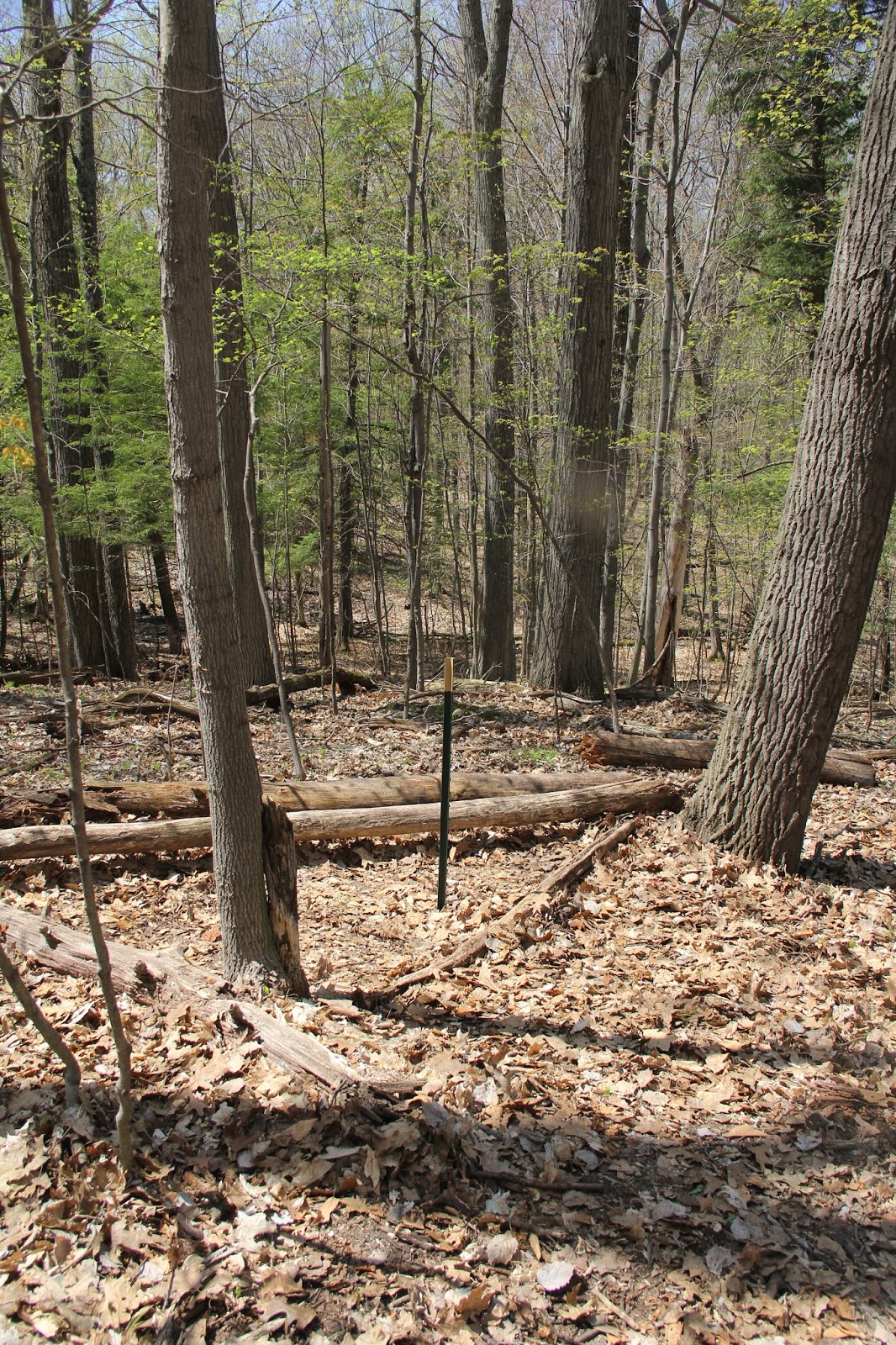
If you have visited the Chippewa Watershed Conservancy's Audubon Woods Preserve in the past week you may have noticed some metal T-posts that weren't there before.

A metal T-post standing alone at Audubon Woods Preserve

Why are these posts at Audubon Woods?  What are they for?

For the past seven years, I have used Audubon Woods as an outdoor science classroom for local elementary students.  The T-posts are meant to be semi-permanent education stations.  In the past, every time I took students to Audubon Woods I would set up temporary stations at somewhat random points in the woods.  There is a lot that can be done by using temporary points, but more can be learned long term if students use the same locations time after time.

With permission, I set about placing posts along a series of transects (lines) throughout the woods.  I set up three transects at regularly spaced intervals in the woods and placed six evenly-spaced posts along each transect.  Now with semi-permanent locations, data that the students collect can be compared over time.

So what kinds of data are the students collecting?

Over the past two day (07 & 08 MAY 2018) I have been working with fifth grade students from Shepherd Elementary.  These classes were able to travel to Audubon Woods because last fall their teachers applied for and received a Wheels To Woods field trip grant. 

Students are measuring the circumference of trees in their study plot and using that to calculate diameter.

Measuring a tree's circumference

Measuring large trees takes teamwork


Students are also counting trees at their study plot to determine the number of trees in one acre of forest and in the entire forest.  Audubon Woods is 40 acres in size - at 43,560 sq. ft/acre, that means Audubon Woods is 1,742,400 sq. ft!  Counting all of the trees in an area this size would be an impossible task.  Luckily, it is easy to count the number of trees in a much smaller area and then use that number to estimate the total number of trees in the forest.  A circle with a radius of approximately 37 feet will have an area of 1/10 acre.   Remember those T-posts?  Students counted every tree within 37 feet of the post and used multiplied that number by 10 to find the number of trees in one acre and then again by 40 to find the total number of trees in Audubon Woods.

Tape measures are an important forestry tool

Measuring trees to make sure they fit in their plot

Students then calculated the number of leaves on the forest floor by counting the number of leaves in one square foot and then multiplying by 43,560 to get the number of leaves in one acre, and then by 40 to get the total number of leaves on the floor of Audubon Woods.  Imagine if a single square foot holds exactly 100 leaves, this would calculate out to over 172 million leaves in the forest!

Students had a square made from PVC pipe to make their task easier

Counting leaves from a single square foot of forest

Re-calculating...

Students also calculated the weight of all the leaves in the forest, identified and sketched leaves, and drew a sketch of the forest near their study plot.  Perhaps just as important as the science, this field trip allowed students to get out of the classroom for a few hours.  The months of April and May are testing time in Michigan.  Students spend hours taking state-mandated assessments and even more hours taking tests required by their local school district.  A field trip like this exposes them to sights, sounds, and smells that thy can never experience in the classroom.

Large-flowered Trillium

 
Trillium surrounded by Mayapple


Spring Beauty flowers


Bloodroot

Skunk Cabbage

Wood Frogs were everywhere hidden among the leaves

Another Bloodroot flower

The maples and other trees are just starting to leaf out

Wednesday, April 19, 2017

Sounds of Spring - Spring Peepers

We spent the past week in the Traverse City area.  When we pulled up to our hotel on Friday night we immediately noticed a familiar sound.  The area behind the hotel is basically a shrub swamp and this weekend that swamp was hosting dozens of male Spring Peepers (Pseudacris crucifer) each hoping to attract a mate with his peep peep peep calls.  The louder and more frequently a frog call, the better his chances of attracting a mate.  There was also at least one Western Chorus Frog (Pseudacris triseriata) that periodically adds his voice.


It didn't happen while I was recording, but at one point a storm passed through with a loud crack of thunder.  Every single frog, which to that point had been vociferously calling, immediately went silent.  The effect was enough to make me chuckle.

Monday, April 10, 2017

The sounds of Spring - Wood Frogs

Last week I posted a short video from a local wetland area.  The video itself wasn't anything special; I was mainly trying to record the sounds of a local wetland.  The star of that video was a group of Western Chorus Frogs (Pseudacris triseriata), but in the background of the video you could hear the breeding calls of Wood Frogs (Lithobates sylvaticus).

Yesterday, Shara and I went out to Forest Hill Nature Area to walk the trails.  As we approached the North Woods we could hear Wood Frogs calling from several of the vernal pond scattered throughout the woods.  I took the opportunity to record another video.  Again this video should really be treated as a sound recording, the picture is definitely secondary.

The primary sound in this video is the "quacking" sound from the Wood Frogs.  There are also periodic bird calls and the sound of wind blowing over the microphone on my camera.

Enjoy.


Sunday, April 2, 2017

The sounds of Spring

My camera has a video function that I rarely use, but yesterday I could not resist.  Nevermind the video itself (I was standing in a thicket surrounded willows and Indian Hemp).  What I really wanted to record was the sound.  The overlying sound is the call of Western Chorus Frogs (Pseudacris triseriata).  Periodically you hear a male Red-winged Blackbird (Agelaius phoeniceus) add his voice.  Deep in the background are the duck-like calls of Wood Frogs (Lithobates sylvaticus).

Enjoy.


Wednesday, December 28, 2016

Favorite Photos of 2016

We've reached the end of another year.  Every year I post a sort of year-in-review of my favorite photographs from the year.  This is the 2016 edition.  My favorite photos from past years can be found here, here, and here.

The first photograph comes from a post I made back on January 13th.  It shows a miniature forest of Wild Leek stalks and tree seedlings poking up through snow at Chipp-A-Waters Park in Mt. Pleasant.  I like the stark, almost abstract quality that this image has.


The second photograph come from February 25th.  The night before saw about 8 inches of snow dumped on Mid-Michigan and caused all local schools to be cancelled.  I paused for a moment while shoveling out to take this photo of the sun trying to cut through the overcast sky.  The snow covered branches belong to a large Honey Locust tree right outside my back door. 


Some of my favorite photographs are a bit more abstract than others.  This picture was taken at Dow Gardens in Midland on March 30th.  Every year Dow Gardens hosts an exhibit called Butterflies in Bloom in their conservatory - the 2017 Butterflies in Bloom exhibit is scheduled for 03 March through 16 April.  Shara and I attend every year to see and photograph the butterflies.  There are often so many people packed into the conservatory that it is almost impossible to get good pictures of the butterflies.  I often find myself spending more time taking pictures of the tropical plants than I do of the butterflies.  I especially liked the fan-like leaves of this plant.


The next picture comes from Mill Pond Park on April 14th.  I don't spend a lot of time photographing birds.  I generally lack the patience required to be a birder (and frankly most birds don't excite me all that much) so I spend very little time looking for birds.  However, there are times a bird shows up that just demands to be photographed.  Although not a rare bird, and becoming quite a nuisance in many places, the Canada Goose is an attractive bird.  This goose was casually swimming around the pond and approached quite close, which allowed my to take a large number of portraits of it.


This next picture might be my favorite image from the entire year.  I frequently take students out into the woods to study trees and learn about forestry.  Although I have been bringing students from Winn Elementary to the Chippewa Watershed Conservancy's Audubon Woods Preserve for several years, this was the first year that I have ever brought students from the Saginaw Chippewa Academy to this location.  While measuring tree diameters, some of the students found this Grey Tree Frog hanging out on the bark of one of the trees.  I love how this frog just disappears on the bark - camouflage is an awesome adaptation!  This images dates from May 17th and appeared in a post the next day.


I take thousands of photographs every year.  Most of them never make it onto this blog.  That doesn't mean that I don't like them or that they aren't good photographs.  Sometimes I just don't have time to write about everything I want to.  This year a disproportionate number of my posts were about wildflowers so other subjects often went untouched.  Back on June I spent several days meeting students at various ponds and rivers to sample aquatic invertebrates.  None of the photos ever showed up on this blog.  One of my favorite pictures was this one from June 7th of a student from Shepherd Elementary holding a small Wood Frog that she found along the Little Salt River.  Why do I like this photo?  The contrast of the pink sweatshirt with the greens and browns of the frog - girls rock at science!


I spend a significant part of July away from Mid-Michigan.  I attended the Michigan Department of Natural Resources 2016 Academy of Natural Resources.  Later in the month, Shara and I traveled through parts of four states while on vacation.  My favorite photo from the month isn't necessarily a great picture, but it documents my favorite place that we visited during our travels - Great Serpent Mound.

Great Serpent Mound is what is known as an effigy mound - this means it is an earthen mound created in the shape of a person, animal, or symbol.  It is the largest effigy mound in the world.  It measures approximately just over a 1/4 mile long (1348 feet) and is several feet tall.  When you remember that this was constructed entirely by hand using wood, stone, and bone tools the achievement of its construction becomes even more remarkable.  The exact age of Great Serpent Mound is unknown.  Several burial mounds on the site date from Fort Ancient Culture (1000 - 1500 AD) and the earlier Adena Culture (800 BC - 100 AD).  Great Serpent Mound probably dates to one (or both) of these cultures as it was likely rebuilt several times over its history.


The next photograph was taken the morning of  August 22nd.  It shows a band of low clouds rolling across the landscape.  This unusual cloud formation is known as an arcus cloud and is usually associated with thunderstorms, but can also occur when a cold front passes through.  This specific type of arcus cloud is known as a roll cloud, because it appears to be rolling through the sky completely detached from all other clouds.


If you haven't figured it out by now, I am sharing one photograph from each month of the year.  September is the time that the school gardens really their stride.  Almost everything is in bloom and many pants are starting to develop their seeds.  Back on September 14th and 15th I spent some time photographing the native pollinator gardens at the Saginaw Chippewa Academy and Winn Elementary.  This picture of Butterflyweed s my favorite garden photograph of the year and a strong contender for my favorite photo of 2016.  I love the full exploding fluffiness of the ripe seeds bursting from the pod to the right and how it contrasts with the still closed pods to the left of the photo.


October was one of the toughest months to pick a favorite.  I had lots of images of fall color to choose from.  Instead I picked this picture of the sunrise from October 26th.  I often lament the fact that Mid-Michigan does not have any dramatic landscapes, but if you look hard enough there is still drama to be found.


November was one of the most difficult months from which to choose a favorite photograph - photos of leaves and tree trunks, the full moon, Lake Michigan, etc..  The photograph I chose was an instant favorite.  It shows three fourth-grade students from Vowles Elementary posing during a woodland ecology activity at the school.  Why do I like this photo?  It reminds me of the painting The Son of Man by RenĂ© Magritte.  It shows the students, but the leaves hide their identities.  As soon as one of the students picked up a large leaf I thought of posing them like this.  I rarely ask people to pose in photos, but I like the results in this image.


December was probably my lightest month of the year for photography.  I hardly took any photographs - I know the month isn't over so I have a few more chances.  My favorite picture of the month is sort of an abstract one - it shows ice pans covering the surface of the Chippewa River at Mill Pond Park on December 14th.  Although I shared several photos from this date, this picture was not one of them.  Is it s great photograph?  No.  Is it even a good photograph?  Probably not, but I like how it shows how small pans of ice come together to eventually cover the river with a layer of ice.   I started this list with a winter scene and bookended the year with another winter scene.


Wednesday, June 8, 2016

Those awkward teenage years...

Bonus picture for the day.

This Green Frog (Lithobatesis clamitans) currently in that stage where it is no longer a tadpole, but is not quite a frog.  After spending almost a full year as a tadpole, it began to develop legs this spring.  It is temporarily residing in an aquarium at our home as it undergoes metamorphosis.


Almost a Green Frog (photo by Shara LeValley)