Nearly two weeks into summer and I am finally finishing up my spring photography project. I began this project on the spring equinox and have photographed something outdoors in the natural world (with one notable exception) every day of the season. I have selected only one photograph to represent each day. If you haven't seen the first eight sets of images they can be found at the following links: Days 1 - 10, 11 - 20, 21 - 30, 31 - 40, 41 - 50, 51 - 60, 61 -70, and 71 - 80.
The final set of images consisted of fourteen photographs photographed between June 8th and June 20th (the last full day of spring)
Day 81 (08 June 2019) - White Campion
This image shows a white campion (Silene latifolia). This species is native to Europe but has naturalized across much of North America. Unlike many European imports, this species probably does not have a negative impact on the environment. In fact it may have a slight positive impact as its white flowers attract a variety of moths that seek it out for nectar. This photograph was taken at Forest Hill Nature Area. Forest Hill is located northwest of Alma in Gratiot County and is operated by the Gratiot-Isabella RESD. Forest Hill is located less than fifteen minutes from my house so it is a convenient site for me to visit and photograph. Many of the photos from my 2018 summer photography project were taken at Forest Hill.
Day 82 (09 June 2019) - How Blue Can You Get?
My second image was taken at one of the Chippewa Watershed Conservancy's farthest flung preserves. Peterson Natural Area is located in Mecosta County nearly 40 miles west of Mt. Pleasant. The preserve is significantly closer to Big Rapids (less than 10 road miles away). Before become a nature preserve, the Peterson Natural Area was farmed for many years. Much of the property remains clear of trees and shrubs today. This attracts birds that like open habitats such as this pair of eastern bluebirds (Sialis sialis) who claimed this nesting box along the old farm lane. A pair of tree swallows was using a nesting box a few posts away.
Day 83 (10 June 2019) - Backroad, Tree and Clouds
Sometimes I take the gravel roads home just in case I find something worth photographing. I love photographing clouds and on this day the cumulous clouds were perfect. As I passed this tree I realized I had found something worth taking time to photograph. This picture was taken from a low angle so the grass along the roadside would block a couple trees in the background.
Day 84 (11 June 2019) - Cirrocumulus Clouds
Another day, another cloud photograph. This image of cirrocumulus clouds was taken from my driveway in Alma, MI. Cirrocumulus clouds are often referred to as "mackerel scales" because the pattern of the clouds resemble the scales on a fish.
Day 85 (12 June 2019) - A Snake Called Fluffy
Until 2013 I had never seen a northern water snake (Nerodia sipedon) in Mt. Pleasant, despite working in the city parks from 2002 through 2010. Now I see them every single year, sometimes several at a time. I now know that if I want to see this species I can reliably find them at Chipp-A-Waters Park. There is a small pond located near the southernmost parking area in the park. This pond was originally dug as part of a wetland mitigation project. It now is home to fish, tadpoles, and frogs. In other words it's the perfect hunting ground for the northern water snake. This particular snake did not appear to be actively hunting; instead it was basking in the sun in the middle of the pond. The white fluff covering the surface of the water is composed of hundred (more like thousands) of fluffy cottonwood seeds.
Day 86 (13 June 2019) - Hairy Beardtongue
The native pollinator garden at the Saginaw Chippewa Academy was planted way back in 2011. Other than the occasional weeding and trimming down old stalks each spring, the garden has been largely on its own since it was planted. One of my favorite flowers in the garden is hairy beardtongue (Penstemon hirsutus). This species doesn't flower profusely every year, but this was one of those years where it did. I especially like how it contrasts with the surrounding lance-leaf coreopsis (Coreopsis lanceolata).
Day 87 (14 June 2019) - Sic semper Tyrannus tyrannus!
This photograph of an eastern kingbird (Tyrannus tyrannus) was taken at the Ziibiwing Center. Eastern kingbirds are a species of flycatcher. As that association implies, they feed on flying insects. This was one a pair of kingbirds I observed feeding in the open field behind the Ziibiwing Center.
Day 88 (15 June 2019) - Bombus ternarius
June 15th was a busy day for me. I had to be in Tustin, MI at the Kettunen Center for a meeting of the Michigan Alliance for Environmental and Outdoor Education (MAEOE) board of directors at 1:00PM. At 3:00PM I needed to be in Cadillac at William Mitchell State Park to give a presentation on Michigan's logging history. When the presentation was over I had to return to the Kettunen Center for more MAEOE meetings. Arriving back at the Kettunen Center I decided to take a few minutes to walk along the edge of the woods before going back into the meeting. I photographed a few flowers and some fern. Then I noticed a bumblebee buzzing around a bunch blackberry or raspberry plants. Right away I could see that this was not the common eastern bumblebee (Bombus impatiens), instead its the orange-belted or tricolored bumblebee (Bombus ternarius). I rarely see this species as it is not common in the southern half of the lower peninsula.
Day 89 (16 June 2019) - Emerald Spreadwing
This photograph was taken near Laingsburg, MI at my parent's home. My parents own approximately 15 acres of land of which nearly half is part of the floodplain of the nearby Looking Glass River. The floodplain has been consistently flooded for much of this year. That much water should result in a mosquito problem, but the damselflies seem to be keeping populations under control. I can honestly say that I have never seen so many damselflies in one place - at one point I was standing in a small clearing (maybe 20ft by 20ft) in a planted woodland and was surrounded by several hundred individual. Most of them appeared to be emerald spreadwings (Lestes dryas) such as this one, but there were several other species mixed in.
Day 90 (17 June 2019) - You Talkin' to Me?
Another day, another damselfly. This ebony jewelwing (Calopteryx maculata) was photographed at the Chippewa Watershed Conservancy's Audubon Woods Preserve. When I first started approached this damselfly I began photographing it from the side, but it quickly turned to face me. It didn't fly away. It just seemed curious and allowed me to photograph it for several minutes. This photo was cropped from a horizontal to a vertical format.
Day 91 (18 June 2019) - Hungry Hungry Caterpillar
As summer gets closer and closer more insects appear. This monarch caterpillar (Danaus plexippus) was feeding on a common milkweed (Asclepia syriaca) at the Mt. Pleasant Discovery Museum's native pollinator garden. This photograph was originally in a horizontal format, but has been cropped to a vertical format.
Day 92 (19 June 2019) - Hive Mentality
There are currently a pair of honeybee hives at the Forest Hill Nature Area. When I visited on June 19th one of the hives had almost no activity while the other was literally abuzz with activity. I took this photograph from about ten feet away. The bees were completely unconcerned by my presence, but I would not recommend approaching the hive from the front. I really like this picture because of the bees I captured in flight on the left of the image.
Day 93 (20 June 2019) - Last Day of Spring
With this photograph we've reached the end of spring. This image of a pair of flies on a buttercup (Ranunculus sp.) flower was taken at Picken's Field in Mt. Pleasant. For some reason, I find yellow flowers really difficult to photograph. They always seem to be over exposed and the highlights completely blow out the details. Because of this I did adjust the brightness of this image on the computer to tone down the highlights. I also cropped this to a vertical image from the original horizontal.
I may have reached the end of spring, but the photography hasn't stopped. As I type this on July 3rd, I'm thirteen days into an as-yet-unnamed summer photography project. I'll start posting those photographs soon. Hopefully I will be able to catch up on that project fairly quickly.
Showing posts with label caterpillars. Show all posts
Wednesday, July 3, 2019
Vernal: A Spring Photo Project (Day 81 through Day 93)
Labels:
bees,
bluebird,
bumble bee,
caterpillars,
clouds,
damselfly,
flies,
Forest Hill Nature Area,
gardens,
honeybees,
insects,
mimicry,
monarch,
native plants,
roads,
snakes,
spring photo project,
trees,
water,
wildflowers
Tuesday, September 26, 2017
Native Species Profile - Witch Hazel
While most wildflowers in Mid-Michigan are either done blooming or close to the end, one species has just begun to bloom and will continue to do so for another four to six weeks. Witch Hazel (Hamamelis virginiana) is an understory shrub that reaches heights of 10 to 20 feet. This species is found in deciduous and evergreen forests and savannas throughout the eastern United States and Canada. In Michigan it is found throughout the Lower Peninsula, but is less common in the UP.
| Witch Hazel flowers - note long, narrow petals |
Witch Hazel flowers are yellow and have four narrow petals, four short sepals, four stamen, and a pair of pistils. The petals measure about 3/4 inch long and are typically curved or twisted. These flowers are one of the last nectar sources of the year and are pollinated by a number of insect species including moths, bees, flies, and wasps. After pollination, the tree develops small brown seed pods that measure roughly 2/3 to 3/4 inch long. These pods are roughly shaped like acorns and are divided into four sections. These seed pods often remain on a tree for a year or more.
| A wasp-mimic fly pollinating Witch Hazel flowers |
| Witch Hazel flowers - note four-part seed capsule at lower right of image |
Witch hazel leaves are roughly oval, ovate (egg-shaped with a wider base than tip), or obovate (egg-shaped with a wider tip than base) in shape with wavy margins. The leaves can measure up to five inches long and three inches wide. They are arranged alternately on the plant's branches.
| Oval-shaped leaves of Witch Hazel - note wavy margins of leaf. |
| Yellow fall leaves and flowers of Witch Hazel appear at approximately the same time. |
![]() |
| Witch Hazel leaf - note obovate shape and wavy margins |
While Witch Hazel can have a single trunk, it typically branches out right at ground level. The branches are rarely straight. Instead they undulate back and forth giving the Witch Hazel a wavy appearance.
| A stand of Witch Hazel can be mistaken for no other species. |
| Undulating branches of Witch Hazel |
Witch Hazel is a host plant for approximately twenty species of moths. Most of the caterpillars are small and inconspicuous. Exceptions to this are the caterpillars of the Pyreferra genus - these caterpillars are usually lemon yellow and white striped.
| Pyreferra caterpillar on Witch Hazel leaf |
Basic Information
Witch Hazel
Hamamelis virginiana
Wednesday, September 6, 2017
A bunch of "almost" butterfies...
| Monarch chrysalis in the wild |
I photographed this Monarch (Danaus plexippus) chrysalis last night at the home of John and Jean Mitchell. John is the president of board of directors for the Chippewa Watershed Conservancy. I was at John's home for a committee meeting. The board of the CWC often breaks into smaller committees to handle matters that do not require the attention of the entire board of directors. The meeting last night was to discuss land acquisition and stewardship. Before the meeting John asked me about some insect burrows along the edge of their driveway. I didn't see any insects, but from what he described and the shape of the burrows I am pretty confident that they have mining bees. Right above the mining bee nests, John pointed out the Monarch chrysalis hanging in a juniper. I rarely find chrysalises in the wild so this was a rare treat for me.
Meanwhile, at home...
We have thirty-two Monarchs is some stage of development.
| Monarch chrysalis |
We have eleven chrysalises (or chrysalids).
| Monarch hanging in a J |
Three are in the J stage where they hang upside sown from a "button" of silk attached to the tip of their abdomen. In this stage they are close to sloughing off their exoskeleton and becoming a chrysalis. They may remain in a J for a day or more before becoming a chrysalis.
| "buttoning" caterpillar and chrysalises |
We currently have two caterpillars that are "buttoning". In this stage they are adhering their abdomen to a solid surface with a web of sticky silk. This button has to be strong enough to support their weight when they hang from it. In the picture above you can see not only a caterpillar buttoning, but also several chrysalises attached by silk buttons.
| Monarch caterpillars |
Finally, we still have sixteen caterpillars (or more - I may have missed a couple) still munching away happily on Common Milkweed (Asclepias syriaca) leaves. Many of these are in their third or fourth instar. An instar is a growth phase that a caterpillar goes through. At the end of each instar the caterpillar must shed its exoskeleton for a newer more flexible exoskeleton that will stretch as it grows. Monarch caterpillars go through five instars before shedding their exoskeleton on final time to become a chrysalis.
| Monarch caterpillars on Common Milkweed in our rearing container. How many can you see in this photo? |
Tuesday, August 22, 2017
Field Trip to Peterson Natural Area (12 August 2017)
| Field trip participants (Cathy Murray, Dick and Diana Moreau, and Ruth Chapman) pose by the preserve sign |
On Saturday August 12th, I led a field trip to the Chippewa Watershed Conservancy's Peterson Natural Area. At 79 acres, Peterson NA is one of the largest preserves in the CWC's inventory. It is also (probably) one of the least visited. Located in Mecosta County, Peterson NA is much closer to Big Rapids (less than 10 miles) than it is to Mt. Pleasant (approximately 40 miles). This distance from Mt. Pleasant puts off the radar for most CWC supporters - if you are going to Peterson Natural Area you are making a time commitment.
Despite the distance from Mt. Pleasant (or in my case from Alma), visiting Peterson Natural Area is worth the effort. Here are a few pics from that visit.
| Ruth was wearing a walking cast and needed a helping hand to navigate a couple stretches |
| Goldenrod Soldier Beetle (Chauliognathus pensylvanicus) on Great Blue Lobelia (Lobelia siphilitica) |
The surprise of the day was finding a Wood Turtle (Glyptemys insculpta) in the wet meadow that runs down the center of the property. The Wood Turtle is considered a Species of Special Concern by the State of Michigan so it is always a thrill to see one. Wood Turtles do frequently spend much of the summer in upland areas, but I didn't suspect that the small stream running through Peterson Natural Area would bring one to the property from the nearby Muskegon River. I actually found this turtle with my feet - while walking through the tall grass of the meadow, I stepped on what initially I thought was a rounded rock. Surprise!
| Cathy photographing the Wood Turtle |
| Who wouldn't love that face! |
| Joe-pye Weed (Eutrochium maculatum) was growing everywhere along the stream. |
| Swamp Milkweed (Asclepias incarnata) adds its magenta hues to the landscape mosaic. |
| Mating Yellow-collared Scape Moths (Cisseps fulvicollis) on Common Boneset (Eupatorium perfoliatum) |
| Giant Swallowtail (Papilio cresphontes) nectaring on Swamp Milkweed |
Near the end of our walk, we found three Monarch caterpillars. All three were in their 5th instar and were almost ready to enter the chrysalis stage. The first two caterpillars were feeding on Common Milkweed plants.
| Ruth zooms in on a Monarch caterpillar |
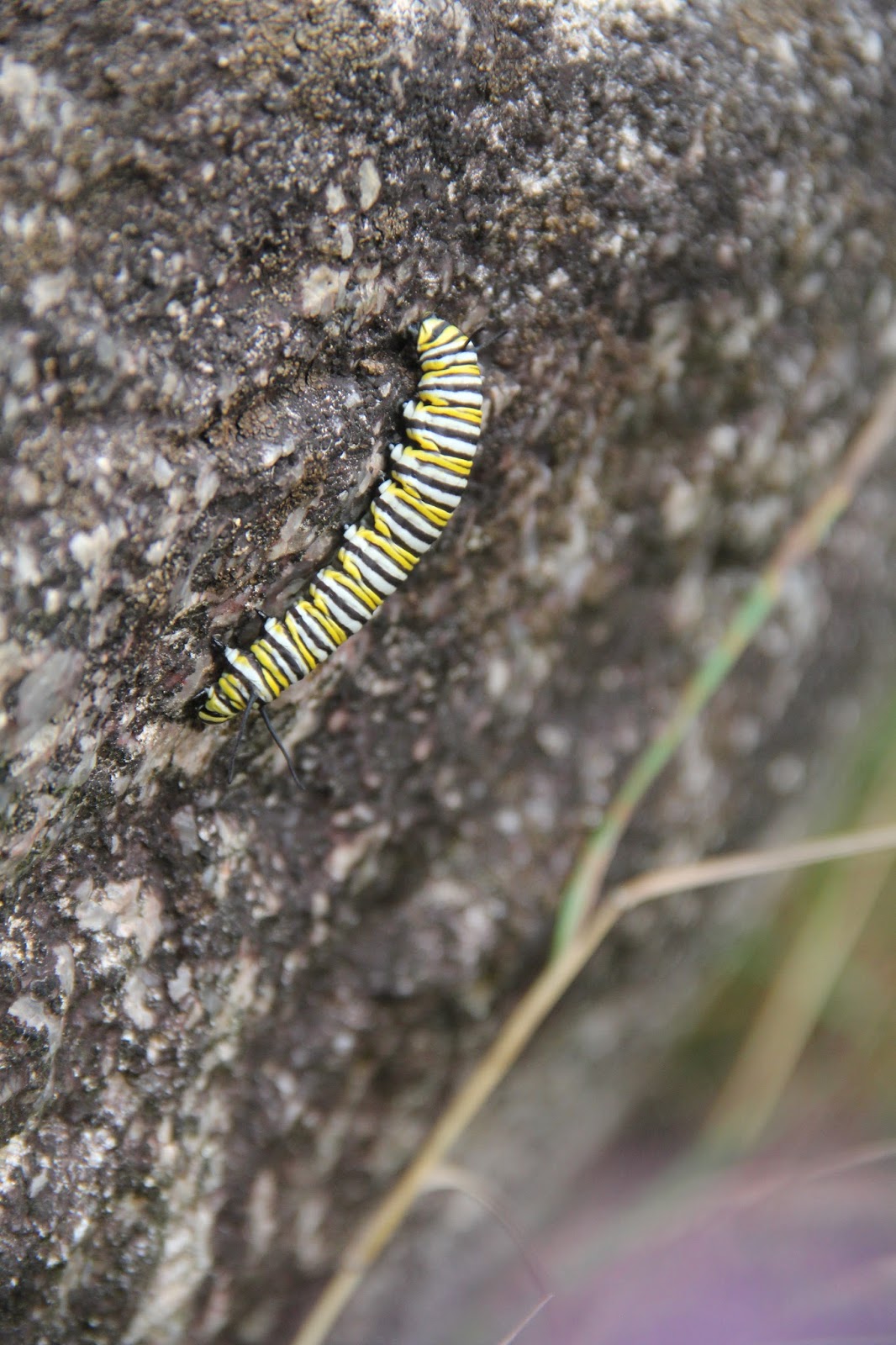
The third caterpillar was crawling around on the side of a large rock. In the hours before forming a chrysalis, Monarch caterpillars (and those of other butterfly species) often wander far from their host plant.
If you are interested in visiting Peterson Natural Area, this is the best time of year to do so. The late summer wildflowers in the wet meadow are at their peak and the fall asters and goldenrods will be blooming soon. If time allows, I may try to take one more trip over before the bloom is done.
Tuesday, June 20, 2017
A caterpillar at breakfast
Earlier this morning, Shara sent me a photograph from the Saginaw Chippewa Academy's native pollinator garden.
Woohoo!
That's a Monarch (Danaus plexippus) caterpillar munching on a Common Milkweed (Asclepias syriaca) flower. It's nice to see the garden being used by wildlife, especially Monarchs. I am hopeful that we will find more Monarchs in the garden as the summer progresses further.
![]() |
| Monarch caterpillar on Common Milkweed (photo by Shara LeValley) |
Woohoo!
That's a Monarch (Danaus plexippus) caterpillar munching on a Common Milkweed (Asclepias syriaca) flower. It's nice to see the garden being used by wildlife, especially Monarchs. I am hopeful that we will find more Monarchs in the garden as the summer progresses further.
Tuesday, June 13, 2017
Nestlings and more (12 June 2017)
Shara and I stopped at the Ziibiwing Center last night (12 June) to check on the bluebird nesting boxes. First up was the single Eastern Bluebird nest. Here is what they looked like yesterday.
For comparison, the same nest on June 6th. Those little buggers have grown a lot in a week!
We also checked on the four Tree Swallow nests. One nest had chicks that appeared to have hatched in the last 24 hours. The chicks in the other three nests are a five to ten days old. Here is a picture of one of the older nests. Unfortunately most of the other photos were too dark and blurry.
The birds were not the only babies that we found. While walking across the lawn, we noticed a patch of Common Milkweed and out of habit began to search for Monarch eggs and caterpillars. We found one - our first caterpillar of the year! Because grounds was at that time mowing the lawn, we knew this caterpillar would not survive where it was found. We collected it and took it home to rear. We'll release it once it metamorphoses as an adult.
Finally, we discovered paper wasps creating a nest on the underside of a sculpture. Wasps create these nests by chewing up wood fibers and mixing it with their saliva to create a paper-like substance. The hexagonal shape of each cell allows the wasps to fit the maximum number of cells in a small space.
| Eastern Bluebird nestlings on 12 June 2017 (photo by Shara LeValley) |
For comparison, the same nest on June 6th. Those little buggers have grown a lot in a week!
| Eastern Bluebird nestlings on 06 June 2017 (photo by Shara LeValley) |
| Tree Swallow nestlings on 12 June 2017 (photo by Shara LeValley) |
| Monarch caterpillar (photo by Shara LeValley) |
| Paper wasps (photo by Shara LeValley) |
| Paper wasp nest on coneflower sculpture (photo by Shara LeValley) |
Subscribe to:
Posts (Atom)