Showing posts with label fields. Show all posts

Monday, September 24, 2018

The Days of Summer - Day Eighty-seven through Day Ninety-four

This is the final installment of my Days of Summer photography project.  I began the summer with the plan to photograph something in nature every single day and share one image from each day on this site.  The first image taken on June 21st showed trees lit by the sunrise of the Summer Solstice.  Starting with that first image I have photographed outdoors for 94 consecutive days.  I've photographed the sun and the moon, insects, birds, wildflowers, trees, and more.  I've shared photos from local parks, nature preserves, a national monument, and my own yard.  At times it has been a challenge to pick a single photo to represent each day.  Some days it was a challenge just to take a photograph. 

I think that I had become stagnant in my photography over the past few years and this project gave me a new challenge to embrace.  I do know that if I had to pick my top twenty-five photographs, several of them would come from this project.

Here are the final eight images from the project.  If you would like to see the other pictures, you can start with this link to the previous set of images.

Day 87 (15 September) - Turkey Vulture


This image was take at Forest Hill Nature Area.  A deer had been struck and killed by a car in the road on the east side of the property.  This carcass attracted several Turkey Vultures.  MY hope was to get images of one or more birds feeding on the deer, but the vultures took off when I approached.  I did manage to get several pictures of them on trees and utility poles near the carcass, but this image of one in flight was my favorite picture of the day.

Day 88 (16 September) - Give me some sugar, little honey bee...


This picture was taken in the native pollinator garden at our home in Alma.  The goldenrods and New England Aster are attracting hundreds of bees at a time, including this worker honeybee.  This image has been cropped from a horizontal to a vertical format.

If you recognize the title of this picture comes from a Tom Petty song, good for you!  If you don't, click here to learn more about one of my favorite albums.


Day 89 (17 September) - Waxing gibbous moon


This image of the moon was taken from our driveway in Alma.  The word waxing in the title means that the moon is getting larger.  The word gibbous means that more than fifty percent of the face of the moon is visible.  in other words, the moon has passed the "first quarter" phase and is nearing its "full moon" phase.

This image has been cropped as a square.  This picture is best viewed at full size to see all possible details.

Day 90 (18 September) - Milkweed seeds


I took this photograph in the field next to the Conservation District Office.  I like the contrast between the bright green of the grass, the white fluff of the milkweed, and the brown seeds.

Day 91 (19 September) - Late summer creek


This picture was taken at Chippewa Watershed Conservancy's Alyce J. Peterson Natural Area near Big Rapids.  This small creek flows through the property before emptying into the nearby Muskegon River.  I was visiting Peterson Natural Area to complete an annual monitoring visit for the CWC.  During this visit I walked through the entire property and crossed this creek several times.  Most of the preserve is old field habitat, but part of the land along the creek is shaded by mature hardwood trees.

Day 92 (20 September) - Late summer colors


This picture is all about color and light.  I photographed these flowers in the native pollinator garden on the south side of our house.  If you look just above the center of the image there is Monarch butterfly.  This is one of more than sixty that we raised from caterpillars.

Day 93 (21 September) - Sunset and soybeans


This is my favorite photo of the week.  It was taken in Clinton County between DeWitt and St. Johns.  I hadn't taken a photograph all day and lucked out with a beautiful sunset as we were returning home from dinner in Lansing.  As the sunset started we pulled off the highway and began searching for a backroad with good views of the horizon.  I love how the setting sun lights up all the soybeans in the foreground and the clouds in the sky.


Day 94 (22 September) - Equinox bees


This is the final picture of the summer and again it comes from our native pollinator garden.  As summer ends our garden is more alive than at any other time of the year.  Three species of goldenrod light up the garden with approximately one million tiny flowers (maybe a slight exaggeration). New England Aster adds thousands of purple and yellow flowers of its own.  These flowers are drawing hundreds of honeybees and bumble bees that buzz from the time the sun warms them enough to fly until dark.

That's it.  One photograph for each day of the summer.  I hope you have enjoyed the journey as much as I have.  Someday soon I plan to create a slideshow of all the images and share it here in one post.

Monday, September 17, 2018

The Days of Summer - Day Eighty through Day Eighty-six

Summer is nearly at an end.  This is my next-to-last installment of my Days of Summer photography project.  I began this project on the Summer Solstice (21 June 2018) with the idea that I would photograph something in nature every day until the Fall Equinox (22 September 2018) and share one image from each day of the summer.  If you've missed the previous seventy-nine photographs, you can start to get caught with the images that I shared last week.

Day 80 (08 September) - Golden


This image of the sun shining through a Boxelder (Acer negundo) was photographed at Forest Hill Nature Area.  This is one of my favorite photos of the summer.  In addition to the sun, I like the contrast of the light sky with the band of dark trees on the horizon, the goldenrods lit up by the setting sun and the shadows in the foreground.


Day 81 (09 September) - Eastern Hemlock


We spend so much time looking down, sometimes we need to remember to look up.  This photograph was taken during a hike at the Chippewa Watershed Conservancy's (CWC) Audubon Woods Preserve.  Audubon Woods is my favorite CWC nature preserve.  On September 9th, I led a group on an off-trail hike at the preserve.  One of the sites that I led the group to was this small grove of Eastern Hemlock (Tsuga canadensis) trees.  Most visitors to the preserves never leave the established trails and I wanted to show off some of my favorite sites in the woods including this grove.


Day 82 (10 September) - Milkweed Portrait


When I started this project I knew that it would be a challenge to take a good nature photo every day, especially once school started.  Fortunately there are many local parks and preserves that can be easily accessed within a few minutes distance from schools or the office.  On September 10th, I did my first school programs of the 2018-19 School Year.  This photo was taken in the field behind the Conservation District offices after completing my classroom presentations for the day.


Day 83 (11 September) - Ah-choo!


This picture was taken at Chipp-A-Waters Park in Mt. Pleasant.  This bumble bee (and a bunch of other insects) were eating pollen and nectar from Sneezeweed (Helenium autumnale) blossoms.  I took several pictures of this bee as it foraged, but this was my favorite.  I like how you can see the bee's long tongue as it sips nectar.  I have never found Sneezeweed growing wild in Mt. Pleasant.  These flowers were planted about a decade ago as part of restoration project.


Day 84 (12 September) - Fall Abstract


I photographed these poplar leaves at the Conservation District offices.  This trees has been changing color and dropping leaves for about a week.  I thought about cropping the right leaf out of the picture to make the picture more of an abstract image, but decided that I liked the contrast of color.


Day 85 (13 September) - Coral Mushrooms


Recent rains have caused fungi to fruit in every local woods.  This image of coral mushrooms was taken at the CWC's Sylvan Solace Preserve.  I think this is one of several species of Ramaria fungi - there are several yellow Ramaria species that can be difficult to tell apart.  I would have liked to have taken several more images of this mushroom, but the rains have also caused mosquito populations to explode!  I couldn't stop in one place for more than a few seconds.  I am generally pretty tolerant of mosquitos, but they are absolutely miserable right now.


Day 86 (14 September) - Bean Fields


The final image for the week was taken in southern Isabella County.  Mid-Michigan is farm country and soy beans are one of the major crops.  I really liked the color of the sky when I took this picture and wanted to find the simplest landscape that I could.  The row of trees blocked out more distant elements and let me focus on the field and sky without worrying about other distractions.  The color of the ripening bean fields, sky, and clouds remind me of an impressionist landscape painting.

I hope that you have been enjoying viewing this series of photographs as much as I have enjoyed capturing them.  I am into the final week of the project and I don't know what my next photographic journey will be.

Monday, September 3, 2018

The Days of Summer - Day Sixty-six through Day Seventy-two

This is part ten of my Days of Summer photography project.  It's hard to believe that August has passed and we are into September.  I started this project on the Summer Solstice (21 June 2018) and have just under three weeks remaining until the Fall Equinox (22 September 2018).  Photographing every day has been both incredibly rewarding and a grind.  I have taken some of the best photos of my life, but there have also been days when I did not want to pick up a camera at all. When I reach the end I plan to compile all the photographs into one long post, but if you can't wait here is the previous installment.


Day 66 (25 August 2018) - Sunset at Forest Hill Nature Area


On August 26th, we headed out to Forest Hill Nature Area to participate in a public bird-banding event.  While waiting for birds to be caught I made a quick circuit of the property to try to photograph several Sandhill Cranes that could be heard on one of the hills.  The cranes (as always) were wary and while I has able to get several photos from a distance, none of them were very high quality.  Instead my favorite image of the day was this one of the seed heads of Big Bluestem Grass silhouetted against the setting sun.


Day 67 (27 August 2018) - Spotted Touch-me-not


This picture of a raindrop on a Spotted Touch-me-not (Impatiens capensis) flower was taken during a hike at the Chippewa Watershed Conservancy's Hall's Lake Natural Area.  Spotted Touch-me-not is also known as Jewelweed for the way raindrops bead up on its leaves like so many miniature jewels.  This image has been cropped from a horizontal to a vertical format and the brightness of the image has been adjusted to tone down the highlights.


Day 68 (27 August 2018) - Yellow-collared Scape Moth on Blue Vervain


This image of a Yellow-collared Scape Moth (Cisseps fulvicollis) on a Blue Vervain (Verbena hastata) flower was taken at Forest Hill Nature Area.  A wasp mimic, this day-flying moth is a common sight in late summer as it nectars enthusiastically in the restored grassland at Forest Hill.  Blue Vervain is one of my favorite wildflowers.  It's individual flowers are tiny, but each plant may have hundreds of individual blooms.  Large patches of this plant can paint fields, shorelines, and ditches purple.


Day 69 (28 August 2018) - Black Saddlebags in flight


Several days recently have been spent indoors, at my desk, preparing for the new school year.  On these days, my time sent outdoors has been short.  Outdoor time is not always measured in length, but in moments.  On this day, I walked into the field behind the office.  As I walked, a mixed swarm dragonflies flew overhead hawking at small flying insects.  I spent more than a few minutes trying to photograph them in flight.  This picture of a Black Saddlebags (Tramea lacerata) was my best image of the bunch.

Day 70 (29 August 2018) - Turbines


On August 29th, I drove to St. Charles, MI for a meeting on a generally dreary day.  Driving back from the meeting, somewhere in eastern Gratiot County, I stopped to take a few photographs of wind turbines against a cloudy sky.  I took this image over a corn field by standing on the running boards of my truck and photographing over the cab.  I like this picture because of the brooding dark-banded clouds and the upright lines of the wind turbine.

Day 71 (30 August 2018) - Oleander Aphids


This image was another taken at the office.  Some days there is an obvious star photograph; on other days, all the photos feel like duds.  This was one of those days.  I do like the pop of color provided by these bright orange Oleander Aphids (Aphis nerii) feeding on a Common Milkweed stalk, but otherwise I am not enamored by this picture.  I was shooting images of aphids because I spend so much attention on Monarch butterflies and I wanted to get photos of some of the other species that depend on milkweeds.  This picture has been cropped from a horizontal to a vertical format.  I feel like I could have cropped it further, but I thought it would lose some context. 

Day 72 (31 August 2018) - Habitat


This final photograph for the week was photographed on private land near Winn, MI.  This property is owned by a member of the Board of Directors for the Isabella Conservation District and open to the the public for hunting through the MI DNR's Hunting Access Program (HAP). 

I visit this property a couple of times each summer for a very specific kind of hunting.  I am hunting for Monarch caterpillars.  The property is a perfect Monarch habitat with a mix of milkweed and nectar plants.  Right now the Common and Lance-leafed Goldenrod are both in bloom and the Sky Blue Aster is just beginning to flower.  Mix in several species from the mint family, Joe-pye Weed, Water Smartweed, and some hawkweeds and it's a pollinator paradise.

I have visited this place twice in the past three days and have come away with 21 caterpillars.  One of them is hiding in the picture above.  I would never have noticed this caterpillar if I had not knelt down to photograph a bee as it passed from one goldenrod bloom to another.

Sunday, July 29, 2018

The Days of Summer - Day Thirty-one through Day Thirty-seven

This is installment five of my Days of Summer photography project.  (Click here to view the photos from part four.)  The intent of this project is to get outdoors everyday to photograph something in nature and to pick a single image to represent each day of the summer from the Summer Solstice (21 June 2018) to the Fall Equinox (22 September 2018).  Five weeks into summer, this has been a very rewarding project.  It takes time, but I think I am producing some of my best photography ever.  I am definitely learning more about my camera and lenses.

Enjoy.

Day 31 (21 July 2018) - Raindrops on Rosinweed


This image a raindrops on a Rosinweed (Silphium integrifolium) was photographed at home in our native pollinator garden during a lull between rain showers.

Day 32 (22 July 2018) - Monarch on Purple Coneflower


This photograph was taken at Forest Hill Nature Area during a very windy afternoon.  At one point this Monarch Butterfly (Danaus plexippus) nearly blew off the top of this Purple Coneflower (Echinacea purperea).  Despite the wind, this was a great day for pollinator photography.  I was able to photograph five butterfly species, a couple moths, numerous bees, and several wasp species.  Picking a single image for the day was difficult, but I like the position of the butterfly facing into the wind and the grass blades blowing in from the left of the picture.

Day 33 (23 July 2018) -Early Fall Colors


This picture of Red-osier Dogwood (Cornus sericea) berries and leaves was also taken at Forest Hill Nature Area.  Many of the dogwood leaves were already changing color.  This is not necessarily a sign of fall, but a sign of stress such as too little rain.

Day 34 (24 July 2018) - Green Frog


This picture was taken at Chipp-A-Waters Park in Mt. Pleasant.  I heard several Green Frogs (Lithobates clamitans) calling from a small wetland area near the back of the park.  Most of the frogs dove into the pond when I approached but this one let me approach to about five or six feet.  This image has been cropped from a horizontal to a vertical image.

Day 35 - Yeah, Here Come the Rooster


This image and the next one were actually taken indoors.  I spent much of last week at the Isabella County Fair.  County fairs are an integral part of summer across much of the United States.  This rooster was one of the many animals entered in the fair by 4H members.

If you understand the title of this image, bonus points for you!  If you don't...

Day 36 (26 July 2018) - Charolais Steer


Another image from the Isabella County Fair.  Raising beef cattle is one of the most popular projects for 4H members in the area.  It quite something to watch a nine or ten year old kid weighing maybe 100 pounds walk a full grown steer around the arena and present it for judging.  I photographed the Charolais steer  in the beef cattle barn as it stared at me from its stall.

Day 37 (27 July 2018) - Stormcloud


The final picture of the week was photographed in southern Isabella County on my way home from work.  I watched this storm approached from the west and raced to try to intersect it in a place where I could get a good image.  Don't worry, I never went above the speed limit - the gravel road that I was traveling on would not allow for speeds much above 30 mph in most sections.  I like this picture because of the contrast between the dark water laden bottom of the cloud and the sun shining through the top.

Saturday, July 21, 2018

The Days of Summer - Day Twenty-four through Day Thirty

This part four of my Days of Summer photography project.  Sometimes I get so busy with work and everything else in life that I forget to take time to get out in nature.  So I've given myself a photography project that requires me to get outdoors every single day.  Starting with the Summer Solstice (21 June 2018) and ending on the Fall Equinox (22 September 2018), I will get outdoors every single day to take photos.  One picture from each day will be shared here.  To see last week's installment click here.

I hope you enjoy looking at this photos as much as I enjoy taking them.


Day 24 (14 July 2018) - Queen Anne's Sunset


This image of the sun setting behind a Queen Anne's Lace or Wild Carrot (Daucus carota) bloom was photographed at Forest Hill Nature Area.  This has become my go-to location for photography for this project.  Forest Hill is located less than fifteen minutes from home.  If I didn't get anywhere else during the day, I can always find time to run to Forest Hill for a short photo visit.

Day 25 (15 July 2018) - Square-stemmed Monkeyflower


On Sunday July 15th I spent the afternoon at Chipp-A-Waters Park in Mt Pleasant for the second annual Chippewa River Water Festival.  The Isabella Conservation District had a booth at the festival and I was helping pass out conservation swag and literature.  I was also scheduled to lead three nature hikes through the park during the afternoon.  During one of the scheduled times, I had no takers so I went by myself with just my camera as a companion.  This Square-stemmed Monkeyflower (Mimulus ringens) was growing on a point bar along the edge of the Chippewa River.  There were probably thirty of these plants total - I normally find less than ten a year.

Day 26 (16 July 2018) - Wheatfields and Stormclouds


This picture was taken near the Chippewa Watershed Conservancy's Sylvan Solace Preserve wet of Mt. Pleasant.  Clouds are always a good photo subject.  So are fields of ripening wheat.  This location had both.  This is my second photo of a wheat field, but I think this image is more about the clouds than the wheat.   I also liked that I could get a picture without trees on the horizon.  (There are a couple on the far left of the picture, but they don't detract from the open horizon feel.)  About ninety minutes after this picture rainstorms moved into the area.

Day 27 (17 July 2018) - Waxing Crescent Moon


This photo of a waxing crescent moon was taken from my backyard at 10:25PM.  This picture has been cropped from the original to a square image.  I like the sharp lies of the crater edges where the sunlit side of the moon meets the half in shadow. 

Day 28 (18 July 2018) - Twelve-spotted Skimmer


Some days it's hard to pick a favorite photo to share.  This was not one of those days.  This male Twelve-spotted Skimmer (Libellula pulchella) was taken at Forest Hill.  When I spied it perched on this grass, back-lit by the setting sun, I knew it was a "winner".  This image has been cropped from a horizontal to a vertical format.

Day 29 (19 July 2018) - Cedar Waxwing


I spent nearly thirty minutes at Mill Pond Park watching Cedar Waxwings (Bombycilla cedrorum) flying over the Chippewa River to snag insects out of the air.  Occasionally one would land on a tree limb about twenty feet in front of me.  This is one of about seventy-five picture of fur different Waxwings.  This image has been cropped considerably with about 1/3 of the picture removed from the left and 1/3 removed from the bottom.

Day 30 (20 July 2018) - A Hole in the Clouds


The final image of the week was another one from Forest Hill Nature Area.  I spent an hour photographing the setting sun, the moon, clouds, and a sun dog.  As we were preparing to leave I spied this patch of light peeking through a dark cloud. 

Friday, July 6, 2018

The Days of Summer - Day Ten through Day Sixteen

This is the second installment of my Days of Summer photo project.  To read about the project and see the first installment click here.

Day 10 (30 June 2018) - Wheatfield


Agriculture may not be the first thing that you think of when you hear the word Michigan, but it is one of the leading industries in the state.  This image of a ripening field of wheat was taken along the border of Isabella County and Gratiot County.  I spent the morning at Forest Hill Nature Area photographing wildflowers in a restored grassland.  Deciding to take a different route home, I passed by this field a couple of miles from Forest Hill.  I've been admiring wheat fields for the past several weeks, but never found one that I could easily photograph.  Stopping here was a no-brainer.

Day 11 (01 July 2018) - Ragged Fringed Orchid


This photo was taken at the Williamston Township Community Park in Ingham County, MI.  I stopped at this park to revisit an older grassland restoration that I have photographed several times over the years.  A pair of Ragged Fringed Orchids (Platanthera psycodes) was my reward.

Day 12 (02 July 2018) - Moss Sporophytes


Mosses are small; thus they are easily overlooked.  For those that take the time to notice them, they are well worth the effort.  One of the best books I have read in recent years is about moss.  These white balloon-like structures are reproductive bodies known as sporophytes.  When conditions are right, they will each release hundred or thousands of spores into the world.  We often associate mosses with shady woodland habitats, but these mosses were growing on bare sandy soil on land owned by Shepherd Public Schools.

Day 13 (03 July 2018) - Last of the Brood


This Days of Summer project means that I have to photograph something every day.  It means I have to get outdoors and away from my desk.  Fortunately Isabella County has lots of public land within a short drive of my office.  This picture of a Wild Turkey (Meleagris gallopavo) with a single poult (chick) was taken at Chipp-A-Waters Park in Mt. Pleasant.  Seeing a hen with only a single chick raises so many questions.  Was this the only egg that hatched?  Were the other eggs stolen by predators such as raccoons? Did predators get the rest of its nest mates?

Unlike most of my photographs, this image has been edited.  It has been cropped from the original size (about 50%) and the highlights have been toned down to bring some of the color back into the image.

Day 14 (04 July 2018) - Curious Fawn


The Fourth of July found me exploring the Maple River State Game Area.  This curious White-tailed Deer (Odocoileus virginianus) fawn wanted to check me out up close.  Unlike the previous picture, this one has not been cropped.  The fawn was that close and approaching closer.  It probably would have allowed me to touch it if I hadn't shooed it away into the woods.

Day 15 (05 July 2018) - Great Spangled Fritillaries


Yesterday I visited the Chippewa Watershed Conservancy's Sylvan Solace Preserve for about an hour in the middle of the day.  Mid-day may not be the best time for photography, but the heat of the day does bring out the pollinators.  I was luck to spot this pair of mating Great Spangled Fritillaries (Speyeria Cybele).

Day 16 (06 July (2018) - Chicory Flowers 


My final photo for the week is of a pair of Common Chicory (Cichorium intybus) flowers.  This photograph was taken at the Mt. Pleasant Discovery Museum early this morning.  Originally from Europe, Chicory is a common roadside plant in Mid-Michigan.  Even though this plant is not native to North America, it is well-behaved and likes roadsides and other waste places.    This is one of my favorite flowers to photograph.  The pale blue color is absolutely beautiful.  You have to get up early to photograph Chicory, by mid-day the flowers have closed up tight.

Tuesday, August 22, 2017

Field Trip to Peterson Natural Area (12 August 2017)

Field trip participants (Cathy Murray, Dick and Diana Moreau, and Ruth Chapman) pose by the preserve sign
 
On Saturday August 12th, I led a field trip to the Chippewa Watershed Conservancy's Peterson Natural Area.  At 79 acres, Peterson NA is one of the largest preserves in the CWC's inventory.  It is also (probably) one of the least visited.  Located in Mecosta County, Peterson NA is much closer to Big Rapids (less than 10 miles) than it is to Mt. Pleasant (approximately 40 miles).  This distance from Mt. Pleasant puts off the radar for most CWC supporters - if you are going to Peterson Natural Area you are making a time commitment.

Despite the distance from Mt. Pleasant (or in my case from Alma), visiting Peterson Natural Area is worth the effort.  Here are a few pics from that visit.

Ruth was wearing a walking cast and needed a helping hand to navigate a couple stretches

Goldenrod Soldier Beetle (Chauliognathus pensylvanicus) on Great Blue Lobelia (Lobelia siphilitica)

The surprise of the day was finding a Wood Turtle (Glyptemys insculpta) in the wet meadow that runs down the center of the property.  The Wood Turtle is considered a Species of Special Concern by the State of Michigan so it is always a thrill to see one.  Wood Turtles do frequently spend much of the summer in upland areas, but I didn't suspect that the small stream running through Peterson Natural Area would bring one to the property from the nearby Muskegon River.  I actually found this turtle with my feet - while walking through the tall grass of the meadow, I stepped on what initially I thought was a rounded rock.  Surprise!


Cathy photographing the Wood Turtle

Who wouldn't love that face!

Joe-pye Weed (Eutrochium maculatum) was growing everywhere along the stream.

Swamp Milkweed (Asclepias incarnata) adds its magenta hues to the landscape mosaic.

Mating Yellow-collared Scape Moths (Cisseps fulvicollis) on Common Boneset (Eupatorium perfoliatum)

Giant Swallowtail (Papilio cresphontes) nectaring on Swamp Milkweed
The upland parts of the property (northwest quarter) is very different from the low area along the stream.  It is very dry and sandy.  The Michigan Natural Features Inventory pre-settlement vegetation map indicates that Peterson Natural Area was once covered with Beech-Sugar Maple-Hemlock Forest, but the vegetation on this hill is currently more like that found on a Dry Sand Prairie or Oak-Pine Barren.  Pre-settlement maps indicate that two areas of  Oak-Pine Barren could be found within two miles of Peterson NA in the past.


Near the end of our walk, we found three Monarch caterpillars.  All three were in their 5th instar and were almost ready to enter the chrysalis stage.  The first two caterpillars were feeding on Common Milkweed plants.


Ruth zooms in on a Monarch caterpillar


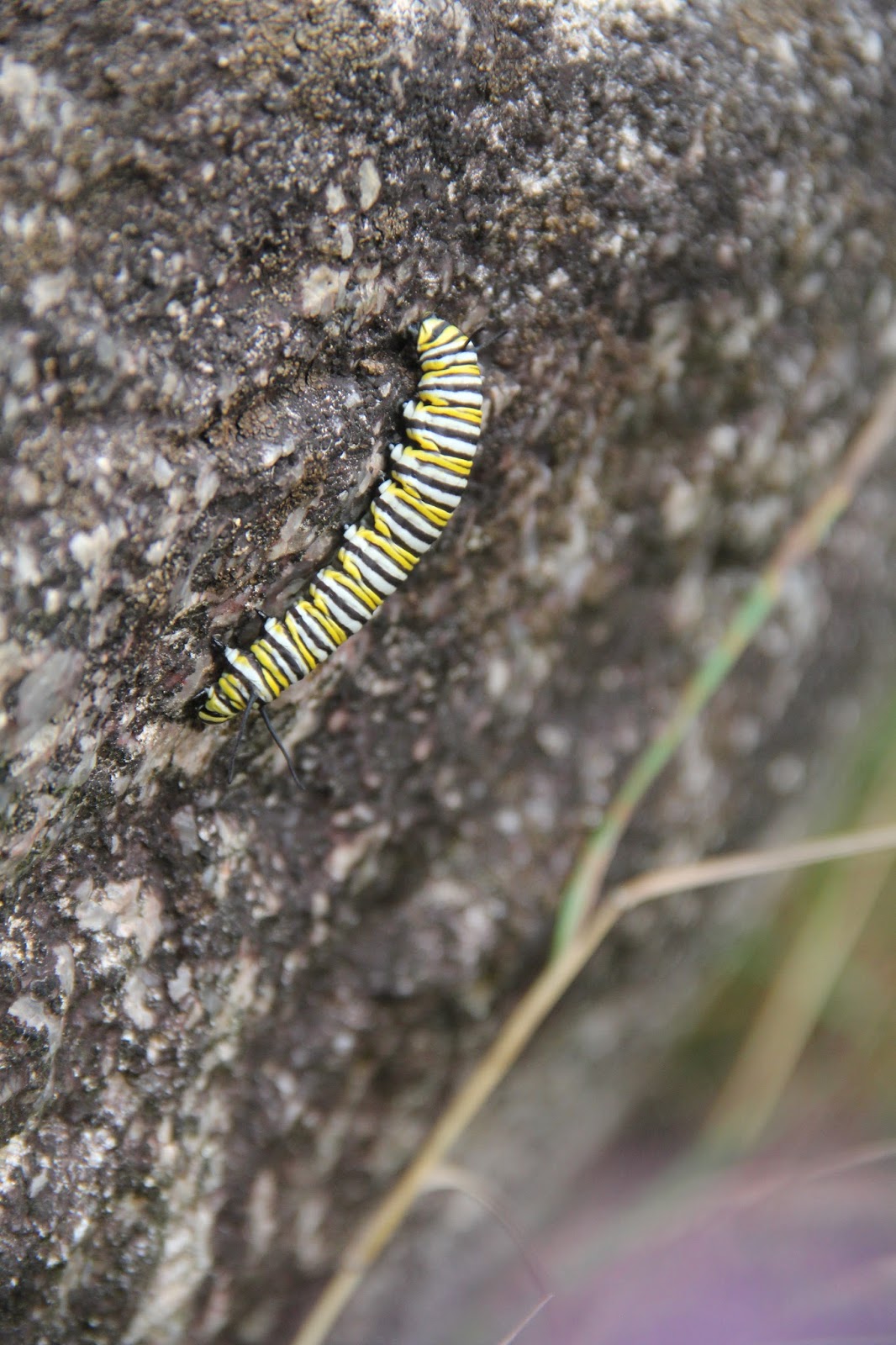
The third caterpillar was crawling around on the side of a large rock.  In the hours before forming a chrysalis, Monarch caterpillars (and those of other butterfly species) often wander far from their host plant.


If you are interested in visiting Peterson Natural Area, this is the best time of year to do so.  The late summer wildflowers in the wet meadow are at their peak and the fall asters and goldenrods will be blooming soon.  If time allows, I may try to take one more trip over before the bloom is done.