Thursday, January 17, 2019

Trail cam pics and a walk in the January woods.

In late December I placed my trail cameras in the woods for the first time in nearly a year.  Today I went to switch out the memory cards.  Although I managed to get pictures of red fox, raccoon, squirrels, and deer (including several bucks) I was disappointed by the results and ended up moving both cameras.

A fox runs in front of the camera

Part of a herd of deer, including two bucks, passing by the camera

After moving the cameras I used the opportunity to take a walk through the woods and take some photographs.  There was no snow on the ground, but lots of ice.  My favorite photos of the day were probably those showing leaves locked in ice.  Here are a few of the images that I captured.

Bright sunlight has been a rare sight in recent days

This picture was not planned - the plane flew over just as I was taking the picture.

Flowing water carved this channel down through the ice

Many shades of brown

Living and dead trees stand bare in the winter swamp


Oak leaves trapped in ice

Coyote scat on top of a pile of deer scat

Water levels have dropped several inches since this ice formed

Eastern Hemlock


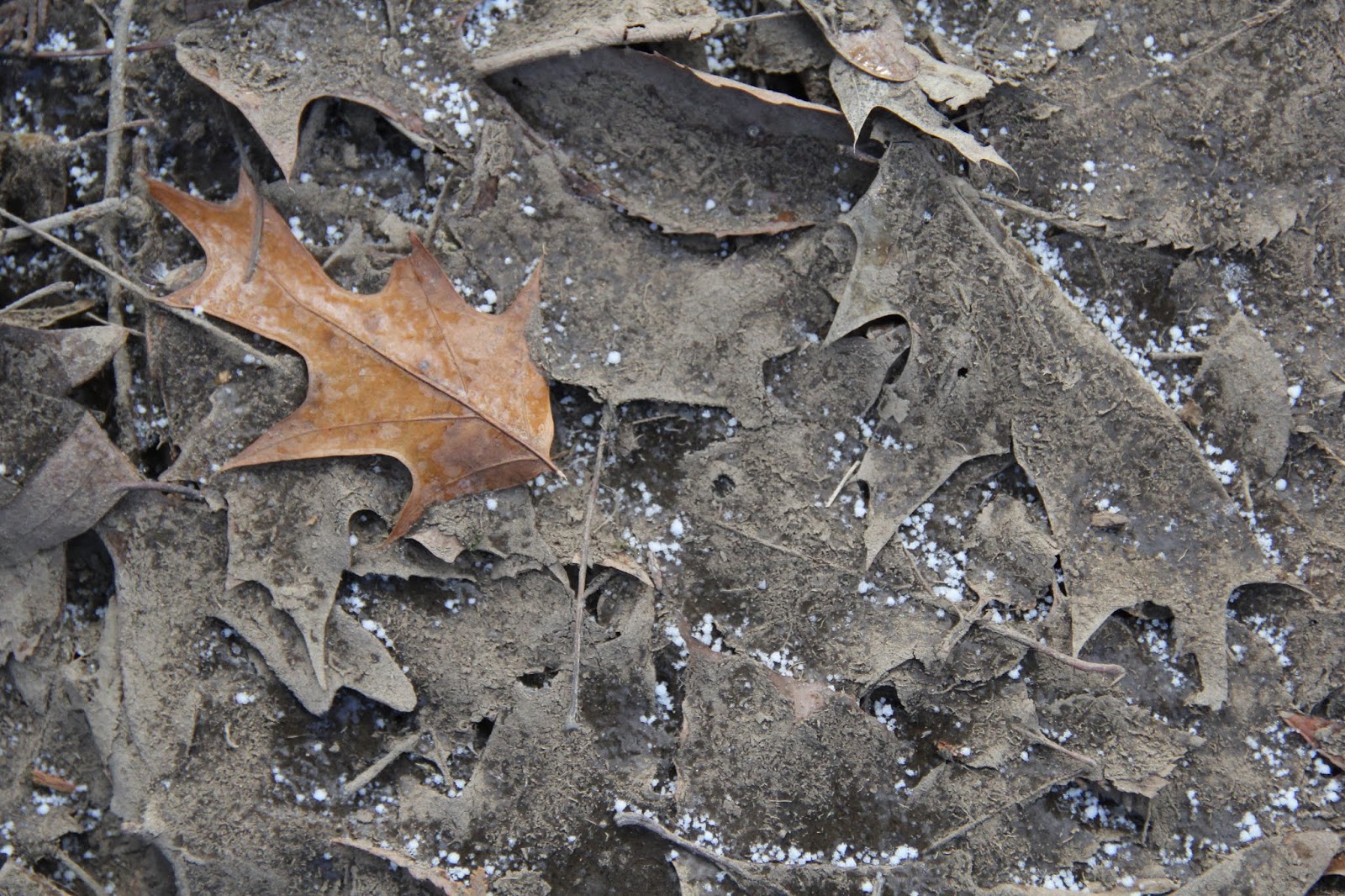
Silt covered leaves, topped by a single clean oak leaf

A boardwalk crosses an eroded area on the trail

Northern White Cedar

The bright trunks of aspen trees glow in the sunlight

Tuesday, January 15, 2019

A new way of looking at ice

This morning, Mid-Michigan woke up to find everything covered in a layer of ice.  The icy road meant that dozens of schools throughout the state canceled classes for the day.  Weather conditions haven't changed so there is a good chance that classes will be canceled again tomorrow.It's winter here in Mid-Michigan.  During winter you might expect to see everything covered in ice and snow, but have you ever thought about what ice and snow are?

The obvious answer is that ice (and snow) is the solid state of water.

The less obvious answer is that ice is a mineral.  

Yes, a mineral.

Like the thing that rocks are made of.


How is that possible?  If you look at the definition of a mineral, ice checks all of the boxes.  A mineral is a naturally-occurring inorganic crystalline solid with a specific chemical composition.

Ice is naturally-occurring.  Ice can form outdoors when the temperature drops below 32 degrees Fahrenheit.  (As I write, the temperature outdoors is 28 degrees.)  Ice that forms in your freezer is not a mineral because it would be considered man-made.

Ice is inorganic.  Inorganic simply means that it has never been alive.  Things might live in ice, but the ice itself has never been alive.


Ice is crystalline.  Ice forms crystals that have a specific internal structure - the water molecules that form ice bond together in a predictable pattern.  Liquid water and water vapor form much looser bonds and do not lock together in a predictable patter.

Ice is a solid.  When water drops below 32 degrees Fahrenheit, the molecules of water bond together to form a solid.  Only in its solid form can water be considered a mineral; neither liquid water or water vapor meet the definition of being a mineral.

Ice has a specific chemical composition.  Ice is formed from bonded molecules of water, each composed of two atoms of hydrogen and one atom of oxygen.  Other elements or molecules may be included in the ice, but the ice itself is formed only from the water molecules.


Ice is the only state of water that can be called a mineral.  If the ice melts or evaporates to form water vapor (a process known as sublimation) it ceases to be a mineral.  Due to the ability of water to shift states of matter, ice is a very ephemeral mineral across most of the earth.  In mid-latitudes such as where Michigan is located, ice can only be found during roughly half of the year.  At latitudes closer to the equator, ice would only be found in the highest elevations where the temperature can drop below the freezing point.  It is only in the highest elevations and the highest latitudes (the Arctic and Antarctic) that ice can be found year round. 

It's fun to look at familiar things in new and unexpected ways - like looking at ice as a mineral.  Right now large portions of the United States and Canada are rich in naturally formed ice, but come the period May to September it will be unavailable at any price throughout much of the same region. 

Thursday, January 10, 2019

Teaching about niches and the relationships between species

Back in October I started sharing Michigan species cards and promised that I would show how I used them in the classroom.  After much delay, here is an example of their use - I can use the cards to help students understand the relationships between species in a habitat.

If you think of an environment as a giant puzzle, species only fit in a certain place in the environment.  They have a role that they belong in.  In the same way that a puzzle piece from the edge will not fit into the center and vice versa, a species can only fit in a certain place in the environment.  That role or place that a species occupies in its environment is known as its niche.  A species locks into its niche by a series of connections with the species around it.  Some species will connect with many species while others will only connect with a few.

Let's start by exploring the relationships between two species.


Some species are connected by their shared needs.  They might compete for resources such as food, water, shelter, or space.  For example a Downy Woodpecker and an Eastern Grey Squirrel may both wish to occupy a hole in a Red Oak tree, but they will not share the space so this makes them competitors.  The woodpecker and squirrel might also compete over food as both eat fruit, seeds, and nuts.  In times of plenty this may not be an issue, but when foods are scarce there may not be enough for both species to survive.  So the relationships between the two species (form the squirrel's perspective) are as follows.
  • The squirrel competes for shelter with the woodpecker.
  • The squirrel competes for food with the woodpecker.
We could also state this from the perspective of the woodpecker as thus:
  • The woodpecker competes for shelter with the squirrel.
  • The woodpecker competes for food with the squirrel.
In addition to competition, species may be connected by food in other ways.  To continue using the Eastern Grey Squirrel as an example, this species eats fruit, nuts, seeds, fungi, insects, bird eggs, birds, and very small mammals.  Although not listed on the card above, this species will also feed on leaf and flower buds and tree sap.  The squirrel might consume the eggs or young from the woodpecker's nest - another relationship between the two species.  If we think of it from both perspectives there are two relationships:
  • The squirrel receives food (eats) the woodpecker.
  • The woodpecker provides food (is eaten by) to the squirrel.

The squirrel also gets food from the Red Oak tree in which it lives.  At different times of the year the squirrel may consume leaf and flower buds, acorns, or sap from the tree.  Again two relationships can be identified if viewed from both perspectives.
  • The squirrel receives food from the oak.
  • The red oak provides food to the squirrel.
I have already mentioned another relationship between the squirrel and the oak tree.  Squirrels find shelter in trees.  They live in holes in trees, but they also construct nests made of leaves high in the canopy.  
  • Squirrel receives shelter from the oak.
  • Oak provides shelter to the squirrel.
In addition to the relationships involving food and shelter, the squirrel is connected to the oak tree by a pair of chemical relationships.  As a plant capable of producing its own food through the process of photosynthesis, the oak produces oxygen (O2) as a waste product.  The squirrel needs that oxygen to survive.  Conversely, the tree needs carbon dioxide (CO2) to perform photosynthesis and the squirrel creates carbon dioxide through the process of respiration (breathing).  
  • Squirrel receives  O2 from the oak.  
  • Squirrel provides CO2  to the oak.

Or from the perspective of the tree:
  • Oak provides O2  to the squirrel
  • Oak receives CO2  from the squirrel.
The squirrel and oak tree have another potential chemical relationship.  The squirrel's urine and dung contain nutrients that the oak tree may need.  The urine (diluted by groundwater) may be taken up directly by the oak tree's roots.  The dung must be broken down by decomposers before it can taken in by the tree.
  • The squirrel provided nutrients to the oak.
  • The oak receives nutrients from the squirrel.
A final relationship between the squirrel and the oak involves seed dispersal.  The squirrel consumes the seeds (acorns) of the oak tree, but the squirrel cannot eat them all at once.  To prevent competitors (other squirrels, deer, turkeys, jays, mice, etc.) from consuming the acorns, the squirrel will hoard them to consume later.  The Eastern Grey Squirrel is a "scatter hoarder"; it buries acorns in scattered locations throughout the woods.  Not all of these acorns are recovered.  Some will sprout and develop into new trees.  The tree actually counts on this dispersal, that is why the tree will create so many acorns in a given year, by ensuring an overwhelming supply at least every few years there will be enough seeds to regenerate the forest.
  • The squirrel disperses seeds for the oak tree.
  • The oak tree's seeds are dispersed by the squirrel.

The more species that I add, the better I can define the niche that the squirrel occupies.  For example, if I add a Red Fox to the equation, what relationships or connections would that fox have to the squirrel?  The fox is an omnivore.  It easts fruit, nuts, seeds, birds, eggs, amphibians, reptiles, insects, small to medium-sized mammals, and carrion (dead animals).  Based on food alone, the fox has two possible connections to the squirrel both as a competitor and as a predator.
  • The squirrel competes with the fox for food.
  • The squirrel provides food to (is eaten by) the fox.
Or these can be expressed from the fox's perspective as:
  • The fox competes with the squirrel for food.
  • The fox receives food from (eats) the squirrel.

If I expand my thinking beyond the squirrel, I can define how all the other species in the habitat relate and see other degrees of interconnectedness.  For instance it may be difficult to see the relationships that exist between the Red Fox and a Black-capped Chickadee, but by digging deeper a couple of relationships emerge - they eat some of the same foods such as fruit, berries, and insects.  This makes them competitors (on a small level).  
  • The fox competes with the chickadee for food.
  • The chickadee competes with the fox for food.
Both species will also eat carrion (dead animals).  However, a chickadee can only eat carrion if a larger animal has first "opened" the carcass. 


For example, if the fox finds a dead White-tailed Deer it can chew through the deer's hide to get to the meat.  Once the hide has been opened the chickadee can then begin to feed on small bits of meat and fat.  The fox has therefore made the food accessible to the chickadee (and other small birds such as the Downy Woodpecker).  Some of the relationships that can be described here include:
  • The fox scavenges the remains of the deer.
  • The deer provides food (in the form of carrion) to the fox.
  • The fox makes food accessible to the chickadee.
  • The chickadee scavenges the remains of the deer.
  • The chickadee scavenges the remains of the fox's meal.
  • The deer provides food (in the form of carrion) to the chickadee.
If look at the deer while it's alive, I can find several other connections in the ecosystem. 
  • The deer competes with the squirrel for food.
  • The deer competes with the fox for food.
  • The deer competes with the chickadee for food.
  • The deer competes with the woodpecker for food
  • The deer receives food from (eats) the oak.
  • The deer receives oxygen from the oak. 
  • The deer provides carbon dioxide to the oak.
  • The deer provides nutrients to the oak.
Finally, let's add fungi into this model ecosystem that we have created.  Some fungi like the Fly Agaric mushroom have symbiotic relationships with trees such as the Red Oak.  The fungi coat the roots of the trees and send out hyphae (roots) to collect water and minerals that they share with the tree.  In exchange, the tree shares sugar with the fungi.  Other species of fungi such as the Gem-studded Puffball act as decomposers, breaking down organic matter that is then recycled by plants such as the oak tree.  This organic matter might include wood, leaves, other plant debris, animal dung, and even animal parts.  These fungi might then be eaten by animals in the habitat.  Despite the toxicity of the Fly Agaric mushroom, the Grey Squirrel is able to eat it with no ill effects


A couple of the relationship of the Fly Agaric include:
  • The Fly Agaric provides nutrients to the oak tree.
  • The Fly Agaric provides food to (is eaten by) the squirrel.
  • The Fly Agaric receives food from the oak tree.


The Gem-studded Puffball has some of the following relationships:
  • The puffball receives food (decomposes) the oak.
  • The puffball provides food to (is eaten by) the squirrel.
  • The puffball receives food from (decomposes) the squirrel's dung.
  • The puffball receives food from (decomposes) the deer's dung.
  • The puffball provides nutrients to the oak.
So how can all of this information be shown graphically?  The way that I use in the classroom is with a puzzle as a graphic organizer.  In this example, I have picked the Grey Squirrel to be the central piece in the puzzle.  All of the other pieces are described by their relationship(s) to the squirrel.  This method could be used with any of the species shown above - I could have the Red Oak be the central species in this puzzle, or the Downy Woodpecker, or any of the other species.  The goal of this activity is to get students to realize that species are connected on many different levels.

 Instead of using the puzzle pieces, I could also do this with a honeycomb arrangement of hexagons.  This allows me to expand beyond one species and the relationships between many species.

In this example I haven't listed every relationship between species, but only a couple that connect any two species together.  This activity can be as simple or complex as you want to make, but either way it meets the goal of demonstrating to students the relationships that exist between species in a habitat.


Wednesday, January 2, 2019

My favorite photos of 2018

Normally in December of each year I publish a post of my favorite photographs of the year.  This was a difficult task for 2018.  Most of my favorite photos were taken during my Days of Summer photography project.  Truth be told, I spent so much time photographing things from June to September that it seemed like I barely used my camera during the final three months of the year.  So instead of sharing my favorite pictures from the entire year, I am going to share my top ten from the summer (plus a pair of bonus pics from earlier in the year).

This first image is my favorite photograph of 2018.  I photographed this small native bee on a Fragrant Water Lily bloom on July 13th at Mill Pond Park in Mt. Pleasant.  To get all of the details in the flower and bee I deliberately underexposed the image to prevent everything from being washed out by the late morning light.  I would have loved this picture even without the bee, but its presence just makes everything come together for me.


I photographed lots of insects in 2018, not only bees, but also dragonflies, and grasshoppers (among many other species).  Two of my favorite pictures of the year are of dragonflies.  The first of these images took me two days to photograph.   I spotted this Halloween Pennant at Chipp-A-Waters Park on July 31st, but was unable to get close enough to take a picture.  I returned to the park the following day and waited, and waited, and waited for the dragonfly to appear.  When it finally did show up, I was ready.  I shot several pictures that morning, but this is my favorite of the bunch.


This next dragonfly photograph did not take nearly as long to get.  I just happened to be in the right place at the right time.  This Twelve-spotted Skimmer was resting on a grass stem backlighting and a background in deep shadow, this was an instant "winner".  This image was taken at Forest Hill Nature Area on the evening of July 18th.  I never spotted another dragonfly in that same location the rest of the summer.  If it wasn't for the water lily, this would be my favorite photo of the year.


This image of a Carolina Grasshopper was taken at Chipp-A-Waters Park on July 31st.  While dragonflies are almost impossible to approach closely, this grasshopper let me approach so close that I was using my camera at its minimum focal length.  I love all the details on this image especially the mottled camouflage coloring, the veins on the wings, and the small hairs on the legs and thorax.


I spent a lot of time looking up at the sky this year, specifically at the moon.  The next two photographs were taken from my driveway in Alma.  I still am not good at photographing the moon.  It seems that the settings I use for lunar pictures will work during one photo session, but won't the next time I try.  This first picture of a waxing crescent moon was taken on July 17th.


This waxing gibbous moon was photographed two months later on September 17th.  While I can get away with hand-holding my camera for most photos, I always use a tripod when shooting the moon.  It's the only way to get really clear images.


This picture of a rising full moon was taken on June 28th at Forest Hill Nature Area.  I drove home from Iowa earlier that day and despite being tired I wanted to go photograph the moonrise.  I'm glad that I did.  I love the dark indigo sky, the dark line of trees, and the glowing moon perched atop the tallest trees.


In addition to looking up at the sky, I spent a lot of time looking down at things on the ground like this dead American Robin.  I discovered it in the woods at my parents house near Laingsburg, MI on August 18th.  I love all the fine details of the feathers and the varying shades of color, especially the little "pop" of orange in the bottom left corner of the picture.  I took more than a dozen pictures of this bird from varying angle; this on just seems to work best to me eyes.


Clouds remain a favorite subject for me.  I took this image of goldenrod plants and clouds at Forest Hill Nature Area on September 2nd.  I like how the curved lines of the clouds, the trees on the horizon, and the goldenrods all fit together.


Sometimes the clouds are good enough to change your plans.  I photographed this sunset near St. Johns, MI on the last full day of summer (September 21st).  While driving home from Lansing I kept an eye on the approaching sunset and decided that it was going to be good enough to exit the highway and find a place to photograph.  I drove a few miles off the highway and found this field of soy beans with a line of trees about 1/2 mile away.  The clouds and the light just continued to get better as the sun went down.  The best part of the image to me though is how the bean pods are all backlit by the sun and seem to glow.


The final two pictures were not taken during my summer photography project.  The next image dates to June 7th and was photographed in the native pollinator garden at the Saginaw Chippewa Academy. I sometimes like to take pictures from unique perspectives.  When we look at flowers, it's usually from above.  What do they look like when viewed from below?  This picture shows a group of Beardtongue flowers against bright backlit clouds.  I just think it's a pleasing image because it is different.


My final picture is a favorite not because of the quality of the image, but rather for the subject.  It is not all that unusual to see Wood Ducks perched in trees, but until May 7th 2018 I had never been able to get a good photograph.  This pair of ducks at the Chippewa Watershed Conservancy's Audubon Woods Preserve obliged by hanging out long enough for me to not only retrieve my camera from the truck, but also take about a dozen photos.  While I did get closer photos of each bird individually, the drake (left) and hen (right) stayed far apart and this was my favorite image of the pair.  This picture is definitely more about the memory for me than the picture itself.


Tuesday, January 1, 2019

New Year's Day 2019

Happy 2019!

As I have for the past two years (2017 and 2018), I greeted the new year by leading a hike at the Chippewa Watershed Conservancy's Bundy Hill Preserve.  This year I actually led two hikes, a "sunrise" hike at 7:30AM and a more leisurely hike at 10:00AM for the late-risers.


Despite an overnight storm that made roads treacherous (and contributed to many accidents overnight) I was joined by a crew of six hardy souls with the goal of being the first people to top Bundy Hill in 2019.


The trees at Bundy Hill were covered in a layer of ice and snow that created a beautiful backdrop for out hike.  Unfortunately, cloudy skies meant that we did not get to see the sunrise.  My record for new Year's Day sunrise hikes is now one-for-three (0.333 is a great batting average in baseball, but not so great for sunrise hikes).

No sunrise to see, but we made it to the summit!

After the first group of hikers departed, I had about an hour to kill before the second hike was scheduled to begin.  I had planned ahead - I brought a book to read and boiled a kettle of water for tea on the tailgate of my truck.


I was joined by eleven people for the second hike (including a family of 5). For the first hike, we had taken the most direct route (the McNeel Trail) up the hill so we could be on top before sunrise; for the second hike we took the more leisurely path (the Summit Trail) around the west side of the preserve.  Both trails climb approximately 170 feet from the parking area to the summit, but the second trail is a more gradual climb.  This is important when the climbers include young children and a dad carrying one of the kids most of the way up the hill!


The view from the top was worth the climb.  Bundy Hill has two summits; the main (east) summit has no view as it is surrounded by trees, but the west summit offers views facing south.  The sky was still clear as we approached the west summit, but there was enough light to make the view of snow-covered trees dazzling against a steel grey sky.  As with so many things in life, picture do not do it justice.

Love the brooding skies...

We snapped a couple of group photos in this location (with the gorgeous trees in the background) and then proceeded to the real summit for another group picture to prove that we made it to the top.

Near the false summit

On the summit
After reaching the summit, we took the McNeel trail back to our parked vehicles.  This trail is a little steeper and we had a couple of slip-and-fall incidents.  Fortunately the only thing injured was pride. Everyone seemed to enjoy the hike and it was a great way to kick off 2019!


Mark you calendar for Wednesday January 1st 2020 to join my for my 4th Annual New Year's Day hike - I'll be there for sunrise!  Until then, get outdoors and, if your schedule allows, join me for more hikes with the Chippewa Watershed Conservancy.  Keep an eye on the CWC website or facebook page for upcoming events.