Tuesday, October 14, 2014

Earth Science Week - Tuesday

Every day of Earth Science Week has a focus.  The focus today is "No Child Left Inside".  There is a lot of research that shows that the average child today spends less time playing outside that his/her parent's generation did.  While there are many reasons for this, the point is that kids need to spend more time outside.  What better way to spend time outside and learn about earth science than to go somewhere and pick up rocks.

Interesting rocks can be found throughout Mid-Michigan.  The glaciers that covered Michigan during the Ice Age picked up rocks from further north (Canada) and dumped them across Michigan.  Any time you did a hole in Mid-Michigan you are likely to come across rocks that are not only hundreds of millions of years old, but that have also traveled hundreds of miles from where they formed.

Rather than digging holes to search for rocks, I would rather go to a place where I can look over thousands of rocks at once.  There is no better place to do this than a rocky beach.  I have two favorite beaches where I like to search for rocks.  Unfortunately neither one is very close to Mid-Michigan.

Peterson Park Beach

Peterson Park Beach is located near the tip of the Leelanau Peninsula (Michigan's pinkie finger).  Unlike the sandy beaches that can be found along most of Northwest Michigan, the beach at Peterson Park is covered with rocks.  Most of the rocks range from fingernail to fist-size, but larger ones can be found in the water offshore.  The rocks are variety of igneous, sedimentary, and metamorphic types and represent the many types of bedrock found in the Canadian Shield and Michigan Basin.

Peterson Park Beach

The rocks extend out into the lake.

Sizes, shapes, and colors of Peterson Park Beach rocks

If you go to Peterson Park make sure that you bring a bucket to carry your treasures home.  You will want to limit how many rocks you collect - it's 114 stairs back up to the parking lot...

The stairway down to the beach.


Click here for directions to Peterson Park from Mt. Pleasant.

Peterson Park is my favorite place in the Lower Peninsula to pick up beach rocks, but my favorite place in Michigan to look for rocks is in the Upper peninsula.

Muskallonge Lake State Park Beach.

Muskallonge Lake is located about 4 1/2 hours from Mt. Pleasant, Muskallonge Lake State Park is located in Luce County in Michigan's Upper Peninsula.  The park is situated between Muskallonge Lake and Lake Superior and includes two miles of Lake Superior Beach.  Storms and waves constantly bring a new supply of rocks to the beach.  The rocks here are concentrated along the edge of the water with sand higher up the beach.  Again, the rocks come mainly from bedrock types found in the Canadian Shield - lucky searchers find Lake Superior Agates.  There is no stairway to climb back up here so you can easily collect as many rocks as you want to carry.  On our last trip to the park we brought back about 3 gallons of rocks.
 
The Lake Superior Beach at Muskallonge Lake State Park

A closer view of the beach rocks

Lake Superior's waves constantly bring new rocks toward shore.

The campground at Muskallonge Lake State Park is one of my favorites in Michigan.  On one clear night we spent about an hour lying on a picnic table staring up at the innumerable stars. 

Click here for directions to Muskallonge Lake from Mt. Pleasant.

Monday, October 13, 2014

Happy Earth Science Week - Monday

Happy Earth Science Week 2014!

What is Earth Science?  The short answer is that Earth Science is the study of the Earth and its neighbors in space.

Earth Science is generally divided into four disciplines:

Geology (the study of the earth) is a science that deals with the study of the Earth's materials, structures, and processes.

Lichen covered granite - Cadillac Mountain, Acadia NP, Maine

Meteorology is a science that deals with the study of atmosphere and how processes in the atmosphere affect weather and climate (long term weather patterns).

Early morning clouds - Mt. Pleasant, Michigan

Oceanography is a science that involves the study of Earth's oceans and seas and their composition, patterns, and processes.  This science also includes the study of the organisms that inhabit the oceans.

Atlantic Ocean shoreline - Acadia NP, Maine

Astronomy is the study of the universe.  It includes the study of how nearby celestial bodies influence the Earth.

Night Sky (20 July 2007) - Munising, Michigan

To learn more about Earth Science please check out this series of videos produced by the American Geosciences Institute.

Thursday, October 9, 2014

Wetland Exploration with Fancher SIxth Graders

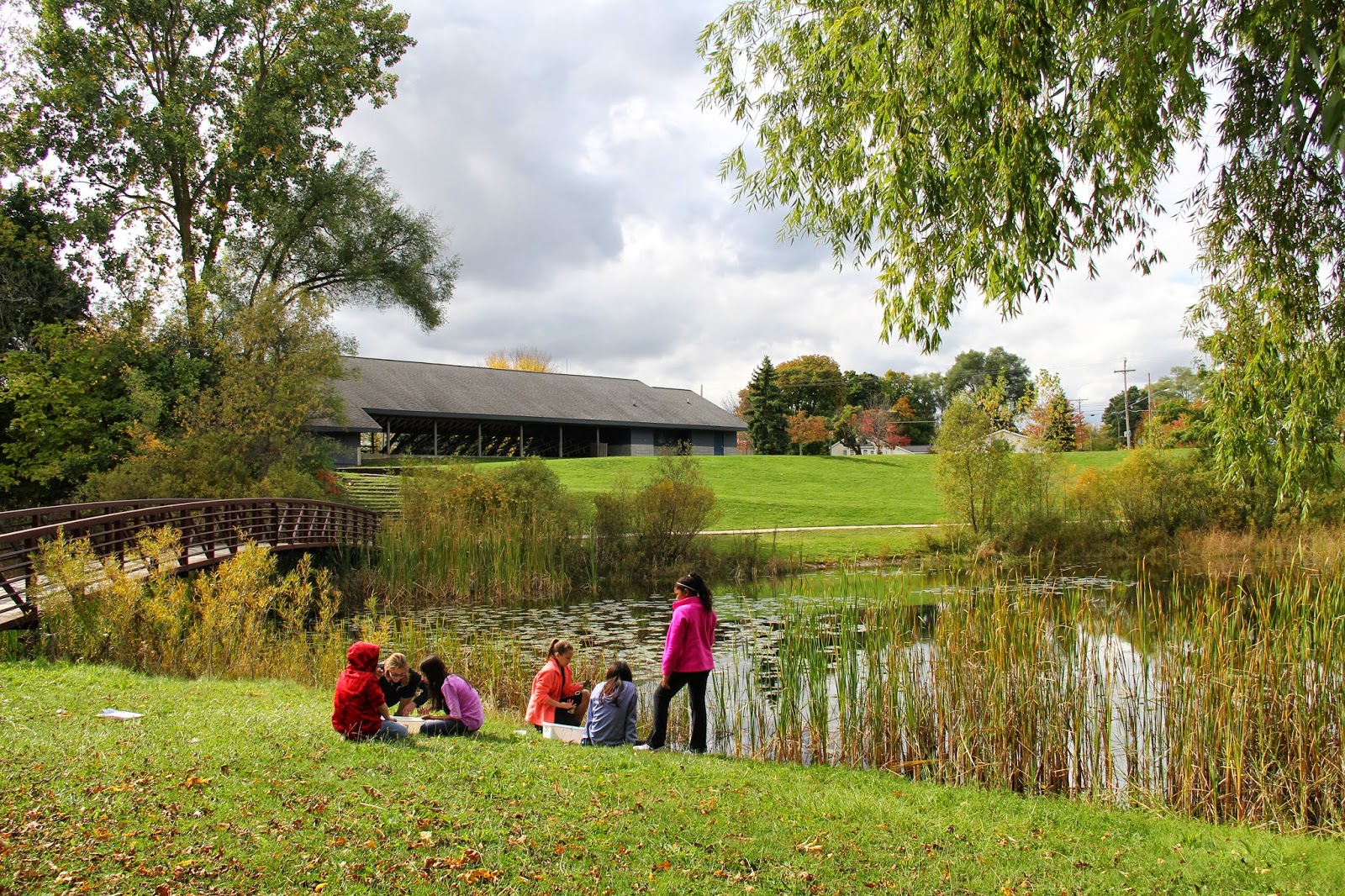
On Tuesday (07 OCT) I spent the day exploring Mill Pond Park with three classes of 6th Grade students from Fancher Elementary.  I had previously visited each of these classes to talk about wetland habitats.  This field trip enabled the student to get a hands-on experience with something that they were learning about in class.  Each class visited the park for a little over an hour.  During that time we talked about the different zones found in wetlands(upland plants/emergant plants/floating leaf plants/submersed plants), looked at wetland soil, and searched for aquatic invertebrates.

Here are a few photos from the day.

Me explaining the zones of plant life found in a wetland

Me trying to fall down.

A big thank you to Brooke Friesen for taking the photographs of me.  Brooke is a Central Michigan University student studying environmental and outdoor education.  In her spare time she has started volunteering time with our Environmental Education Program.


The absolute best thing of the day for me was having a student tell me that, after learning about wetlands from me over the past two weeks, she thinks she wants to be a wetlands ecologist.  That is awesome...

A future wetlands ecologist holding a water scorpion


As I was photographing the reflection of the sun and clouds among some water lily leaves, a student asked what I was taking a picture of.  So I showed him.  His reaction was "cool".

The trees are starting to turn, but the water is still warm.

Students cataloging their finds.

Tuesday, October 7, 2014

Upcoming Event - 08 OCT 2014

Please join the Chippewa Valley Audubon Club on Wednesday 08 October 2014 for our monthly meeting.  The meeting begins at 7PM and is held at the Veterans Memorial Library in Mt. Pleasant.  This month's presentation is on the Passenger Pigeon.  This year marks the 100th anniversary of the extinction of the Passenger Pigeon, once the most numerous bird on the planet.

Monday, October 6, 2014

Earth Science Week 2014 - 12 OCT to 18 OCT


Next week is Earth Science Week. 

This celebration of all things earth science is organized by the American Geosciences Institute and has been celebrated annually since 1998.  This year's them is "Earth's Connected Systems".  For more information about Earth Science Week and to order an Earth Science Week Toolkit please visit earthsciweek.org.

My posts next week will all focus on the earth science theme.

Friday, October 3, 2014

Wildflowers of 2014 - #234 through #237

The 2014 Wildflower season is really winding down now.  On Monday 22 SEP, I was able to get to Chipp-A-Waters Park and find four more species to add to my list for the year.

Wildflowers of 2014 - #234 Cheerful Sunflower (Helianthus x laetiflorus)

This flower had me stumped.  It was obviously a sunflower, but it didn't quite fit the descriptions of any of the sunflowers found on the Michigan Flora website.  The description of the Stiff Sunflower (Helianthus pauciflorus) mentioned a hybrid with Jerusalem Artichoke (H. tuberosus).  This hybrid is known as the Cheerful Sunflower (Helianthus x laetiflorus).  After researching this plant on several websites, I decided that this was probably my mystery sunflower.

A colony of Cheerful Sunflower (Helianthus x laetiflorus)

Cheerful Sunflower, which is also known as Hybrid Prairie Sunflower and Mountain Sunflower, is a perennial that reaches heights of 1 1/2 to 8 feet.  It has opposite leaves.  The leaves and stalk are both hairy.  The stalk varies in color from green to purple.

Cheerful Sunflower - note the opposite leaves and several flower heads

Plants produce one to several flowers.  The flowers consist of a central disc surrounded by 10 to 20+ rays (petals).  The rays are bright yellow and the disc may be a darker yellow or brown or purplish.

Cheerful Sunflower - note the many petals and small crab spider waiting for a meal

Everything that I could find about this sunflower seemed to fit my mystery plants so I am calling it a Cheerful Sunflower.  If anyone disagrees with this identification and can provide an alternate ID, please let me know.

Wildflowers of 2014 - #235 Frost Aster (Symphyotrichum pilosum)

The next two species are often confused because they are both Asters with many small white flowers and small leaves.  In February 2014 I wrote a post about how to tell the Frost Aster (Symphyotrichum pilosum) from other small, many-flowered Asters.  Please look here for more information.  This species is also known as Hairy Aster.

Frost Aster (Symphyotrichum pilosum)

Frost Aster - a closer view of the flowers

Wildflowers of 2014 - #236 Heath Aster (Symphyotrichum ericoides)

Heath Aster (Symphyotrichum ericoides) differs from the previous species by having leaves that are both smaller and more numerous.  It also typically has fewer rays (petals) on each flower than the Frost Aster. Individual flowers are also smaller 1/4 to 1/2 inch versus 3/8 to 3/4 inch.  Both the Heath Aster and Frost Aster can reach heights of 1 to 4 1/2 feet tall.  Both plants grow in open dry habitats - I found both of these flowers growing within yards of each other.

Heath Aster

Heath Aster - note the many small pointed leaves

Wildflowers of 2014 - #237 Redroot Amaranth (Amaranthus retroflexus)

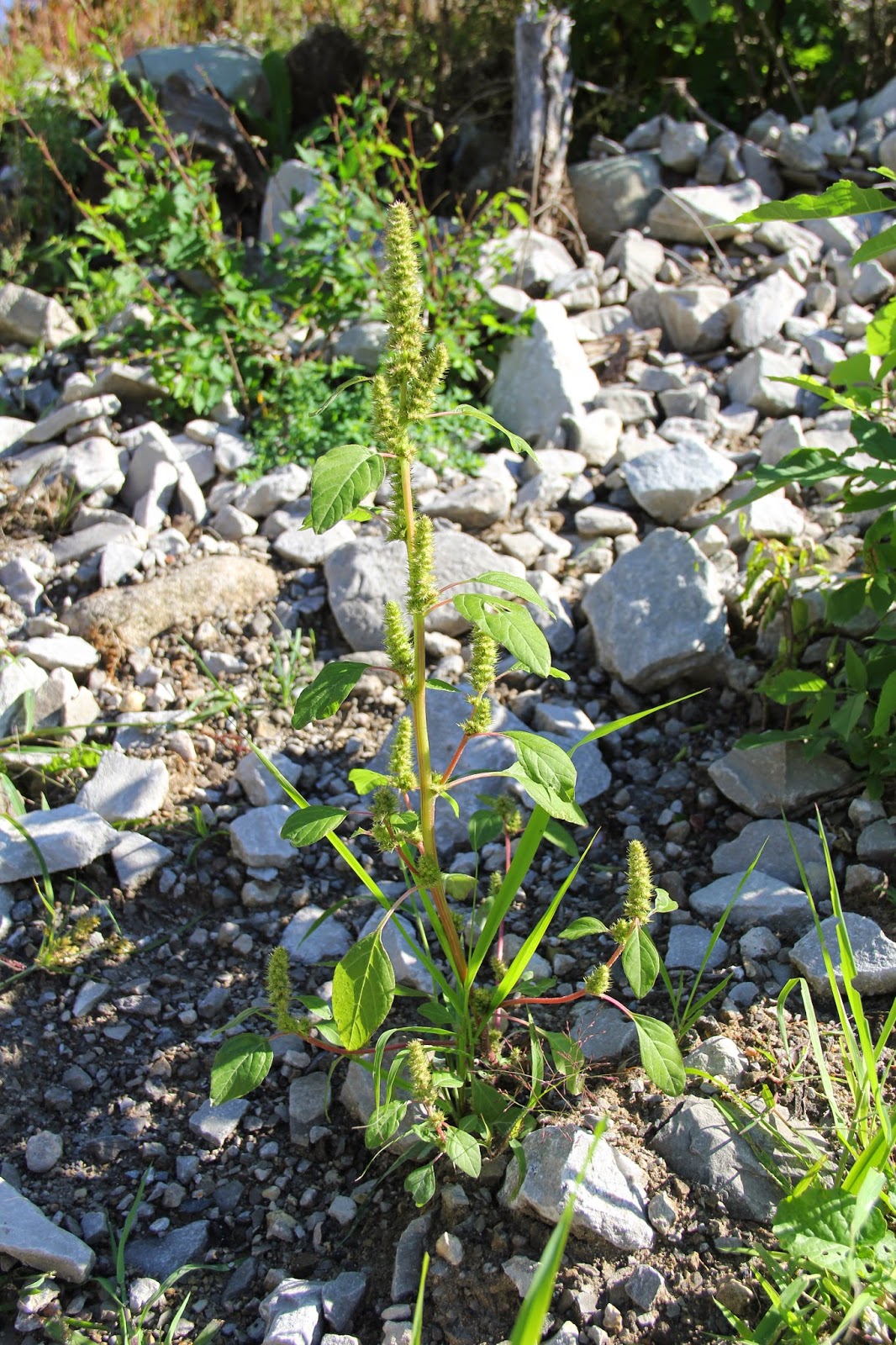
The final flower of the day was Redroot Amaranth (Amaranthus retrofexus).  This species is also known as Rough Amaranth or Rough Pigweed.  It is a common weed of disturded areas and agricultural field.  It is found across almost all of the United States and Canada.  There is some debate over its origin.  The USDA lists it as native to the Lower 48, but introduced in Canada and Alaska.  Michigan Flora says the plant is not native to Michigan, listing its origin as the eastern United States, but ackowledges that it was found in the state's first plant survey in 1838.

Redroot Amaranth grows well in disturbed areas

This species can grow to be quite large (up to 7 feet), but is typically much shorter.  It has oval shaped leaves.  The plant has spikes of small green flowers on both the main stem and branches.

Redroot Amaranth flower spikes

Wednesday, October 1, 2014

Visions of Fall

As we progress further into Fall, the hours of sunlight each day decreases.  The chlorophyll that has been powering the trees of Mid-Michigan begins to shut down and fade away.  This un-greening of the leaves reveals the other colorful pigments that have been masked by the green chlorophyll during the growing season.  We can finally start to see the reds, oranges, yellows, and browns of the leaves.

Here are a few photos from previous Autumns in Mid-Michigan.